

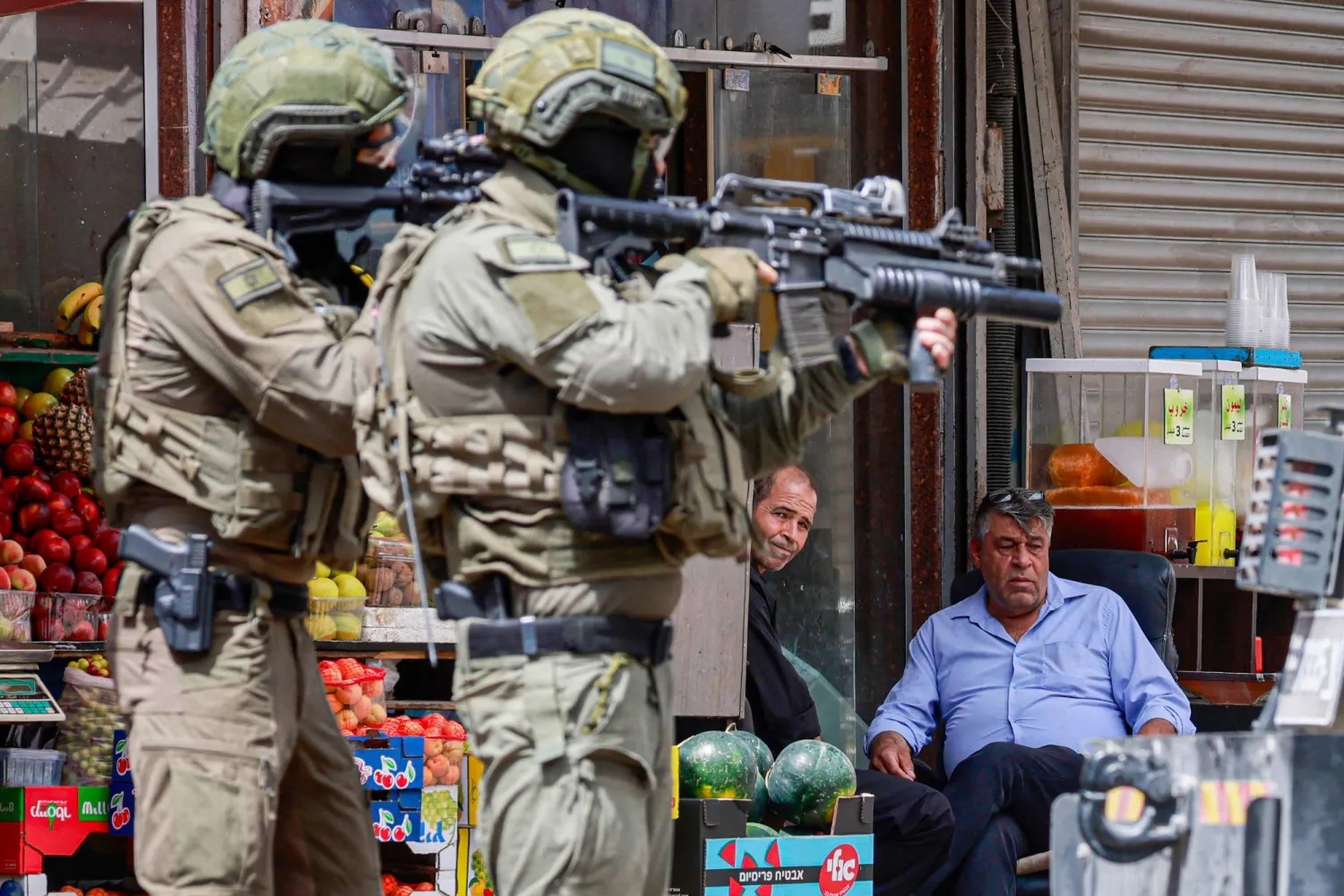

Israeli Forces Raid Money Exchange Companies in West Bank

Israeli troops aim their rifles during a raid in the heart of the Palestinian city Nablus in the occupied West Bank on May 27, 2025. (Photo by Jaafar ASHTIYEH / AFP)
TT

Israeli Forces Raid Money Exchange Companies in West Bank

Israeli troops aim their rifles during a raid in the heart of the Palestinian city Nablus in the occupied West Bank on May 27, 2025. (Photo by Jaafar ASHTIYEH / AFP)

Israeli forces on Tuesday raided several money exchange companies in what Israeli media described as part of a campaign to disrupt financial networks allegedly linked to Palestinian factions.

The campaign targeted most West Bank cities, where the occupation forces raided the offices of money exchange companies and confiscated computers and safes.

They also arrested several shop owners in Bethlehem, Ramallah, Nablus, Hebron and Jenin.

The forces confiscated cash, cryptocurrency and jewelry that were intended to finance terrorist attacks, according to the Yedioth Ahronoth newspaper.

“Israeli security forces launched a West Bank operation Tuesday targeting currency exchange businesses suspected of funneling terror funds, seizing approximately 7.5 million shekels ($2 million) in cash and assets,” the newspaper wrote.

Yedioth Ahronoth said the operation follows extensive planning by the Israeli army’s Central Command and West Bank divisions, focusing on intercepting funds used to finance “terror” activity.

In addition to cash, the newspaper wrote that the Israeli forces confiscated cryptocurrency (including Bitcoin), jewelry and other tools allegedly used by currency exchangers to transfer funds to terror networks.

Several suspects were arrested and businesses were shut down under military orders.
Since the Gaza war began on October 7, 2023, the army’s West Bank Division has escalated its financial crackdown, confiscating more than 28 million shekels ($7.5 million) in terror-linked assets, according to Yedioth Ahronoth.

It quoted Palestinian sources as saying that on Tuesday, Israeli forces raided a currency exchange company named Al-Khaleej (The Gulf) in Nablus, arresting an employee and seizing money and furniture.

On some money exchange shops, the Israeli forces left behind flyers that read: “Attention! Israeli security forces are taking action against this company due to its ties to terrorist organizations. As a resident, you should seek a different exchanger who operates lawfully. Any dealings with Al-Khaleej put you and your money at risk and may result in legal consequences. Stay away from this place.”

Al-Khaleej is the main money exchange company that Israeli forces targeted during their campaign in the West Bank.

Videos and photos showed the forces arresting several shop employees while confiscating sums of money and equipment.

The Ramallah-based Palestinian Authority did not immediately comment on the Israeli raids. But on previous occasions, it has described such campaigns as an “an act that aims to undermine the Palestinian banking sector.”

For years, Israel has been fighting what it calls the “Hamas money channels” in both Gaza and the West Bank.

Most of the seized money originated from Türkiye and Iran and was intended to support terror attacks in the West Bank and other areas, Yedioth Ahronoth said.

The Israeli army says that some of the money sent to Hamas were channeled through humanitarian aid and in hand-carry cash, while others via normal bank transfers.

It accuses the movement of smuggling money in ways that are difficult to uncover, using multiple money exchange businesses rather than a central office.



Lebanon ‘Not Informed’ of Terms of Iran-US Deal, Says Official

A photograph taken from the southern area of Marjeyoun shows smoke rising from fires reportedly ignited at a site targeted by Israeli artillery shelling in the southern village of Kfar Tibnit on June 15, 2026. (AFP)
TT

Lebanon ‘Not Informed’ of Terms of Iran-US Deal, Says Official

A photograph taken from the southern area of Marjeyoun shows smoke rising from fires reportedly ignited at a site targeted by Israeli artillery shelling in the southern village of Kfar Tibnit on June 15, 2026. (AFP)

Lebanon has not been informed of details of an agreement between the United States and Iran to end the Middle East war on all fronts including in Lebanon, an official source told AFP on Monday.

Lebanon's state-run National News Agency (NNA) reported intermittent artillery shelling in the country's south on Monday but no airstrikes -- a lower level of violence compared to previous days.

Hezbollah has not commented on the agreement, but the Iran-backed group has not claimed any fresh attacks on Monday on Israeli targets.

"Lebanon was not informed of the terms of the agreement or the time of the ceasefire," the source said on condition of anonymity.

Few details have been made public about the agreement announced overnight.

Lebanese parliament Speaker Nabih Berri, a Hezbollah ally who acts as an intermediary between the group and the US, praised the deal, thanking the United States and Tehran for their "insistence on including... an essential and binding clause on halting the Israeli aggression on all of Lebanon".

Israel and Hezbollah have been at war since March 2 when the Iran-backed group fired rockets at Israel to avenge the killing of Iran's supreme leader in US-Israeli strikes days earlier.

Israel responded with a campaign of airstrikes and a ground invasion. Previous ceasefire announcements have failed to stop the fighting.

Pakistan's Prime Minister Shebhaz Sharif, whose country has been mediating between Tehran and Washington, said that "both sides have declared the immediate and permanent termination of military operations on all fronts, including in Lebanon".

Iran's Deputy Foreign Minister Kazem Gharibabadi said that "a permanent and immediate end to the war has been declared on all fronts, including Lebanon".

AFP correspondents on Monday reported a cautious return of some residents to their homes in areas of south Lebanon not occupied by Israel's army.


Police Captain Injured in Car Bomb Explosion in Syria’s Aleppo

 A damaged car is seen after an explosion in the city of al-Bab, Aleppo, on Sunday. (Syrian Al-Ikhbariya TV)
A damaged car is seen after an explosion in the city of al-Bab, Aleppo, on Sunday. (Syrian Al-Ikhbariya TV)
TT

Police Captain Injured in Car Bomb Explosion in Syria’s Aleppo

 A damaged car is seen after an explosion in the city of al-Bab, Aleppo, on Sunday. (Syrian Al-Ikhbariya TV)
A damaged car is seen after an explosion in the city of al-Bab, Aleppo, on Sunday. (Syrian Al-Ikhbariya TV)

A Syrian police officer holding the rank of captain was among two people injured Sunday when an explosive device detonated inside a vehicle in the city of al-Bab in eastern Aleppo province, according to local media.

Syrian state-affiliated media said the blast occurred near the al-Center roundabout and was caused by a bomb placed inside the vehicle. The explosion wounded two people, who were transported to nearby hospitals for treatment.

A source told Syria TV that, according to preliminary information, the vehicle was parked near the city’s Grand Mosque when the explosion occurred.

The incident comes amid heightened security tensions across Aleppo province.

Authorities have reported a recent increase in attacks targeting checkpoints and facilities operated by government Internal Security Forces, particularly around the city of Kobani, or Ain al-Arab, in northeastern Aleppo.

Syrian officials have blamed many of the attacks on the Revolutionary Youth movement, a group linked to the Syrian Democratic Forces (SDF), although the allegations have not been independently verified.

On Friday, Aleppo Internal Security Commander Col. Mohammed Abdel Ghani sought to reassure residents of Kobani, stressing that maintaining security, stability, and public safety remained the authorities’ top priority.

His remarks followed a series of attacks on security personnel and installations, including an incident last Thursday in which unidentified assailants fired RPG rounds at an Internal Security Forces checkpoint near Kobani.

The violence has fueled debate over the motives. A tribal elder from Hasakah described the attacks as an attempt to pressure the Syrian government into making further concessions during the implementation of an agreement with Kurdish forces reached on Jan. 29.

By contrast, an official from the Syrian Democratic Council (SDC), the political wing associated with the SDF, said the incidents were isolated acts carried out by individuals rather than an organized campaign.


Lebanon Warns Displaced against Rushing Home after US-Iran Deal

This photograph taken from the southern Lebanese area of Marjayoun shows smoke as it rises from the site of an Israeli airstrike that targeted the village of Kfar Tibnit on June 11, 2026. (Photo by AFP) /
TT

Lebanon Warns Displaced against Rushing Home after US-Iran Deal

This photograph taken from the southern Lebanese area of Marjayoun shows smoke as it rises from the site of an Israeli airstrike that targeted the village of Kfar Tibnit on June 11, 2026. (Photo by AFP) /

Authorities in southern Lebanon warned people displaced by three months of war between Israel and Hezbollah against rushing home on Monday despite a US-Iran deal to end the wider conflict, as Israel said it would not withdraw troops from the south.

Lebanon has suffered the deadliest spillover of the conflict between the US and Iran, with thousands of people killed and some 1.2 million people uprooted by an Israeli offensive against the Iran-backed Hezbollah group, which ‌opened fire on ‌Israel in support of Tehran on March 2.

Pakistani ‌Prime ⁠Minister Shehbaz Sharif, ⁠a key mediator between Tehran and Washington, announced that a deal was struck early on Monday local time, and that the pact called for "the immediate and permanent termination of military operations on all fronts, including in Lebanon".

In south Lebanon, where Israeli forces have occupied a self-declared security zone, municipal councils issued statements calling on residents to hold off on returning, the state-run National News ⁠Agency reported.

Mona Mazeh, a displaced woman sheltering in Beirut's ‌Hamra district, had no immediate plans to ‌return to her village near the southern city of Tyre. "Frankly, we are hesitant; ‌Israel cannot be trusted," she said.

ISRAEL IS NOT A PARTY TO US-IRAN ‌DEAL

Israeli Defense Minister Israel Katz, whose country is not a party to the US-Iran deal, said Israel would not withdraw from security zones in southern Lebanon, Gaza and Syria, and that it would retaliate if Iran attacked Israel due to ‌events in Lebanon.

Katz said the security zone in southern Lebanon would be cleared of local residents, and "all terrorist ⁠infrastructure, including houses in ⁠contact villages", in reference to Hezbollah.

The Israeli military has been razing villages in southern Lebanon for weeks, saying it is acting against Hezbollah militants embedded in civilian areas of the predominantly Shi'ite Muslim region.

Hundreds of thousands of Lebanese Shi'ites are sheltering in other parts of the country.

In Nabatieh, a devastated city in the south, Mohammed Daqdouq said he had returned on Monday morning to check on his home. "We'll need a lifetime to rebuild - to rebuild it again and bring Nabatieh back to how it was," he said.

Iran, whose Revolutionary Guards established Hezbollah in 1982, had insisted that a Lebanon ceasefire be included as part of any broader deal with the United States.