


Climate Action Could Save Half of World's Vanishing Glaciers

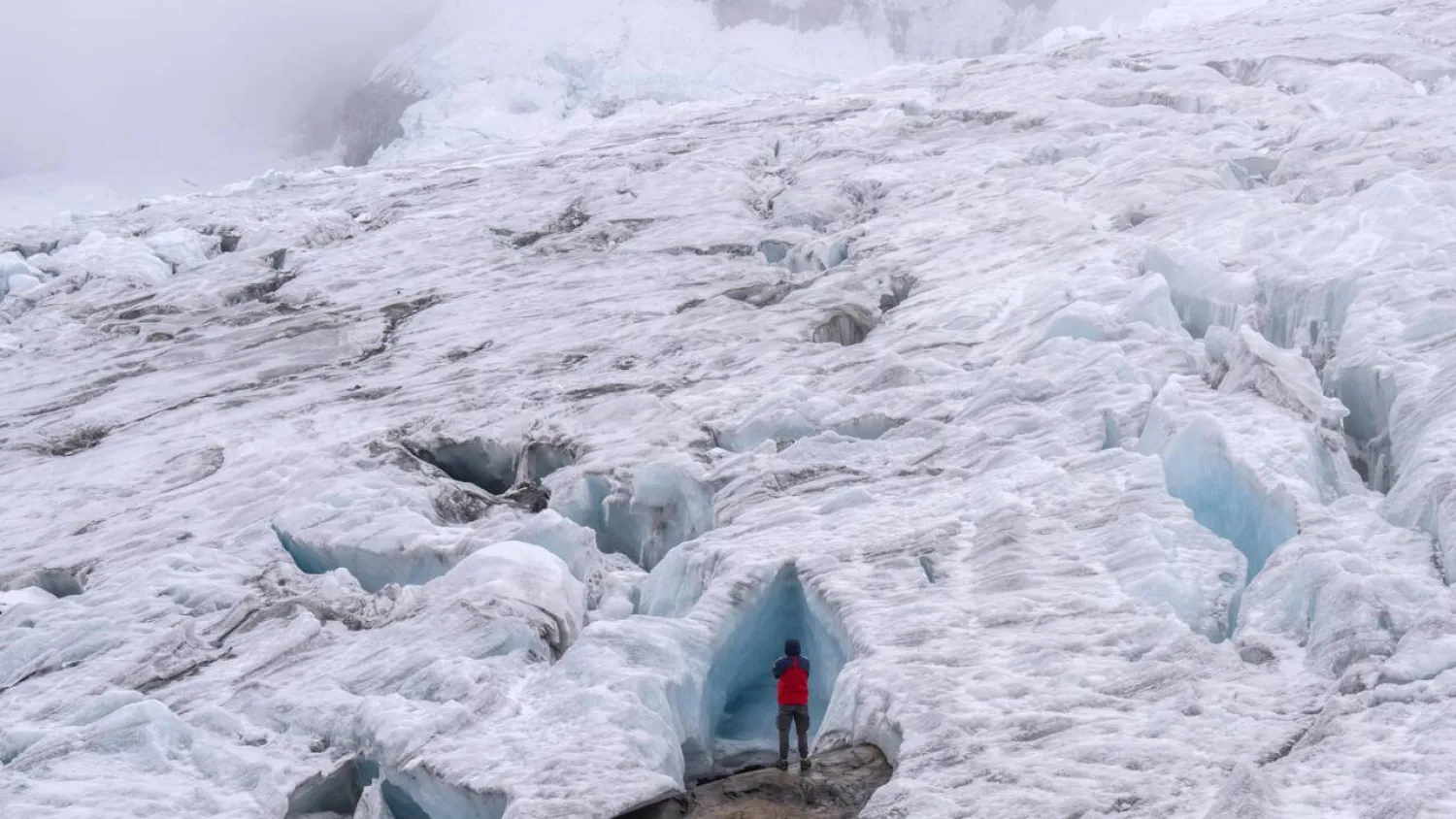
A tourist explores the Ritacuba Blanco glacier at the Natural National Park Nevado El Cocuy in Boyaca Department, Colombia, on April 19, 2024. Luis ACOSTA / AFP/File
TT

Climate Action Could Save Half of World's Vanishing Glaciers

A tourist explores the Ritacuba Blanco glacier at the Natural National Park Nevado El Cocuy in Boyaca Department, Colombia, on April 19, 2024. Luis ACOSTA / AFP/File

More than three-quarters of the world's glaciers are set to vanish if climate change continues unchecked, a major new study warned Thursday, fueling sea-level rise and jeopardizing water supplies for billions.

Published in Science, the international analysis provides the clearest picture yet of long-term glacier loss, revealing that every fraction of a degree in global temperature rise significantly worsens the outlook, reported AFP.

It may sound grim, but co-lead author Harry Zekollari, a glaciologist at Vrije Universiteit Brussel and ETH Zurich, told AFP the findings should be seen as a "message of hope."

Under existing climate policies, global temperatures are projected to reach 2.7 degrees Celsius (4.9F) above pre-industrial levels by 2100 -- a pathway that would ultimately erase 76 percent of current glacier mass over the coming centuries.

But if warming is held to the Paris Agreement's 1.5C target, 54 percent of glacial mass could be preserved, according to the study, which combined outputs from eight glacier models to simulate ice loss across a range of future climate scenarios.

"What is really special about this study is we can really show how every tenth of a degree of additional warming matters," co-lead author Lilian Schuster of the University of Innsbruck told AFP.

The paper's release comes as Swiss authorities monitor flood risks following the collapse of the massive Birch Glacier, which destroyed an evacuated village.

While Swiss glaciers have been heavily impacted by climate change, it remains unclear how much the latest disaster was driven by warming versus natural geological forces.

Cultural and economic importance

Glaciers are found on every continent except Australia -- from Mount Kilimanjaro to the Austrian Alps and the Karakoram range in Pakistan.

While most are clustered in the polar regions, their presence in mountain ranges across the world makes them vital to local ecosystems, agriculture and human communities.

Vast bodies of snow, ice, rock, and sediment that gain mass in winter and lose it in summer, glaciers formed in the Earth's deep past when conditions were far colder than today.

Their meltwater sustains rivers critical for farming, fisheries, and drinking water.

Their loss can have profound ripple effects, from disrupting tourism economies to eroding cultural heritage.

In recent years, symbolic glacier funerals have been held in Iceland, Switzerland and Mexico.

"The question I always get is, why are you a glaciologist in Belgium?" said Zekollari. "Well -- sea level rise. Glaciers melt everywhere on Earth... and that affects coastal defenses even in places far from mountains."

Around 25 percent of current sea-level rise is attributed to glacier melt.

Even if all fossil fuel use stopped today, the study finds that 39 percent of glacier mass loss is already locked in -- enough to raise sea levels by at least 113 millimeters (4.4 inches).

Uneven impacts

One key finding of the study is that some glaciers are far more vulnerable than others -- and the global average obscures drastic regional losses.

Glaciers in the European Alps, the Rockies of the US and Canada, and Iceland are expected to lose nearly all their ice at 2C of warming -- the fallback goal of the Paris accord.

In the central and eastern Himalayas, whose rivers support hundreds of millions of people, only 25 percent of glacier ice would remain at 2C.

By contrast, the west of the range may retain 60 percent of its ice at the same temperature thanks to its wide range of elevations, which allows some glaciers to persist at colder, higher altitudes, said Shuster.

Glacier loss is already affecting communities.

In a related commentary in Science, Cymene Howe and Dominic Boyer of Rice University describe how the retreat of Oregon's Glisan Glacier has imperiled orchards, fisheries, and the cultural heritage of the Indigenous Quinault people.

"Unfortunately we'll lose a lot, but with ambitious targets we can still save many of these glaciers -- which are not only beautiful, but vital for water supply, sea-level regulation, tourism, hydroelectricity, spiritual values, ecology, and more," said Zekollari.



Study: Pandemic Disruptions to Health Care Worsened Cancer Survival

FILE - A radiologist uses a magnifying glass to check mammograms for breast cancer in Los Angeles, May 6, 2010. (AP Photo/Damian Dovarganes, File)
TT

Study: Pandemic Disruptions to Health Care Worsened Cancer Survival

FILE - A radiologist uses a magnifying glass to check mammograms for breast cancer in Los Angeles, May 6, 2010. (AP Photo/Damian Dovarganes, File)

During the early years of the COVID-19 pandemic, experts worried that disruptions to cancer diagnosis and treatment would cost lives. A new study suggests they were right.

The federally funded study published Thursday by the medical journal JAMA Oncology is being called the first to assess the effects of pandemic-related disruptions on the short-term survival of cancer patients.

Researchers found that people diagnosed with cancer in 2020 and 2021 had worse short-term survival than those diagnosed between 2015 and 2019. That was true across a range of cancers, and whether they were diagnosed at a late or early stage.

Of course, COVID-19 itself was especially dangerous to patients already weakened by cancer, but the researchers worked to filter out deaths mainly attributed to the coronavirus, so they could see if other factors played a role, The Associated Press reported.

The researchers were not able to definitively show what drove worse survival, said Todd Burus of the University of Kentucky, the study’s lead author.

“But disruptions to the health care system were probably a key contributor,” said Burus, who specializes in medical data analysis.

COVID-19 forced many people to postpone cancer screenings — colonoscopies, mammograms and lung scans — as the coronavirus overwhelmed doctors and hospitals, especially in 2020.

Earlier research had shown that overall cancer death rates in the US continued to decline throughout the pandemic, and there weren’t huge shifts in late diagnoses.

Recinda Sherman, a researcher on that earlier paper, applauded the new work.

“As this study is the first to document pandemic-related, cause-specific survival, I think it is important," said Sherman, of the North American Association of Central Cancer Registries. “The more we understand about the impact of COVID-19, the better we will be able to prepare for the next one.”

How could overall cancer death rates decline in 2020 and 2021, while short-term survival worsen for newly diagnosed patients?

Cancer prevention, diagnosis and treatment measures that for years had been pushing cancer death rates down did not suddenly disappear during the pandemic, Burus noted.

“We didn’t forget how to do those things," he said. “But disruptions could have changed access, could have changed how quickly people were getting treated.”

Further research will show if any impact was lasting, said Hyuna Sung, senior principal scientist and cancer epidemiologist at the American Cancer Society.

“Transient declines in survival that quickly recover may have little impact on long-term mortality trends," she said.

The new study tapped national cancer registry data to focus more specifically on patients who had a first diagnosis of a malignant cancer in 2020 and 2021.

More than 1 million people were diagnosed with cancer in those two years, and about 144,000 died within one year, according to the researchers' data.

The researchers looked at one-year survival rates for those patients, checking for what stage they were at the time of diagnosis.

They calculated that one-year survival was lower for both early- and late-stage diagnoses, for all cancer sites combined. Most worrisome were large differences seen in colorectal, prostate and pancreatic cancers, they said.

Overall, the researchers found that more than 96% of people who got an early-stage cancer diagnosis in 2020 and 2021 — and more than 74% of those with a late-stage diagnosis — survived more than a year. Those rates were slightly lower than would have been expected based on 2015-2019 trends, resulting in about 17,400 more deaths than expected.


Jazan Honey Exhibition Attracts over 20,000 Visitors in Six Days

Sales outlets and exhibitor booths saw strong demand from visitors from within and outside Jazan - SPA
TT

Jazan Honey Exhibition Attracts over 20,000 Visitors in Six Days

Sales outlets and exhibitor booths saw strong demand from visitors from within and outside Jazan - SPA

The Jazan Honey Exhibition, held as part of the Jazan Festival 2026, attracted more than 20,000 visitors over the past six days, underscoring its growing status as a prominent tourism and economic event in the region.

Sales outlets and exhibitor booths saw strong demand from visitors from within and outside Jazan, drawn by high-quality local products and exclusive offers, SPA reported.

Executive Director of the exhibition, Suleiman Al-Ghazwani, said the event aims to highlight the quality of locally produced honey and its derivatives and to encourage beekeepers to expand and enhance production by opening new marketing opportunities.

He noted that the exhibition brings together 60 beekeepers showcasing more than 15 varieties of premium honey produced in the region.

He added that the exhibition offers diverse activities suitable for all age groups, including a dedicated children’s theater, bee- and honey-inspired recreational activities, seating areas, and a range of prizes and gifts for visitors.

He also added that the exhibition provides an engaging educational experience, introducing visitors to the beekeeping sector as a key component of Jazan’s tourism landscape and a promising contributor to its future development.


Fifth Saudi Media Forum Concludes with Awards Ceremony and Global Participation

The closing ceremony of the fifth edition of the Saudi Media Forum, held under the theme “Media in an Evolving World". (SPA)
TT

Fifth Saudi Media Forum Concludes with Awards Ceremony and Global Participation

The closing ceremony of the fifth edition of the Saudi Media Forum, held under the theme “Media in an Evolving World". (SPA)

Saudi Minister of Media Salman Al-Dossary attended on Wednesday the closing ceremony of the fifth edition of the Saudi Media Forum, held under the theme “Media in an Evolving World,” alongside the accompanying Future of Media Exhibition (FOMEX).

The ceremony also included the announcement of the winners across the Forum’s award tracks, in the presence of several distinguished officials and media professionals from within the Kingdom and abroad.

President of the Saudi Media Forum Mohammed Al-Harthi expressed appreciation to all supporters, partners, and participants, affirming that a culture of gratitude and appreciation reinforces the values of recognition and acknowledgment of efforts.

He noted that the forum attracted around 300 speakers from countries around the world, and that the strong turnout enriched discussions and helped transform the event into a global media platform.

Al-Harthi said FOMEX achieved broad global participation, with more than 250 companies taking part and showcasing the latest content-creation technologies.

He emphasized that media today is a key partner in development, a contributor to awareness-building, and a driver of change.

The Saudi Media Forum announced that it had set a new global record, with 65,603 visitors in attendance, earning a Guinness World Records certificate and underscoring its rising profile among international media events.

During the closing ceremony, the winners of the Forum’s awards for its fifth edition were announced. Khalid Al-Badr won the news report award, Abdulhadi Habtoor received the journalistic interview award, while Lama Al-Suhali won the academic research award.

In the visual and audio media category, the winner of the AI-generated content award was announced. The “Rachid Show” from Morocco won the social talk shows track award, while the Ministry of Culture received the podcast and radio talk shows track award for its podcast "1949".

The Tourism Development Fund won the best media work for National Day award, while the Ministry of Defense won the best media work for Founding Day award for the film “Al-Awja.”

Supervisor General of the King Salman Humanitarian Aid and Relief Center Dr. Abdullah Al-Rabeeah received the global competitor award, while Dr. Mohammed Al-Rumaihi won the column writing award. The Saudi Vision 2030 account was awarded the best media work for Flag Day award.

During the ceremony, the media personality of the year award was presented to Dr. Hussein Najjar in recognition of his distinguished media career.

At the conclusion of the ceremony, commemorative photos were taken of the winners with the minister of media, who honored the forum’s partners and sponsors.