


Putin Approves Big Revamp of Russia’s Navy, Kremlin Aide Says

In this pool photograph distributed by the Russian state agency Sputnik, Russian President Vladimir Putin holds a meeting of the Council for Strategic Development and National Projects at the Novo-Ogaryovo state residence outside Moscow on June 6, 2025. (Gavriil Grigorov / Pool / AFP)
TT

Putin Approves Big Revamp of Russia’s Navy, Kremlin Aide Says

In this pool photograph distributed by the Russian state agency Sputnik, Russian President Vladimir Putin holds a meeting of the Council for Strategic Development and National Projects at the Novo-Ogaryovo state residence outside Moscow on June 6, 2025. (Gavriil Grigorov / Pool / AFP)

Russian President Vladimir Putin has approved a new naval strategy which aims to fully restore Russia's position as one of the world's leading maritime powers, Kremlin aide Nikolai Patrushev said in an interview published on Monday.

Russia has the world's third most powerful navy after China and the United States, according to most public rankings, though the navy has suffered a series of high-profile losses in the Ukraine war.

Patrushev, a former KGB officer who served with Putin in the northern Russian city of St Petersburg during Soviet times, said the new naval strategy - entitled "The Strategy for the Development of the Russian Navy up to 2050" - had been approved by Putin in late May.

"Russia's position as one of the world's greatest maritime powers is gradually recovering," Patrushev told the Argumenti i Fakti newspaper in an interview.

"It is impossible to carry out such work without a long-term vision of the scenarios for the development of the situation in the oceans, the evolution of challenges and threats, and, of course, without defining the goals and objectives facing the Russian Navy," Patrushev said.

Patrushev gave no further details about the strategy, though Russia has ramped up spending on defense and security to Cold War levels as a percentage of gross domestic product.

A US Department of Defense report said in 2021 that China had the largest navy in the world and that Beijing's overall battleforce is expected to grow to 460 ships by 2030.

Open source data suggests Russia has 79 submarines, including 14 nuclear powered ballistic missile submarines, as well as 222 warships. Its main fleet is the Northern Fleet headquartered in Severomorsk on the Barents Sea.



US Attacks Iran, IRGC Says Strait of Hormuz to Remain Closed ‘Until Further Notice’

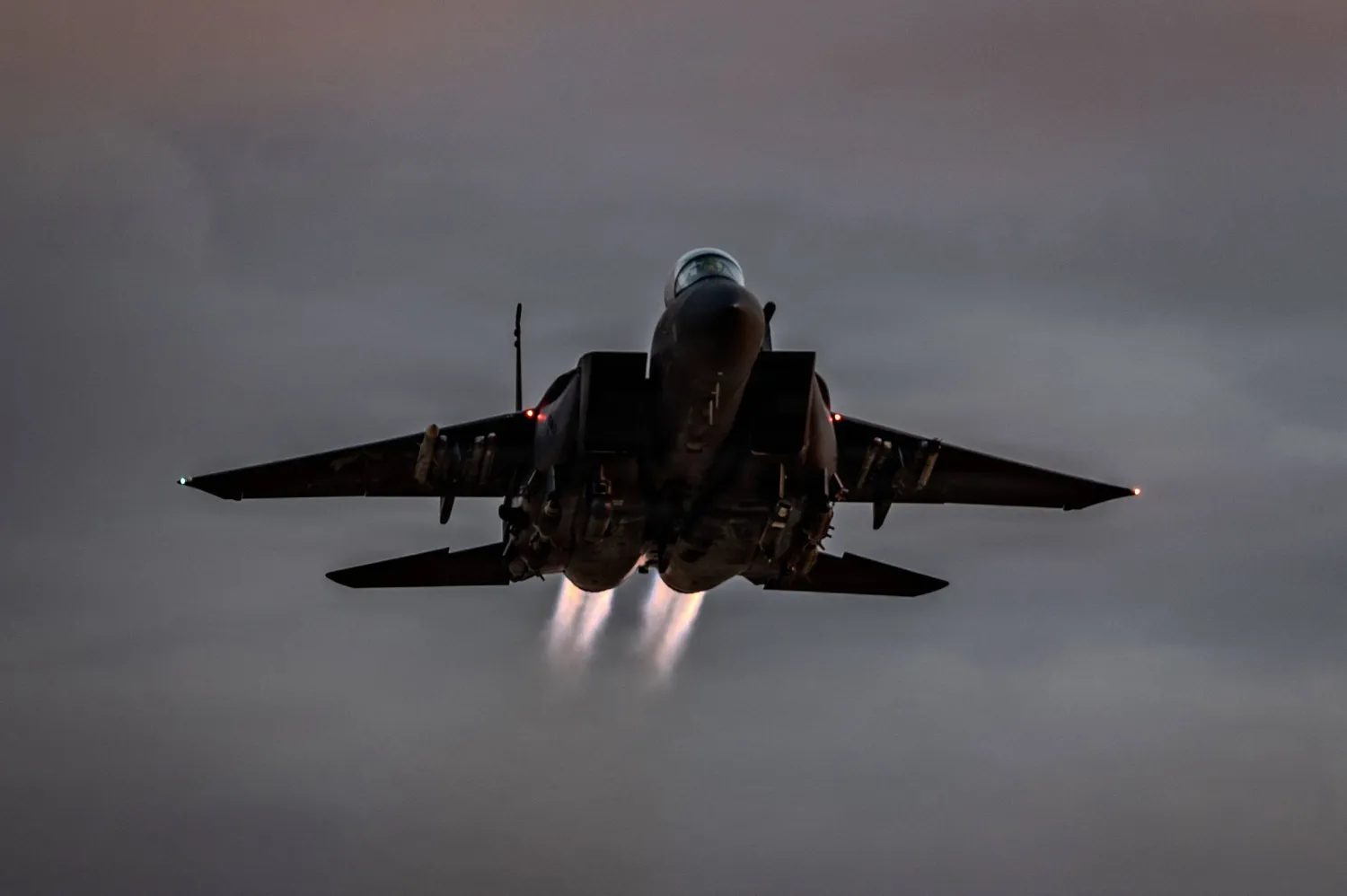
A US Air Force F-15E Strike Eagle fighter jet takes off from a base in the Middle East (US Army file photo)
TT

US Attacks Iran, IRGC Says Strait of Hormuz to Remain Closed ‘Until Further Notice’

A US Air Force F-15E Strike Eagle fighter jet takes off from a base in the Middle East (US Army file photo)

The United States attacked Iran early Sunday morning over an Iranian attack on a vessel in the Strait of Hormuz, setting the container ship ablaze and forcing its crew to abandon it.

The strait has become the key sticking point in any further negotiations between Iran and the United States to find a permanent end to the war that began back on Feb. 28.

About a fifth of all traded oil and natural gas passed through the strait before the war began. Iran’s grip on it during the war led to a global energy crisis, though oil prices have sharply dropped since wartime highs of $120 a barrel.

Iran's Revolutionary Guard (IRGC) said multiple vessels “disregarded our warnings and instructions to correct their course and proceed along the approved route.” One of them “was struck by a warning shot and brought to a stop.”

Iran said that the strait would remain closed “until further notice” and said it would consider targeting “additional enemy bases in the region” if it faced more attacks.

The US attacks on Iran apparently targeted Bandar Abbas and Sirik, as well as other areas, along the shores of the strait, Iran state media reported. Iran offered no immediate information about casualties or damage.

US forces completed a third round of strikes this week against Iran, hitting approximately 140 Iranian ⁠military targets, the ⁠Central Command said late on Saturday ⁠in a post on X.

Targets included Iranian missile and drone sites, naval capabilities, ammunition storage facilities, communication networks, ⁠and ⁠coastal surveillance locations, the Central Command added.


US Lawmaker Says He Was ‘Detained’ by Israeli Settlers in West Bank

US Representative Ro Khanna (D-CA) speaks with a Palestinian resident of Turmus Ayya, near Ramallah, during a visit in the Israeli-occupied West Bank, July 9, 2026. (Reuters)
TT

US Lawmaker Says He Was ‘Detained’ by Israeli Settlers in West Bank

US Representative Ro Khanna (D-CA) speaks with a Palestinian resident of Turmus Ayya, near Ramallah, during a visit in the Israeli-occupied West Bank, July 9, 2026. (Reuters)

A prominent Democratic US lawmaker from California, Ro Khanna, said Saturday he was "detained" by armed Israeli settlers along with other Americans during a visit to the Israeli-occupied West Bank and said the military was complicit in the incident.

"Israeli settlers, brandishing American made M4s, detained me & other Americans on my trip to Palestine," Khanna said in a post on X.

When the Israeli military arrived at the scene, he added, "they sided with the settlers & continued our detention. They made a huge mistake."

Footage and accounts provided to The New York Times by Khanna and his team shows a group of armed men blocking the road outside a small village in the southern West Bank and swearing at them in Hebrew and Arabic.

Khanna told the Times that when the Israeli troops arrived at the scene, the soldiers spoke to the settlers and subsequently blocked the road themselves when the settlers left.

After calls to the US embassy and Israeli police, Khanna said he was allowed to pass.

The Israeli army did not immediately respond to an AFP request for comment.

The United States is a staunch ally of Israel, but some lawmakers, especially Democrats, have vehemently criticized Israel's military offensive in Gaza, and more generally the treatment of Palestinians in the occupied territories.


Floods in Bangladesh Kill 44, Leave Over a Million Stranded

11 July 2026, Bangladesh, Dhaka: People wade through floodwaters in Dhaka, after torrential rain caused severe flooding and waterlogging across parts of the country. (dpa)
TT

Floods in Bangladesh Kill 44, Leave Over a Million Stranded

11 July 2026, Bangladesh, Dhaka: People wade through floodwaters in Dhaka, after torrential rain caused severe flooding and waterlogging across parts of the country. (dpa)

Floods and landslides triggered by days of torrential monsoon rain have killed at least 44 people in southeastern Bangladesh and left over a million stranded as authorities raced on Saturday to deliver aid to devastated communities.

The disaster management ministry said on Saturday that flooding across seven districts — Chattogram, Cox’s Bazar, Bandarban, Rangamati, Khagrachhari, Moulvibazar and Habiganj — has disrupted daily life, isolated thousands of families, and stranded 267,918 households.

Power outages, damaged roads and broken communication ‌links have slowed ‌rescue and relief efforts. Many residents have been unable ‌to ⁠cook for days ⁠as flood waters submerged their homes, while others are struggling after thick layers of mud covered kitchens and living spaces.

“There is still water inside our home and we have no way to cook. The dry food we had has run out, and we spend the nights in the dark with our children because there is no ⁠electricity,” said Nurul Islam, a resident of a flood-hit ‌area in Chattogram.

Thousands of families are ‌relying on dry food — flattened rice, puffed rice or biscuits that do ‌not require cooking — and emergency relief. Washed-out roads and damaged bridges, ‌however, have made it difficult for aid workers to reach some of the hardest-hit communities.

Army and navy personnel are ferrying food, drinking water, medicines and other essential supplies by boat to isolated communities, as authorities step up relief ‌efforts.

"The government is doing everything possible to support flood victims. Relief, safe drinking water and medical supplies are ⁠being distributed, ⁠and we urge people whose homes have been inundated to move to the nearest shelter," Disaster Management and Relief Minister Iqbal Hossain said during a visit to affected areas in Chattogram.

The heavy rain also triggered landslides in Rohingya refugee camps in Cox’s Bazar earlier this week, killing 16 refugees, including women and children. More than one million Rohingya refugees live in the camps, where makeshift shelters on steep, deforested hillsides are especially vulnerable during the monsoon season.

Bangladesh is one of the world’s most disaster-prone countries, with seasonal monsoon rains regularly causing floods, river erosion and landslides. Scientists say climate change is making extreme rainfall more frequent and intense, increasing the scale and severity of such disasters.