


Israel Strikes Iran for Second Night, Trump Says It’s Not Too Late for Deal

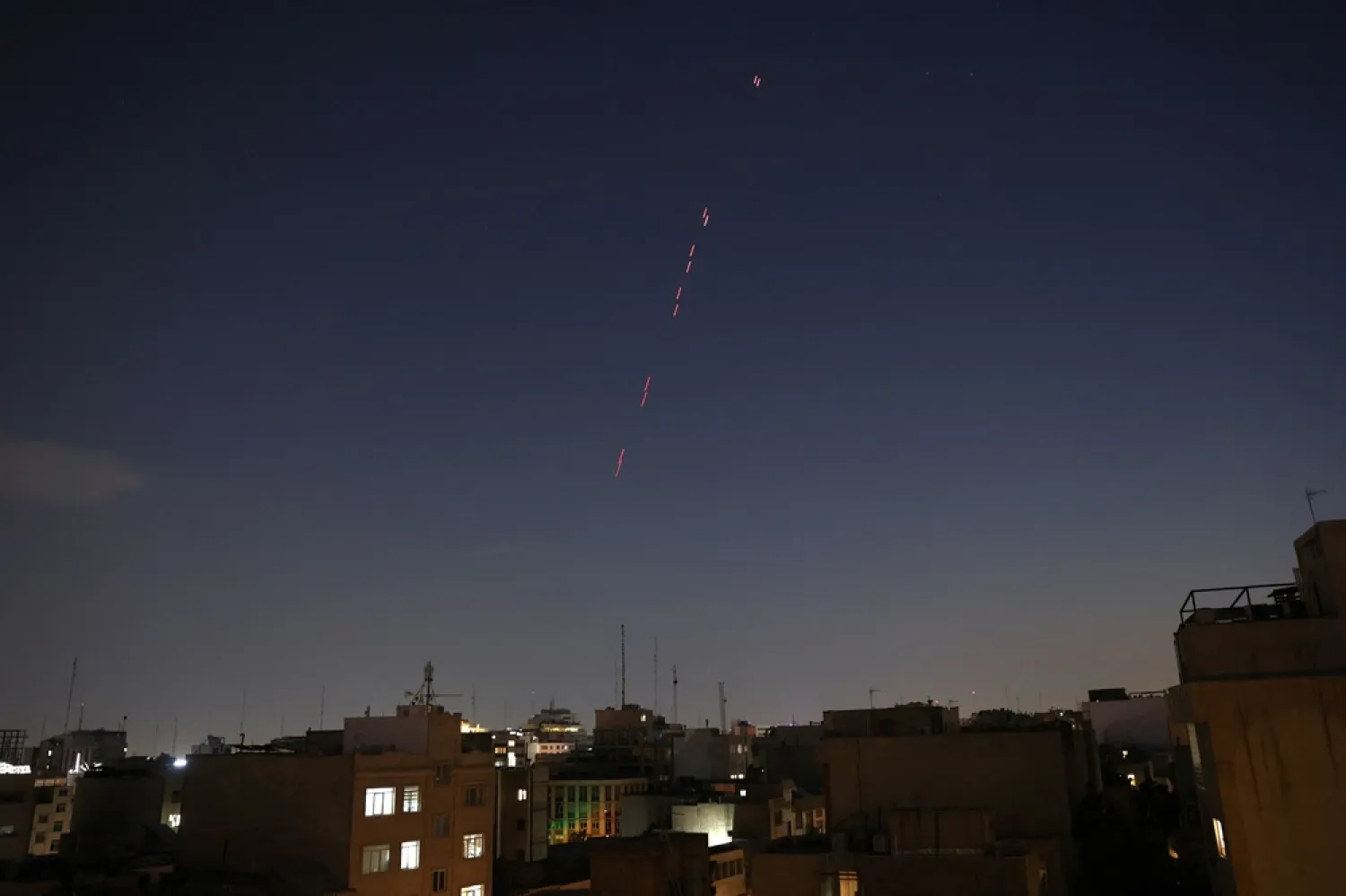
Army air defense firing is seen following the Israeli strike in Tehran, Iran, June 13, 2025. Majid Asgaripour/WANA (West Asia News Agency) via Reuters
TT

Israel Strikes Iran for Second Night, Trump Says It’s Not Too Late for Deal

Army air defense firing is seen following the Israeli strike in Tehran, Iran, June 13, 2025. Majid Asgaripour/WANA (West Asia News Agency) via Reuters

Israel launched renewed attacks on Iran as evening fell on Friday, after its biggest ever attack against its longstanding foe blasted Iran's huge underground nuclear site at Natanz and wiped out its entire top echelon of military commanders. 

Iran said that in retaliation "the gates of hell will open", while Israel said the strikes were only the start of "Operation Rising Lion". US President Donald Trump said it was not too late for Tehran to halt the bombing campaign by reaching a deal on its nuclear program. 

As evening fell on Friday, Iranian media reported explosions on the northern and southern outskirts of Tehran and at Fordow, near the city of Qom, a second nuclear site which had been spared in the first wave of attacks. 

Air defenses were activated across Tehran and explosions could be heard in Isfahan. 

Israel's military said it was striking Iranian missile and drone launching sites, and had struck another nuclear site in Isfahan. 

Israeli Prime Minister Benjamin Netanyahu said the Israeli campaign was aimed at defeating an existential threat from Iran, invoking the failure to halt the Holocaust in World War Two. 

Israel's operation "will continue for as many days as it takes to remove this threat," he said in a TV address. "Generations from now, history will record our generation stood its ground, acted in time and secured our common future." 

Iran's Supreme Leader Ali Khamenei said Israel had "unleashed its wicked and bloody" hand and would suffer "a bitter fate". 

In a phone interview with Reuters, Trump said it was not clear if Iran's nuclear program had survived. He said nuclear talks between Tehran and the United States, scheduled for Sunday, were still on the agenda though he was not sure if they would take place. 

"We knew everything," Trump said of the Israeli attack plans. 

"I tried to save Iran humiliation and death. I tried to save them very hard because I would have loved to have seen a deal worked out," Trump said. "They can still work out a deal, however, it’s not too late." 

Earlier, Trump posted on Truth Social: "Iran must make a deal, before there is nothing left." 

Israel's National Security Adviser Tzachi Hanegbi said military action by itself would not destroy Iran's nuclear program, but could "create the conditions for a long-term deal, led by the United States" to get rid of it. 

DECAPITATION 

Two regional sources said at least 20 Iranian military commanders were killed, a stunning decapitation reminiscent of Israeli attacks that swiftly wiped out the leadership of Lebanon's once-feared Hezbollah group last year. Iran also said six of its top nuclear scientists had been killed. 

Among the generals killed on Friday were the armed forces chief of staff, Major General Mohammad Bagheri, and the Revolutionary Guards chief, Hossein Salami. 

Major General Mohammad Pakpour, swiftly promoted to replace Salami as Guards commander, vowed retaliation in a letter to the Supreme Leader read out on state television: "The gates of hell will open to the child-killing regime." 

Iranians described an atmosphere of fear and anger, with some people rushing to change money and others seeking a way out of the country to safety. 

"People on my street rushed out of their homes in panic, we were all terrified," said Marziyeh, 39, who was awakened by a blast in Natanz. 

While some Iranians quietly hoped the attack would lead to changes in Iran's hardline clerical leadership, others vowed to rally behind the authorities. 

"I will fight and die for our right to a nuclear program. Israel and its ally America cannot take it away from us with these attacks," said Ali, a member of the pro-government Basij militia in Qom. 

Iranian media showed images of destroyed apartment blocks, and said nearly 80 civilians were killed in attacks that targeted nuclear scientists in their beds and wounded more than 300 people. 

Iran's ability to retaliate with weapons fired by its regional proxies has been sharply degraded over the past year, with the downfall of its ally Bashar al-Assad in Syria and the decimation of Hezbollah in Lebanon and Hamas in Gaza. 

Israel said a missile fired from Yemen - whose Houthi militia are one of the last remaining Iranian-aligned groups still able to fire at Israel - had landed in Hebron in the occupied West Bank. The Palestinian Red Crescent said three Palestinian children were wounded by shrapnel there. 

'COWARDLY' 

Israel said that Iran had launched around 100 drones towards Israeli territory on Friday, but Iran denied this and there were no reports of drones reaching Israeli targets. 

The United Nations Security Council was due to meet on Friday at Tehran's request. Iran said in a letter to the Council that it would respond decisively and proportionally to Israel's "unlawful" and "cowardly" acts. 

The price of crude leapt on fears of wider retaliatory attacks across a major oil-producing region, although there were no reports that oil production or storage was damaged. OPEC said the escalation did not justify any immediate changes to oil supply. 

An Israeli security source said Mossad commandos had been operating deep inside the country before the attack, and the Israeli spy agency and military had mounted a series of covert operations against Iran's strategic missile array. 

Israel also established an attack-drone base near Tehran, the source added. The military said it had bombarded Iran's air defenses, destroying "dozens of radars and surface-to-air missile launchers". 

Israeli officials said it may be some time before the extent of damage to the underground nuclear site at Natanz is clear, where Iran has refined uranium to levels Western countries have long said are suitable for a bomb rather than civilian use. 

Iran has long insisted its nuclear program is for civilian purposes only. The UN nuclear watchdog concluded this week that it was in violation of its obligations under the global non-proliferation treaty. 

Tehran had been engaged in talks with the Trump administration on a deal to curb its nuclear program to replace one that Trump abandoned in 2018. Tehran had rejected the last US offer. 


Australia to Toughen Gun Laws after Deadly Bondi Shootings

Police patrol in the early morning following a shooting Sunday at Sydney's Bondi Beach, Monday, Dec. 15, 2025. (AP Photo/Mark Baker)
TT

Australia to Toughen Gun Laws after Deadly Bondi Shootings

Police patrol in the early morning following a shooting Sunday at Sydney's Bondi Beach, Monday, Dec. 15, 2025. (AP Photo/Mark Baker)

Australia's leaders agreed on Monday to tougher gun laws after the country's worst mass shooting in almost three decades saw a father and son open fire on a Jewish festival at Bondi Beach, killing 15 people including a child.

The duo fired into crowds packing the Sydney beach for the start of Hanukkah on Sunday evening, sending people fleeing in panic across the tourist hotspot, said AFP.

A 10-year-old girl, a Holocaust survivor and a local rabbi were among those killed, while 42 more were rushed to hospital with gunshot wounds and other injuries.

Prime Minister Anthony Albanese convened a meeting of the leaders of Australia's states and territories in response, agreeing with them "to strengthen gun laws across the nation".

Albanese's office said they had agreed to look into ways to improve background checks for firearm owners, bar non-nationals from obtaining gun licenses and limit the types of weapons that are legal.

Mass shootings have been rare in Australia since a lone gunman killed 35 people in the tourist town of Port Arthur in 1996.

That massacre led to sweeping reforms that were long seen as a gold standard worldwide.

These included a gun buyback scheme, a national firearms register and a crackdown on the ownership of semi-automatic weapons.

But Sunday's shootings have raised fresh questions on how the father and son -- who public broadcaster ABC reported had possible links to the ISIS group -- obtained the weapons.

- 'We thought it was fireworks' -

Police are still unravelling what drove the shootings, although authorities have said it was clearly designed to sow terror among the nation's Jews.

Albanese called it "an act of pure evil, an act of antisemitism, an act of terrorism on our shores".

The gunmen targeted an annual celebration that drew more than 1,000 people to the beach to mark the Jewish festival.

They took aim from a raised boardwalk looking over the beach, which was packed with swimmers cooling off on a steamy summer evening.

Witness Beatrice was celebrating her birthday and had just blown out the candles when the shooting started.

"We thought it was fireworks," she told AFP.

"We're just feeling lucky we're all safe."

Carrying long-barreled guns, they peppered the beach with bullets for 10 minutes before police shot and killed the 50-year-old father.

The 24-year-old son was arrested and remained under guard in hospital with serious injuries.

Hours after the shooting, police found a homemade bomb in a car parked close to the beach, saying the "improvised explosive device" had likely been planted by the pair.

Rabbi Mendel Kastel said his brother-in-law was among the dead.

"It's unbelievable that this has happened here in Australia, but we need to hold strong. This is not the Australia that we know. This is not the Australia that we want."

Wary of reprisals, police have so far dodged questions about the attackers' religion or ideological motivations.

Misinformation spread quickly online in the wake of the attacks, some of it targeting immigrants and the Muslim community.

Police said they responded to reports on Monday of several pig heads left at a Muslim cemetery in southwestern Sydney.

- Panic and bravery -

A brave few dashed towards the beach as the shooting unfolded, wading through fleeing crowds to rescue children, treat the injured and confront the gunmen.

Footage showed one man, identified by local media as fruit seller Ahmed al Ahmed, grabbing one of the gunmen as he fired.

The 43-year-old wrestled the gun out of the attacker's hands, before pointing the weapon at him as he backed away.

A team of off-duty lifeguards sprinted across the sand to drag children to safety.

"The team ran out under fire to try and clear children from the playground while the gunmen were firing," said Steven Pearce from Surf Life Saving New South Wales.

Bleeding victims were carried across the beach atop surfboards turned into makeshift stretchers.

A grassy hill overlooking Bondi Beach was strewn with discarded items from people fleeing the killing, including a camping table and blankets.

People gathered flip-flops, sneakers and thermos flasks and lined them up in the sand for collection.

Australia mourned the dead by lowering flags to half-mast.

And at Bondi beach on Monday evening, a crowd gathered to mourn and sing in tribute to the victims.

- 'Oil on the fire' -

A string of antisemitic attacks has spread fear among Jewish communities in Australia following the October 7, 2023, Hamas attack on Israel and the ensuing war in Gaza.

Israeli Prime Minister Benjamin Netanyahu accused Australia's government of "pouring oil on the fire of antisemitism" in the months leading up to the shooting.

Other world leaders expressed revulsion and condemnation, including in the United States where President Donald Trump said it was a "purely antisemitic attack".

The Australian government this year accused Iran of orchestrating a recent wave of antisemitic attacks and expelled Tehran's ambassador nearly four months ago.

Tehran directed the torching of a kosher cafe in Sydney's Bondi suburb in October 2024, and a major arson attack on the Adass Israel Synagogue in Melbourne in December 2024, the government said in August citing intelligence findings.


Iran: Our Armed Forces Are in Full Readiness to Deal with Any Emergency

Iran's Foreign Ministry spokesperson Esmaeil Baghaei (Mehr)
TT

Iran: Our Armed Forces Are in Full Readiness to Deal with Any Emergency

Iran's Foreign Ministry spokesperson Esmaeil Baghaei (Mehr)

Iran on Sunday said its armed forces are in full readiness to deal with any emergency, while reiterating its continued contacts with the International Atomic Energy Agency to reach a solution to its nuclear file.

On Sunday, Iran's Foreign Ministry spokesperson Esmaeil Baghaei denied the presence of mediation, in the conventional sense, between Tehran and the UN International Atomic Energy Agency (IAEA).

“Iran is in contact with the Agency whenever it is necessary and based on the law passed by parliament,” he said during his weekly press briefing, according to state-run IRNA agency.

Baghaei then commented on IAEA Chief Rafael Grossi, who, last week, asked Iran to uncover the fate of its uranium stockpiles and allow inspectors to return to the country.

“The statements made by Grossi regarding Iran’s stockpile of enriched uranium merely repeat previous claims and do not change existing realities,” he said, calling on the IAEA chief to address parties responsible for the current situation rather than repeatedly singling out Iran.

He then criticized the “unfair approach” by the IAEA and its Board of Governors, noting that they have failed even to condemn US attacks on Iran’s nuclear facilities earlier this year.

“Targeting one side cannot resolve the issue,” Baghaei said, urging the IAEA director general to apply a strictly technical perspective in line with the agency’s statutory mandate.

Iran had 441 kilograms of uranium enriched to 60% level before US and Israeli airstrikes last June hit its key nuclear sites.

Unclear Negotiation Path

Concurrently, there is no clear prospect of nuclear negotiations between Iran and Western countries, which reimposed UN sanctions against Tehran last October.

Commenting on the future of those talks, Baghaei reiterated that diplomacy remains one of Iran’s tools for safeguarding national interests. However, he added, Tehran faces parties that do not value negotiations.

The spokesperson also emphasized that Iran’s armed forces are fully prepared to confront any form of adventurism, and that this message is crystal clear to opposing parties.

Last Thursday, US President Donald Trump told reporters that he is strongly seeking a deal with Iran, but warned that Tehran would face a new US attack if it resumes nuclear activities.

Iran and Venezuela

In a separate development, Baghaei commented on the US seizure of a Venezuelan oil tanker, saying, “We have adopted an official position on this matter. Washington’s action has no legal basis whatsoever.”

The spokesman then rejected claims about Iran's interference in Venezuela's affairs as “utterly irrelevant.”

Last week, Trump said the US has seized a sanctioned oil tanker off the coast of Venezuela.

“We've just seized a tanker on the coast of Venezuela, large tanker, very large, largest one ever, actually, and other things are happening,” said Trump, who has been pressuring Venezuelan President Nicolas Maduro to step down.

In response, the Venezuelan government in a statement accused the US of “blatant theft” and described the seizure as “an act of international piracy.” It said it would denounce the incident before international bodies.

In his weekly briefing on Sunday, Baghaei accused the US of having a long history of regime-change efforts in Latin America and that, in Venezuela’s case, it is “entirely clear” Washington is seeking to impose its will on an independent country. “This behavior violates all principles and rules of international law,” he said.

Commenting on a Wall Street Journal report, which said the US commandos have intercepted a vessel en route from China to Iran, Baghaei said Iranian authorities are awaiting verified details from relevant bodies.

“So far, we have not received any information from competent sources,” he said.


Thailand Cuts Laos Fuel Route as Cambodia Border Conflict Deepens

TOPSHOT - Soldiers carry the coffin of Special Forces volunteer Mustakim Majehma, who died amid clashes along Cambodia-Thailand border, during a military ceremony at Narathiwat airport in Thailand's southern province of Narathiwat on December 14, 2025. (Photo by Madaree TOHLALA / AFP)
TT

Thailand Cuts Laos Fuel Route as Cambodia Border Conflict Deepens

TOPSHOT - Soldiers carry the coffin of Special Forces volunteer Mustakim Majehma, who died amid clashes along Cambodia-Thailand border, during a military ceremony at Narathiwat airport in Thailand's southern province of Narathiwat on December 14, 2025. (Photo by Madaree TOHLALA / AFP)

Thailand's military said on Monday that it has stopped fuel shipments passing through a border checkpoint with Laos because of fears they were being diverted to Cambodia, with which it is fighting a fierce border conflict.

The Thai and Cambodian militaries are clashing at multiple locations along their 817 km (508 mile) land border, both sides said, with no signs of the fighting abating despite international efforts to negotiate a ceasefire, including calls by US President Donald Trump, Reuters said.

A special meeting of Southeast Asian foreign ministers - where top diplomats from both sides could have met - that was scheduled to take place on Tuesday had been pushed back to December 22 at Thailand's request, the Malaysian foreign ministry said in a statement.

The neighbors have long disputed sections of the frontier, but the scale and intensity of the latest clashes - that stretch from forested inland areas near the Laos border to coastal provinces - are unprecedented in recent history.

Over half a million people have been displaced by the fighting, which has killed at least 38 on both sides over the past eight days, according to national authorities, who mounted a round of evacuations in July when the neighbors clashed for five days before Trump helped broker a truce.

RESTRICTIONS AT LAOS BORDER CROSSING

Thailand's military has restricted the movement of all fuel supplies through the Chong Mek border crossing into Laos after receiving intelligence that these were being routed to Cambodian troops, said Thai defense ministry spokesperson Rear Admiral Surasant Kongsiri.

"Our intention is not to cause impacts on the Lao people or government," he said at a press conference.

The Laotian Foreign Ministry did not immediately respond to an email seeking comment.

The military is also considering limiting the movement of Thai vessels into "high-risk areas" in Cambodian waters where they could be fired upon, a navy official said, adding that any such measures would not impact shipments from other countries.

A sizeable portion of Cambodia's refined fuel imports such as gasoline, gasoil and jet fuel comes via the sea route, according to multiple trade sources, though an exact percentage of market share could not be confirmed.

Singapore is currently the largest supplier of these fuels to Cambodia, Kpler ship-tracking data showed, with volumes so far this year totaling around 915,000 metric tons.

Volumes from Thailand have fallen to around 30,000 tons this year, from less than 180,000 tons last year, the data showed.

In a statement issued on Friday, Thailand's energy ministry said there had been no exports of oil to Cambodia after July.

DRONE ATTACKS AND AIRSTRIKES

Fighting is continuing at least nine locations along the frontier, with heavy exchanges of firing across four border provinces, including at the coast, Thai defense ministry spokesperson Surasant said.

Cambodia said Thai forces had used drones and heavy artillery at multiple areas, alongside deploying its F-16 fighter jets for airstrikes in Siem Reap Province, which houses the country's second-largest city and the major tourist center of Angkor Wat.

"It is also noteworthy that the number of fighter jets and cluster bombs used by the Thai military to attack Cambodia has been increasing significantly," Maly Socheata, Cambodia Defense Ministry spokesperson, said in a briefing.

Thailand's military is vastly superior to that of its neighbor, including a much larger navy and one of the best-equipped and trained air forces in Southeast Asia that has a fleet of 28 F-16s and 11 Swedish Gripen fighter jets.

Thailand and Cambodia accuse each other of moves that led to a breakdown of July's Trump-brokered truce, which was expanded into a wider agreement to help settle the conflict in October.

Bangkok insists that any end to the current fighting must start with a cessation of hostilities by the other side and a clear ceasefire proposal, even as Phnom Penh maintains that it is defending itself against military actions by its neighbors.
