Picasso on a Plate: Unseen Ceramics Up for Auction

Artworks by Pablo Picasso are pictured during the media preview of 'Picasso for Asia: A Conversation' at M+ in Hong Kong. May JAMES / AFP
TT

Picasso on a Plate: Unseen Ceramics Up for Auction

Artworks by Pablo Picasso are pictured during the media preview of 'Picasso for Asia: A Conversation' at M+ in Hong Kong. May JAMES / AFP

A clutch of one-off and hitherto unseen ceramic plates and dishes by Pablo Picasso are going under the hammer in Geneva on June 19.

Emblematic motifs from Picasso's artistic universe -- pigeons, fish, a goat, a bull, and a bird adorn the colorful plates and dishes, AFP said.

"It's a truly exceptional collection. The plates and dishes we have here are real Picasso works," Bernard Piguet, director of the Piguet auction house in Geneva, told AFP.

"These unique pieces belonged to Picasso's estate, and in the early 1980s, his heirs gave them to one of their friends," he said.

The close friend, a French art lover whose name has not been revealed, kept them until his death. His heirs have decided to put the ceramics up for sale.

Made between 1947 and 1963 in the Madoura workshop in Vallauris on the southeast French coast, the ceramic artworks are being exhibited to the general public for the first time ahead of Thursday's auction.

'Reasonable' prices

The seven pieces are being sold in separate lots.

Two large platters decorated with pigeons are both expected to fetch between 30,000 and 50,000 Swiss francs ($37,000-$61,500).

A third plate depicting three blue, pink, and brick-colored fish on a white background, resembling a child's drawing, is estimated at 20,000 to 30,000 francs.

A thin brick, titled "Head of a Bearded Man", and painted with ceramic pastels in yellow, white, garnet, brown, blue orange and green, has the same estimate.

Glazed on a painted background in shades of grey, brown, and black, a terracotta plate depicting a goat's head bears the prestigious stamp "Original Picasso print" on the back. It is valued at 20,000-30,000 francs.

The two others feature a bull on a hexagonal terracotta tile (15,000-20,000 francs), and a stylized bird on a plate painted in black and white (15,000-25,000 francs).

"It's a lot," Piguet said of the price. "But don't forget that these are works of art in their own right and unique pieces" without replicas.

"If you step back from Picasso's work and his drawings, which are becoming practically unaffordable today, you have here original works by Picasso that command a reasonable estimate."

New outlet

Picasso was one of the most influential artists of the 20th century. The prolific Spanish painter died in 1973, aged 91.

He created thousands of plates, platters, vases, pitchers, and other earthenware utensils in the Madoura ceramics studio, run by the pottery couple Georges and Suzanne Ramie.

After World War II, "Picasso was already an internationally-renowned artist," said Adeline Bisch Balerna, head of paintings and sculptures at Piguet.

"He had already opened up a huge number of avenues for all artists; the great, well-known works had been created, and he was seeking new means of expression for his art."

Picasso would visit the Madoura studio, meet Georges Ranie, and be "captivated by all the possibilities offered" by this new artistic outlet, she explained.

Piguet is also auctioning two Picasso works "never before seen on the art market", from the same family friend's collection: "Serenade" (1919), an Indian ink and watercolor painting estimated at 20,000-30,000 francs, and the pencil drawing "Famille balzacienne" (1962), valued at 80,000-120,000 francs.

Unseen Klein

Meanwhile the contemporary art in Thursday's sale includes one of French artist Yves Klein's first blue monochromes, in what is its first appearance on the art market, according to Piguet auction house.

From 1959, "Monochrome bleu sans titre (IKB 328)", estimated at 100,000-150,000 francs, is painted in International Klein Blue, the deep blue hue developed by the artist himself.

"In daylight, it really has this luminous blue, this completely fascinating Klein blue. And when you put it indoors, you see it as a dark blue, almost midnight blue," said Bernard Piguet.

Klein died in 1962 aged 34, following a series of heart attacks.

The work comes from the collection of the Swiss artist couple Muriel and Gerald Minkoff, who liked to exchange their works with their contemporaries.

It was discovered by their successors in their Geneva apartment, according to Piguet.


French TV Broadcasts Louvre Robbery Images

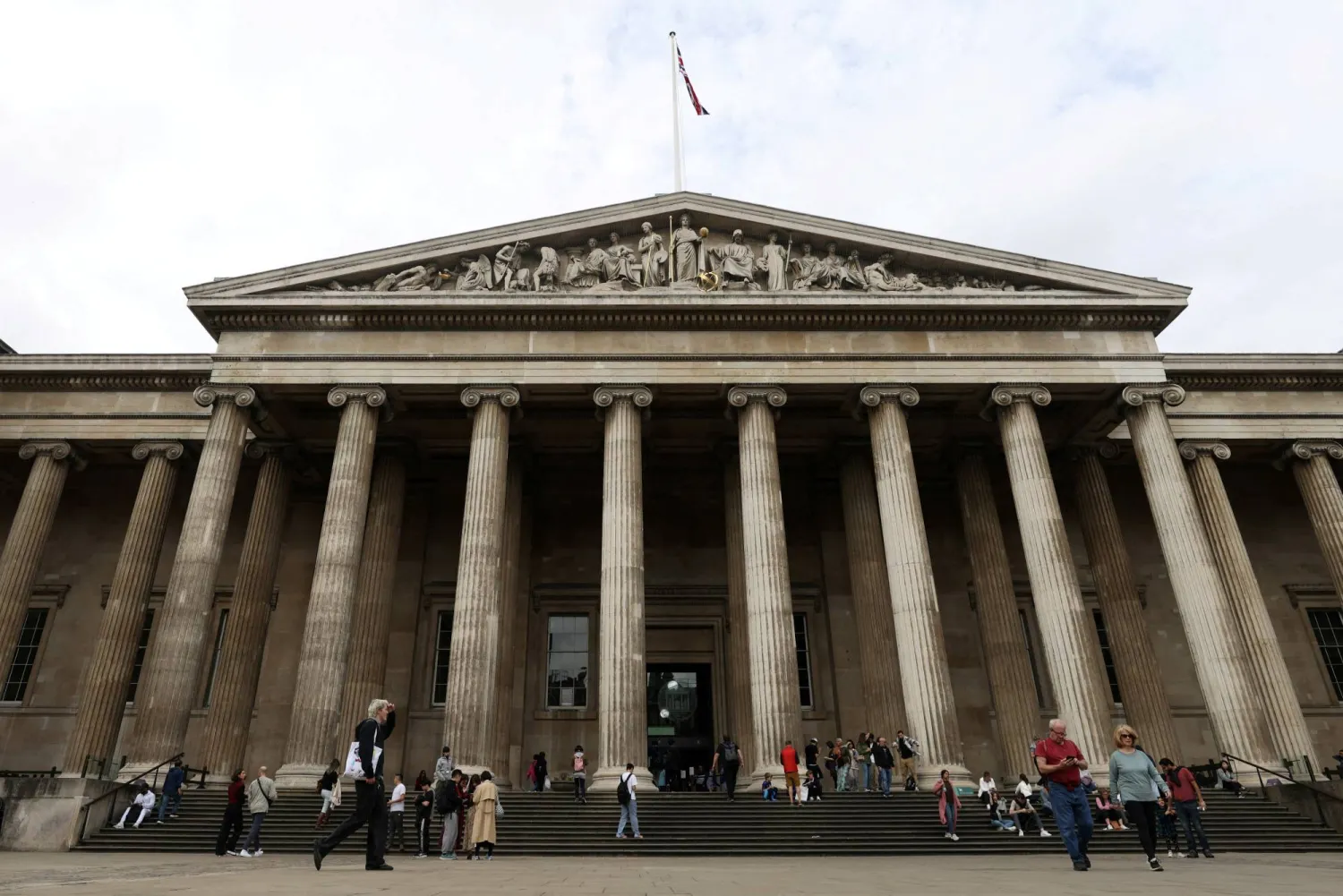
People wait for the Louvre museum to open as employees at the Louvre Museum vote to extend a strike that has disrupted operations at the world's most visited museum, Thursday, Dec. 18, 2025 in Paris. (AP)
TT

French TV Broadcasts Louvre Robbery Images

People wait for the Louvre museum to open as employees at the Louvre Museum vote to extend a strike that has disrupted operations at the world's most visited museum, Thursday, Dec. 18, 2025 in Paris. (AP)

Footage of the spectacular robbery at the Louvre Museum has been broadcast for the first time on French television, showing the brazen jewel thieves breaking into display cases.

The images, filmed by surveillance cameras, were shown by the TF1 and public France Televisions channels on Sunday evening, three months after the hugely embarrassing break-in in October.

They show the two burglars, one wearing a black balaclava and a yellow high-visibility jacket, the other dressed in black with a motorcycle helmet, as they force their way into the Apollo Gallery.

After breaking in through a reinforced window with a high-powered disk cutters, they begin slicing into display cases under the eyes of several staff members who do not intervene.

Managers at the Louvre have stressed that staff are not trained to confront thieves and are asked to prioritize the evacuation of visitors.

During the roughly four minutes that the two men were inside the gallery, one staff member can be seen holding a bollard used to orient visitor through the gallery, according to France Televisions.

The images form a key part of the ongoing criminal investigation into the October 19 heist.

Details of the footage have been reported in French newspapers, including Le Parisien.

Four suspects are in police custody, including the two suspected thieves, but the eight stolen items of French crown jewels worth an estimated $102 million have not been found.

The security failures highlighted by the break-in on a Sunday morning in broad daylight have lead to major pressure on director Laurence des Cars, who has apologized.

Metal bars have since been installed over the windows of the Apollo Gallery.


Cultural Development Fund Highlights Economic Value of Saudi Culture in Davos

The Cultural Development Fund (CDF) logo
TT

Cultural Development Fund Highlights Economic Value of Saudi Culture in Davos

The Cultural Development Fund (CDF) logo

The Cultural Development Fund (CDF) is participating in the Saudi House pavilion initiative, led by the Ministry of Economy and Planning, during the Annual Meeting of the World Economic Forum 2026, held in Davos, Switzerland, from January 19 to 23.

Through this participation, CDF aims to showcase the economic value of Saudi culture, highlight its role in diversifying the national economy and enhancing quality of life, attract international investment in the cultural sector, and spotlight Saudi cultural entrepreneurship.

According to a statement from the fund, the CDF’s participation includes a networking breakfast bringing together global economic leaders and investors from various countries, with the aim of raising awareness of Saudi culture as an economic force and a key pillar of Saudi Vision 2030.

The event will also provide a platform for exchanging perspectives and opportunities with international investors and financial institutions, while offering a closer look at the enablers of the Saudi cultural sector and its investment opportunities.

As part of the event, the CDF will host a panel discussion titled “Investing in Culture as an Economic Engine” that will feature CEO of the Cultural Development Fund Majed bin Abdulmohsen Al-Hugail, alongside Deputy Minister of Cultural Strategies and Policies at the Ministry of Culture Albara Al-Auhali.

The discussion will address the economic value of culture globally and locally, highlighting the CDF’s role in providing financial solutions that support cultural enterprises and enable their contribution to GDP growth and quality of life. The session will also explore cultural policies and their impact on strengthening the sector’s economic and investment potential.

Within the NextOn dialogue series organized by the Saudi House in Davos, the Cultural Development Fund will enable supported cultural projects to share their success stories and highlight their role in enhancing cultural production and increasing its economic value.

Participating entrepreneurs include Co-Founder of AlMashtal Creative Incubator Princess Noura bint Saud bin Naif, and CEO of Arabian Housing and Building company (AHB) Khalid Henaidy, who will speak about the role of entrepreneurship in shaping the future of the Kingdom’s cultural economy.

‏This participation underscores the CDF’s role as a center of excellence and financial enabler for the cultural sector in the Kingdom, and forms part of its efforts to strengthen the presence of Saudi cultural dynamism on the global stage. It aligns with the CDF’s objectives to maximize the cultural sector’s economic and social impact, increase its contribution to GDP, quality of life, and advance the goals of Saudi Vision 2030.


Red Sea Museum Signs Cooperation Agreement to Support Artisans and Designers

The cooperation agreement aims to support local and regional artisans and designers. SPA
TT

Red Sea Museum Signs Cooperation Agreement to Support Artisans and Designers

The cooperation agreement aims to support local and regional artisans and designers. SPA

Saudi Arabia’s Museums Commission announced the signing of a cooperation agreement between the Red Sea Museum and Ahmed Angawi Studio to launch the "Made in the Red Sea" initiative at the Red Sea Museum in the heart of Historic Jeddah, aiming to support local and regional artisans and designers.

The initiative aims to preserve traditional skills and develop contemporary products inspired by the rich heritage, traditions and the tangible and intangible culture of the Red Sea region, for sale at the museum gift shop.

It builds on the momentum of the Saudi Ministry of Culture's Year of Handicrafts 2025 initiative launched to reinforce pride in national identity and support artisans, as one of the goals of the National Culture Strategy.

The partnership includes content development, the delivery of workshops and the selection of participating artists and artisans, in addition to promoting the "Made in the Red Sea" initiative and overseeing specialized workshops in traditional wood designs inspired by the historic Bab Al Bunt building, which now houses the Red Sea Museum. These efforts contribute to a contemporary reinterpretation of its architectural elements.