

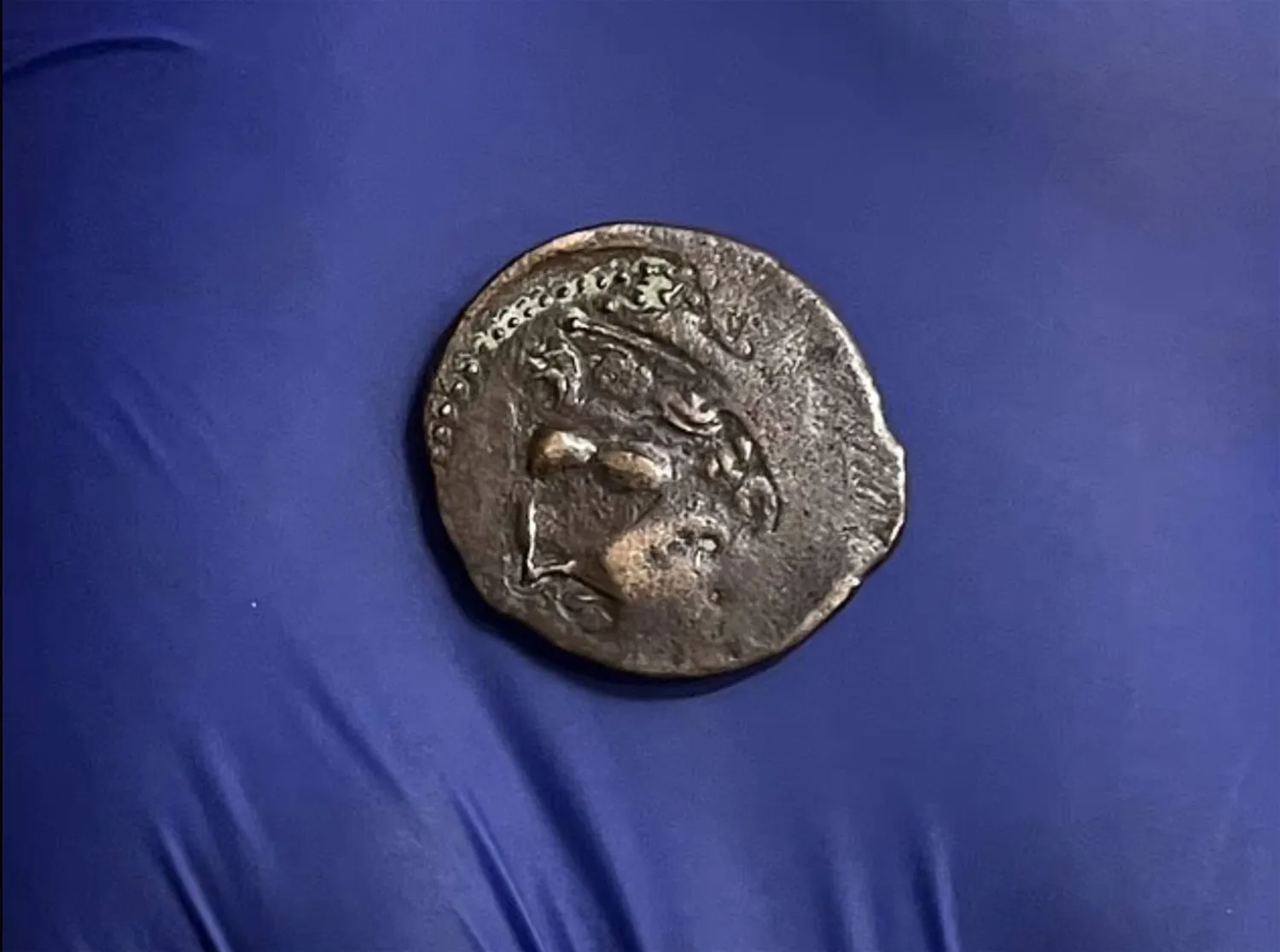

Coin Used to Pay for Bus Ticket in Leeds Found to Be Phoenician

The coin has been donated to Leeds Museums and Galleries. (Leeds City Council)
TT

Coin Used to Pay for Bus Ticket in Leeds Found to Be Phoenician

The coin has been donated to Leeds Museums and Galleries. (Leeds City Council)

An odd-looking coin used to pay for a bus fare in Leeds in the 1950s has been found to belong to an ancient civilization from more than 2,000 years ago, reported The Independent.

The coin, handed to a local bus driver decades ago, came into the hands of James Edwards, former chief cashier with Leeds City Transport, who gathered fares and counted them at the end of each day.

Since it couldn’t be spent, Edwards took it home and gifted the ancient coin to his young grandson, Peter, who kept it in a small wooden chest for more than 70 years.

Archaeologists from the University of Leeds have now found that it came from the Carthaginians, part of the Phoenician culture, in the Spanish city of Cadiz during the 1st century BC.

“My grandfather would come across coins which were not British and put them to one side, and when I went to his house, he would hand me a few,” the now 77-year-old grandson said.

“It was not long after the war, so I imagine soldiers returned with coins from countries they had been sent to. Neither of us were coin collectors, but we were fascinated by their origin and imagery – to me, they were treasure,” he said.

Peter attempted to uncover the coin’s origin, focusing on a particular inscription.

It bears the face of the god Melqart on one side, resembling the Greek hero Herakles and wearing his famed lionskin headdress.

Experts said it came from what was once a Carthaginian settlement on the Spanish coast.

“The coin always fascinated me because it was hard to decipher where it came from,” Peter said.

“My first thought when I found out its origin was that I would like to return it to an institute where it could be studied by all, and Leeds Museums and Galleries kindly offered to give it a good home,” he said.

The coin has been donated to Leeds Museums and Galleries and is now part of the Leeds Discovery Centre, which includes coins and currency from cultures around the world, spanning thousands of years of history.

“It’s incredible to imagine how this tiny piece of history created by an ancient civilization thousands of years ago has somehow made its way to Leeds and into our collection,” said Salma Arif, Leeds City Council’s executive member for adult social care, active lifestyles and culture.

“Museums like ours are not just about preserving objects, they’re also about telling stories like this one and inspiring visitors to think about the history that’s all around us, sometimes in the most unlikely of places,” Arif said.



Geisha Spectacle in Japan’s Kyoto Celebrates Arrival of Spring

 Maiko (apprentice geisha) take part in a press interview ahead a rehearsal for the annual "Miyako Odori" -- which means "capital city dance" in Japanese, at the Gion Kobu Kaburenjo in Kyoto on March 31, 2026. (AFP)
Maiko (apprentice geisha) take part in a press interview ahead a rehearsal for the annual "Miyako Odori" -- which means "capital city dance" in Japanese, at the Gion Kobu Kaburenjo in Kyoto on March 31, 2026. (AFP)
TT

Geisha Spectacle in Japan’s Kyoto Celebrates Arrival of Spring

 Maiko (apprentice geisha) take part in a press interview ahead a rehearsal for the annual "Miyako Odori" -- which means "capital city dance" in Japanese, at the Gion Kobu Kaburenjo in Kyoto on March 31, 2026. (AFP)
Maiko (apprentice geisha) take part in a press interview ahead a rehearsal for the annual "Miyako Odori" -- which means "capital city dance" in Japanese, at the Gion Kobu Kaburenjo in Kyoto on March 31, 2026. (AFP)

Against a backdrop of blooming cherry blossoms, a group of geishas elegantly shuffle onto a stage in Japan's Kyoto city to begin a centuries-old performance celebrating the arrival of spring.

Dressed in sky blue kimonos emblazoned with flowers, the dancers twist and twirl in unison in front of hundreds of spectators eager to see the annual "Miyako Odori" in the nation's spectacular ancient capital.

Geishas, known as geikos in Kyoto, and apprentices called maikos have been donning elaborate costumes and fluttering fans since the Miyako Odori -- or "capital city dance" -- first started in 1872.

"Just as cherry blossoms bloom when spring approaches, the Miyako Odori is a spring tradition in Kyoto," Kyoko Sugiura, head of the Yasaka Nyokoba Gakuen, a school for geishas in Kyoto's Gion district, told AFP.

In Japanese, the word geisha means "person of the arts", and can refer to a woman or man trained in traditional Japanese performing arts.

In the popular imagination geishas are often confused with courtesans but their work as trained masters of refined old artforms does not involve selling sex.

Their performances are usually small and private, and take place at high-class establishments which operate a no first-time customer policy.

"That's why it is often thought of as a very exclusive world," Sugiura said.

"But the Miyako Odori is a one-hour show in which geisha and maiko have the opportunity to showcase the arts they practise daily," she said.

"Anyone and everyone with a ticket can enjoy the show."

The Miyako Odori began soon after Kyoto hosted Japan's first national expo -- an effort to revitalize the western city following the relocation of the capital to Tokyo in 1869.

The format of the performance has not changed much, Sugiura explained, although the music and dance moves are sometimes switched up.

Maria Superata, a geisha expert who has worked with them as an interpreter, explained that the show "combines all of the traditional performing arts that you can see in Japan".

"For example, elements from kabuki (classical Japanese theatre), elements from traditional dance. So they have to act, they have to sing, they have to play the instruments, everything all in one," she said.

"That's why it's so special."

But the number of geishas, who once made a living through performing for Japan's wealthy elite, is in decline.

Superata said that fewer young Japanese want a life that demands huge discipline and comes with a strict practice schedule.

"Nowadays, young Japanese people... are not very interested that much in traditional art and in kimono."


Danish Warship Sunk by Nelson’s British Fleet Discovered After 225 Years

 Morten Johansen, head of maritime archaeology at Denmark's Viking Ship Museum, shows a metal insignia recovered from the wreck of Danish flagship "Dannebroge" that sank during the Battle of Copenhagen in 1801, in Copenhagen, Denmark, Tuesday, March 31, 2026. (AP)
Morten Johansen, head of maritime archaeology at Denmark's Viking Ship Museum, shows a metal insignia recovered from the wreck of Danish flagship "Dannebroge" that sank during the Battle of Copenhagen in 1801, in Copenhagen, Denmark, Tuesday, March 31, 2026. (AP)
TT

Danish Warship Sunk by Nelson’s British Fleet Discovered After 225 Years

 Morten Johansen, head of maritime archaeology at Denmark's Viking Ship Museum, shows a metal insignia recovered from the wreck of Danish flagship "Dannebroge" that sank during the Battle of Copenhagen in 1801, in Copenhagen, Denmark, Tuesday, March 31, 2026. (AP)
Morten Johansen, head of maritime archaeology at Denmark's Viking Ship Museum, shows a metal insignia recovered from the wreck of Danish flagship "Dannebroge" that sank during the Battle of Copenhagen in 1801, in Copenhagen, Denmark, Tuesday, March 31, 2026. (AP)

More than 200 years after being sunk by Adm. Horatio Nelson and the British fleet, a Danish warship has been discovered on the seabed of Copenhagen Harbor by marine archaeologists.

Working in thick sediment and almost zero visibility 15 meters (49 feet) beneath the waves, divers are in a race against time to unearth the 19th-century wreck of the "Dannebroge" before it becomes a construction site in a new housing district being built off the Danish coast.

Denmark’s Viking Ship Museum, which is leading the monthslong underwater excavations, announced its findings on Thursday, 225 years to the day since the Battle of Copenhagen in 1801.

“It’s a big part of the Danish national feeling,” said Morten Johansen, the museum’s head of maritime archaeology.

A great deal has been written about the battle “by very enthusiastic spectators, but we actually don’t know how it was to be onboard a ship being shot to pieces by English warships and some of that story we can probably learn from seeing the wreck,” Johansen said. The Associated Press was the only international outlet given access to the site.

In the Battle of Copenhagen, Nelson and the British fleet attacked and defeated Denmark’s navy as it formed a protective blockade outside the harbor.

Thousands were killed and wounded during the brutal hourslong naval clash, considered one of Nelson’s “great battles.” The intention was to force Denmark out of an alliance of Northern European powers, including Russia, Prussia and Sweden.

At the center of the fighting was the Danish flagship, the Dannebroge, commanded by Commodore Olfert Fischer.

The 48-meter (157-foot) Dannebroge was Nelson’s main target. Cannon fire tore through its upper deck before incendiary shells sparked a fire aboard.

“(It was) a nightmare to be on board one of these ships,” Johansen said. “When a cannonball hits a ship, it’s not the cannonball that does the most damage to the crew, it’s wooden splinters flying everywhere, very much like grenade debris.”

The battle also is believed to have inspired the phrase “to turn a blind eye.” After deciding to ignore a superior’s signal, Nelson, who had lost sight in his right eye, reportedly remarked: “I have only one eye, I have a right to be blind sometimes.”

Nelson eventually offered a truce and a ceasefire was later agreed with Denmark’s Crown Prince Frederik.

The stricken Dannebroge slowly drifted northward and exploded. Records say the sound created a deafening roar across Copenhagen.

Marine archaeologists have discovered two cannons, uniforms, insignia, shoes, bottles and even part of a sailor’s lower jaw, perhaps one of the 19 unaccounted-for crew members who likely lost their lives that day.

The dig site will soon be enveloped by construction work for Lynetteholm, a megaproject to build a new housing district in the middle of Copenhagen Harbor that is expected to be completed by 2070.

Marine archaeologists began surveying the area late last year, targeting a spot thought to match the flagship’s final position.

Experts say the sizes of the wooden parts found match old drawings. Dendrochronological dating, the method of using tree rings to establish the age of wood, match the year the ship was built. They also say the darkened dig site is full of cannonballs, a hazard for divers navigating waters darkened by clouds of silt stirred up from the seabed.

“Sometimes you can’t see anything, and then you really have to just feel your way, look with your fingers instead of with your eyes,” diver and maritime archaeologist Marie Jonsson said.

Chronicled in books and painted on canvases, the 1801 battle is deeply embedded in Denmark’s national story.

Archaeologists hope their discoveries may help reexamine the event that shaped the Scandinavian country and perhaps uncover personal stories of those who went into battle on that day 225 years ago.

“There are bottles, there are ceramics, and even pieces of basketry,” Jonsson said. “You get closer to the people onboard.”


Priceless Ancient Golden Helmet Stolen from Dutch Museum Is Recovered

A police officer stands by a stolen artifact from Romania, the 2,500-year-old Cotofenesti helmet, recovered in Netherlands, is shown during a press conference in Assen, Netherlands, Thursday, April 2, 2026. (AP Photo/Aleksandar Furtula)
TT

Priceless Ancient Golden Helmet Stolen from Dutch Museum Is Recovered

A police officer stands by a stolen artifact from Romania, the 2,500-year-old Cotofenesti helmet, recovered in Netherlands, is shown during a press conference in Assen, Netherlands, Thursday, April 2, 2026. (AP Photo/Aleksandar Furtula)

A priceless ancient golden helmet from Romania stolen last year from a museum in the Netherlands has been recovered, Dutch authorities announced Thursday.

Under the guard of heavily armed, balaclava-clad police, prosecutors unveiled the 2,500-year-old Cotofenesti helmet, one of Romania’s most revered national treasures from the Dacia civilization, during a news conference in the eastern Dutch city of Assen.

“We are incredibly pleased,” Corien Fahner of the prosecution service told reporters. “It has been a roller-coaster. Especially for Romania, but also for employees of the Drents Museum.”

The helmet was on display at the small museum in January 2025, the last weekend of a six-month-long exhibition, when thieves broke in and grabbed it, along with three golden wristbands.

There were fears the helmet may have been melted down because its fame and dramatic studded appearance made it virtually unsellable.

Two of three missing armbands were also recovered as part of a deal prosecutors reached with three men arrested for the heist shortly after it occurred. Their trial will begin later in April.

Fahner said the search for the remaining armband would continue.

The helmet did not return unscathed.

“The helmet is slightly dented, but there will be no permanent damage,” Drents Museum director Robert van Langh said during the news conference. “The armbands are in perfect condition.”

Thieves used a homemade firework bomb and sledgehammer to break into the museum. Grainy security video distributed by police after the raid appeared to show three people opening a museum door with a large crowbar, followed by an explosion.

The theft put a strain on relations between the Netherlands and Romania

Romanian Justice Minister Radu Marinescu last year called the incident a “crime against our state” and said recovering the artifacts “is an absolute priority.”