

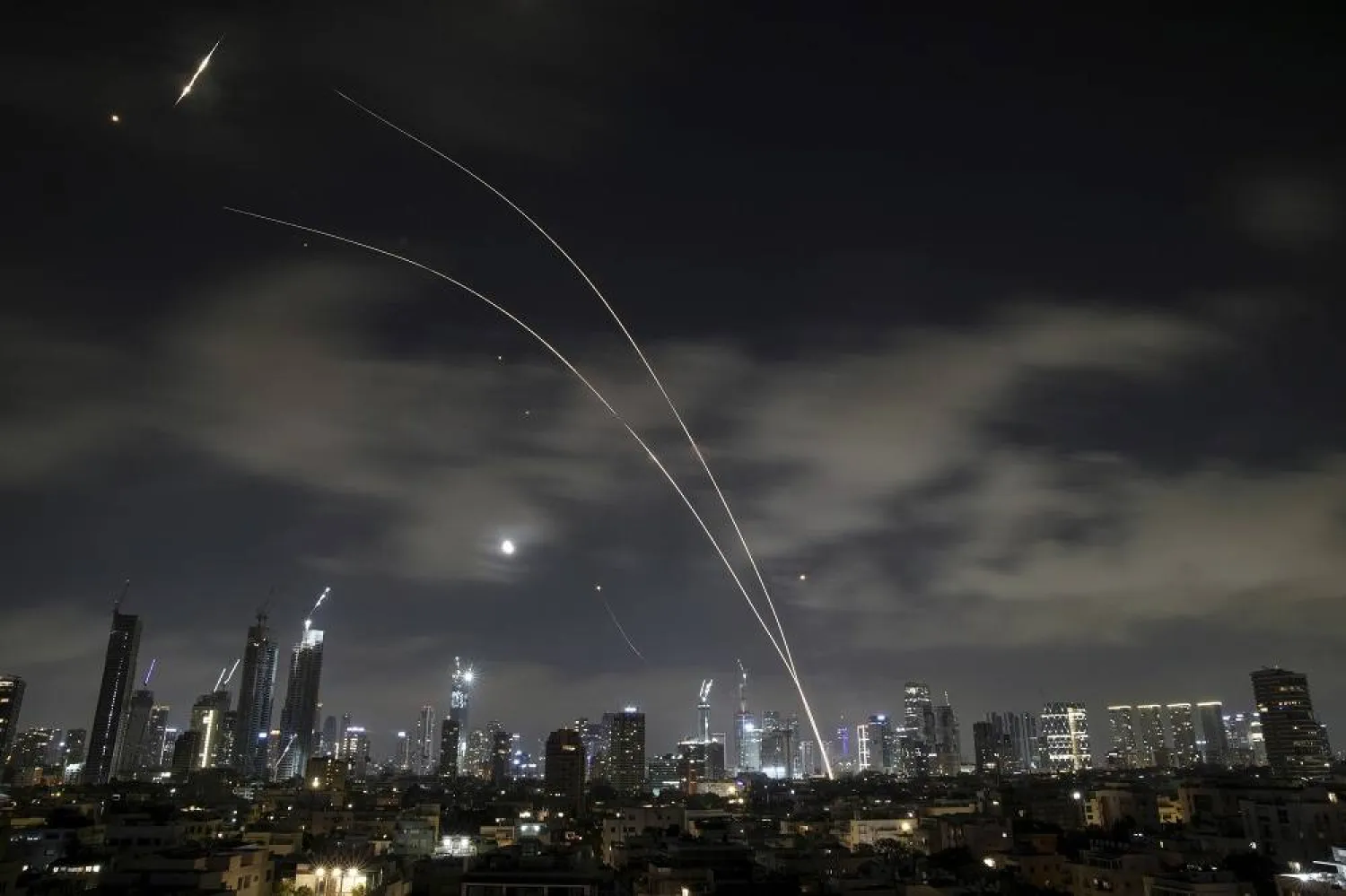

Missile Exchanges between Iran, Israel Turn Lebanese Skies into Aerial Frontline

Israeli air defense system fires to intercept missiles during an Iranian attack over Tel Aviv, Israel, early Wednesday, June 18, 2025. (AP)
TT

Missile Exchanges between Iran, Israel Turn Lebanese Skies into Aerial Frontline

Israeli air defense system fires to intercept missiles during an Iranian attack over Tel Aviv, Israel, early Wednesday, June 18, 2025. (AP)

Lebanese skies have turned into a daily theater of missiles streaking across between Iran and Israel, with the country’s geography making it a frontline in their aerial confrontation.

Missiles launched towards Israeli cities like Haifa and Tel Aviv must begin their descent trajectory over Lebanon, forcing Israeli air defense systems to intercept the threats near Lebanon’s southern and eastern borders.

Since Friday night, Lebanese people have witnessed a variety of projectiles, ranging from Iranian missiles and drones to Israeli air defense rockets, intersecting mid-air near Lebanon’s airspace.

Some fly in droves over Lebanese territory, others collide in the sky, while others veer off course, leaving fiery trails visible above the country.

Israeli interception launches come from multiple locations: the Mediterranean Sea to the west, the Golan Heights to the east, and central and northern Israel south of Lebanon.

Military and strategic affairs researcher Mustafa Asaad said Iranian forces have employed about 13 different types of missiles and projectiles in their attacks since last Friday.

In response, Israel is deploying five separate air defense systems operating at various altitudes.

Asaad explained that each missile type follows distinct flight paths and heights. Some travel at fixed altitudes, others maneuver to evade interception, and some even breach the atmosphere altogether.

This complex choreography aims to allow a few missiles, typically two or three, to bypass Israel’s air defenses and reach their targets.

Asaad added that Lebanese observers tend to see the missiles more clearly because they witness the final descent phase, when projectiles begin their downward trajectory toward targets.

While drones are rarely visible to the naked eye except when intercepted, Lebanese people in the south and to a lesser extent in Beirut, the Bekaa Valley, and Mount Lebanon frequently observe Iranian projectiles in flight.

Asaad explained this visibility occurs because these projectiles are often in their final stages, descending toward impact. “What we see are mostly medium-range missiles flying at altitudes low enough to be visible at night,” he said.

In contrast, missiles flying at higher altitudes become visible only during their final drop or when intercepted by Israeli air defenses, producing distinct explosions resembling stars or meteors. Missiles in these higher atmospheric layers are typically targeted by Israel’s missile defense systems.

In recent days, residents in southern Lebanon have witnessed several Iranian missiles descending in “convoy-like” formations toward Israel.

Some estimates suggest these projectiles’ warheads may split into two, four, or six parts when hit by Israeli interceptors, usually targeting the missile’s main body, creating the illusion of multiple missiles traveling together.

However, Asaad cast doubt on this theory, saying, “There is no evidence that Iran possesses such technology.”

He explained that the missiles observed in images are single-warhead ballistic missiles launched from a single platform, flying closely in a group along the same trajectory.

Asaad noted that Tehran’s missile arsenal does not yet match the sophistication of Russia’s recent systems, some of which were used in a major strike on Ukraine two weeks ago and featured advanced defenses like decoy flares designed to confuse air defenses.



Rescue Teams Search for Survivors in Building Collapse that Killed at Least 2 in Northern Lebanon

A Lebanese flag is pictured, in the aftermath of a massive explosion, in Beirut's damaged port area, Lebanon August 17, 2020. REUTERS/Hannah McKay
TT

Rescue Teams Search for Survivors in Building Collapse that Killed at Least 2 in Northern Lebanon

A Lebanese flag is pictured, in the aftermath of a massive explosion, in Beirut's damaged port area, Lebanon August 17, 2020. REUTERS/Hannah McKay

At least two people were killed and four rescued from the rubble of a multistory apartment building that collapsed Sunday in the city of Tripoli in northern Lebanon, state media reported.

Rescue teams were continuing to dig through the rubble. It was not immediately clear how many people were in the building when it fell.

The bodies pulled out were of a child and a woman, the state-run National News Agency reported.

Dozens of people crowded around the site of the crater left by the collapsed building, with some shooting in the air.

The building was in the neighborhood of Bab Tabbaneh, one of the poorest areas in Lebanon’s second largest city, where residents have long complained of government neglect and shoddy infrastructure. Building collapses are not uncommon in Tripoli due to poor building standards, according to The AP news.

Lebanon’s Health Ministry announced that those injured in the collapse would receive treatment at the state’s expense.

The national syndicate for property owners in a statement called the collapse the result of “blatant negligence and shortcomings of the Lebanese state toward the safety of citizens and their housing security,” and said it is “not an isolated incident.”

The syndicate called for the government to launch a comprehensive national survey of buildings at risk of collapse.


Israel to Take More West Bank Powers and Relax Settler Land Buys

A view of Israeli settlement of Maale Adumim, in the West Bank, Sunday, June 18, 2023. (AP)
TT

Israel to Take More West Bank Powers and Relax Settler Land Buys

A view of Israeli settlement of Maale Adumim, in the West Bank, Sunday, June 18, 2023. (AP)

Israel's security cabinet approved a series of steps on Sunday that would make it easier for settlers in the occupied West Bank to buy land while granting Israeli authorities more enforcement powers over Palestinians, Israeli media reported.

The West Bank is among the territories that the Palestinians seek for a future independent state. Much of it is under Israeli military control, with limited Palestinian self-rule in some areas run by the Western-backed Palestinian Authority (PA).

Citing statements by Finance Minister Bezalel Smotrich and Defense Minister Israel Katz, Israeli news sites Ynet and Haaretz said the measures included scrapping decades-old regulations that prevent Jewish private citizens buying land in the West Bank, The AP news reported.

They were also reported to include allowing Israeli authorities to administer some religious sites, and expand supervision and enforcement in areas under PA administration in matters of environmental hazards, water offences and damage to archaeological sites.

Palestinian President Mahmoud Abbas said the new measures were dangerous, illegal and tantamount to de-facto annexation.

The Israeli ministers did not immediately respond to requests for comment.

The new measures come three days before Prime Minister Benjamin Netanyahu is scheduled to meet in Washington with US President Donald Trump.

Trump has ruled out Israeli annexation of the West Bank but his administration has not sought to curb Israel's accelerated settlement building, which the Palestinians say denies them a potential state by eating away at its territory.

Netanyahu, who is facing an election later this year, deems the establishment of any Palestinian state a security threat.

His ruling coalition includes many pro-settler members who want Israel to annex the West Bank, land captured in the 1967 Middle East war to which Israel cites biblical and historical ties.

The United Nations' highest court said in a non-binding advisory opinion in 2024 that Israel's occupation of Palestinian territories and settlements there is illegal and should be ended as soon as possible. Israel disputes this view.


Arab League Condemns Attack on Aid Convoys in Sudan

A general view shows the opening session of the meeting of Arab foreign ministers at the Arab League Headquarters (Reuters)
TT

Arab League Condemns Attack on Aid Convoys in Sudan

A general view shows the opening session of the meeting of Arab foreign ministers at the Arab League Headquarters (Reuters)

Arab League Secretary-General Ahmed Aboul Gheit strongly condemned the attack by the Rapid Support Forces on humanitarian aid convoys and relief workers in North Kordofan State, Sudan.

In a statement reported by SPA, secretary-general's spokesperson Jamal Rushdi quoted Aboul Gheit as saying the attack constitutes a war crime under international humanitarian law, which prohibits the deliberate targeting of civilians and depriving them of their means of survival.

Aboul Gheit stressed the need to hold those responsible accountable, end impunity, and ensure the full protection of civilians, humanitarian workers, and relief facilities in Sudan.