


Israel-Iran Air War Enters Second Week as Europe Pushes Diplomacy

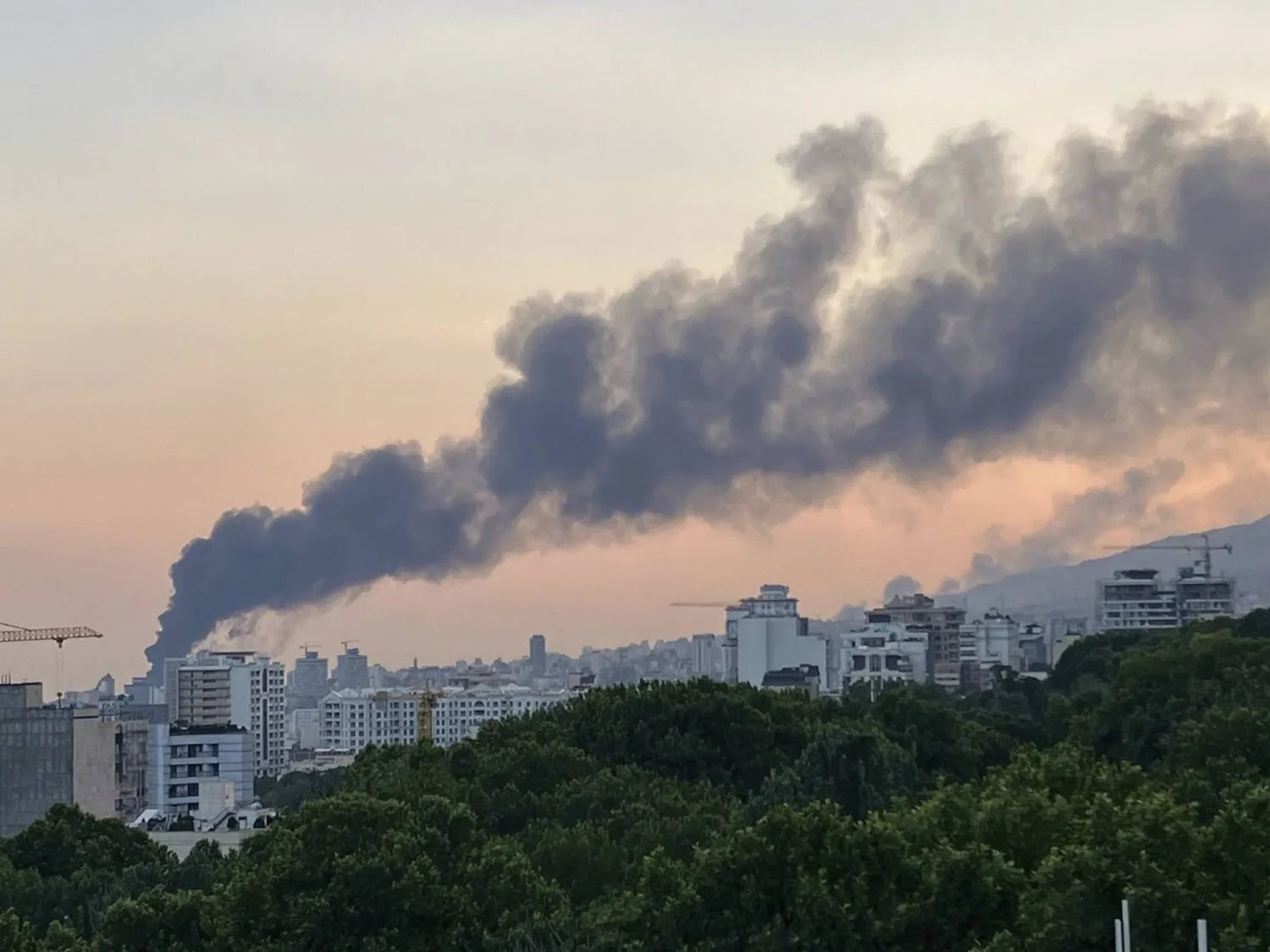
Smoke rises from the building of Iran's state-run television after an Israeli strike in Tehran, Iran, Monday, June 16, 2025. (AP Photo)
TT

Israel-Iran Air War Enters Second Week as Europe Pushes Diplomacy

Smoke rises from the building of Iran's state-run television after an Israeli strike in Tehran, Iran, Monday, June 16, 2025. (AP Photo)

Israel and Iran's air war entered a second week on Friday and European officials sought to draw Tehran back to the negotiating table after President Donald Trump said any decision on potential US involvement would be made within two weeks.

Israel began attacking Iran last Friday, saying it aimed to prevent its longtime enemy from developing nuclear weapons. Iran retaliated with missile and drone strikes on Israel. It says its nuclear program is peaceful.

Israeli air attacks have killed 639 people in Iran, the Human Rights Activists News Agency said. Those killed include the military's top echelon and nuclear scientists. Israel has said at least two dozen Israeli civilians have died in Iranian missile attacks. Reuters could not independently verify the death toll from either side.

Israel has targeted nuclear sites and missile capabilities and sought to shatter the government of Supreme Leader Ali Khamenei, according to Western and regional officials.

"Are we targeting the downfall of the regime? That may be a result, but it's up to the Iranian people to rise for their freedom," Israeli Prime Minister Benjamin Netanyahu said on Thursday.

Iran has said it is targeting military and defense-related sites in Israel, although it has also hit a hospital and other civilian sites.

Israel accused Iran on Thursday of deliberately targeting civilians through the use of cluster munitions, which disperse small bombs over a wide area. Iran's mission to the United Nations did not immediately respond to a request for comment.

With neither country backing down, the foreign ministers of Britain, France and Germany along with the European Union foreign policy chief were due to meet in Geneva with Iran's foreign minister to try to de-escalate the conflict on Friday.

"Now is the time to put a stop to the grave scenes in the Middle East and prevent a regional escalation that would benefit no one," said British Foreign Minister David Lammy ahead of their joint meeting with Abbas Araghchi, Iran's foreign minister.

US Secretary of State Marco Rubio also met Lammy on Thursday and held separate calls with his counterparts from Australia, France and Italy to discuss the conflict.

The US State Department said that Rubio and the foreign ministers agreed that "Iran can never develop or acquire a nuclear weapon."

Lammy said the same on X while adding that the situation in the Middle East "remained perilous" and a "window now exists within the next two weeks to achieve a diplomatic solution."

Russian President Vladimir Putin and Chinese President Xi Jinping both condemned Israel and agreed that de-escalation is needed, the Kremlin said on Thursday.

The role of the United States remained uncertain. Trump's special envoy to the region, Steve Witkoff, has spoken with Araghchi several times since last week, sources say.

The White House said Trump will take part in a national security meeting on Friday morning. The president has alternated between threatening Tehran and urging it to resume nuclear talks that were suspended over the conflict.

MISSILE STRIKES

At dawn on Friday, the Israeli military issued a fresh warning of an incoming barrage of missiles from Iran. At least one made a direct impact in Beersheba, Israel's largest southern city, which has been targeted in recent days.

The missile struck near residential apartments, office buildings, and industrial facilities, leaving a large crater and ripping off the facade of at least one apartment complex while damaging several others.

"We have a direct strike next to one of the buildings. The damage here is quite (extensive)," paramedic Shafir Botner said.

Israeli public broadcaster Kan aired footage showing cars engulfed in flames, thick plumes of smoke and shattered windows at apartment buildings.

At least six people sustained light injuries in the blast, according to Botner, who said that first responders were still searching apartments for casualties.

On Thursday, Iran hit a major hospital in Beersheba, Israel's largest city in the south. Iran said it was targeting Israeli military headquarters near the hospital but Israel has denied there were any such facilities in the area.

Israel's military also said it had carried out several overnight strikes in the heart of the Iranian capital. The military said the targets included missile production sites and a facility for nuclear weapons research and development.

Trump has mused about striking Iran, possibly with a "bunker buster" bomb that could destroy nuclear sites built deep underground. The White House said Trump would decide in the next two weeks whether to get involved in the war.

That may not be a firm deadline. Trump has commonly used "two weeks" as a time frame for making decisions and allowed other economic and diplomatic deadlines to slide.

With Iran facing one of its greatest external threats since the 1979 revolution, any direct challenge to its 46-year-long rule would likely require some form of popular uprising.

But activists involved in previous bouts of protest say they are unwilling to unleash mass unrest, even against a system they hate, with their nation under attack.

"How are people supposed to pour into the streets? In such horrifying circumstances, people are solely focused on saving themselves, their families, their compatriots, and even their pets," said Atena Daemi, a prominent activist who spent six years in prison before leaving Iran.



Ukraine’s New Defense Minister Reveals Scale of Desertions as Millions Avoid the Draft

Ukraine's newly appointed Defense Minister Mykhailo Fedorov attends a parliamentary session in Kyiv, Ukraine, 14 January 2026. (EPA)
TT

Ukraine’s New Defense Minister Reveals Scale of Desertions as Millions Avoid the Draft

Ukraine's newly appointed Defense Minister Mykhailo Fedorov attends a parliamentary session in Kyiv, Ukraine, 14 January 2026. (EPA)

Wide-scale desertions and 2 million draft-dodgers are among a raft of challenges facing Ukraine's military as Russia presses on with its invasion of its neighbor after almost four years of fighting, the new defense minister said Wednesday.

Mykhailo Fedorov told Ukraine's parliament that other problems facing Ukraine’s armed forces include excessive bureaucracy, a Soviet-style approach to management, and disruptions in the supply of equipment to troops along the about 1,000-kilometer (600-mile) front line.

“We cannot fight a war with new technologies but an old organizational structure,” Fedorov said.

He said the military had faced some 200,000 troop desertions and draft-dodging by around 2 million people.

President Volodymyr Zelenskyy appointed 34-year-old Fedorov at the start of the year. The former head of Ukraine’s digital transformation policies is credited with spearheading the army's drone technology and introducing several successful e-government platforms.

His appointment was part of a broad government reshuffle that the Ukrainian leader said aimed to sharpen the focus on security, defense development and diplomacy amid a new US-led push to find a peace settlement.

Fedorov said the defense ministry is facing a shortfall of 300 billion hryvnia ($6.9 billion) in funding needs.

The European Union will dedicate most of a massive new loan program to help fund Ukraine’s military and economy over the next two years, European Commission President Ursula von der Leyen said Wednesday.

Fedorov said Ukraine’s defense sector has expanded significantly since Russia’s full-scale invasion in February 2022. At the start of the war, he said, the country had seven private drone companies and two firms developing electronic warfare systems. Today, he said, there are nearly 500 drone manufacturers and about 200 electronic warfare companies in Ukraine.

He added that some sectors have emerged from scratch, including private missile producers, which now number about 20, and more than 100 companies manufacturing ground-based robotic systems.


France Explores Sending Eutelsat Terminals to Iran Amid Internet Blackout

 Protesters hold up placards with pictures of victims as they demonstrate in support of anti-government protests in Iran, outside Downing Street, in London, Wednesday, Jan. 14, 2026. (AP)
Protesters hold up placards with pictures of victims as they demonstrate in support of anti-government protests in Iran, outside Downing Street, in London, Wednesday, Jan. 14, 2026. (AP)
TT

France Explores Sending Eutelsat Terminals to Iran Amid Internet Blackout

 Protesters hold up placards with pictures of victims as they demonstrate in support of anti-government protests in Iran, outside Downing Street, in London, Wednesday, Jan. 14, 2026. (AP)
Protesters hold up placards with pictures of victims as they demonstrate in support of anti-government protests in Iran, outside Downing Street, in London, Wednesday, Jan. 14, 2026. (AP)

France is looking into sending Eutelsat satellite terminals to Iran to help citizens after Iranian authorities imposed a blackout of internet services in a bid to quell the country's most violent domestic unrest in decades.

"We are exploring all options, and the one you have mentioned is among them," French Foreign Minister Jean-Noel Barrot said on Wednesday in ‌the lower house ‌after a lawmaker asked whether France ‌would ⁠send Eutelsat ‌gear to Iran.

Backed by the French and British governments, Eutelsat owns OneWeb, the only low Earth orbit constellation, or group of satellites, besides Elon Musk's Starlink.

The satellites are used to beam internet service from space, providing broadband connectivity to businesses, governments and consumers in underserved areas.

Iranian authorities in recent days have ⁠launched a deadly crackdown that has reportedly killed thousands during protests against clerical rule, ‌and imposed a near-complete shutdown of internet ‍service.

Still, some Iranians have ‍managed to connect to Starlink satellite internet service, three people ‍inside the country said.

Even Starlink service appears to be reduced, Alp Toker, founder of internet monitoring group NetBlocks said earlier this week.

Eutelsat declined to comment when asked by Reuters about Barrot's remarks and its activities in Iran.

Starlink’s more than 9,000 satellites allow higher speeds than Eutelsat's fleet of over 600, ⁠and its terminals connecting users to the network are cheaper and easier to install.

Eutelsat also provides internet access to Ukraine's military, which has relied on Starlink to maintain battlefield connectivity throughout the war with Russia.

Independent satellite communications adviser Carlos Placido said OneWeb terminals are bulkier than Starlink’s and easier to jam.

"The sheer scale of the Starlink constellation makes jamming more challenging, though certainly not impossible," Placido said. "With OneWeb it is much easier to predict which satellite will become online over a given ‌location at a given time."


China Says It Opposes Outside Interference in Iran’s Internal Affairs

Iranians walk next to a billboard reading "Iran is our Homeland" at Enqelab Square in Tehran, Iran, 13 January 2026. (EPA)
TT

China Says It Opposes Outside Interference in Iran’s Internal Affairs

Iranians walk next to a billboard reading "Iran is our Homeland" at Enqelab Square in Tehran, Iran, 13 January 2026. (EPA)

China opposes any outside interference in Iran's ​internal affairs, the Chinese foreign ministry said on Wednesday, after US President Donald Trump warned that Washington ‌would take "very ‌strong action" ‌against Tehran.

China ⁠does ​not ‌condone the use or the threat of force in international relations, Mao Ning, spokesperson at ⁠the Chinese foreign ministry, said ‌at a ‍regular ‍news conference when ‍asked about China's position following Trump's comments.

Trump told CBS News in ​an interview that the United States would take "very ⁠strong action" if Iran starts hanging protesters.

Trump also urged protesters to keep protesting and said that help was on the way.