


Damascus Gov’t on Alert to Prevent ISIS Resurgence

Emergency services work at the scene of a suicide bombing at Mar Elias Church on the outskirts of Damascus, Syria, 22 June 2025. EPA/MOHAMMED AL RIFAI
TT

Damascus Gov’t on Alert to Prevent ISIS Resurgence

Emergency services work at the scene of a suicide bombing at Mar Elias Church on the outskirts of Damascus, Syria, 22 June 2025. EPA/MOHAMMED AL RIFAI

A suicide bombing that targeted the Mar Elias church in the Dweila district of Damascus has reignited debate over ISIS’s activity inside Syria, amid growing concerns that extremist groups are intensifying efforts to destabilize the government of President Ahmed al-Sharaa.

Although a lesser-known faction, Saraya Ansar al-Sunna, claimed responsibility for the attack, multiple sources say various radical groups, despite differing ideologies, are now pursuing parallel strategies to undermine the Syrian state.

A senior commander in the New Syrian Army warned of a looming ISIS plan to stage a large-scale, surprise assault on Damascus. They said the group was seeking to infiltrate cities by moving militants from the vast Syrian desert into urban areas, while other factions were launching attacks driven by resentment and anger towards the authorities.

“ISIS’s current strategy is based on relocating from the desert into cities, embedding itself within civilian populations, and forming new sleeper cells,” the commander, who spoke under the condition of anonymity, told Asharq Al-Awsat.

“We have the capabilities to confront the threat and dismantle their networks. We know them better than anyone else,” they added.

According to the commander, the new Syrian army has disclosed sensitive intelligence on ISIS’s renewed push to infiltrate urban centers, warning that the extremist group is adapting its tactics as it regroups across Syria.

The commander also said the army uncovered key details of ISIS’s plans after dismantling a sleeper cell in Homs several months ago.

The militants had reportedly travelled from the Syrian desert, or al-Badiya, highlighting what the commander described as “a clear strategy” by ISIS to move from remote regions into population centers.

“The cell was part of a broader effort to penetrate cities from the desert,” the commander said, adding that the group appeared to be shifting its operational base closer to Damascus and other strategic urban areas.

The revelations come in the wake of the suicide bombing that struck the Mar Elias church.

One day after the June 22 attack, Syria’s Interior Ministry announced it had carried out a “precision operation” in coordination with the General Intelligence Directorate to track and dismantle ISIS hideouts in and around Damascus, including those believed to be directly linked to the church bombing.

ISIS was preparing to launch a wide-scale, coordinated assault on several Syrian cities, starting from Homs, revealed the commander, adding that the terror group’s strategy involved seizing control of multiple neighborhoods in key urban centers simultaneously, in a surprise offensive designed to destabilize the country.

“Dismantling the sleeper cells was crucial,” the commander told Asharq Al-Awsat.

“We reinforced our military presence in Homs and its surrounding areas. It was a major preemptive blow that disrupted ISIS’s plans and helped bolster stability in Syria.”

The group's tactical goals also included targeting religious sites belonging to Alawites, Murshidis, and Christians in an attempt to embarrass the Syrian government and project a sense of insecurity across the country.

“It’s a familiar ISIS tactic used in both Syria and Iraq to inflame sectarian tensions, undermine state authority, and recruit new followers through chaos,” the commander added.

The June 22 bombing of the Orthodox Saint Mar Elias church in Damascus, which killed and injured many civilians, appears to fit this pattern. Syria’s Interior Ministry quickly blamed ISIS for the attack and later announced the arrest of several individuals it said were affiliated with the group.

While local media have reported that ISIS is stepping up efforts to rebuild its networks after a period of dormancy, independent verification of these claims remains limited.

However, intelligence gathered by the Syrian army suggests that ISIS is prioritizing urban operations and symbolic attacks on religious sites, a strategy consistent with the government’s swift attribution of the church bombing to the group.

The bombing of the Mar Elias church, the first attack of its kind targeting worshippers inside a church in the capital since 1860, has triggered both shock and competing interpretations about who was behind the deadly blast.

While many Syrians and analysts have aligned with the government’s accusation that ISIS was responsible, citing the group’s enduring threat, some well-informed sources remain skeptical. They argue that despite similarities in method, the operation does not fully align with ISIS’s known tactics or ideological playbook in Syria, particularly at this stage of its insurgency.

“ISIS has never targeted churches in this manner within its areas of influence in Syria,” a source familiar with the group’s activity told Asharq Al-Awsat. “Such attacks do not serve its goals while it's engaged in a broader war against al-Sharaa’s government.

Historically, ISIS has defiled and desecrated churches, destroying crosses, smashing altars, and raising its black flags above Christian sites. These acts were documented in parts of Deir Ezzor, rural Homs, and Idlib over the past decade.

However, the group typically targeted religious symbols in already-conquered territory, rather than staging suicide bombings in government-controlled urban centers.

Further complicating the narrative is the fact that churches have also been struck by shelling or airstrikes carried out by the previous Syrian regime, undermining the notion that religious sanctuaries were ever fully protected during the war.

Syrian authorities are stepping up efforts to sever ISIS from its former support networks, using a mix of security operations and reconciliation initiatives aimed at individuals who once backed or belonged to the group.

Mediators involved in government-led reconciliation efforts told Asharq Al-Awsat that more than 150 former ISIS affiliates who were not found to have committed crimes against civilians have renounced the group and been granted amnesty.

“These individuals chose to walk away from ISIS, and the state responded by offering a path back through forgiveness,” one mediator said, describing the initiative as part of a broader strategy to drain the group’s residual influence in previously sympathetic communities.

Another mediator, a respected tribal elder who spoke to Asharq Al-Awsat on condition of anonymity, revealed that many of those pardoned had joined the state’s reconciliation efforts after receiving endorsements from local religious and tribal figures.

Observers say the policy signals a strategic shift aimed at rehabilitating former ISIS affiliates who played no direct role in civilian bloodshed. The goal, they argue, is to detach these individuals from the group’s ideological grip, strip ISIS of its remaining support base, and stem future recruitment.

“We asked the government to settle the status of former ISIS members who had no blood on their hands, to encourage others to walk away from the group,” the mediator said. “The authorities understand that continued pursuit of these individuals could push them back into ISIS’s arms.”

However, he clarified that the state remains resolute in pursuing key ISIS operatives responsible for violence against civilians and rival factions such as Hayat Tahrir al-Sham. “There is no clemency for those who’ve committed acts of terror,” he said.

The reconciliation initiative runs parallel to ongoing military and intelligence operations targeting ISIS cells, as Damascus attempts to contain the group’s underground resurgence and prevent a return to widespread insurgency.



Lebanon Tells a UN Team the Country Will Need a Back-up Force Once Peacekeepers’ Term Ends

Lebanese Prime Minister Nawaf Salam, in front of the Lebanese flags (C), meets with a United Nations Security Council delegation at the government palace in Beirut, Lebanon, 05 December 2025. (EPA)
TT

Lebanon Tells a UN Team the Country Will Need a Back-up Force Once Peacekeepers’ Term Ends

Lebanese Prime Minister Nawaf Salam, in front of the Lebanese flags (C), meets with a United Nations Security Council delegation at the government palace in Beirut, Lebanon, 05 December 2025. (EPA)

The Lebanese prime minister on Friday told a visiting UN delegation that his country will need a follow-up force in southern Lebanon along the border with Israel to fill the vacuum once the UN peacekeepers' term expires by the end of next year.

The UN Security Council voted unanimously in August to terminate the UN Interim Force in Lebanon (UNIFIL) at the end of 2026 — nearly five decades after the force was deployed. The multinational force has played a significant role in monitoring the security situation in the region, including during the Israel-Hezbollah war last year.

But it has drawn criticism from officials in President Donald Trump’s administration, which has moved to slash US funding for the operation as Trump remakes America’s approach to foreign policy.

Lebanese Prime Minister Nawaf Salam held talks with the team representing the 15 members of the UN Security Council, saying he believes another, follow-up force would help Lebanese troops along the border where they have intensified efforts in the volatile area that witnessed the 14-month war between Israel and the Iran-backed Hezbollah group.

Salam proposed that a small follow-up force could work much like the UN observers force that has been deployed along Syria’s border with Israel since 1974.

There was no immediate response from the UN delegation, which arrived in Lebanon after a visit to Syria. Earlier Friday, the delegation also met with Lebanese President Joseph Aoun, who said Lebanon would welcome any country's decision to keep its forces in southern Lebanon after UNIFIL's term expires.

Aoun also touted Lebanon’s appointment of former ambassador to Washington, Simon Karam, to head the Lebanese delegation to a previously military-only committee that monitors the US-brokered ceasefire that halted the latest Israel-Hezbollah war.

The appointment has angered Hezbollah, whose leader Sheikh Naim Qassem said in a televised speech later Friday that the appointment of the ex-ambassador was allegedly a “concession" to Israel.

Qassem said it would not change "the enemy’s stance and its aggression,” referring to Israel’s almost daily airstrikes on what the Israeli military says are Hezbollah targets in Lebanon since the ceasefire went into effect in November last year. The UN says that the Israeli strikes since the ceasefire have killed 127 civilians.

Israel’s air force carried out a series of airstrikes on Thursday in south Lebanon, saying it struck Hezbollah’s infrastructure. Warnings were issued in advance to evacuate the area.

The latest Israel-Hezbollah war began a day after Hamas attacked southern Israel on Oct. 7, 2023, with Hezbollah firing rockets into Israel in solidarity with the Palestinian Hamas group. Israel's response operation that included bombardment and a ground operation last year has severely weakened Hezbollah.


Palestinians Say Israeli Army Killed Man in Occupied West Bank

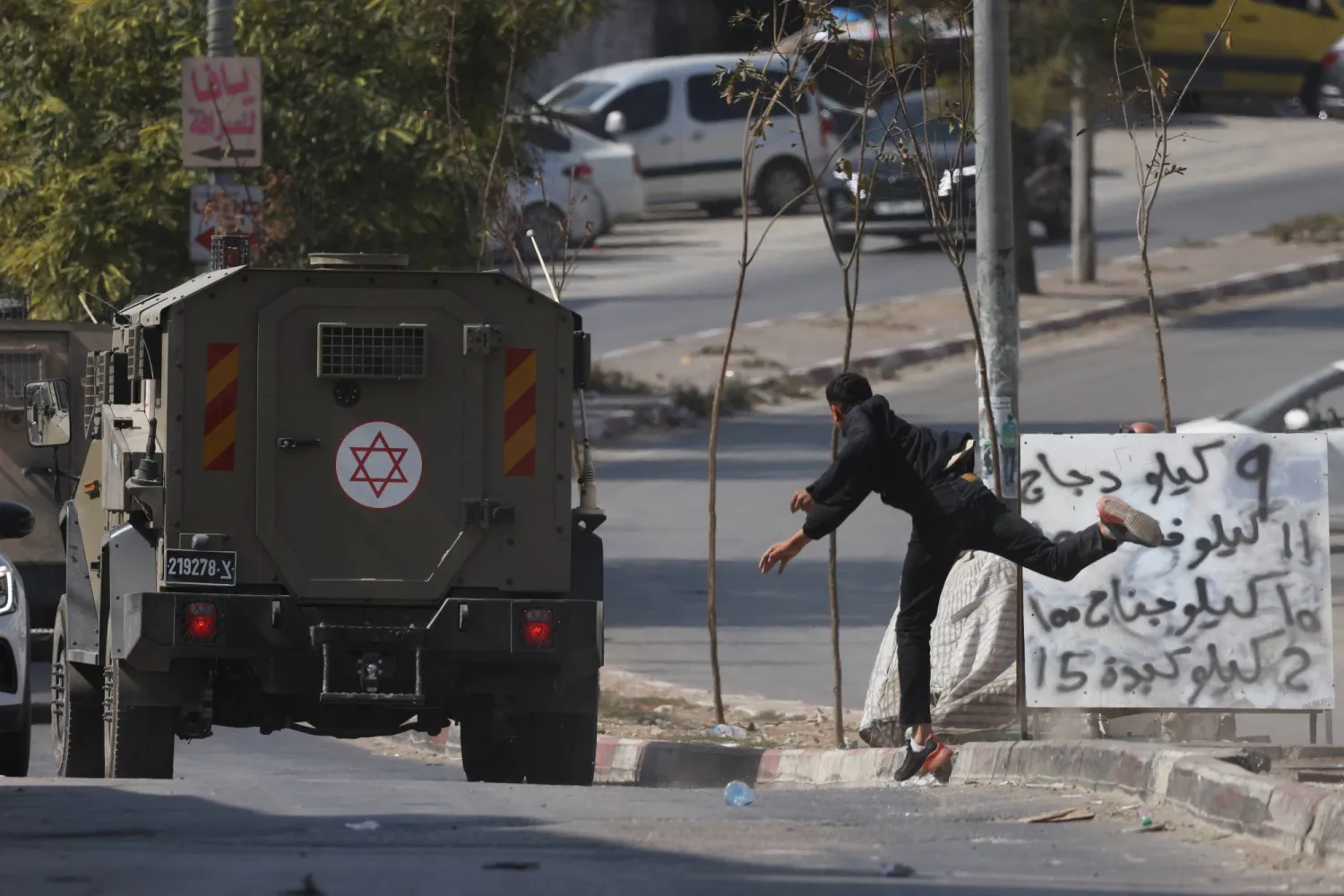
 Israeli military vehicles roll during a raid in Ramallah, in the occupied West Bank on December 1, 2025. (AFP)
Israeli military vehicles roll during a raid in Ramallah, in the occupied West Bank on December 1, 2025. (AFP)
TT

Palestinians Say Israeli Army Killed Man in Occupied West Bank

 Israeli military vehicles roll during a raid in Ramallah, in the occupied West Bank on December 1, 2025. (AFP)
Israeli military vehicles roll during a raid in Ramallah, in the occupied West Bank on December 1, 2025. (AFP)

The Ramallah-based Palestinian health ministry said that Israeli forces killed a man in the northern occupied West Bank on Friday.

"Bahaa Abdel-Rahman Rashid (38 years old) was killed by Israeli fire in the town of Odala, south of Nablus," the health ministry said in a statement.

Shortly before, the Palestinian Red Crescent said its teams handled the case of a man "who suffered a critical head injury during clashes in the town of Odala near Nablus, and CPR is currently being performed on him".

The Israeli military told AFP it was looking into the incident.

Witness and Odala resident Muhammad al-Kharouf told AFP that Israeli troops were patrolling in Odala and threw tear gas canisters at men who were exiting the local mosque for Friday prayer.

Rashid was killed by live fire in the clashes that followed, added Kharouf, who had been inside the mosque with him.

The Israeli military said Friday it had completed a two-week counter-terrorism operation in the northern West Bank during which it killed six gunmen and questioned dozens of suspects.

It told AFP that Rashid was not among the six gunmen killed over the past two weeks.

Dozens of men including Rashid's father gathered at the nearby city of Nablus' Rafidia hospital to bid him goodbye on Friday, an AFP journalist reported.

Violence in the West Bank has soared since Hamas's October 2023 attack on Israel triggered the Gaza war.

It has not ceased despite the fragile truce between Israel and Hamas that came into effect in October.

Israeli troops or settlers have killed more than 1,000 Palestinians, many of them gunmen, but also scores of civilians, in the West Bank since the start of the Gaza war, according to an AFP tally based on Palestinian health ministry figures.

At least 44 Israelis, including both soldiers and civilians, have been killed in Palestinian attacks or Israeli military operations, according to official Israeli figures.


Lebanese President, Hezbollah Split Over Expanded Talks with Israel

A handout photo made available by the Lebanese Presidency press office shows Lebanese President Joseph Aoun (9-R) posing for a photo with a United Nations Security Council delegation following their meeting at the Presidential Palace in Baabda, east of Beirut, Lebanon, 05 December 2025. (Lebanese Presidency)
TT

Lebanese President, Hezbollah Split Over Expanded Talks with Israel

A handout photo made available by the Lebanese Presidency press office shows Lebanese President Joseph Aoun (9-R) posing for a photo with a United Nations Security Council delegation following their meeting at the Presidential Palace in Baabda, east of Beirut, Lebanon, 05 December 2025. (Lebanese Presidency)

Lebanon's president on Friday defended his decision to expand talks with Israel as a way to avoid further violence, but the head of armed group Hezbollah called it a blunder, lifting the lid on divisions at a watershed moment for the country.

Israel and Lebanon on Wednesday both sent civilian envoys to a military committee monitoring their ceasefire, a step towards a months-old US demand that the two countries broaden talks in line with President Donald Trump's Middle East peace agenda.

President Joseph Aoun told visiting representatives of the United Nations Security Council that his country "has adopted the option of negotiations with Israel" and that "there is no going back".

"These negotiations are mainly aimed at stopping the hostile actions carried out by Israel on Lebanese territory, securing the return of the captives, scheduling the withdrawal from the occupied areas, and resolving the disputed points along the Blue Line," Aoun said in a statement on Friday, referring to the UN-mapped line that separates Israel from Lebanon.

HEZBOLLAH CALLS MOVE 'FREE CONCESSION'

But the expanded talks were criticized by armed group Hezbollah.

Its head, Sheikh Naim Qassem, said on Friday afternoon that sending a civilian delegate to the truce monitoring committee was a "blunder," and urged the government to rethink its decision.

"You offered a free concession that will not change anything in the enemy's (Israel's) position or its attacks," Qassem said.

Lebanon and Israel have been officially enemy states for more than 70 years, and meetings between their civilian officials have been extraordinarily rare throughout their fraught history.

Over the last year, military officials have met as part of a committee, chaired by the United States, to monitor a 2024 truce that ended more than a year of fighting between Israel and Hezbollah which badly weakened the Lebanese Iran-backed armed group.

In that time, Israel has continued its air strikes on what it says are Hezbollah's attempts to re-arm in violation of the truce. Lebanon says those strikes and Israel's occupation of southern Lebanese territory are ceasefire breaches.

Fears are growing in Lebanon that Israel could expand its air campaign further to ratchet up pressure on the Lebanese government to disarm Hezbollah more swiftly across the country.

The group has refused to disarm in full and has raised the specter of internal strife if the state tries to confront it.