


UAE: Life Sentences for 24 Defendants in the ‘Justice and Dignity’ Case

The United Arab Emirates’ Federal Supreme Court (WAM)
TT

UAE: Life Sentences for 24 Defendants in the ‘Justice and Dignity’ Case

The United Arab Emirates’ Federal Supreme Court (WAM)

The United Arab Emirates’ Federal Supreme Court has issued a ruling partially overturning a previous verdict in the case known as the “Justice and Dignity Terrorist Organization,” sentencing 24 defendants to life imprisonment after they were found guilty of collaborating with the group and funding the “Al Islah Terrorist Organization.”

The court also ordered the confiscation of funds and tools seized in connection with both crimes.

The court delivered its decision during a session held on Thursday, June 26, following the partial acceptance of an appeal filed by the Attorney General, Counselor Dr. Hamad Al Shamsi. The appeal contested the ruling of the Abu Dhabi Federal Court of Appeal – State Security Chamber, which had dismissed the criminal case on the grounds that the defendants had already been tried in the matter.

In his appeal, the Attorney General argued that the contested ruling was flawed, as it failed to recognize the distinct nature of the crimes of financing and collaborating with the terrorist organization as stipulated under Federal Law No. (1) of 2004. He noted that these charges had not been included in the earlier 2012 case, in which the defendants were convicted solely of establishing and managing the “Al Islah Organization,” in accordance with the Penal Code.

In its reasoning, the Federal Supreme Court emphasized that the acts attributed to the defendants in the current case are different from those previously adjudicated. The court stated that they cannot be considered a single act under multiple legal descriptions, as the cause and subject of each are separate. It underlined that the criminal conduct at the heart of the new charges is distinct and carries a harsher penalty prescribed by law, thereby justifying a retrial on these offenses.

As a result of this ruling, the number of convicted individuals in what is regarded as one of the country’s largest national security cases has risen to 83 out of 84 defendants referred to trial.

According to the Emirates News Agency (WAM), the State Security Chamber of the Abu Dhabi Federal Court of Appeal had previously convicted 53 defendants, who were leaders and members of the terrorist Muslim Brotherhood organization, along with six affiliated companies. Sentences in that judgment ranged from life imprisonment to temporary prison terms, as well as fines of up to 20 million dirhams. One defendant was acquitted.

WAM confirmed that this ruling reflects the UAE’s approach in confronting terrorist organizations and their financing, underscoring the independence of the judiciary and its strict application of the law in matters that threaten the security and stability of the state.



Gulf States Pursue IRGC, Hezbollah Cells Amid Ongoing Attacks

 Suspects identified as fugitives abroad (Bahrain’s Interior Ministry) 
Suspects identified as fugitives abroad (Bahrain’s Interior Ministry) 
TT

Gulf States Pursue IRGC, Hezbollah Cells Amid Ongoing Attacks

 Suspects identified as fugitives abroad (Bahrain’s Interior Ministry) 
Suspects identified as fugitives abroad (Bahrain’s Interior Ministry) 

Gulf Cooperation Council states are pursuing hunting down terrorist cells linked to Tehran and Lebanon’s Hezbollah, as they continue to counter Iranian attacks, intercepting more than 6,246 missiles and drones, according to the Gulf Research Center.

Monitoring by Asharq Al-Awsat shows that within 30 days, Gulf security services uncovered nine cells tied to Iran or its allies, particularly Hezbollah, across four countries: Qatar, Bahrain, Kuwait, and the UAE.

The first cell was announced in Qatar on March 3, and the latest on March 30—meaning all nine were dismantled within 27 days, or roughly one Iran-linked cell every three days.

Seventy-four suspects across nine Iranian cells

About 74 individuals were arrested or identified across the nine cells, according to official data. They include nationals of Kuwait, Lebanon, Iran, and Bahrain.

According to official statements and confessions, the suspects were involved in coordinating with operatives abroad in ways that undermine state sovereignty and endanger public safety. Charges include raising funds for attacks, plotting assassinations targeting leaders and public figures, damaging strategic interests, infiltrating national economies, and executing schemes that threaten financial stability.

They also face accusations of espionage, collecting intelligence on military and critical sites, and possessing drones and coordinates of sensitive locations.

“Exporting the revolution”

The activities and charges mirror previously uncovered Iran-linked networks in the Gulf. Gulf security specialist Dhafer Alajmi said Iran has pursued a policy of exporting its 1979 revolution, turning sleeper cells into an existential threat to Gulf states.

Gulf countries began dismantling such networks early in the current conflict. The first announced operation came less than 72 hours after the outbreak of US, Israeli, and Iranian military confrontations, reflecting heightened security vigilance.

In Bahrain, authorities uncovered three cells involving 14 individuals, including 12 detained and two identified as fugitives abroad.

In Kuwait, three cells linked to the banned Hezbollah group involved 45 individuals, some arrested and others identified overseas.

The UAE announced the dismantling of a network linked to Hezbollah and Iran comprising five members.

Qatar, the first to act on March 3, said two cells working for the Revolutionary Guards involved 10 suspects.

A three-dimensional strategy

Alajmi said Tehran relies on a three-dimensional strategy to encircle the region: local terrorist cells, recruitment within Gulf states to carry out bombings and assassinations, and regional armed proxies such as the Houthis and Hezbollah to exert missile and drone pressure.

He also pointed to “nuclear blackmail,” using nuclear facilities as cover for destabilizing activities and as leverage against the international community.

He said Gulf states have demonstrated exceptional efficiency through preemptive operations that foiled dozens of plots and uncovered weapons and explosives linked to the Revolutionary Guard.

He cited strict anti-money laundering and counterterrorism financing laws that have constrained Iran-linked networks financially, alongside defense alliances, enhanced security coordination such as the Peninsula Shield Force, and advanced air defense systems.

He added that public awareness has denied such cells a supportive environment, turning them from pressure tools into losing assets.

“An old, renewed tactic”

Bahraini writer Faisal Al-Sheikh said targeting Bahrain and the wider Gulf through terrorist cells and proxy networks is a long-standing Iranian tactic central to its proxy warfare strategy, aimed at undermining states from within and spreading instability.

He described it as a system built on recruiting agents and exploiting weak loyalties, calling it “organized betrayal.”

Lebanese political analyst Ibrahim Raihan said Tehran uses such cells to destabilize Gulf states and signal that any attack on it would trigger broader regional chaos.

Developments since the start of hostilities show Gulf forces have not only intercepted attacks in the air but are also engaged in a parallel ground campaign to dismantle Iran-linked networks operating within their borders.


Russia Stresses its Support to Saudi Arabia’s Sovereignty, Security

Prince Mohammed bin Salman bin Abdulaziz Al Saud, Crown Prince and Prime Minister, and Russian President Vladimir Putin. (Asharq Al-Awsat)
TT

Russia Stresses its Support to Saudi Arabia’s Sovereignty, Security

Prince Mohammed bin Salman bin Abdulaziz Al Saud, Crown Prince and Prime Minister, and Russian President Vladimir Putin. (Asharq Al-Awsat)

Prince Mohammed bin Salman bin Abdulaziz Al Saud, Crown Prince and Prime Minister, held telephone talks on Thursday with Russian President Vladimir Putin on the rapid developments in the region amid the military escalation.

They tackled the negative repercussions of the escalation and its impact on marine navigation and the global economy.

Putin stressed to Crown Prince Mohammed Russia’s support to Saudi Arabia’s sovereignty and security.

The leaders also exchanged views on several regional and international issues of common interest.


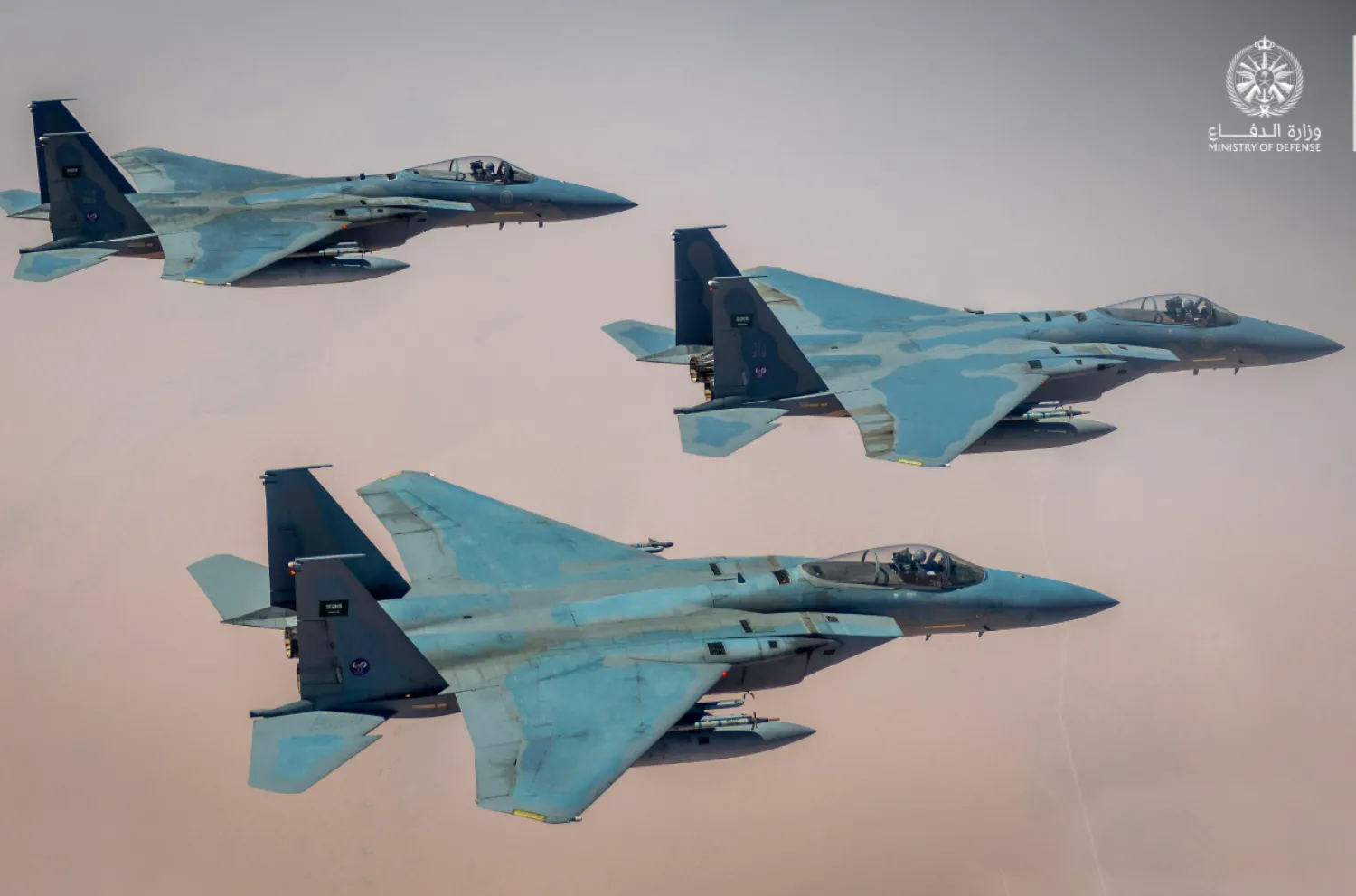
Saudi Defenses Intercept, Destroy 5 Drones and a Ballistic Missile

The armed forces' readiness succeeded in protecting the airspace and dealing with various threats without recording any damage (Ministry of Defense)
TT

Saudi Defenses Intercept, Destroy 5 Drones and a Ballistic Missile

The armed forces' readiness succeeded in protecting the airspace and dealing with various threats without recording any damage (Ministry of Defense)

Saudi air defenses intercepted five drones and a ballistic missile launched by Iran toward the Kingdom in recent hours.

The official spokesperson for the Saudi Ministry of Defense, Maj. Gen. Turki Al-Maliki, announced the interception and destruction of five drones in recent hours, as well as a ballistic missile targeting the Eastern Province.

Al-Maliki confirmed the success of the operations and the readiness of the armed forces to protect the airspace and respond to various threats, with no damage reported.