


Air France-KLM to Take Majority Stake in Scandinavian Airline SAS

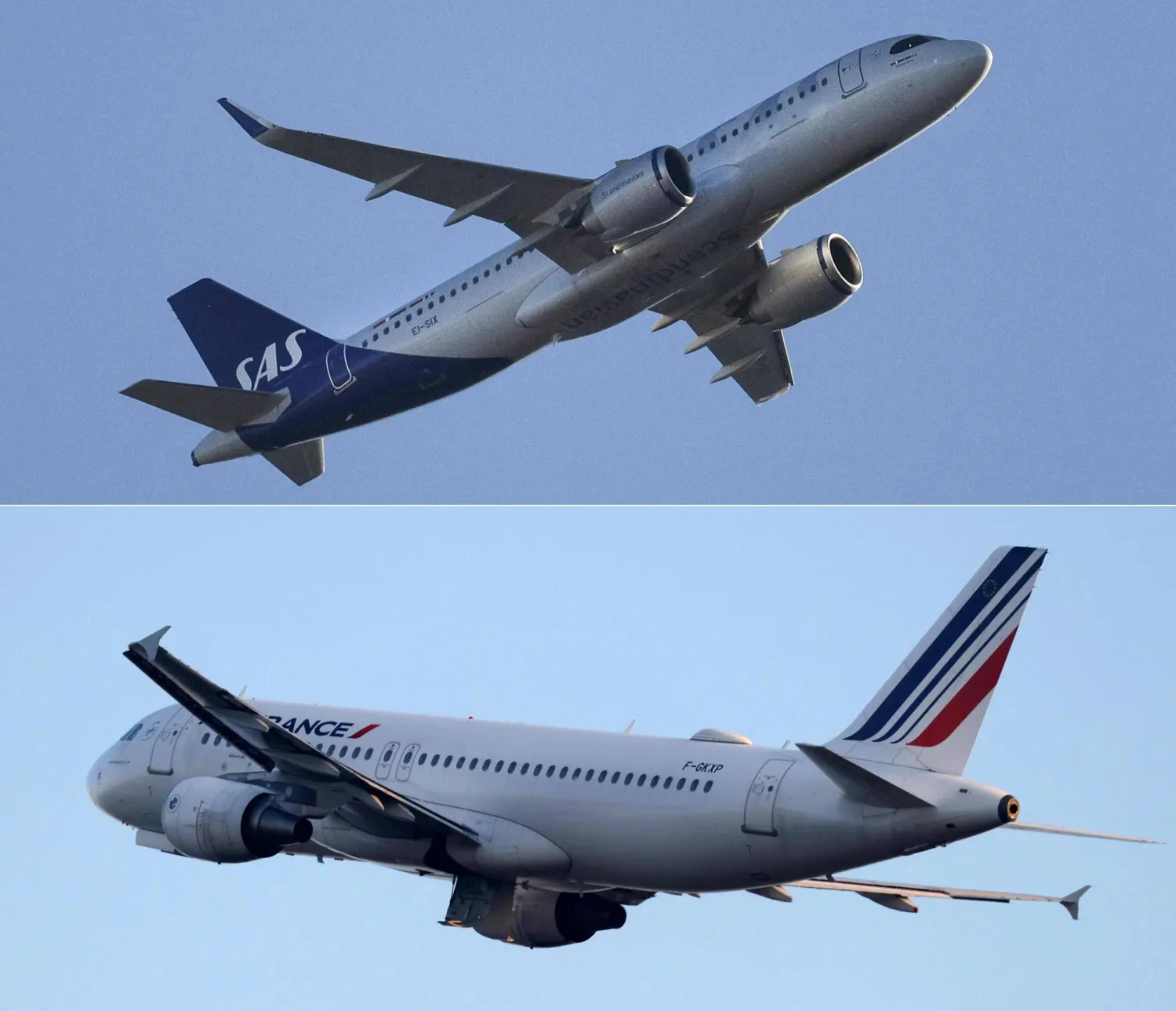
(COMBO) This combination of pictures created on July 04, 2025 shows a Scandinavian airline SAS plane flying over Heathrow airport on the outskirts of London on January 15, 2024 (top) and an Air France-KLM plane taking off from Tegel 'Otto Lilienthal' Airport in Berlin on November 8, 2020. (Photo by Adrian DENNIS and Odd ANDERSEN / AFP)
TT

Air France-KLM to Take Majority Stake in Scandinavian Airline SAS

(COMBO) This combination of pictures created on July 04, 2025 shows a Scandinavian airline SAS plane flying over Heathrow airport on the outskirts of London on January 15, 2024 (top) and an Air France-KLM plane taking off from Tegel 'Otto Lilienthal' Airport in Berlin on November 8, 2020. (Photo by Adrian DENNIS and Odd ANDERSEN / AFP)

Air France-KLM plans to increase its stake in Scandinavian airline SAS to 60.5%, the latest step towards consolidating Europe's fragmented airline sector as carriers seek to strengthen their position against rivals.

The Franco-Dutch airline group said on Friday it intended to increase its stake from 19.9% currently by acquiring the stakes held by top shareholders Castlelake and Lind Invest.

The purchase, subject to regulatory clearances, is expected to close in the second half of 2026, Reuters quoted Air France-KLM as saying.

The value of the investment would be determined at closing, based on SAS's latest financial performance, including core earnings (EBITDA) and net debt, the company said. It declined to give details on those metrics.

Air France-KLM expects to generate "three-digit million" euros in synergies from raising its SAS stake, Air France-KLM finance chief Steven Zaat told analysts on a call.

Zaat said the deal would be funded from cash or a "plain vanilla bond" and would not impact the drive to reduce the group's hybrid debt. "We have ample room for it," he said.

Air France-KLM shares were flat in early trading.

JPMorgan analysts said there were reasons to be positive about the deal.

"SAS offers deeper access to a GDP-rich region in Scandinavia, there will now be an opportunity to unlock cost synergies as SAS becomes a subsidiary of the group," they said in a note, adding that "industry consolidation should also be viewed positively for the whole sector, even if not game-changing in terms of size."

INDUSTRY CONSOLIDATION

SAS welcomed Air France-KLM's announcement.

"European consolidation had to happen further, and we're very happy to be part of that," SAS CEO Anko van der Werff told Danish broadcaster TV2.

"In the current setup where Air France-KLM is a 19.9% shareholder, they're still a competitor," he said. "With the new stake, going above 50%, we can really tap into all of those synergies and offer those benefits to customers."

SAS said it would continue to invest in its fleet and network.

In 2023, Air France-KLM said it would invest about $144.5 million for its initial SAS stake, boosting its presence in Sweden, Denmark and Norway with the option to become a controlling shareholder after a minimum of two years, subject to conditions.

SAS exited from Chapter 11 bankruptcy protection in August last year.

The two carriers have already had a commercial cooperation since summer 2024. Control of SAS would allow Air France-KLM to expand in the Scandinavian market and create additional value for shareholders, Air France-KLM said in a statement.

"Following their successful restructuring, SAS has delivered impressive performance, and we are confident that the airline's potential will continue to grow through deeper integration within the Air France-KLM Group," said Air France-KLM CEO Ben Smith.

The deal comes as executives seek more consolidation in Europe's fragmented airline industry, which they say is needed to compete with US and Middle Eastern rivals.

Earlier this year, Germany's Lufthansa bought a 41% stake in Italy's ITA Airways and a stake in Air Baltic. The Portuguese government is looking to privatize its national carrier TAP.

Lufthansa and Air France are also in talks about buying a stake in Spain's Air Europa.
SAS has 138 aircraft in service and carried more than 25 million passengers last year, generating revenues of 4.1 billion euros ($4.8 billion).

Air France-KLM group would have a majority of seats on the board of directors, while the Danish state will keep its 26.4% stake in SAS and its seats on the board.




Saudi Crown Prince’s Directives Cut Riyadh Property Prices by 3%

A general view of Riyadh, Saudi Arabia. (SPA)
TT

Saudi Crown Prince’s Directives Cut Riyadh Property Prices by 3%

A general view of Riyadh, Saudi Arabia. (SPA)

Real estate prices in Saudi Arabia’s capital fell 3% in the final quarter of last year, reversing a 1% rise in the previous quarter, in a shift that highlights the on-the-ground impact of policy moves ordered by Prince Mohammed bin Salman bin Abdulaziz, Crown Prince and Prime Minister, to rein in soaring property costs across the Kingdom, particularly in Riyadh.

According to an index issued by the General Authority for Statistics on Tuesday, the real estate price index in Saudi Arabia fell 0.7% in the fourth quarter of last year compared with the same period of 2024.

The decline was driven mainly by weaker performance in the residential sector, which carries the most significant weight in the index, as its annual rate of change fell 2.2%.

The commercial sector continued to see a slight slowdown in growth momentum, while maintaining positive annual growth of 3.6%.

A real balance

Real estate specialists told Asharq Al-Awsat that the Crown Prince’s directives have become evident on the ground after property prices in Riyadh surged to unprecedented levels, prompting government intervention to curb the increases and enable citizens to own their first homes without excessive financial burdens.

Real estate analyst Khaled Al-Mobid said the 0.7 % decline in the real estate price index in the fourth quarter of 2025 reflects the market’s entry into a phase of real balance after years of rapid price increases, describing it as a healthy indicator that supports, rather than weakens, market sustainability.

“What we are witnessing today is not a loss in value, but a logical price correction, particularly in the residential sector, due to increased supply, improved regulation, and greater awareness among market participants, whether buyers or investors,” Al-Mobid told Asharq Al-Awsat.

He added that this balance creates better opportunities for end users, redirects investment toward appropriate products at fair prices, and curbs short-term speculation, serving the real estate economy over the medium and long term.

Housing stability

Real estate specialist Ahmed Omar Basudan told Asharq Al-Awsat that the sector has seen declines in many regions of the Kingdom, as buyers await the effects of government decisions issued under the Crown Prince’s direction.

He cited recent measures, including the announcement of the names of beneficiaries of subsidized land grants in northern Riyadh, located in some of the area’s best neighborhoods.

Basudan said the decision to fix residential rental prices in Riyadh for five years also contributed to the decline in the capital’s real estate market, as tenants are experiencing a period of housing stability, reducing demand for purchases at this stage.

He added that recent amendments to fees on undeveloped land and vacant properties, which have been implemented and are now being collected, also played a role, prompting landowners to move quickly to sell some plots at competitive prices to avoid bearing those fees.

Data from the General Authority for Statistics showed that residential real estate prices fell in the fourth quarter of last year compared with the same quarter of 2024, with the sector declining 2.2%. The drop was driven by a 2.4% fall in residential land prices, a 2.5% decline in apartment prices, a 1.3% decrease in villa prices, and a 0.2% drop in residential floor prices.

Quarterly comparison

The real estate price index fell 0.4% in the fourth quarter of last year, at a slower pace than in the third quarter.

The index was affected by a 0.4% decline in the residential sector, driven by a 0.7% drop in residential land prices, a 0.4% fall in apartment prices, and a 0.2% decrease in residential floor prices, while villa prices rose 0.8%.

At the regional level, the annual real estate price index fell 0.7% nationwide in the fourth quarter of last year, with Riyadh recording a 3% decline, compared with a 1% increase in the third quarter.

The Eastern Province posted the highest real estate price increase at 4%, followed by Makkah at 2.5%, Tabuk and Jazan at 1.1% each, and Al-Jawf at 0.4%.

By contrast, Hail, the Northern Borders region, and Madinah recorded the steepest declines, at 8.9%, 6.8%, and 6.1%, respectively.


Saudi Industry Minister Meets with Global Leaders at World Economic Forum to Advance Partnerships

Saudi Minister of Industry and Mineral Resources Bandar Alkhorayef held a series of high-level meetings with government officials and global business leaders at the World Economic Forum. (SPA)
TT

Saudi Industry Minister Meets with Global Leaders at World Economic Forum to Advance Partnerships

Saudi Minister of Industry and Mineral Resources Bandar Alkhorayef held a series of high-level meetings with government officials and global business leaders at the World Economic Forum. (SPA)

Saudi Minister of Industry and Mineral Resources Bandar Alkhorayef held on Tuesday a series of high-level meetings with government officials and global business leaders on the sidelines of the Kingdom's participation in the 2026 World Economic Forum in Davos.

As part of the Saudi delegation, Alkhorayef participated in a meeting with Swiss President Guy Parmelin. The meeting reviewed the robust strategic partnership between their nations and explored avenues to deepen cooperation in the industrial and mining sectors, aiming to expand bilateral ties to serve mutual interests.

Alkhorayef met with CEO of BlackRock Larry Fink, and President and CEO of the World Economic Forum Børge Brende. Talks focused on boosting the partnership between the Kingdom and the forum, exploring new cooperation in advanced manufacturing and critical minerals, and strengthening joint efforts to fortify industrial and mining supply chains.

In a series of bilateral meetings, Alkhorayef met with leaders of major global firms, including CEO of Capgemini Aiman Ezzat, Senior Partner at Bain & Company Dr. Jörg Gnamm, and CEO of Copa-Data Stefan Reuther. The meetings focused on unlocking opportunities for collaboration in advanced manufacturing, digital solutions, industrial automation, and smart systems. The officials emphasized leveraging global consulting expertise to boost factory efficiency, accelerate the Kingdom's industrial transformation, and bolster the competitiveness of its industrial and mining sectors.


Saudi-US Trade and Investment Council Meetings Kick Off in Riyadh

Chaired by the GAFT, the Saudi-US Trade and Investment Council aims to strengthen economic cooperation between the two countries by reviewing trade and investment policies, addressing barriers, and supporting technical dialogue among relevant entities. (SPA)
TT

Saudi-US Trade and Investment Council Meetings Kick Off in Riyadh

Chaired by the GAFT, the Saudi-US Trade and Investment Council aims to strengthen economic cooperation between the two countries by reviewing trade and investment policies, addressing barriers, and supporting technical dialogue among relevant entities. (SPA)

Technical team meetings of the Saudi-US Trade and Investment Council (TIFA) kicked off in Riyadh on Tuesday.

Held under the theme “A Platform for Dialogue, Partnership, and Economic Growth,” the meetings were attended by Deputy Governor of the General Authority of Foreign Trade (GAFT) for International Relations Abdulaziz Alsakran, Assistant United States Trade Representative for Europe and the Middle East Bryant Trick, with the participation of 20 entities from both sides.

Chaired by the GAFT, the Saudi-US Trade and Investment Council aims to strengthen economic cooperation between the two countries by reviewing trade and investment policies, addressing barriers, and supporting technical dialogue among relevant entities.

The council focuses on five main objectives: developing trade and investment policies; facilitating trade and addressing technical and regulatory barriers; supporting cooperation on sanitary and phytosanitary measures and agricultural products; enhancing intellectual property protection; and advancing digital trade, innovation, and emerging technologies.

Saudi government entities participating in the council work to develop initiatives and activities that help elevate cooperation between the two countries and achieve its objectives, serving mutual interests.

Over the past ten years, trade exchange between Saudi Arabia and the United States has reached $500 billion, making the United States the Kingdom’s second-largest import partner. Trade exchange since 2020 has recorded a growth rate exceeding 50%, reflecting the depth and strength of economic relations between the two countries.