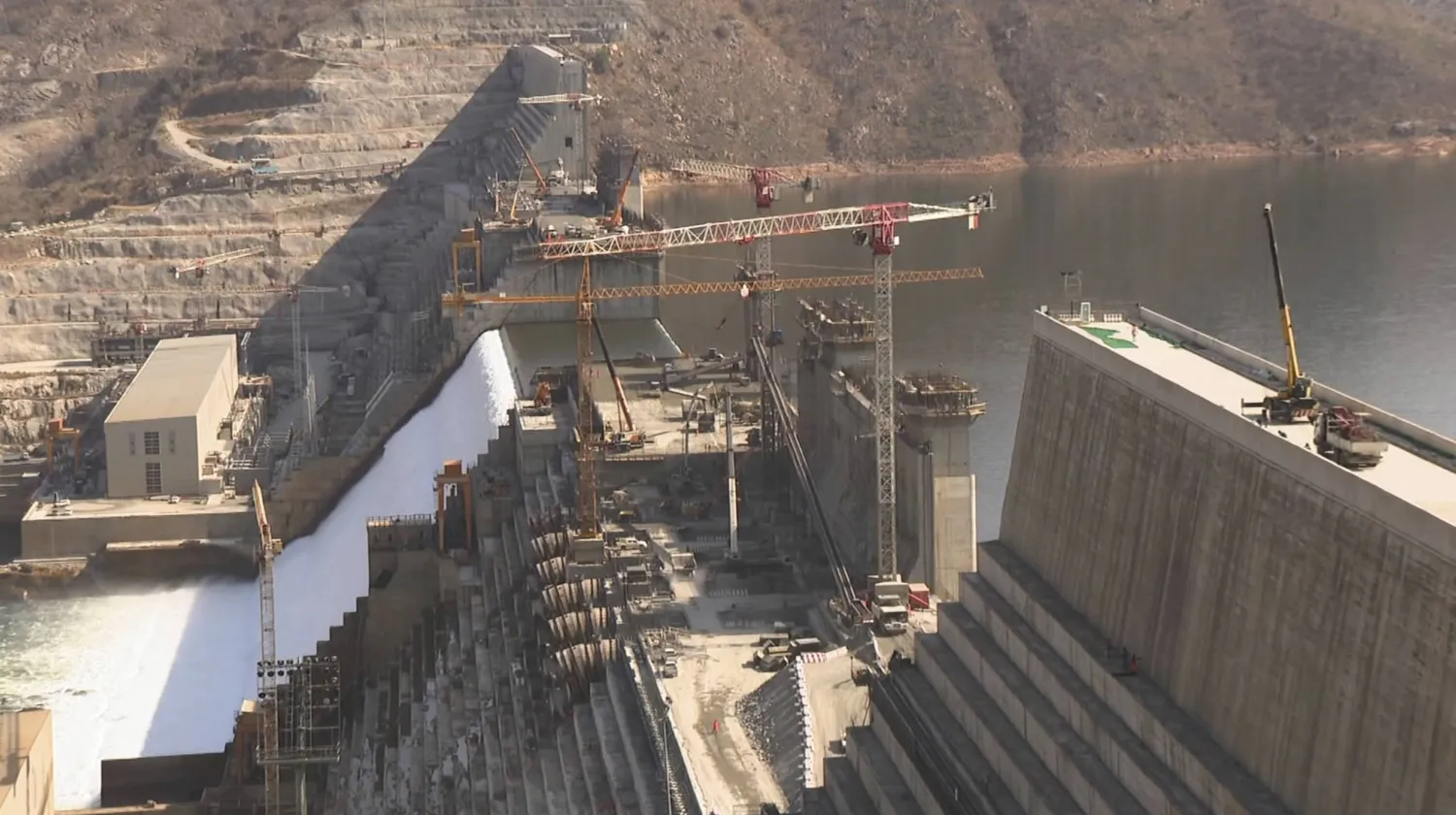
Egypt Says GERD Lacks Legally Binding Agreement

This grab taken from video shows Grand Ethiopian Renaissance Dam in the Benishangul-Gumuz region, Ethiopia, Feb. 20, 2022. (AP Photo)
TT

Egypt Says GERD Lacks Legally Binding Agreement

This grab taken from video shows Grand Ethiopian Renaissance Dam in the Benishangul-Gumuz region, Ethiopia, Feb. 20, 2022. (AP Photo)

Egypt said Friday that Ethiopia has consistently lacked the political will to reach a binding agreement on its now-complete dam, an issue that involves Nile River water rights and the interests of Egypt and Sudan.

Ethiopia’s prime minister said Thursday that the country’s power-generating dam, known as the Grand Ethiopian Renaissance Dam (GERD), on the Nile is now complete and that the government is “preparing for its official inauguration” in September.

Egypt has long opposed the construction of the dam, because it would reduce the country's share of Nile River waters, which it almost entirely relies on for agriculture and to serve its more than 100 million people.

The more than the $4 billion dam on the Blue Nile near the Sudan border began producing power in 2022. It’s expected to eventually produce more than 6,000 megawatts of electricity — double Ethiopia’s current output.

Ethiopia and Egypt have spent years trying to reach an agreement over the dam, which Ethiopia began building in 2011.

Both countries reached no deal despite negotiations over 13 years, and it remains unclear how much water Ethiopia will release downstream in case of a drought.

Egyptian officials, in a statement, called the completion of the dam “unlawful” and said that it violates international law, reflecting “an Ethiopian approach driven by an ideology that seeks to impose water hegemony” instead of equal partnership.

“Egypt firmly rejects Ethiopia’s continued policy of imposing a fait accompli through unilateral actions concerning the Nile River, which is an international shared watercourse,” Egypt’s Ministry of Water Resources and Irrigation said in a statement Friday.

Ethiopian Prime Minister Abiy Ahmed, in his address to lawmakers Thursday, said that his country “remains committed to ensuring that our growth does not come at the expense of our Egyptian and Sudanese brothers and sisters.”

“We believe in shared progress, shared energy, and shared water,” he said. “Prosperity for one should mean prosperity for all.”

However, the Egyptian water ministry said Friday that Ethiopian statements calling for continued negotiations “are merely superficial attempts to improve its image on the international stage.”

“Ethiopia’s positions, marked by evasion and retreat while pursuing unilateralism, are in clear contradiction with its declared willingness to negotiate,” the statement read.

However, Egypt is addressing its water needs by expanding agricultural wastewater treatment and improving irrigation systems, according to the ministry, while also bolstering cooperation with Nile Basin countries through backing development and water-related projects.


Gaza's Education System Could Take Seven Years to Recover

Palestinian students attend their first day of the new school year in a makeshift classroom inside a tent at a school in Khan Younis, southern Gaza Strip, on September 19 (Reuters)
TT

Gaza's Education System Could Take Seven Years to Recover

Palestinian students attend their first day of the new school year in a makeshift classroom inside a tent at a school in Khan Younis, southern Gaza Strip, on September 19 (Reuters)

Julia Dicum, Director of Education at the United Nations Relief and Works Agency for Palestine Refugees (UNRWA), has warned that Gaza's education system could take up to seven years to recover, according to research projections, following years of disruption and military operations that have deprived children of a normal school life.

"When we opened the school year in September this year, we met children who should have been in third grade but were entering a school building for the first time," Dicum told Asharq Al-Awsat in an exclusive interview.

Some children in the final years of primary school have received no more than one full academic year of in-person education because of disruptions caused by the COVID-19 pandemic and the past three years of war.

Their learning gaps have been compounded by "the psychological trauma of loss and living under constant fear of bombardment and uncertainty," Dicum said.

Years of Accumulated Learning Gaps

Research conducted by the University of Cambridge, the Centre for Lebanese Studies and UNRWA projected that cumulative disruptions could leave children as much as five years behind in their educational progress.

That estimate was made more than a year ago, and Dicum believes the extent of the learning loss is likely to be even greater now.

As educational disruptions continue, she warned: "The longer this disruption continues, the wider the learning gaps become, and the greater the risk that children will drop out of education permanently."

Maintaining children's connection to structured, recognized education is therefore among UNRWA's highest priorities, alongside establishing the resources, capacity and conditions needed for a transition to safe and sustainable formal schooling.

A Return Far From the Normal School Day

At the start of the 2026-2027 academic year, more than 200,000 children in Gaza remained without access to structured learning, according to estimates provided by Dicum.

Meanwhile, the Education Cluster reported in September 2026 that 495,680 learners were attending 687 learning spaces operated by humanitarian response partners.

The Education Cluster is a coordination mechanism for humanitarian organizations working in education in Gaza, helping organize responses to emergency learning needs.

However, access to a learning space does not mean a return to a normal school day.

Many children who have resumed learning receive far fewer instructional hours than usual, amid overcrowding, shortages of school supplies and damaged buildings or temporary facilities lacking adequate water, sanitation and hygiene services.

Displacement and the dangers posed by explosive remnants of war add to these challenges.

"Gaza is still far from a return to regular, full-time schooling for all girls and boys," Dicum said.

Restrictions on the entry of educational supplies and construction materials also hinder debris removal, repairs and reconstruction, preventing a return to normal educational activities.

Under these circumstances, instruction has been reduced to four core subjects: Arabic, English, mathematics and science, alongside expanded mental health and psychosocial support services.

Universities and technical and vocational education and training institutions have also suffered extensive damage and are offering modified forms of learning.

Unaccredited Programs Threaten Educational Progression

The Palestinian Authority's Ministry of Education and Higher Education has approved programs using educational materials aligned with the Palestinian curriculum, including UNRWA's distance-learning program.

However, many other initiatives provide informal, unaccredited learning experiences.

Dicum warned that these programs would not enable the current generation to access higher education on a broad scale.

"The challenge is no longer simply to return children to some form of learning, but to restore quality, sustainable and accredited education that allows children to learn, progress and acquire the skills that will give them a future built on recovery and hope," she said.

From Emergency Shelters to Learning Spaces

UNRWA's educational response began in October 2023 with mental health and psychosocial support services for children in its emergency shelters.

In early 2024, the agency developed flexible self-learning materials in core subjects, aligned with United Nations values and standards.

It then began establishing temporary learning spaces in the summer of that year.

By late 2024, UNRWA had launched an accredited distance-learning program, seeking wherever possible to reconnect students with the teachers and classmates they had been assigned to in August 2023.

By the end of September 2026, the agency was operating approximately 84 temporary learning spaces across Gaza, reaching nearly 100,000 learners.

It was also providing structured distance education to around 280,000 students in grades one through nine, according to figures supplied by Dicum.

For comparison, UNRWA educated approximately 300,000 students in grades one through nine during the 2022-2023 academic year.

That represented half of all students enrolled in grades one through 12 across Gaza, with the other half attending Palestinian Authority schools and a small number of private schools.

Current in-person instruction takes place in tents and some classrooms inside UNRWA schools.

Families have helped prepare these spaces for learning, sometimes moving their belongings aside each day so teachers can conduct lessons.

Dicum said cooperation between Gaza's communities and UNRWA has developed to the point where "the local community returned three school buildings to UNRWA for use in full-time education during 2026."

"This reflects the importance Gaza's communities attach to education and the contribution they are making to restoring it," she added.

Efforts to resume education have also extended to technical and vocational training for Palestine refugee youth aged 16 to 18.

The initial focus was on helping students who had enrolled at the beginning of the 2023-2024 academic year complete their training and obtain their qualifications through blended and online learning.

In September 2026, UNRWA enrolled students in two-year courses and began planning shorter vocational programs, particularly in skills that could contribute to recovery.

Dicum noted that this type of training is not usually part of an emergency response.

Making Up for Lost Learning Starts With Each Child's Level

Returning to learning offers an opportunity to prevent educational gaps from widening further.

However, making up for years of disrupted schooling requires identifying what each child can actually do and providing support appropriate to their current level.

"Educational recovery is possible, but there is no quick way to make up for years of disrupted education," Dicum said.

The process begins with reading, writing and numeracy, assessing individual learning levels, providing adapted educational materials and ensuring continued support from teachers.

Recovery also depends on the broader conditions in which children live and attempt to study, as well as their ability to receive sufficient and regular instructional time.

Dicum outlined the immediate priority: "What matters now is preventing further learning loss and giving children a reliable pathway back to sustainable, quality education."

Funding and the Continuity of Learning Opportunities

UNRWA currently faces a major challenge in the form of its financial crisis, which could hamper its ability to maintain and expand its educational response.

Sustaining existing programs and preparing for a return to formal schooling when conditions permit require consistent resources that allow for long-term planning.

Dicum concluded by emphasizing that "sustainable, regular and predictable funding" is essential to preserving learning opportunities and supporting the return to safe, adequately resourced formal education.


7 Killed in Armed Attack on Church in Jordan's Hammoud Village

Jordanian security personnel in the capital, Amman (Reuters/File Photo)
TT

7 Killed in Armed Attack on Church in Jordan's Hammoud Village

Jordanian security personnel in the capital, Amman (Reuters/File Photo)

Eyewitnesses told Asharq Al-Awsat that unidentified gunmen armed with automatic weapons attacked a church in Hammoud village, home to Christian communities in Karak Governorate, about 120 kilometers south of the Jordanian capital, Amman.

Jordanian state television reported that seven people were killed in the attack.

Eyewitnesses confirmed that several people were killed and dozens wounded. They said the attack was carried out by terrorists who fled the scene afterward, although the full circumstances remained unclear.

Jordan's Public Security Directorate said in a statement that an investigation had been launched.


Did Hamas Threaten Israel with Another October 7 Attack?

Palestinians fill plastic bottles with water at a tent camp in Deir al-Balah, Gaza Strip, Thursday, Oct. 22, 2026. (AP Photo/Abdel Kareem Hana)
TT

Did Hamas Threaten Israel with Another October 7 Attack?

Palestinians fill plastic bottles with water at a tent camp in Deir al-Balah, Gaza Strip, Thursday, Oct. 22, 2026. (AP Photo/Abdel Kareem Hana)

Israeli newspapers have repeatedly reported a similar account claiming that Hamas warned Israel it would carry out another attack on the scale of October 7, 2023, and that the warning was conveyed through UN Middle East envoy Ramiz Alakbarov during his visit to the Gaza Strip last week, when he allegedly met senior Hamas leaders.

The Israeli newspapers, particularly Yedioth Ahronoth, based their reports on information circulated by Israel's Coordinator of Government Activities in the Territories (COGAT), which reportedly sent an urgent warning to the country's political and military leadership.

The alleged threat was linked to Israeli military operations in Gaza, where the army continues to occupy more than half the territory a year after the ceasefire was announced.

Hamas spokesperson Hazem Qassem denied in a brief statement distributed to journalists in Gaza that the movement had threatened to carry out another attack similar to October 7.

He reaffirmed Hamas's commitment to the ceasefire agreement and called on mediators to intervene to stop Israeli violations against Palestinians and ensure the agreement's implementation.

Qassem also warned against accepting Israeli allegations and exploiting them for electoral purposes.

He did not address reports that the UN official had met Hamas leaders.

Asharq Al-Awsat sought further comment from the Hamas spokesperson, but he did not respond to the correspondent's questions.

Late Thursday evening, Hamas issued an official statement denying that it had threatened any attacks, without confirming or denying whether a meeting with the UN official had taken place.

The published itinerary for Alakbarov's two-day visit to the Gaza Strip on October 11 and 12 made no reference to meetings with Hamas officials.

According to the schedule posted on the United Nations website, his visit focused on assessing humanitarian conditions at several locations, including displacement centers, affected families, winter preparedness efforts and female-headed households.

The itinerary also listed a meeting with humanitarian partners at a UNRWA facility in Gaza City to discuss humanitarian responses and gaps in assistance.

An official from Alakbarov's office told Asharq Al-Awsat that the UN envoy had not met any Hamas officials during his latest visit.

However, Asharq Al-Awsat learned from a local UN employee that Alakbarov visited Al-Shifa Medical Complex on Sunday, October 11, and met hospital and health officials to assess conditions at medical facilities.

That visit was not mentioned in the published itinerary, and Alakbarov's office neither confirmed nor denied it.

The local official also said the UN delegation came under Israeli shellfire while visiting the Zarqa area northeast of Gaza City, near the Yellow Line.

No injuries were reported, and the delegation quickly left the area.

Asharq Al-Awsat attempted to contact Mohammed Abu Salmiya, director of Al-Shifa Medical Complex, but he did not answer the calls. Officials from Gaza's Government Media Office were also unreachable.

UN officials routinely visit hospitals, displacement centers and other facilities to assess humanitarian conditions. Many have made such visits without meeting Hamas officials, particularly amid the precarious security situation and continuing pursuit and assassination of Hamas members in Gaza.

Observers believe the Israeli account is primarily motivated by electoral considerations, particularly amid repeated statements by Israeli officials, including Prime Minister Benjamin Netanyahu and Defense Minister Israel Katz, about alleged Hamas plans to carry out attacks similar to October 7.

Both officials have emphasized that Israel would respond forcefully to any such attack, in statements seen as attempts to influence the elections. Similar warnings have also been made concerning Iran and Hezbollah.

However, Israeli security sources told Haaretz that, contrary to claims made by Netanyahu and Katz in recent days, security agencies had not detected intensive efforts by any party to launch attacks against Israel with the aim of influencing the elections.

Israeli military Chief of Staff Eyal Zamir, meanwhile, limited his remarks to affirming that the armed forces were prepared to deal with any attempts at external interference in the elections.

He said the military would undertake defensive and offensive operations should any such scenario materialize.