

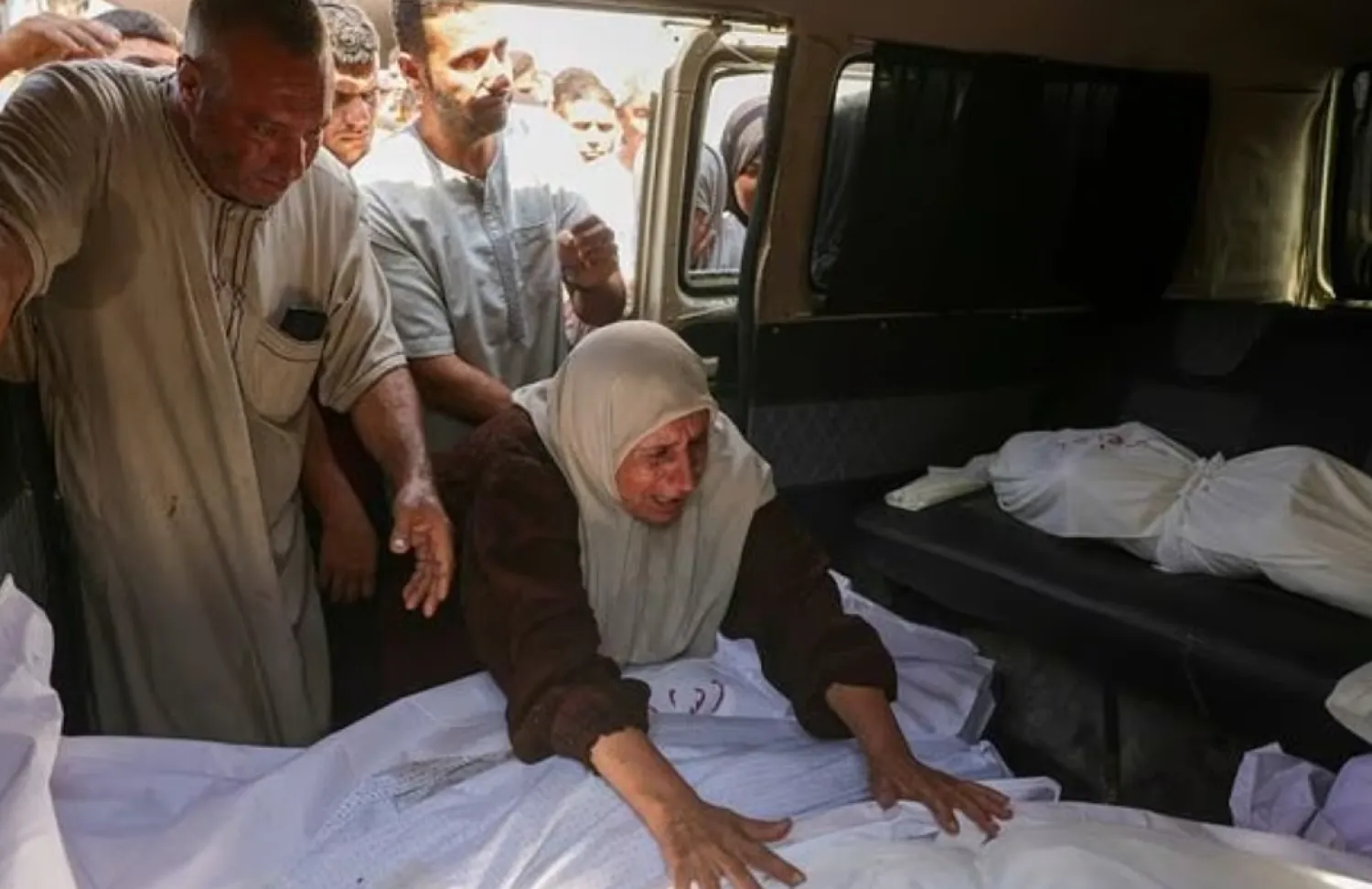

Gaza Civil Defense Says Israeli Forces Kill 18

A Palestinian mourns a relative killed in a strike on a school-turned-shelter in northern Gaza - AFP
TT

Gaza Civil Defense Says Israeli Forces Kill 18

A Palestinian mourns a relative killed in a strike on a school-turned-shelter in northern Gaza - AFP

Gaza's civil defense agency said Israeli forces killed 18 people on Friday, including 10 who were waiting for aid in the south of the war-ravaged territory.

The fresh deaths came as the United Nations said nearly 800 people had been killed trying to access food in Gaza since late May, when Israel began easing a more than two-month total blockade on supplies.

UN rights office spokeswoman Ravina Shamdasani said most of the deaths occurred near facilities operated by the US- and Israel-backed Gaza Humanitarian Foundation, AFP reported.

"We've recorded now 798 killings, including 615 in the vicinity of the GHF sites," from the time the group's operations began in late May until July 7, Shamdasani said Friday.

An officially private effort, GHF operations have been marred by chaotic scenes and frequent reports of Israeli forces firing on people waiting to collect rations.

The UN and major aid groups have refused to cooperate with the foundation over concerns it was designed to cater to Israeli military objectives and violates basic humanitarian principles.

Responding to the UN's figures, Israel's military said it had worked to minimize "possible friction between the population and the army forces as much as possible".

"Following incidents in which harm to civilians who arrived at distribution facilities was reported, thorough examinations were conducted... and instructions were issued to forces in the field following lessons learned," it added.

Gaza civil defense official Mohammed al-Mughayyir said that 10 people were shot by Israeli forces on Friday while waiting for supplies in the Al-Shakoush area northwest of Rafah, where there are regular reports of deadly fire on aid seekers.

- 'Extremely difficult' -

The civil defense reported six more people killed in four separate Israeli airstrikes in the area of Khan Yunis, in the south of the territory.

Two drone strikes around Gaza City in the north killed two more people, civil defense spokesman Mahmud Bassal told AFP.

There was no immediate comment on the latest strikes from the Israeli military, which has recently expanded its operations across Gaza.

Media restrictions in Gaza and difficulties in accessing many areas mean AFP is unable to independently verify the tolls and details provided by the civil defense agency and other parties.

A Palestinian speaking to AFP from southern Gaza on condition of anonymity reported ongoing attacks and widespread devastation, with Israeli tanks seen near Khan Yunis.

"The situation remains extremely difficult in the area -- intense gunfire, intermittent airstrikes, artillery shelling, and ongoing bulldozing and destruction of displacement camps and agricultural land to the south, west and north of Al-Maslakh," an area to Khan Yunis's south, said the witness.

Israel's military said in a statement that its soldiers were operating in the area, dismantling "terrorist infrastructure sites, both above and below ground", and seizing "weapons and military equipment".

The civil defense also reported on Friday five people killed in an Israeli strike the previous night on a school sheltering displaced Palestinians in Jabalia al-Nazla, in northern Gaza.

Nearly all of Gaza's population has been displaced at least once during the more than 21-month war, which has created dire humanitarian conditions for the more than two million people living there.

Many have sought shelter in school buildings, but these have repeatedly come under Israeli attack, with the military often saying they were targeting Hamas militants hiding among civilians.



Report: Syrian President Has No Intention of Intervening in Lebanon

 05 April 2026, Syria, Damascus: Syrian President Ahmad al-Sharaa attends a meeting with Ukrainian President Volodymyr Zelensky. (Ukrainian Presidency/dpa)
05 April 2026, Syria, Damascus: Syrian President Ahmad al-Sharaa attends a meeting with Ukrainian President Volodymyr Zelensky. (Ukrainian Presidency/dpa)
TT

Report: Syrian President Has No Intention of Intervening in Lebanon

 05 April 2026, Syria, Damascus: Syrian President Ahmad al-Sharaa attends a meeting with Ukrainian President Volodymyr Zelensky. (Ukrainian Presidency/dpa)
05 April 2026, Syria, Damascus: Syrian President Ahmad al-Sharaa attends a meeting with Ukrainian President Volodymyr Zelensky. (Ukrainian Presidency/dpa)

Syrian President Ahmed al-Sharaa told visitors that Damascus has no intention of intervening in Lebanon, two of them told AFP, days after US President Donald Trump suggested it might be willing to do so.

One of those present, requesting anonymity to speak freely, said that Sharaa told dozens of notables and dignitaries from the Damascus province that "what is being circulated about Syria entering Lebanon is nothing more than rumors".

The Syrian presidency announced on Thursday that Sharaa received the delegation at the presidential palace in a meeting that addressed service and development issues of concern to the province's residents.

The statement made no mention of Sharaa's remarks on Lebanon.

It came with Israel and Iran-backed Hezbollah still trading blows in the country, despite a conditional ceasefire announced by Lebanese and Israeli envoys earlier this month in Washington.

Hezbollah rejected the agreement, which makes no mention of Israel having to cease attacks or withdraw its troops from Lebanon.

Trump told US broadcaster NBC last week that Sharaa was willing to help against Hezbollah, which has been fighting a war with Israel since March 2 as part of the broader Middle East conflict.

"I'd like to see a more surgical attack on Hezbollah. I think it should be more surgical. And we can help them with that, or we can recommend Syria," he said.

"Syria's doing a very good job of cleaning up their act. They have a very good leader. They have a leader that's really done a good job in a short period of time. And he would love to help."

In a televised interview on Thursday, Syrian interior ministry spokesperson Noureddine al-Baba aid that Damascus stands with Lebanese President Joseph Aoun in "preserving Lebanon's security and the sovereignty of the Lebanese state".

"Coordination with our brother Lebanon is the cornerstone of any possible role that Syria can play in resolving Lebanese issues," he added.

Responding to Trump's words, Baba said that "the Syrian and Lebanese sides are best positioned to interpret these statements and agree on a formula that serves both countries within the framework of the common Arab vision".

Syria, which under the Assad family was a close ally of Hezbollah, dominated Lebanon for decades following a military intervention in the latter's 1975-1990 civil war, withdrawing only in 2005, making any new military involvement a fraught proposition.

Hezbollah fought alongside the Syrian government in that country's own civil war, making the new authorities in Damascus, which took over after the fall of Bashar al-Assad in 2024, deeply hostile to it.


Vatican Envoy’s Aid Convoy Stopped by Israeli Forces in South Lebanon

 Smoke billows from southern Lebanon following an Israeli strike, as seen from Marjeyoun, Lebanon, June 12, 2026. (Reuters)
Smoke billows from southern Lebanon following an Israeli strike, as seen from Marjeyoun, Lebanon, June 12, 2026. (Reuters)
TT

Vatican Envoy’s Aid Convoy Stopped by Israeli Forces in South Lebanon

 Smoke billows from southern Lebanon following an Israeli strike, as seen from Marjeyoun, Lebanon, June 12, 2026. (Reuters)
Smoke billows from southern Lebanon following an Israeli strike, as seen from Marjeyoun, Lebanon, June 12, 2026. (Reuters)

An aid convoy organized by the Vatican envoy to Lebanon that was headed for Christian villages in the country's south was stopped by the Israeli military and forced to change course, a convoy member told AFP on Friday.

A number of Christian-majority villages near the border have been caught up in the fighting between Israel and Hezbollah but many residents have refused to leave.

"While approaching the village of Debl on Thursday, we got face-to-face with several Israeli tanks" who stopped the convoy, a member of the convoy told AFP on condition of anonymity.

"There were several tank and machine gun shots towards rear positions that we could not identify... which caused panic," he added.

The person said it was not clear "whether they wanted to intimidate us or they were targeting Hezbollah positions".

Contacted by AFP, the Israeli military and the Vatican did not immediately respond to requests for comment.

The convoy, led by the Apostolic Nuncio Paolo Borgia, included 25 trucks and several cars transporting residents wanting to return home.

The route was coordinated with UN peacekeepers through an international committee created to monitor a ceasefire that sought to end the 2024 Israel-Hezbollah conflict.

After being halted for over an hour, the convoy took another longer route to reach their destination after 12 hours, the member said.

Vincent Gelot, head of Catholic organization Oeuvre d'Orient which regularly takes part in aid convoys, told AFP that the people who chose to remain in their villages "are completely isolated from the rest of the country".

"They are deprived of resources because most of them are farmers. They do not have access to their fields."

The villages are surrounded by areas and localities Israel has warned to evacuate, with Gelot saying they are "threatened to disappear".

On Tuesday, the association of Christian border villages in southern Lebanon urged authorities to "immediately open safe humanitarian and medical corridors to ensure the access of citizens, aid and medical and relief teams to the affected and isolated villages".

On June 2, an Israeli drone strike killed a student alongside her father and brother as she was returning to her border village after sitting for university exams in Beirut.


Video of Visually Impaired Palestinian Boy Draws Global Attention

Ayoub holding his damaged glasses on 2 June. Photograph: Anadolu/Getty Images
TT

Video of Visually Impaired Palestinian Boy Draws Global Attention

Ayoub holding his damaged glasses on 2 June. Photograph: Anadolu/Getty Images

A video of a seven-year-old Palestinian boy in Gaza who suffers from a severe visual impairment crying over his shattered glasses has drawn widespread attention across social and international media, Britain’s the Guardian reported on Thursday.

The footage of Ayoub Junaid has shone a light on the plight of the many visually impaired children in Gaza who, because of Israel’s blockade and the devastation caused by the war, have been unable to access eye examinations, corrective lenses or specialist ophthalmic surgery.

After the clip was viewed by tens of millions of people, Ayoub received a new pair of glasses. This good news, however, does not solve the underlying problem, as he urgently needs surgery.

Ayoub’s mother, Eman Junaid, 30, displaced in the Gaza City port area, tells the Guardian her son’s problem began when he was two.

“Ayoub suffers from very severe nearsightedness after having a fever illness,” she says. A doctor told Junaid that Ayoub’s vision would gradually improve as he got older, but the opposite happened – the prescription he required increased and the lenses he now needs are not available in Gaza.

“We were preparing to travel for treatment, but the war started and everything stopped,” she adds.

Ayoub rarely leaves his tent, Junaid says. When he wants to play with his siblings or other children, he clings tightly to his glasses and moves with extreme caution. He does not run, jump or move freely. The doctors warned the family not to let him engage in strenuous activities because any fall or blow could cause further damage to his retinas.

Ayoub used to ask his mother why he was different from other children. He often asks her: “Why don’t the other children wear glasses like me? Why can’t I move like them? Why can’t I go to school like them?”

“At the end of April, while walking with a family member along a road strewn with rubble, he fell and struck his face on the ground, breaking the glasses,” his mother says. “He burst into tears, rolled on the ground and desperately tried to piece them back together. For Ayoub, those glasses were everything. Even with them, he cannot see clearly and often has to hold objects just inches from his face. But without them, he can barely move around at all.”

His family says the time Ayoub spent without glasses was particularly distressing. For three or four days, he rarely left a corner of the tent and was unable to move around without assistance. When he tried to walk on his own, he would crouch close to the ground, bringing his eyes near the floor in an effort to make out his surroundings.

Relatives said they repeatedly tried to repair his glasses, but the damaged lenses could not be fixed.

“The video I shared was filmed after we reached the tent,” his mother says. “In the street, he was crying even more and saying he wanted to fix his glasses because he could not see without them. After the video spread, donors helped us and we were able to get a new pair of glasses, but it is still not the correct prescription he needs.”

According to his family, Ayoub’s emotional state has shown signs of improvement. In recent days, he has appeared more willing to interact with visitors and those offering support. While the change remains modest, his family say it has brought them a sense of relief and hope.

Health officials in Gaza say the war has devastated eye care services, leaving thousands of visually impaired patients without treatment amid severe shortages of medical equipment and surgical supplies.

Hospitals are lacking key items including surgical microscopes and phaco machines. Officials say more than 2,800 patients are currently waiting for cataract surgery alone, while the total backlog for eye procedures, including corneal transplants, glaucoma operations and reconstructive surgery, exceeds 4,000 cases.

In addition to this, Israeli bombardment around medical facilities has forced the temporary shutdown of Gaza City’s Government Eye Hospital, the only public eye care center in the territory.

“The current situation clearly shows a shortage in all medical consumables and surgical tools,” says Dr. Hussam Dawoud, a senior consultant in ophthalmology and eye surgery and the director of the hospital. “Currently, we are providing services at around 60% of what we used to offer before the war. The main reason is that Israel is preventing the entry of medical equipment and surgical instruments.”

Doctors have also reported a sharp rise in severe corneal infections, which they attribute to overcrowded living conditions, poor sanitation and limited access to medication, with some patients suffering permanent vision loss.