


Syria Announces Ceasefire after Latest Outbreak of Deadly Sectarian Violence

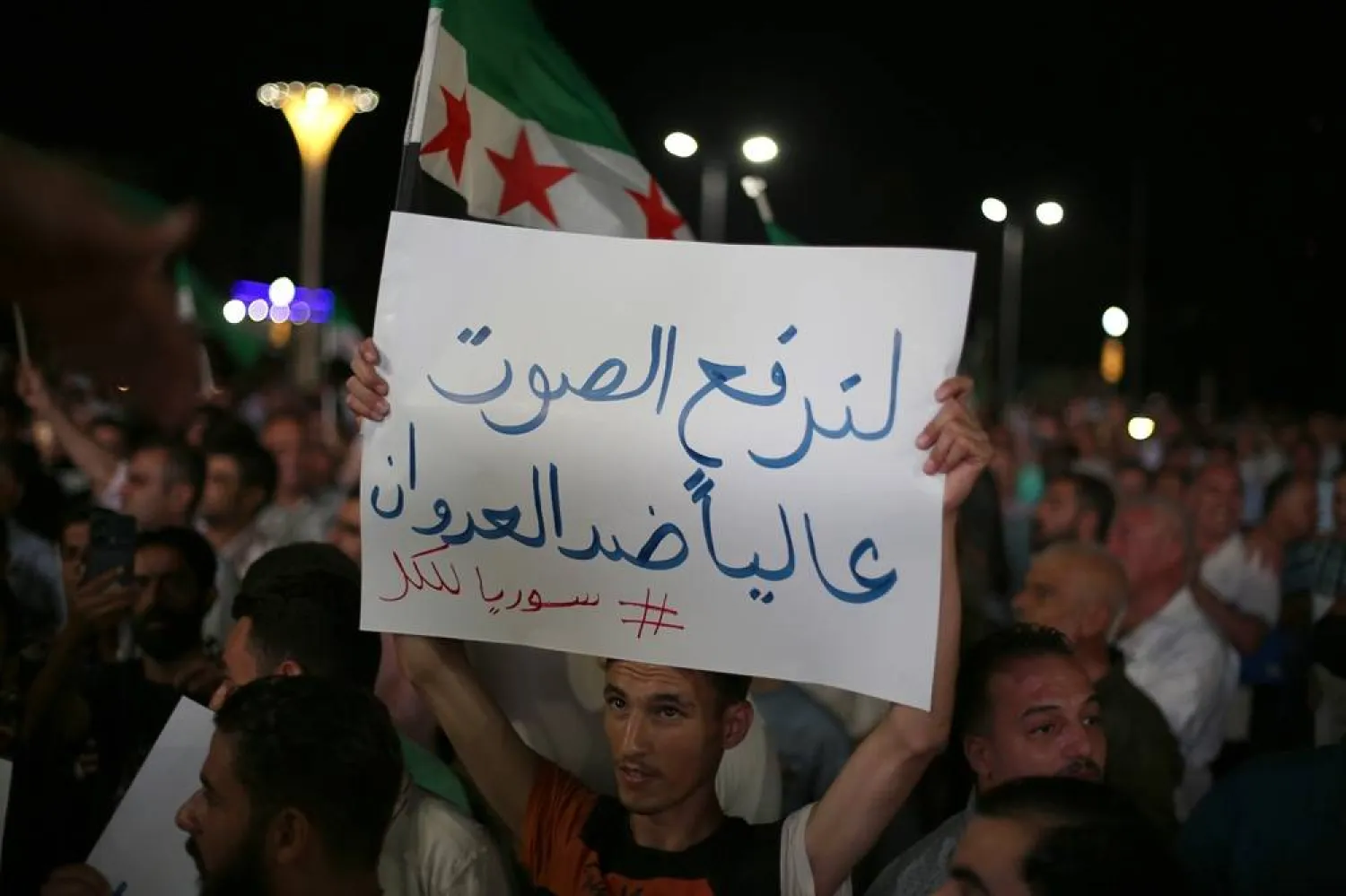
A man holds a placard reading in Arabic "let us raise our voices against the aggression" during a protest against Israeli airstrikes in southern Syria, in Aleppo, Syria, 15 July 2025. (EPA)
TT

Syria Announces Ceasefire after Latest Outbreak of Deadly Sectarian Violence

A man holds a placard reading in Arabic "let us raise our voices against the aggression" during a protest against Israeli airstrikes in southern Syria, in Aleppo, Syria, 15 July 2025. (EPA)

Syria 's defense minister announced a ceasefire shortly after government forces entered a key city in southern Sweida province on Tuesday, a day after sectarian clashes killed dozens there. Neighboring Israel again launched strikes on Syrian military forces, saying it was protecting the Druze minority.

The latest escalation under Syria’s new leaders began with tit-for-tat kidnappings and attacks between local Bedouin tribes and Druze armed factions in the southern province, a center of the Druze community.

Syrian government forces, sent to restore order on Monday, also clashed with Druze armed groups.

On Tuesday, Defense Minister Murhaf Abu Qasra said an agreement was struck with the city’s "notables and dignitaries" and that government forces would "respond only to the sources of fire and deal with any targeting by outlaw groups."

However, scattered clashes continued after his announcement, as did allegations that security forces had committed violations against civilians.

Syria’s Interior Ministry said Monday that more than 30 people had been killed, but has not updated the figures since. The Syrian Observatory for Human Rights, a UK-based war monitor, said Tuesday that 166 people had been killed since Sunday, including five women and two children.

Syrian interim President Ahmed al-Sharaa said in a statement that he had tasked authorities with "taking immediate legal action against anyone proven to have committed a transgression or abuse, regardless of their rank or position."

Associated Press journalists in Sweida province saw forces at a government checkpoint searching cars and confiscating suspected stolen goods from both civilians and soldiers.

Israeli airstrikes targeted government forces' convoys heading into the provincial capital of Sweida and in other areas of southern Syria.

Israeli Prime Minister Benjamin Netanyahu and Defense Minister Israel Katz said the strikes sought to "prevent the Syrian regime from harming" the Druze religious minority "and to ensure disarmament in the area adjacent to our borders with Syria." In Israel, the Druze are seen as a loyal minority and often serve in the armed forces.

Meanwhile, Israeli Cabinet member and Minister of Diaspora Affairs Amichai Chikli called on X for Sharaa to be "eliminated without delay."

A soldier's story Manhal Yasser Al-Gor, of the Interior Ministry forces, was being treated for shrapnel wounds at a local hospital after an Israeli strike hit his convoy.

"We were entering Sweida to secure the civilians and prevent looting. I was on an armored personnel carrier when the Israeli drone hit us," he said, adding that there were "many casualties."

The Syrian Foreign Ministry said Israeli strikes had killed several innocent civilians" as well as soldiers, and called them "a reprehensible example of ongoing aggression and external interference" in Syria's internal matters.

It said the Syrian state is committed to protecting the Druze, "who form an integral part of the national identity and united Syrian social fabric."

Israel has taken an aggressive stance toward Syria’s new leaders since Sharaa's opposition fighters ousted former President Bashar al-Assad in December, saying it doesn't want militants near its borders.

Israeli forces have seized a UN-patrolled buffer zone on Syrian territory along the border with the Golan Heights and launched hundreds of airstrikes on military sites in Syria.

Earlier Tuesday, religious leaders of the Druze community in Syria called for armed factions that have been clashing with government forces to surrender their weapons and cooperate with authorities. One of the main Druze spiritual leaders later released a video statement retracting the call.

Sheikh Hikmat Al-Hijri, who has been opposed to the government in Damascus, said in the video that the initial Druze leaders' statement had been issued after an agreement with the authorities in Damascus but that "they broke the promise and continued the indiscriminate shelling of unarmed civilians."

"We are being subjected to a total war of annihilation," he claimed, without offering evidence.

Some videos on social media showed armed fighters with Druze captives, beating them and, in some cases, forcibly shaving men's moustaches.

The violence drew international concern. The US envoy to Syria, Tom Barrack, called the violence "worrisome on all sides" in a post on.

"We are attempting to come to a peaceful, inclusive outcome for Druze, Bedouin tribes, the Syrian government and Israeli forces," he said.



Gaza Administration Committee Meets in Cairo Amid Cautious Optimism

Palestinians salvage belongings from a home after an Israeli military attack west of Deir al Balah in central Gaza (AFP)
TT

Gaza Administration Committee Meets in Cairo Amid Cautious Optimism

Palestinians salvage belongings from a home after an Israeli military attack west of Deir al Balah in central Gaza (AFP)

The Gaza ceasefire agreement entered a new phase on Friday with the first meeting in Cairo of a technocrat committee tasked with administering the enclave, following its formation by Palestinian consensus, a welcome from Washington, and the absence of an official Israeli objection after earlier reservations.

The inaugural meeting came hours after Israel killed eight Palestinians, prompting Hamas to accuse it of “sabotaging the agreement,” leaving analysts expressing cautious optimism about the ceasefire’s trajectory in light of these developments and the continued Israeli strikes.

They stressed the need for a decisive US position to complete the requirements of the second phase, which began with the formation of the Gaza administration committee and faces major obstacles, including the entry of aid, an Israeli withdrawal, and the disarmament of Hamas.

Egyptian satellite channel Al-Qahera News reported on Friday that the first meeting of the Palestinian National Committee for the Administration of Gaza had begun in the Egyptian capital, with Palestinian Ali Shaath in the chair.

In his first media appearance, Shaath said the committee had officially started its work from Cairo and consists of 15 professional Palestinian national figures. He said the committee had received financial support and had been allocated a two-year budget, which is the duration of its mandate.

He called for the establishment of a World Bank fund for the reconstruction and relief of Gaza, noting that influential countries in the region had promised substantial, tangible financial support.

Shaath said the relief plan is based on the Egyptian plan approved by the Arab League in March 2025, which spans five years and is estimated to cost about $53 billion, and has been welcomed by the European Union.

He added that the first step adopted by the Gaza administration committee was to supply 200,000 prefabricated housing units to the territory.

Hamas said on Friday it was ready to hand over control of Gaza to a technocratic administration.

In a statement, it warned that “massacres” committed by the Israeli army in Gaza, including the killing of nine Palestinians, among them a woman and a child, in air strikes and gunfire targeting displaced people’s tents, underscored Israel’s continued policy of undermining the ceasefire agreement and obstructing declared efforts to entrench calm in the enclave.

Hamas described the attacks as a “dangerous escalation” that coincided with mediators announcing the formation of a technocratic government and the entry into the second phase of the agreement, as stated on Wednesday, as well as US President Donald Trump’s announcement on Thursday of the establishment of a Board of Peace.

It called on mediators and guarantor countries to shoulder their responsibilities by pressuring Israel to halt its violations and comply with what was agreed.

On Thursday, Trump announced the creation of a Gaza-focused Board of Peace, saying the parties had officially entered the second phase of the Gaza ceasefire agreement.

The Gaza government media office said in a statement the same day that Israel had committed 1,244 violations of the ceasefire during its first phase, resulting in the killing, injury, or arrest of 1,760 Palestinians since the deal took effect.

Rakha Ahmed Hassan, a member of the Egyptian Council for Foreign Affairs and a former assistant foreign minister, said the launch of the committee’s work was extremely important and effectively removed one of Israel’s pretexts regarding the presence of Hamas, particularly since the committee is technocratic and enjoys consensus.

He said that while this undermines those pretexts and marks the end of Hamas’s political authority, developments must be handled cautiously and completed with the deployment of stabilization forces and a Palestinian police presence, provided no new Israeli obstacles emerge.

Palestinian political analyst Ayman al-Raqab also voiced cautious optimism, telling Asharq Al-Awsat that the committee faces major challenges, notably administering a territory that has been completely devastated, as well as Israeli complications related to the weapons of the resistance and opposition to full reconstruction and withdrawal.

Mediator efforts are continuing. Egyptian Foreign Minister Badr Abdelatty received a phone call from US Middle East envoy Steve Witkoff regarding next steps and procedures following the transition to the second phase of Trump’s plan.

According to an Egyptian foreign ministry statement on Friday, the call emphasized the need to move forward with implementing the second phase’s obligations, including the start of work by the Palestinian technocrats committee following its formation, the deployment of an international stabilization force to monitor the ceasefire, the achievement of an Israeli withdrawal from the Strip and the launch of early recovery and reconstruction.

Hassan said Egypt’s role remains crucial and focused on completing the agreement without Israeli obstruction, particularly as the Rafah crossing was not opened during the first phase, and delays persist in deploying stabilization forces to oversee border crossings.

He stressed that Washington would seek to complete the agreement to preserve its credibility.

Al-Raqab said that any progress in the second phase and avoiding a repeat of the first phase’s stagnation hinges on US support for fully implementing the deal, particularly securing an Israeli withdrawal rather than just addressing disarmament.


Israeli Soldiers Kill Palestinian Teen in West Bank

Israeli Soldiers Kill Palestinian Teen in West Bank
TT

Israeli Soldiers Kill Palestinian Teen in West Bank

Israeli Soldiers Kill Palestinian Teen in West Bank

Israeli soldiers shot dead a Palestinian hurling a rock at them in the occupied West Bank, the military said on Friday, and the Palestinian health ministry said the person killed was a 14-year-old boy.

There was no further comment from Palestinian officials about the fatal incident in the village of ⁠Al-Mughayyir. Official Palestinian news agency WAFA said the teen was killed during an Israeli military raid that led to confrontations, Reuters reported.

The Israeli military said its forces were called to the area after ⁠receiving reports that Palestinians were throwing stones at Israelis and blocking a road with burning tires.

The soldiers fired warning shots in an attempt to repel a person who was running at them with a rock, the military said, and then shot and killed him to eliminate the ⁠danger.

Violence has surged over the past year in the West Bank. Attacks by Israeli settlers on Palestinians have risen sharply, while the military has tightened movement restrictions and carried out sweeping raids in several cities.

Palestinians have also carried out attacks on Israeli soldiers and civilians, some of them deadly.


Israeli Strikes in South Lebanon Kill Two

Smoke rises from the site of an Israeli airstrike that targeted the village of Sohmor, in southern Lebanon on January 15, 2026. (Photo by Rabih DAHER / AFP)
TT

Israeli Strikes in South Lebanon Kill Two

Smoke rises from the site of an Israeli airstrike that targeted the village of Sohmor, in southern Lebanon on January 15, 2026. (Photo by Rabih DAHER / AFP)

An Israeli strike on south Lebanon killed one person on Friday, the health ministry in Beirut said a day after raids that Israel said had targeted Hezbollah.

Israel has kept up regular strikes in Lebanon despite a November 2024 ceasefire that sought to end more than a year of hostilities with Hezbollah, usually saying it is targeting members of the group or its infrastructure.

In a statement, the health ministry said an "Israeli enemy strike" on a vehicle in Mansuri in south Lebanon killed one person.

According to AFP, it also said that a strike on Mayfadun in south Lebanon the previous night killed one person.

Israel said Thursday's attack killed a Hezbollah member it alleged "took part in attempts to reestablish Hezbollah's infrastructure in the Zawtar al-Sharqiyah area.”

The attacks come a week after Lebanon's military said it had completed disarming Hezbollah south of the Litani River, the first phase of a nationwide plan, although Israel has called those efforts insufficient.

On Thursday, Israel carried out several strikes against eastern Lebanon's Bekaa region, north of the Litani, after issuing warnings to evacuate.

United Nations peacekeepers, deployed in the south to separate Lebanon from Israel, said on Friday that an Israeli drone "dropped a grenade" on its troops.

On Monday, the peacekeeping force said an Israeli tank fired near its troops, and warned that such incidents were becoming "disturbingly common".