
Pakistan's Quiet Solar Rush Puts Pressure on National Grid

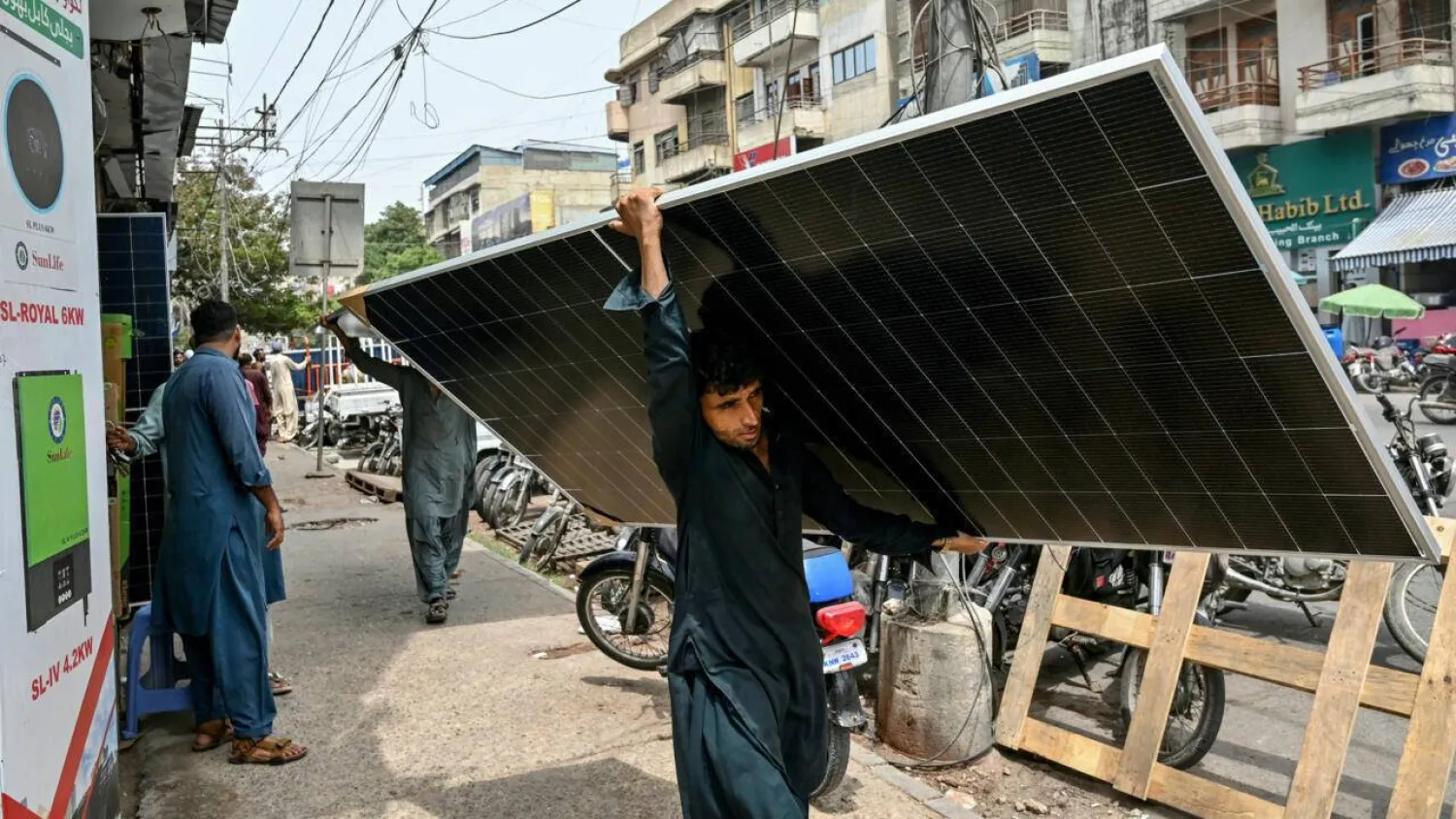
Pakistanis are increasingly ditching the national grid in favor of solar power, prompting a boom in rooftop panels. Asif HASSAN / AFP
TT

Pakistan's Quiet Solar Rush Puts Pressure on National Grid

Pakistanis are increasingly ditching the national grid in favor of solar power, prompting a boom in rooftop panels. Asif HASSAN / AFP

Pakistanis are increasingly ditching the national grid in favor of solar power, prompting a boom in rooftop panels and spooking a government weighed down by billions of dollars of power sector debt.

The quiet energy revolution has spread from wealthy neighborhoods to middle- and lower-income households as customers look to escape soaring electricity bills and prolonged power cuts, said AFP.

Down a cramped alley in Pakistan's megacity of Karachi, residents fighting the sweltering summer heat gather in Fareeda Saleem's modest home for something they never experienced before -- uninterrupted power.

"Solar makes life easier, but it's a hard choice for people like us," she says of the installation cost.

Saleem was cut from the grid last year for refusing to pay her bills in protest over enduring 18-hour power cuts.

A widow and mother of two disabled children, she sold her jewelry -- a prized possession for women in Pakistan -- and borrowed money from relatives to buy two solar panels, a solar inverter and battery to store energy, for 180,000 rupees ($630).

As temperatures pass 40 degrees Celsius (104 degrees Fahrenheit), children duck under Saleem's door and gather around the breeze of her fan.

Mounted on poles above homes, solar panels have become a common sight across the country of 240 million people, with the installation cost typically recovered within two to five years.

Making up less than two percent of the energy mix in 2020, solar power reached 10.3 percent in 2024, according to the global energy think tank Ember.

But in a remarkable acceleration, it more than doubled to 24 percent in the first five months of 2025, becoming the largest source of energy production for the first time.

It has edged past gas, coal and nuclear electricity sources, as well as hydropower which has seen hundreds of millions of dollars of investment over the past decades.

As a result, Pakistan has unexpectedly surged towards its target of renewable energy, making up 60 percent of its energy mix by 2030.

Dave Jones, chief analyst at Ember, told AFP that Pakistan was "a leader in rooftop solar".

'The great Solar rush'

Soaring fuel costs globally, coupled with demands from the International Monetary Fund to slash government subsidies, led successive administrations to repeatedly hike electricity costs.

Prices have fluctuated since 2022 but peaked at a 155-percent increase and power bills sometimes outweigh the cost of rent.

"The great solar rush is not the result of any government's policy push," Muhammad Basit Ghauri, an energy transition expert at Renewables First, told AFP.

"Residents have taken the decision out of clear frustration over our classical power system, which is essentially based on a lot of inefficiencies."

Pakistan sources most of its solar equipment from neighboring China, where prices have dropped sharply, largely driven by overproduction and tech advancements.

But the fall in national grid consumers has crept up on an unprepared government burdened by $8 billion of power sector debt, analysts say.

It is also tied into lengthy contracts with independent power producers, including some owned by China, for which it pays a fixed amount regardless of actual demand.

A government report in March said the solar power increase has created a "disproportionate financial burden onto grid consumers, contributing to higher electricity tariffs and undermining the sustainability of the energy sector".

Electricity sales dropped 2.8 percent year-on-year in June, marking a second consecutive year of decline.

Last month, the government imposed a new 10-percent tax on all imported solar, while the energy ministry has proposed slashing the rate at which it buys excess solar energy from consumers.

'Disconnected from the public

"The household solar boom was a response to a crisis, not the cause of it," said analyst Jones, warning of "substantial problems for the grid" including a surge during evenings when solar users who cannot store energy return to traditional power.

The national grid is losing paying customers like businessman Arsalan Arif.

A third of his income was spent on electricity bills at his Karachi home until he bought a 10-kilowatt solar panel for around 1.4 million rupees (around $4,900).

"Before, I didn't follow a timetable. I was always disrupted by the power outages," he told AFP.

Now he has "freedom and certainty" to continue his catering business.

In the eastern city of Sialkot, safety wear manufacturer Hammad Noor switched to solar power in 2023, calling it his "best business decision", breaking even in 18 months and now saving 1 million rupees every month.

The cost of converting Noor's second factory has now risen by nearly 1.5 million rupees under the new government tax.

"The tax imposed is unfair and gives an advantage to big businesses over smaller ones," he said.

"Policymakers seem completely disconnected from the public and business community."



British Baker’s Criticism of Mexican ‘Ugly’ Bread Triggers Social Media Outrage

Bolillos, a traditional Mexican bread, sit for sale at a street stand in Mexico City, Thursday, Dec. 18, 2025. (AP Photo/Marco Ugarte)
TT

British Baker’s Criticism of Mexican ‘Ugly’ Bread Triggers Social Media Outrage

Bolillos, a traditional Mexican bread, sit for sale at a street stand in Mexico City, Thursday, Dec. 18, 2025. (AP Photo/Marco Ugarte)

A blunt critique of Mexican bread by a British baker sparked a cascade of social media outrage, ultimately leading to a public apology.

In an interview for a food-themed podcast that resurfaced online, Richard Hart, the co-founder of Green Rhino bakery in Mexico City and a well-known figure in international baking circles, said Mexicans “don’t really have much of a bread culture,” adding that “they make sandwiches on these white, ugly rolls that are pretty cheap and industrially made.”

His comments quickly rippled across Instagram, TikTok and X, with many Mexicans accusing him of being dismissive and insulting of Mexico’s traditional breads.

What began as a dispute over bread soon ignited a national debate over food identity — not only over who defines Mexican culinary traditions, but also over the growing influence of foreigners in a capital already tense from a surge of US expatriates and tourists, according to AP.

Social media was soon flooded with memes, reaction videos, and passionate defenses of Mexican bread.

Users took to social media to praise everyday staples — from the crusty bolillos used for tortas to the iconic conchas found in neighborhood bakeries.

In many cases, these simple street foods act as a uniting factor across social groups and classes, and often cut to the core of the country’s cultural identity.

While wheat bread was introduced to Mexico during the colonial period, the classic food staple evolved into a distinct national tradition, blending European techniques with local tastes and ingredients. Today, small neighborhood bakeries remain central to daily life in cities and towns, serving as social hubs as well as food sources.

The incident prompted many to question why a foreign entrepreneur would publicly disparage a staple so deeply embedded in Mexican life. For many, Hart’s remarks echoed long-standing frustrations over foreign chefs and restaurateurs receiving disproportionate prestige, as well as concerns over gentrification in the capital.

“Don’t mess with the bolillo,” warned one viral post on X.

As criticism mounted, Hart issued a public apology on Instagram, saying his comments were poorly phrased and did not show respect for Mexico and its people. He acknowledged the emotional response and said he didn’t behave as a “guest.”

“I made a mistake,” Hart said in his statement. “I regret it deeply.”


High-speed Passenger Train Kills 7 Elephants in India

Elephants are used to clear logs and debris in a village affected by flooding in Pidie Jaya, Aceh province, Indonesia, Monday, Dec. 8, 2025. (AP Photo/Ahyar Tarmizi)
TT

High-speed Passenger Train Kills 7 Elephants in India

Elephants are used to clear logs and debris in a village affected by flooding in Pidie Jaya, Aceh province, Indonesia, Monday, Dec. 8, 2025. (AP Photo/Ahyar Tarmizi)

Seven wild Asiatic elephants were killed and a calf was injured when a high-speed passenger train collided with a herd crossing the tracks in India's northeastern state of Assam early Saturday, local authorities said.

The train driver spotted the herd of about 100 elephants and used the emergency brakes, but the train still hit some of the animals, Indian Railways spokesman Kapinjal Kishore Sharma told The Associated Press.

Five train coaches and the engine derailed following the impact, but there were no human casualties, Sharma said.

Veterinarians carried out autopsies on the dead elephants, which were to be buried later in the day.

The accident site is a forested area around 125 kilometers southeast of Assam’s capital city of Guwahati. Railway tracks in the state are frequented by elephants, but Indian Railways said in a statement the accident location wasn't a designated elephant corridor.

The Rajdhani Express train, traveling from Sairang in Mizoram state bordering Myanmar, was bound for the national capital of New Delhi with 650 passengers onboard when it hit with elephants.

“We delinked the coaches which were not derailed, and the train resumed its journey for New Delhi. Around 200 passengers who were in the five derailed coaches have been moved to Guwahati in a different train,” Sharma said.

Speeding trains hitting wild elephants is not rare in Assam, which is home to an estimated 7,000 wild Asiatic elephants, one of the highest concentrations of the pachyderm in India. Since 2020, at least a dozen elephants have been killed by speeding trains across the state.

Wild elephants often stray into human habitations this time of year, when rice fields are ready for harvesting.


Winter at Tantora Festival Kicks Off in AlUla

The 2025–2026 season features a diverse array of immersive experiences - SPA
TT

Winter at Tantora Festival Kicks Off in AlUla

The 2025–2026 season features a diverse array of immersive experiences - SPA

The Winter at Tantora Festival launched yesterday in AlUla Governorate and will run until January 10, 2026, marking the beginning of the winter season with a rich program that celebrates the region’s deep-rooted agricultural and historical heritage.

The festival derives its name from the Tantora, a traditional mudbrick sundial located in the heart of AlUla’s Old Town. For centuries, local farmers and residents relied on this stone marker to tell time, manage water distribution rights, and signal the start of the winter planting season, SPA reported.

The 2025–2026 season features a diverse array of immersive experiences. "Old Town Nights" offers an atmospheric evening of heritage storytelling and fine dining at the historic AlUla Fort, while the "AlManshiyah Carnival" creates a festive space for families with traditional games and parades.

Music remains a central pillar of the festival, with performances set against AlUla’s most iconic backdrops. The "Shorfat Tantora" (Tantora Balconies) series brings live music to the rooftops of the AlJadidah Arts District, while major concerts are scheduled at the Maraya mirrored hall and the Thanaya open-air amphitheater.

These events are part of the broader AlUla Moments calendar, supporting the goals of Saudi Vision 2030 to highlight the Kingdom's heritage and establish AlUla as a premier global destination.