


'No Life Without Water': Settler Attacks Threaten West Bank Communities

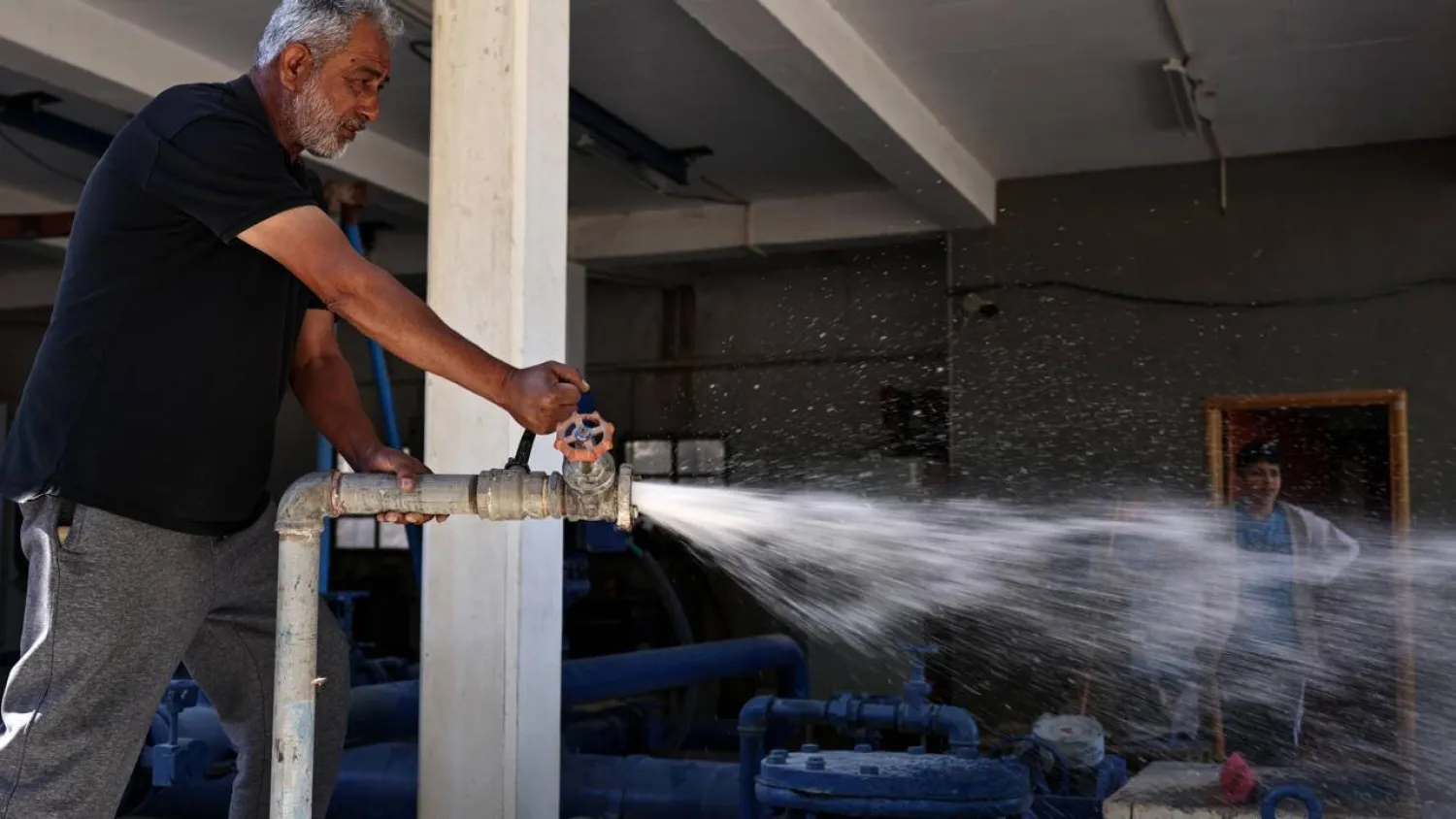
The Ein Samiyah spring is a vital water source for Palestinians in the occupied West Bank grappling with chronic shortages. Zain JAAFAR / AFP
TT

'No Life Without Water': Settler Attacks Threaten West Bank Communities

The Ein Samiyah spring is a vital water source for Palestinians in the occupied West Bank grappling with chronic shortages. Zain JAAFAR / AFP

From his monitoring station on a remote hill in the occupied West Bank, water operator Subhil Olayan keeps watch over a lifeline for Palestinians, the Ein Samiyah spring.

So when Israeli settlers recently attacked the system of wells, pumps and pipelines he oversees, he knew the stakes, AFP reported.

"There is no life without water, of course", he said, following the attack which temporarily cut off the water supply to nearby villages.

The spring, which feeds the pumping station, is the main or backup water source for some 110,000 people, according to the Palestinian company that manages it -- making it one of the most vital in the West Bank, where water is in chronic short supply.

The attack is one of several recent incidents in which settlers have been accused of damaging, diverting or seizing control of Palestinian water sources.

"The settlers came and the first thing they did was break the pipeline. And when the pipeline is broken, we automatically have to stop pumping" water to nearby villages, some of which exclusively rely on the Ein Samiyah spring.

"The water just goes into the dirt, into the ground," Olayan told AFP, adding that workers immediately fixed the damage to resume water supply.

Just two days after the latest attack, Israeli settlers -- some of them armed -- splashed in pools just below the spring, while Olayan monitored water pressure and cameras from a distance.

His software showed normal pressure in the pipes pulling water from the wells and the large pipe carrying water up the hill to his village of Kafr Malik.

But he said maintenance teams dared not venture down to the pumping station out of fear for their safety.

Since the start of the war in Gaza, deadly settler attacks on Palestinians in the West Bank have become commonplace.

Last week, settlers beat a 20-year-old dual US citizen to death in the nearby village of Sinjil, prompting US ambassador Mike Huckabee to urge Israel to "aggressively investigate" the killing.

- Annexation -

Issa Qassis, chairman on the board of the Jerusalem Water Undertaking, which manages the Ein Samiyah spring, said he viewed the attacks as a tool for Israeli land grabs and annexation.

"When you restrict water supply in certain areas, people simply move where water is available", he told AFP at a press conference.

"So in a plan to move people to other lands, water is the best and fastest way", he said.

Since the start of the war in Gaza, several Israeli politicians and officials have become increasingly vocal in support of annexing the West Bank, which Israel has occupied since 1967.

Most prominent among them is Finance Minister Bezalel Smotrich, himself a settler, who said in November that 2025 would be the year Israel applies its sovereignty over the Palestinian territory.

Qassis accused Israel's government of supporting settler attacks such as the one on Ein Samiyah.

The Israeli army told AFP that soldiers were not aware of the incident in which pipes were damaged, "and therefore were unable to prevent it".

The damage to Ein Samiyah's water facilities was not an isolated incident.

In recent months, settlers in the nearby Jordan Valley took control of the Al-Auja spring by diverting its water from upstream, said Farhan Ghawanmeh, a representative of the Ras Ein Al Auja community.

He said two other springs in the area had also recently been taken over.

- Water rights -

In Dura al-Qaraa, another West Bank village that uses the Ein Samiyah spring as a back-up water source, residents are also concerned about increasingly long droughts and the way Israel regulates their water rights.

"For years now, no one has been planting because the water levels have decreased," said Rafeaa Qasim, a member of the village council, citing lower rainfall causing the land to be "basically abandoned".

Qasim said that though water shortages in the village have existed for 30 years, residents' hands are tied in the face of this challenge.

"We have no options; digging a well is not allowed", despite the presence of local water springs, he said, pointing to a well project that the UN and World Bank rejected due to Israeli law prohibiting drilling in the area.

The lands chosen for drilling sit in the West Bank's Area C, which covers more than 60 percent of the territory and is under full Israeli control.

Israeli NGO B'Tselem reported in 2023 that the legal system led to sharp disparities in water access within the West Bank between Palestinians and Israelis.

Whereas nearly all residents of Israel and Israeli settlements have running water every day, only 36 percent of West Bank Palestinians do, the report said.

In Dura al-Qaraa, Qasim fears for the future.

"Each year, the water decreases and the crisis grows -- it's not getting better, it's getting worse."



Israel Says Man's Capture Sabotaged Secret Hezbollah Naval Unit

Amhaz's ID card at the Maritime Sciences and Technology Institute. (Telegram)
TT

Israel Says Man's Capture Sabotaged Secret Hezbollah Naval Unit

Amhaz's ID card at the Maritime Sciences and Technology Institute. (Telegram)

Israel's military said Friday a man seized last year in Lebanon was a Hezbollah operative who played a key role in planning a covert maritime force for the militant group.

The military said special unit troops apprehended Imad Amhaz in November 2024 from the north Lebanese city of Batroun, and transferred him to Israel, reported AFP.

"During his questioning, Amhaz stated that he held a central role in the 'covert maritime portfolio'," which the military called "one of Hezbollah's most classified and sensitive projects".

It said the portfolio's "core objective is the establishment of organized maritime terrorist infrastructure, under civilian cover, in the maritime domain against Israeli and international targets".

The military added that it had disrupted the portfolio's advancement by dismantling its chain of command and through its questioning of Amhaz.

In November 2024, a Lebanese judicial official told AFP that a preliminary probe found that Israeli commandos used a speedboat equipped with radar-jamming devices to abduct Amhaz.

The official called his capture "a war crime that violated national sovereignty" because it involved the kidnapping of a Lebanese citizen in an area far from the fighting.

Amhaz was studying to become a sea captain at the Maritime Sciences and Technology Institute (MARSATI) in Batroun, Lebanon's primary training college for the shipping industry.

Israel says Amhaz was an "invisible" Hezbollah operative who joined the Lebanese armed group in 2004 and was trained in Iran in 2007.

Hezbollah has not claimed Amhaz as a member of the group.

Despite a November 2024 ceasefire supposed to end more than a year of hostilities between Israel and Hezbollah, Israel has kept up strikes on Lebanon and has also maintained troops in five areas of south Lebanon it deems strategic.

Israel says the strikes target Hezbollah members and infrastructure, and aim to stop the group from rearming.


Hamas Official Says Miami Talks Must End Israel's Gaza Truce 'Violations'

12 February 2025, Palestinian Territories, Khan Younis: Palestinians shop in a market in the middle of the destruction in Khan Younis, after the Israeli Forces withdrew as part of the ceasefire agreement with Hamas. Photo: Abed Rahim Khatib/dpa
TT

Hamas Official Says Miami Talks Must End Israel's Gaza Truce 'Violations'

12 February 2025, Palestinian Territories, Khan Younis: Palestinians shop in a market in the middle of the destruction in Khan Younis, after the Israeli Forces withdrew as part of the ceasefire agreement with Hamas. Photo: Abed Rahim Khatib/dpa

A top Hamas official said that talks in Miami on Friday to advance the next phase of the Gaza ceasefire must aim to end Israeli truce "violations" in the Palestinian territory.

"Our people expect these talks to result in an agreement to put an end to ongoing Israeli lawlessness, halt all violations and compel the occupation to abide by the Sharm el-Sheikh agreement," Hamas political bureau member, Bassem Naim, told AFP.

The United States is hosting the discussions, with President Donald Trump's special envoy, Steve Witkoff, expected to meet senior officials from mediator countries Qatar, Egypt and Türkiye in Florida to push for the second stage of the ceasefire deal.


Egypt Signals Possible Activation of Joint Defense Pact to Safeguard Sudan’s Unity

Abdel Fattah el-Sisi during the reception of Abdel Fattah al-Burhan in Cairo on Thursday (Egyptian Presidency)
TT

Egypt Signals Possible Activation of Joint Defense Pact to Safeguard Sudan’s Unity

Abdel Fattah el-Sisi during the reception of Abdel Fattah al-Burhan in Cairo on Thursday (Egyptian Presidency)

Egypt has drawn explicit “red lines” regarding the conflict in Sudan, warning that any attempt to cross them would directly threaten Egyptian national security.

Cairo signaled it is prepared to take all measures permitted under the Joint Defense Agreement between the two countries, a position analysts describe as Cairo’s most forceful since the outbreak of war in Sudan in 2023.

The statement coincided with President Abdel Fattah el-Sisi receiving on Thursday Lt. Gen. Abdel Fattah al-Burhan, Chairman of Sudan’s Transitional Sovereignty Council.

El-Sisi reaffirmed Egypt’s “full support for the Sudanese people in overcoming the current critical phase,” stressing Cairo’s unwavering commitment to Sudan’s unity, sovereignty, security, and stability, according to presidential spokesman Mohamed El-Shennawy.

During the visit, Egypt also renewed its support for US President Donald Trump’s vision for achieving peace and stability in Sudan, aligning with Washington’s broader approach to de-escalation and conflict resolution.

For the first time since the conflict began, Cairo publicly articulated non-negotiable red lines, stressing that Sudan’s unity and territorial integrity are inseparable from Egypt’s own national security. These red lines include preventing the partition of Sudan, protecting the country’s resources, and preserving its state institutions.

The Egyptian presidency underscored that safeguarding Sudan’s institutions is highly important and affirmed Egypt’s “full right to take all necessary measures under international law,” including the possible activation of the Joint Defense Agreement to prevent any violations.

Egypt and Sudan signed a military cooperation agreement in March 2021 covering training, border security, and countering shared threats, building on a Joint Defense Agreement concluded in 1976 to confront external dangers.

Maj. Gen. Yahya Kadwani, a member of Egypt’s parliamentary Committee on Defense and National Security, warned that efforts to divide Sudan necessitate firm red lines to protect Sudanese state assets and Egypt’s own security.

He told Asharq Al-Awsat that invoking the joint defense pact signals strong coordination within international legitimacy and existing bilateral agreements.

The presidency said Egypt is deeply concerned by ongoing escalation in Sudan and the resulting “horrific massacres and flagrant violations of basic human rights,” particularly in El Fasher.

Cairo categorically rejected the creation or recognition of any parallel political or military entities, warning that such moves would undermine Sudan’s unity and territorial integrity.

Ambassador Salah Halima, a member of the Egyptian Council for Foreign Affairs, said Egyptian-Sudanese coordination aims to protect Egyptian, Sudanese, and Arab national security, noting that both countries are members of the Council of Red Sea Coastal States, which plays a strategic role in defense and development.

He added that Egypt’s stance aligns with the International Quartet initiative and a proposal advanced by Saudi Crown Prince and Prime Minister Mohammed bin Salman during his visit to the United States.

The roadmap calls for a three-month humanitarian truce, integration of the Rapid Support Forces into the Sudanese Armed Forces, and preservation of military cohesion.

The Quartet, which includes Saudi Arabia, Egypt, the United Arab Emirates, and the United States, proposed last August a plan for a three-month humanitarian ceasefire, followed by a permanent cessation of hostilities and a political process leading to an independent civilian government within nine months.

Al-Burhan’s visit to Cairo followed talks in Saudi Arabia, where he affirmed Sudan’s readiness to work with Trump, US Secretary of State Marco Rubio, and US envoy Massad Boulos to end the war.

Amani Al-Tawil, Director of the Africa Program at the Al-Ahram Center for Political and Strategic Studies, said Egypt’s position represents its strongest stance yet and aligns with Saudi and US calls to preserve Sudan’s unity, halt the war, reject parallel entities, and protect state institutions.