

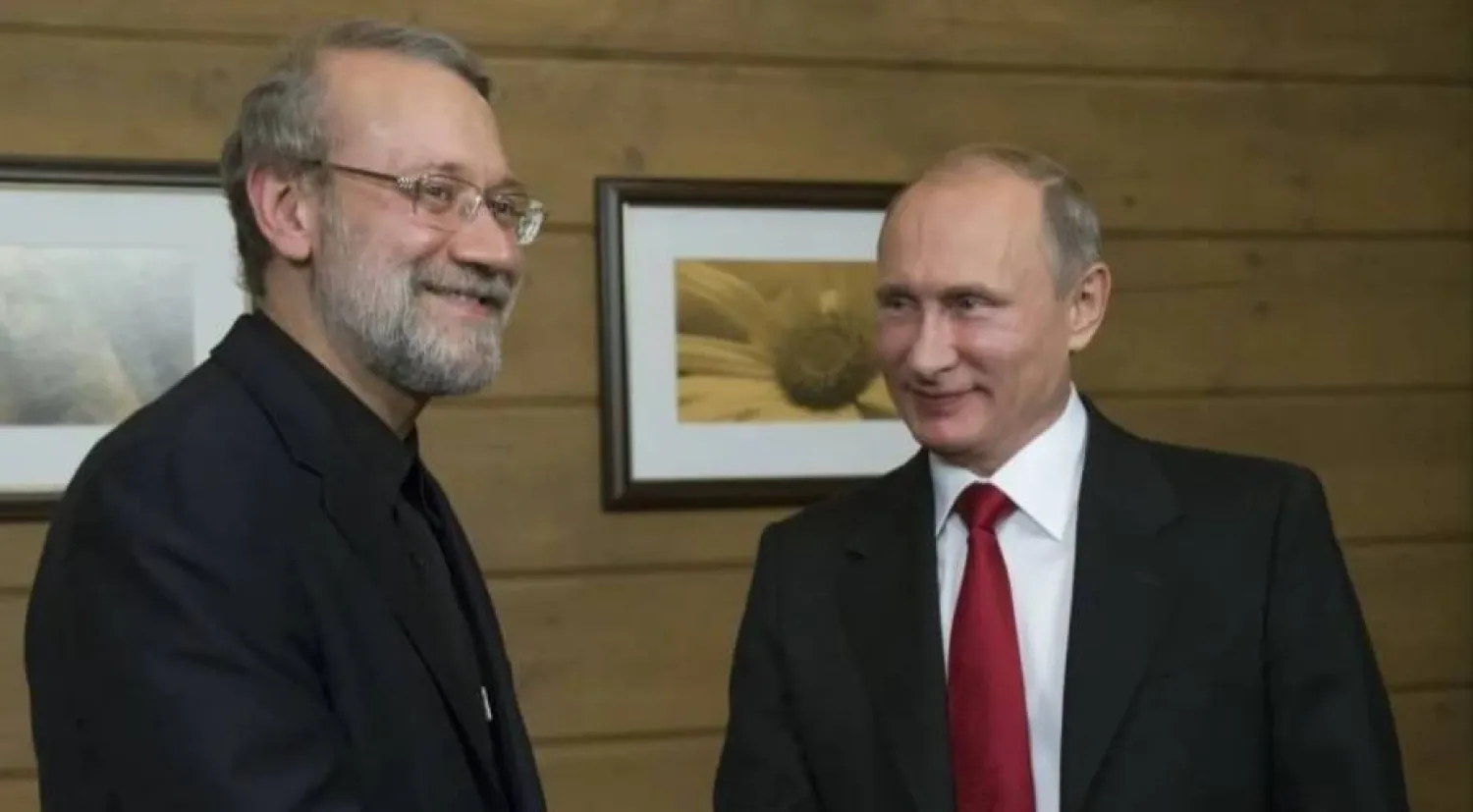

Khamenei Sends Message to Putin on Regional Escalation

Russian President Vladimir Putin held a meeting with Ali Larijani, top adviser to Iran’s supreme leader on nuclear issues (IRNA)
TT

Khamenei Sends Message to Putin on Regional Escalation

Russian President Vladimir Putin held a meeting with Ali Larijani, top adviser to Iran’s supreme leader on nuclear issues (IRNA)

Russian President Vladimir Putin held a meeting with Ali Larijani, top adviser to Iran’s supreme leader on nuclear issues, to discuss Tehran’s nuclear program, the Kremlin said on Sunday.

The meeting came as Iran prepares to resume talks with the E3.

France, Britain and Germany told Iran last Thursday that they would restore UN sanctions unless it reopened talks on its nuclear program immediately and produced concrete results by the end of August.

On Sunday, Kremlin spokesman Dmitry Peskov said: “Today Russian President Vladimir Putin received Ali Larijani, supreme adviser to Iran's Supreme Leader, in the Kremlin.”

“On behalf of his leadership, the Iranian representative provided assessments of the escalated situation in the Middle East and around the Iranian nuclear program,” he added.

“The Russian side expressed well-known positions aimed at stabilizing the situation in the region and a political settlement of the issues related to the Iranian nuclear program,” the spokesperson said.

A source told Iran’s Tasnim news agency on Sunday that Iran and the European troika have agreed to resume their nuclear negotiations.

“Tehran and the European troika have come to an agreement in principle on the resumption of the talks about Iran’s nuclear program, but the timing and location of the negotiations are under debate,” the source said.

The decision as to which country will be hosting the upcoming talks has not been finalized yet, the source added.

Meanwhile, Vahid Ahmadi, a member of the parliamentary commission on national security, told the Iran Observer news website that Iran will not return to nuclear negotiations unless three conditions are met.

He said the conditions include: “International condemnation of recent attacks on the country's territory, compensation for military damages and guarantees against new acts of aggression from the USA or Israel.”

Russia, a longstanding ally of Tehran, plays a role in Iran's nuclear negotiations with the West as a veto-wielding UN Security Council member and a signatory to an earlier nuclear deal Trump abandoned during his first term in 2018.

Currently, Tehran is under increasing Western pressure to resume talks with the E3 powers. The European Troika foreign ministers told their Iranian counterpart Abbas Araghchi that the countries are moving to activate the “snapback” mechanism at the end of August unless an agreement is reached.

Last week, Iranian newspaper Etemad said Iran is trying to convince Russia and China to withdraw from the nuclear deal with an aim to annul Resolution 2231, which expires in October and provides the legal framework that includes the “snapback” mechanism for reimposing UN sanctions on Iran.

Russian Foreign Minister Sergey Lavrov met with his Iranian counterpart on the sidelines of the Shanghai Cooperation Organization’s Foreign Ministers Council Meeting in Tianjin last week.

The parties continued their exchange of views on regional and international issues of mutual interest. They reiterated the imperative of resolving the crisis surrounding Iran’s nuclear program exclusively through political and diplomatic means, in strict compliance with international law.

Two days prior to the Lavrov-Araghchi meeting, Russia rejected an Axios report saying Putin has told both Trump and Iranian officials that he supports the idea of a nuclear deal in which Iran is unable to enrich uranium.

Axios also said that while Moscow publicly advocates for Iran's right to enrich, Putin has taken a tougher position in private in the wake of the 12-day war between Israel and Iran.

Two sources said the Russians also briefed the Israeli government about Putin's position regarding Iran's uranium enrichment. "We know that this is what Putin told the Iranians," a senior Israeli official said.

Putin also expressed that position in calls last week with Trump and French President Emmanuel Macron.

An Alliance with Reservations

While Moscow has bought weapons from Iran for its war in Ukraine and signed a 20-year strategic partnership deal with Tehran earlier this year, their relationship since the 16th century, when Muscovy officially established relations with the Persian Empire, has at times been troubled.

The agreement does not include a mutual defense clause, but it says both countries will work together against common military threats, develop their military-technical cooperation, and take part in joint exercises.

Inside Russia, there were calls for Russia to come to the aid of its partner and to supply Iran with the same support which Washington had given to Ukraine - including air defense systems, missiles and satellite intelligence.

Larijani is the first Iranian official to visit Moscow since Iran and Israel ended their 12-day war. Before that, Araghchi traveled to Moscow on June 23, the eve of the ceasefire. Reports said the FM delivered a message from the Iranian leader to Putin.

A senior source told Reuters at the time that Araghchi was due to deliver a letter from Khamenei to Putin, seeking more help from Russia.

Iran has not been impressed with Russia's support so far, Iranian sources told Reuters, and the country wants Putin to do more to back it against Israel and the United States.

The sources did not elaborate on what assistance Tehran wanted.

Araghchi’s visit came days before the US strike on Iran’s nuclear sites.

The Kremlin at the time denied that the Iranian FM was carrying a letter from Khamenei.
However, the Farhikhtegan newspaper, whose editorial board is headed by the Iranian leader's senior adviser on international affairs, Ali Akbar Velayati, revealed details of the letter, before later deleting it.

The newspaper said Araghchi had conveyed Khamenei “discontent” over what Tehran considered Moscow's shortcomings during the recent war with Israel.



EU to Slash Asylum Cases from 7 Nations Deemed Safe

FILE - A convoy of buses carry Syrian refugees who return home from Lebanon, arrive at the Syrian border crossing point, in Jdeidet Yabous, Syria, Tuesday, July 29, 2025. (AP Photo/Omar Sanadiki, File)
TT

EU to Slash Asylum Cases from 7 Nations Deemed Safe

FILE - A convoy of buses carry Syrian refugees who return home from Lebanon, arrive at the Syrian border crossing point, in Jdeidet Yabous, Syria, Tuesday, July 29, 2025. (AP Photo/Omar Sanadiki, File)

The European Union on Thursday said it would drastically reduce asylum claims from seven nations in Africa, the Middle East and Asia by considering them safe countries of origin, prompting widespread outrage from human rights groups on International Migrants' Day.

An agreement between European Parliament and the European Council, or the group of the 27 EU heads of state, said that the countries would be considered safe if they lack “relevant circumstances, such as indiscriminate violence in the context of an armed conflict.”

Asylum requests by people from Bangladesh, Colombia, Egypt, Kosovo, India, Morocco and Tunisia will be "fast-tracked, with applicants having to prove that this provision should not apply to them,” read the announcement of the agreement. “The list can be expanded in the future under the EU’s ordinary legislative procedure.”

In 2024, EU nations endorsed sweeping reforms to the bloc’s failed asylum system. The rules were meant to resolve the issues that have divided the 27 countries since well over 1 million migrants swept into Europe in 2015, most fleeing war in Syria and Iraq.

Under the Pact on Migration and Asylum, which goes into force in June 2026, people can be sent to countries deemed safe, but not to those where they face the risk of physical harm or persecution.

According to The Associated Press, Amnesty International EU advocate Olivia Sundberg Diez said the new measures were “a shameless attempt to sidestep international legal obligations" and would endanger migrants.

French MEP Mélissa Camara said the safe countries of origins concept and others agreed to by the Council and Parliament “opens the door to return hubs outside the EU’s borders, where third-country nationals are sometimes subjected to inhumane treatment with almost no monitoring” and “undoubtedly places thousands of people in exile in situations of danger.”

Céline Mias, the EU director of the Danish Refugee Council said that "we are deeply worried that this fast-track system will fail to protect people in need of protection, including activists, journalists and marginalized groups in places where human rights are clearly under attack.”

Alessandro Ciriani, an Italian MEP with the European Conservatives and Reformists group, said the designation sends a firm message that the EU has toughened its borders.

“Europe wants enforceable rules and shared responsibility. Now this commitment must become operational: effective returns, structured cooperation with third countries and real measures to support EU member states,” he said.

He said that clear delineations of safe and unsafe nations would rid the EU of “excessive interpretative uncertainty” that led to a kind of paralysis for national decision makers over border controls.

The measures also allows individual nations within the bloc to designate other countries safe for their own immigration purposes.


Rubio Says US Sanctioning ICC Judges for Targeting Israel

US Secretary of State Marco Rubio speaks to traveling journalists at the John C. Munro Hamilton International Airport in Hamilton, Ontario, on November 12, 2025 after the G7 foreign ministers meeting. (Photo by Mandel NGAN / POOL / AFP)
TT

Rubio Says US Sanctioning ICC Judges for Targeting Israel

US Secretary of State Marco Rubio speaks to traveling journalists at the John C. Munro Hamilton International Airport in Hamilton, Ontario, on November 12, 2025 after the G7 foreign ministers meeting. (Photo by Mandel NGAN / POOL / AFP)

US Secretary of State Marco Rubio said on Thursday that the US was sanctioning two judges of the International Criminal Court for targeting Israel.

"Today, I am designating two International Criminal Court (ICC) judges, Gocha Lordkipanidze of Georgia and Erdenebalsuren Damdin of Mongolia, pursuant to Executive Order 14203," Rubio said in a statement, referring to the order President Donald Trump signed in February sanctioning the ICC, Reuters reported.

"These individuals have directly engaged in efforts by the ICC to investigate, arrest, detain, or prosecute Israeli nationals, without Israel's consent," he said.

The United States and Israel are not members of the ICC.

The US sanctions in February include freezing any US assets of those designated and barring them and their families from visiting the United States.


US Imposes Sanctions on Vessels Linked to Iran, Treasury Website Says

A crew member raises the Iranian flag on Iranian oil tanker Adrian Darya 1, previously named Grace 1, as it sits anchored after the Supreme Court of the British territory lifted its detention order, in the Strait of Gibraltar, Spain, August 18, 2019. REUTERS/Jon Nazca
TT

US Imposes Sanctions on Vessels Linked to Iran, Treasury Website Says

A crew member raises the Iranian flag on Iranian oil tanker Adrian Darya 1, previously named Grace 1, as it sits anchored after the Supreme Court of the British territory lifted its detention order, in the Strait of Gibraltar, Spain, August 18, 2019. REUTERS/Jon Nazca

The United States imposed sanctions on Thursday on 29 vessels and their management firms, the Treasury Department said, as Washington continues targeting Tehran's "shadow fleet" it says exports Iranian petroleum and petroleum products, Reuters reported.

The targeted vessels and companies have transported hundreds of millions of dollars of the products through deceptive shipping practices, Treasury said.

Thursday's action also targets businessman Hatem Elsaid Farid Ibrahim Sakr, whose companies are associated with seven of the vessels cited, as well as multiple shipping companies.