


Iran Fires on Israel as Trump Claims Threat from Tehran Nearly Eliminated

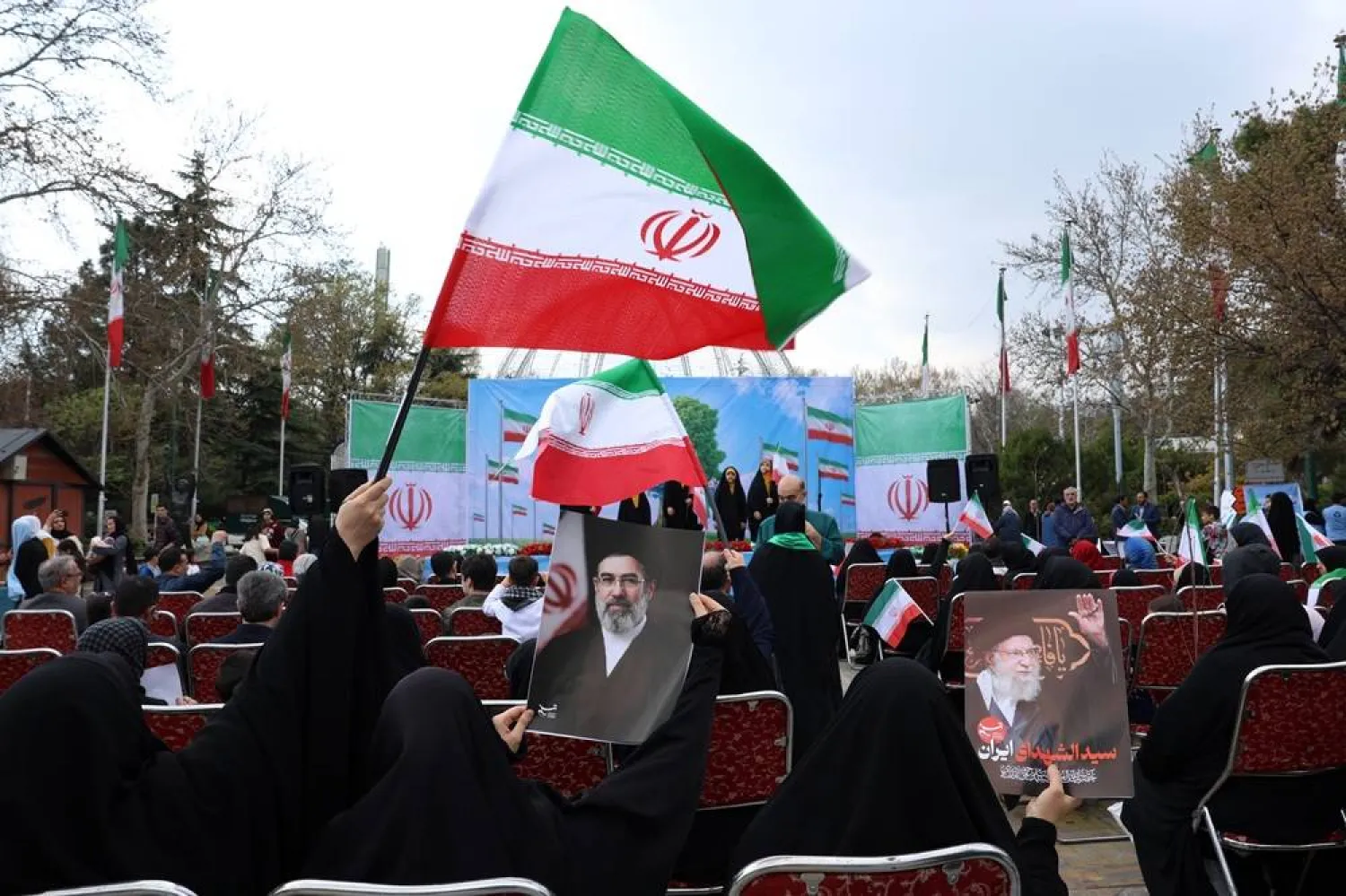
Iranian women clad in black chadors wave national flags and hold posters of Iranian Supreme Leader Mojtaba Khamenei (C) and of his late father, former Iranian Supreme Leader Ali Khamenei (R), during the annual Nature Day festival in Tehran, Iran, 02 April 2026. (EPA)
TT

Iran Fires on Israel as Trump Claims Threat from Tehran Nearly Eliminated

Iranian women clad in black chadors wave national flags and hold posters of Iranian Supreme Leader Mojtaba Khamenei (C) and of his late father, former Iranian Supreme Leader Ali Khamenei (R), during the annual Nature Day festival in Tehran, Iran, 02 April 2026. (EPA)

Iran fired more missiles at Israel and Gulf Arab states Thursday, demonstrating Tehran’s continued ability to strike its neighbors even as US President Donald Trump claimed the threat from the country was nearly eliminated.

Iran’s attacks on Gulf states along with its chokehold on the Strait of Hormuz have disrupted the world’s energy supplies with effects far beyond the Middle East. That has proved to be Iran’s greatest strategic advantage in the war. Britain held a call with nearly three dozen countries about how to reopen the strait once the fighting is over.

Trump has insisted the strait can be taken by force — but said it is not up to the US to do that. In an address to the American people Wednesday night, he encouraged countries that depend on oil from Hormuz to “build some delayed courage” and go “take it.”

Before the US and Israel started the war on Feb. 28 with strikes on Iran, the waterway was open to traffic and 20% of all traded oil passed through it.

Iran continues to strike Israel

Iran responded defiantly to Trump’s speech, in which the American president claimed US military action had been so decisive that “one of the most powerful countries” is “really no longer a threat.”

A spokesman for Iran’s military, Lt. Col. Ebrahim Zolfaghari, insisted Thursday that Tehran maintains hidden stockpiles of arms, munitions and production facilities. He said facilities targeted so far by US strikes are “insignificant.”

Just before Trump began his address — in which he said US “core strategic objectives are nearing completion” — explosions were heard in Dubai as air defenses worked to intercept an Iranian missile barrage.

Less than a half-hour after the president was done, Israel said its military was also working to intercept incoming missiles. Sirens sounded in Bahrain immediately after the speech.

Attacks continued across Iran on Thursday, with strikes reported in multiple cities.

Even amid the conflict, families went to a park in Tehran to play games and grill food to mark the last day of Iranian New Year, or Nowruz.

In Lebanon — home to Iran-backed Hezbollah who is fighting Israel, which has launched a ground invasion — an Israeli strike killed four people in the south, the Health Ministry said.

More than 1,900 people have been killed in Iran during the war, while 19 have been reported dead in Israel. More than two dozen people have died in Gulf states and the occupied West Bank, while 13 US service members have been killed.

More than 1,300 people have been killed and more than 1 million displaced in Lebanon. Ten Israeli soldiers have also died there.

Nearly three dozen nations talk about securing the Strait of Hormuz

Iranian attacks on about two dozen commercial ships, and the threat of more, have halted nearly all traffic in the waterway that connects the Gulf to the open ocean.

Since March 1, traffic through the strait has dropped 94% over the same period last year, according to the Lloyds List Intelligence shipping data firm. Two ships are confirmed to have paid a fee, the firm said, while others were allowed through based on agreements with their home governments.

Saudi Arabia piped about 1 billion barrels of oil away from the Strait of Hormuz in March, according to maritime data firm Kpler, while Iraq said Thursday that it had started to truck oil across Syria to avoid the strait.

The 35 countries that spoke Thursday, including all G7 countries except the US, as well as the United Arab Emirates and Bahrain, signed a declaration last month demanding Iran stop blocking the strait.

Thursday’s talks were focused on political and diplomatic measures, but British Foreign Secretary Yvette Cooper said military planners from an unspecified number of countries will also plot ways to ensure security once fighting ends, including potential mine-clearing work and “reassurance” for commercial shipping.

No country appears willing to try to open the strait by force while the war is raging. French President Emmanuel Macron, while on a visit to South Korea, called a military operation to secure the waterway “unrealistic.”

But there is a concern that Iran might limit traffic through the waterway even after US and Israeli attacks cease.

The idea of an international effort has echoes of the “coalition of the willing,” led by the UK and France, that was assembled to underpin Ukraine’s security in the event of a ceasefire in that war. The coalition is, in part, an attempt to demonstrate to Washington that Europe is doing more for its own security in the face of frequent criticism from Trump.

Oil prices rise again

The conflict is driving up prices for oil and natural gas, roiling stock markets, pushing up the cost of gasoline and threatening to make a range of goods, including food, more expensive.

On Thursday, Brent crude, the international standard, rose again and was around $108, up about 50% from Feb. 28.

Though the oil and gas that typically transits the strait is primarily sold to Asian nations, Japan and South Korea were the only two countries from the region joining Thursday's call about the strait. The supply of jet fuel has also been interrupted, with consequences for travel worldwide.



Russian Strikes Kill 3 Near Ukraine’s Kharkiv

This handout taken and released by the State Emergency Service of Ukraine on June 9, 2026 shows smoke rising from a fire following Russian strikes in the Kharkiv region, amid the Russian invasion of Ukraine. (Photo by Handout / State Emergency Service of Ukraine / AFP)
TT

Russian Strikes Kill 3 Near Ukraine’s Kharkiv

This handout taken and released by the State Emergency Service of Ukraine on June 9, 2026 shows smoke rising from a fire following Russian strikes in the Kharkiv region, amid the Russian invasion of Ukraine. (Photo by Handout / State Emergency Service of Ukraine / AFP)

Russian strikes killed three people and wounded 10 others in Ukraine's northeastern Kharkiv region, its governor said early Tuesday.

"The enemy has hit the city of Chuguiv," Kharkiv regional governor Oleg Synegubov wrote on Telegram, adding that three people had been killed.

"The strikes caused fires and damaged at least 18 vehicles; windows were blown out and building facades damaged in residential multi-storey buildings," Synegubov said.

Separately, Kharkiv mayor Igor Terekhov reported 10 people were wounded in his city.

Daily Russian attacks that claim civilian lives have intensified in recent months, and Ukraine has hit back with its own drone strikes further into Russian territory, saying these are mainly against military and energy facilities.

According to a UN estimate published in April, at least 15,850 civilians have been killed in Ukrainian zones since Russia launched its invasion in February 2022.

More than 2,800 civilians have died in Russian-controlled zones, according to the UN toll, which added that more than 44,800 have been wounded in Ukrainian and Russian-occupied zones.


Congo’s Ebola Outbreak Rises to 100 Deaths out of 550 Cases as Conflict Slows Response

A health worker wearing a face mask as part of his personal protection equipment (PPE) looks on at the Mulago National Referral Hospital isolation unit in Kampala, Uganda, on July 8, 2026. (AFP)
TT

Congo’s Ebola Outbreak Rises to 100 Deaths out of 550 Cases as Conflict Slows Response

A health worker wearing a face mask as part of his personal protection equipment (PPE) looks on at the Mulago National Referral Hospital isolation unit in Kampala, Uganda, on July 8, 2026. (AFP)

At least 100 people have died from Ebola less than a month after authorities declared an outbreak of the disease in eastern Congo, authorities said.

Attacks on health workers from angry residents, skepticism among some locals and armed conflict in hot spots continue to challenge efforts to stop the outbreak declared on May 15.

Out of the 550 cases of the disease confirmed as of Sunday, there have been 101 deaths and 19 recoveries, according to the latest situation report late Monday.

The outbreak is concentrated in Congo’s eastern province of Ituri, which accounts for more than 90% of the cases. Cases have also been recorded in the North Kivu and South Kivu provinces, and has spread across the border to Uganda.

The number of cases in Congo is believed to be higher because the outbreak was confirmed weeks late, and the response has been challenging also because the virus has no approved vaccine or treatment.

The latest Ebola disease outbreak is caused by the rare Bundibugyo virus, which does not have an approved vaccine or treatment unlike the “Zaire virus,” another name for the Ebola virus, responsible for most of Congo’s past 16 outbreaks of the disease.

The rapid increase in the number of cases is in part due to the scale up of diagnostic capacities, enabling testing of the backlog of previously collected samples, authorities said.

Frontline health workers, with little pay or rest, have been attacked multiple times by angry residents and have not been able to reach some communities due conflict involving armed rebel groups.

Eastern Congo has for years seen attacks by dozens of separate rebel and militant groups, some of them with links to foreign countries or to the extremist Islamic State group.

Conflict is “constraining access for the response, disrupting surveillance and response activities, and increasing the risk of undetected transmission,” the World Health Organization said Monday.

“Such incidents underline the challenges of the context and the importance of working closely with local leaders and communities,” it added.


Report: US Leads Record Rise in Spending on Nuclear Arsenals in 2025

The United States spent $69.2 billion on nuclear weapons (archival - Reuters)
TT

Report: US Leads Record Rise in Spending on Nuclear Arsenals in 2025

The United States spent $69.2 billion on nuclear weapons (archival - Reuters)

Spending on nuclear weapons by the world's nine nuclear-armed states rose ‌by almost a fifth in 2025 to $119 billion, a report by the International Campaign to Abolish Nuclear Weapons said on Tuesday.

The 19% increase from 2024 ⁠produced the highest expenditure on nuclear weapons since the campaign group began tracking the annual nuclear arms expenditure of the US, Russia, China, France, Britain, India, Pakistan, North Korea and Israel in 2020.

The United States spent $69.2 billion, more than all other nuclear-armed states combined, and recorded the largest increase, with spending rising by 22 percent.

The campaign said the increase reflects broader growth in US military spending alongside efforts to modernize and expand its nuclear arsenal.

China ranked second, increasing its nuclear weapons spending by seven percent to $13.5 billion.

The United Kingdom overtook Russia to become the third-largest spender, with expenditures rising 17 percent to $12.6 billion. Russia spent $9.5 billion, up six percent from the previous year.

The campaign, which was awarded the Nobel Peace Prize in 2017, advocates for the complete elimination of nuclear weapons.