


Trump Administration Releases FBI Records on MLK Jr. Despite his Family’s Opposition

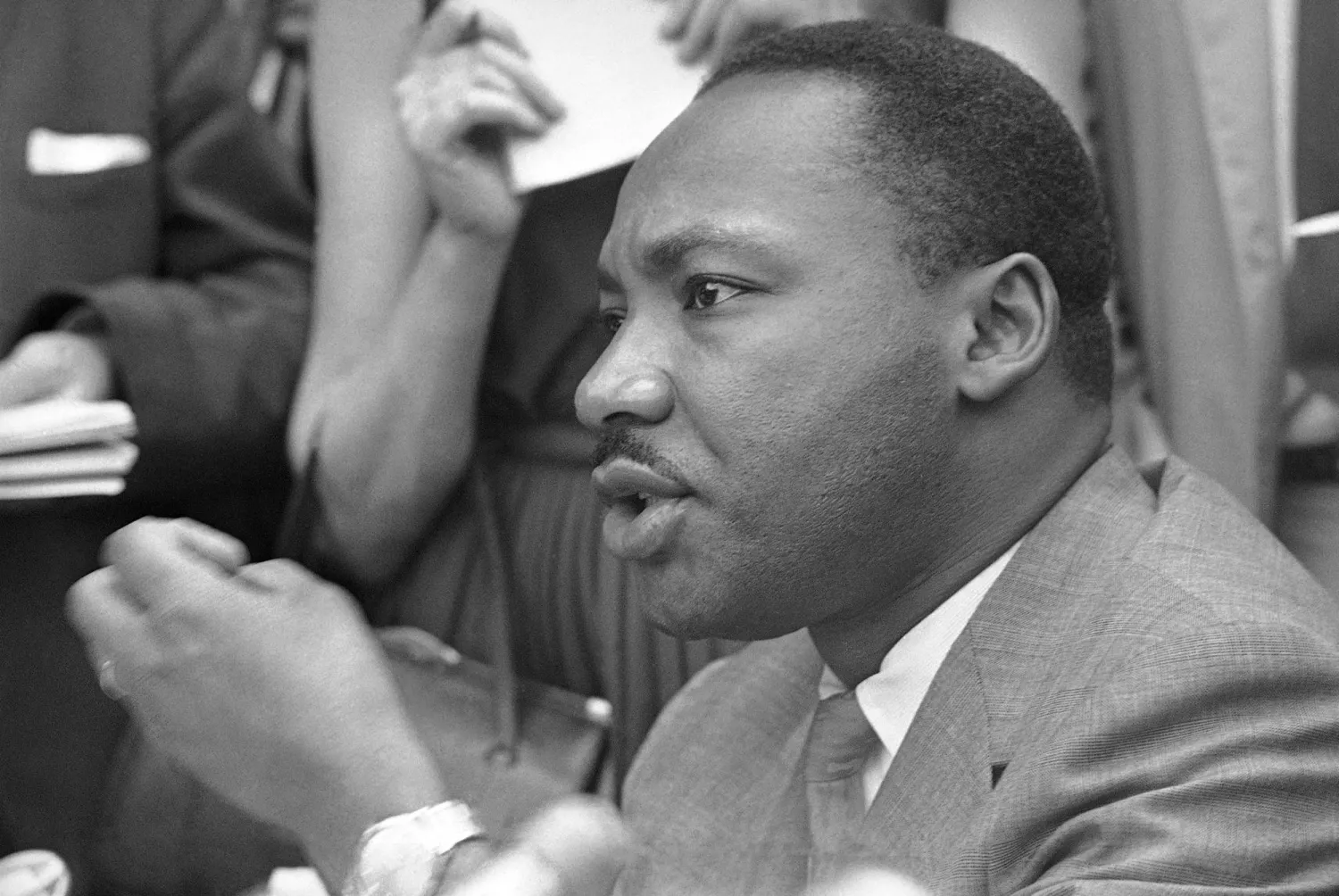
FILE - Rev. Martin Luther King Jr., speaks to reporters in Birmingham, Ala., May 9, 1963. (AP Photo)
TT

Trump Administration Releases FBI Records on MLK Jr. Despite his Family’s Opposition

FILE - Rev. Martin Luther King Jr., speaks to reporters in Birmingham, Ala., May 9, 1963. (AP Photo)

The Trump administration on Monday released records of the FBI’s surveillance of Martin Luther King Jr., despite opposition from the slain Nobel laureate’s family and the civil rights group that he led until his 1968 assassination.

The digital document dump includes more than 240,000 pages of records that had been under a court-imposed seal since 1977, when the FBI first gathered the records and turned them over to the National Archives and Records Administration, The Associated Press said.

In a lengthy statement released Monday, King’s two living children, Martin III, 67, and Bernice, 62, said their father’s killing has been a “captivating public curiosity for decades.” But the pair emphasized the personal nature of the matter and urged that the files “be viewed within their full historical context.”

The Kings got advance access to the records and had their own teams reviewing them. Those efforts continued even as the government granted public access. Among the documents are leads the FBI received after King's assassination and details of the CIA's fixation on King’s pivot to international anti-war and anti-poverty movements in the years before he was killed. It was not immediately clear whether the documents shed new light on King’s life, the Civil Rights Movement or his murder.

“As the children of Dr. King and Mrs. Coretta Scott King, his tragic death has been an intensely personal grief — a devastating loss for his wife, children, and the granddaughter he never met -- an absence our family has endured for over 57 years,” they wrote. “We ask those who engage with the release of these files to do so with empathy, restraint, and respect for our family’s continuing grief.”

They also repeated the family's long-held contention that James Earl Ray, the man convicted of assassinating King, was not solely responsible, if at all.

Bernice King was 5 years old when her father was killed at the age of 39. Martin III was 10.

A statement from the office of Director of National Intelligence Tulsi Gabbard called the disclosure “unprecedented” and said many of the records had been digitized for the first time. She praised President Donald Trump for pushing the issue.

Release is ‘transparency’ to some, a ‘distraction’ for others Trump promised as a candidate to release files related to President John F. Kennedy’s 1963 assassination. When Trump took office in January, he signed an executive order to declassify the JFK records, along with those associated with Robert F. Kennedy’s and MLK's 1968 assassinations.

The government unsealed the JFK records in March and disclosed some RFK files in April.

The announcement from Gabbard's office included a statement from Alveda King, Martin Luther King Jr.'s niece, who is an outspoken conservative and has broken from King's children on various topics — including the FBI files. Alveda King said she was “grateful to President Trump” for his “transparency."

Separately, Attorney General Pam Bondi’s social media account featured a picture of the attorney general with Alveda King.

Besides fulfilling Trump's order, the latest release means another alternative headline for the president as he tries to mollify supporters angry over his administration’s handling of records concerning the sex trafficking investigation of Jeffrey Epstein, who killed himself behind bars while awaiting trial in 2019, during Trump’s first presidency. Trump last Friday ordered the Justice Department to release grand jury testimony but stopped short of unsealing the entire case file.

Bernice King and Martin Luther King III did not mention Trump in their statement Monday. But Bernice King later posted on her personal Instagram account a black-and-white photo of her father, looking annoyed, with the caption “Now, do the Epstein files.”

And some civil rights activists did not spare the president.

“Trump releasing the MLK assassination files is not about transparency or justice,” said the Rev. Al Sharpton. “It’s a desperate attempt to distract people from the firestorm engulfing Trump over the Epstein files and the public unraveling of his credibility among the MAGA base.”

The King Center, founded by King's widow and now led by Bernice King, reacted separately from what Bernice said jointly with her brother. The King Center statement framed the release as a distraction — but from more than short-term political controversy.

“It is unfortunate and ill-timed, given the myriad of pressing issues and injustices affecting the United States and the global society,” the King Center, linking those challenges to MLK's efforts. “This righteous work should be our collective response to renewed attention on the assassination of a great purveyor of true peace.”

Records mean a new trove of research material

The King records were initially intended to be sealed until 2027, until Justice Department attorneys asked a federal judge to lift the sealing order early. Scholars, history buffs and journalists have been preparing to study the documents for new information about his assassination on April 4, 1968, in Memphis, Tennessee.

The Southern Christian Leadership Conference, which King co-founded in 1957 as the Civil Rights Movement blossomed, opposed the release. The group, along with King’s family, argued that the FBI illegally surveilled King and other civil rights figures, hoping to discredit them and their movement.

It has long been established that then-FBI Director J. Edgar Hoover was intensely interested if not obsessed with King and others he considered radicals. FBI records released previously show how Hoover’s bureau wiretapped King’s telephone lines, bugged his hotel rooms and used informants to gather information, including evidence of King's extramarital affairs.

“He was relentlessly targeted by an invasive, predatory, and deeply disturbing disinformation and surveillance campaign orchestrated by J. Edgar Hoover through the Federal Bureau of Investigation,” the King children said in their statement.

“The intent ... was not only to monitor, but to discredit, dismantle and destroy Dr. King’s reputation and the broader American Civil Rights Movement," they continued. “These actions were not only invasions of privacy, but intentional assaults on the truth — undermining the dignity and freedoms of private citizens who fought for justice, designed to neutralize those who dared to challenge the status quo.”

The Kings said they “support transparency and historical accountability” but “object to any attacks on our father’s legacy or attempts to weaponize it to spread falsehoods.”

Opposition to King intensified even after the Civil Rights Movement compelled Congress and President Lyndon B. Johnson to enact the Civil Rights Act of 1964 and the Voting Rights Act of 1965. After those victories, King turned his attention to economic justice and international peace. He criticized rapacious capitalism and the Vietnam War. King asserted that political rights alone were not enough to ensure a just society. Many establishment figures like Hoover viewed King as a communist threat.

King’s children still don’t accept the original explanation of assassination

King was assassinated as he was aiding striking sanitation workers in Memphis, part of his explicit turn toward economic justice.

Ray pleaded guilty to King's murder. Ray later renounced that plea and maintained his innocence until his death in 1998.

King family members and others have long questioned whether Ray acted alone, or if he was even involved. Coretta Scott King asked for the probe to be reopened, and in 1998, then-Attorney General Janet Reno ordered a new look. Reno's Justice Department said it “found nothing to disturb the 1969 judicial determination that James Earl Ray murdered Dr. King.”

In their latest statement, Bernice King and Martin Luther King III repeated their assertions that Ray was set up. They pointed to a 1999 civil case, brought by the King family, in which a Memphis jury concluded that Martin Luther King Jr. had been the target of a conspiracy.

“As we review these newly released files," the Kings said, “we will assess whether they offer additional insights beyond the findings our family has already accepted.”



Israel’s Netanyahu Is Meeting with Trump This Week to Push for a Far Broader Iran Deal

President Donald Trump answers a question from a reporter at the end of a news conference with Israel's Prime Minister Benjamin Netanyahu at Mar-a-Lago, Dec. 29, 2025, in Palm Beach, Fla. (AP)
TT

Israel’s Netanyahu Is Meeting with Trump This Week to Push for a Far Broader Iran Deal

President Donald Trump answers a question from a reporter at the end of a news conference with Israel's Prime Minister Benjamin Netanyahu at Mar-a-Lago, Dec. 29, 2025, in Palm Beach, Fla. (AP)

Prime Minister Benjamin Netanyahu is heading to Washington on Tuesday to encourage President Donald Trump to expand the scope of high-stakes nuclear talks with Iran. The negotiations resumed last week against the backdrop of an American military buildup.

Israel has long called for Iran to cease all uranium enrichment, dial back its ballistic missile program and cut ties to militant groups across the region. Iran has always rejected those demands, saying it would only accept some limits on its nuclear program in return for sanctions relief.

It's unclear if Iran's bloody crackdown on mass protests last month, or the movement of major US military assets to the region, has made Iran’s leaders more open to compromise, or if Trump is interested in broadening the already difficult negotiations.

Netanyahu, who will be in Washington through Wednesday, has spent his decades-long political career pushing for stronger US action toward Iran. Those efforts succeeded last year when the US joined Israel in 12 days of strikes on Iran's military and nuclear sites, and the possibility of additional military action against Iran is likely to come up in this week’s discussions.

Decisions are being made

Netanyahu's visit comes just two weeks after Trump’s special envoy Steve Witkoff and Jared Kushner, Trump’s son-in-law and Middle East adviser, met with the prime minister in Jerusalem. The US envoys held indirect talks in Oman with Iran's foreign minister on Friday.

“The Prime Minister believes that any negotiations must include limiting ballistic missiles and ending support for the Iranian axis,” Netanyahu's office said over the weekend, referring to Iran-backed armed groups like the Palestinian Hamas and Lebanon's Hezbollah.

Years of nuclear talks have made little progress since Trump scrapped a 2015 agreement with Iran, with strong encouragement from Israel. Iran has shown little willingness to address the other issues, even after suffering repeated setbacks. But the meeting with Trump gives Netanyahu an opportunity to shape the process and may also bolster his standing back home.

“Clearly these are the days when decisions are being made, America is expected to complete its force buildup, and it’s trying to exhaust the prospect of negotiations,” said Yohanan Plesner, head of the Israel Democracy Institute, a Jerusalem-based think tank.

“If you want to have influence on the process, only so much can be done via Zoom.”

Israel fears a narrow agreement

rump threatened a military strike against Iran last month over the killing of protesters and concerns of mass executions, moving a number of military assets into the region. Thousands were killed and tens of thousands detained at Iranian authorities crushed the protests over widespread economic distress.

As the protests largely subsided, Trump shifted his focus to Iran's nuclear program, which the US, Israel and others have long suspected is aimed at eventually developing weapons. Iran insists its program is entirely peaceful and says it has the right to enrich uranium for civilian purposes.

Sima Shine, an Iran expert formerly with Israel's Mossad spy agency who is now an analyst at Israel's Institute for National Security Studies, said Israel fears that the US might reach a narrow agreement with Iran in which it would temporarily halt uranium enrichment.

A deal in which Iran halts enrichment for several years would allow Trump to claim victory. But Israel believes any such agreement that does not end Iran's nuclear program and reduce its ballistic missile arsenal will eventually require Israel to launch another wave of strikes, she said.

Iran might be unable to enrich uranium after last year’s strikes, making the idea of a temporary moratorium more appealing.

In November, Iranian Foreign Minister Abbas Araghchi said Iran was no longer enriching uranium due to the damage from last year's war. The US and Israeli airstrikes killed nearly 1,000 people in Iran, while Iranian missile barrages killed almost 40 in Israel.

It's unclear how much damage was done to Iran's nuclear program. Inspectors from the International Atomic Energy Agency have been unable to visit the bombed nuclear sites. Satellite images show activity at two of them.

Netanyahu faces election this year

Netanyahu, who faces elections later this year, has long touted his close ties to world leaders, particularly Trump, who he has praised as the best friend Israel has ever had in the White House. This week's meeting allows Netanyahu to show Israelis he is a player in the Iran talks.

“The issue of relations between Netanyahu and Trump will be the issue of the campaign, and he is saying, ‘Only I can do this, it’s only me,’” Shine said.

Netanyahu is Israel's longest-serving prime minister, having held the office for a total of over 18 years. His government, the most nationalist and religious in Israel's history, is expected to survive until the election in October, or close to it.

Netanyahu was originally scheduled to visit Washington next week for the Feb. 19 launch of Trump's Board of Peace, an initiative that was initially framed as a mechanism for rebuilding Gaza after the Israel-Hamas war but has taken on a larger mandate of resolving global crises.

Netanyahu agreed to join the initiative, but is wary of it because it includes Türkiye and Qatar, countries he does not want to have a presence in postwar Gaza because of their relations with Hamas.

Moving the visit up could provide an “elegant solution” that allows Netanyahu to skip the launch without offending Trump, Plesner said. Netanyahu's office declined to comment.


France Accuses Iran of ‘Repression’ in Sentence for Nobel Laureate

People cross an intersection in downtown Tehran, Iran, Monday, Feb. 9, 2026. (AP)
TT

France Accuses Iran of ‘Repression’ in Sentence for Nobel Laureate

People cross an intersection in downtown Tehran, Iran, Monday, Feb. 9, 2026. (AP)

France accused Iran on Monday of "repression and intimidation" after a court handed Nobel Peace Prize laureate Narges Mohammadi a new six-year prison sentence on charges of harming national security.

Mohammadi, sentenced Saturday, was also handed a one-and-a-half-year prison sentence for "propaganda" against Iran's system, according to her foundation.

"With this sentence, the Iranian regime has, once again, chosen repression and intimidation," the French foreign ministry said in a statement, describing the 53-year-old as a "tireless defender" of human rights.

Paris is calling for the release of the activist, who was arrested before protests erupted nationwide in December after speaking out against the government at a funeral ceremony.

The movement peaked in January as authorities launched a crackdown that activists say has left thousands dead.

Over the past quarter-century, Mohammadi has been repeatedly tried and jailed for her vocal campaigning against Iran's use of capital punishment and the mandatory dress code for women.

Mohammadi has spent much of the past decade behind bars and has not seen her twin children, who live in Paris, since 2015.

Iranian authorities have arrested more than 50,000 people as part of their crackdown on protests, according to US-based Human Rights Activists News Agency (HRANA).


Iran's Supreme Leader Urges Iranians to Show 'Resolve' against Foreign Pressure

Iran's supreme leader Ali Khamenei on (File Photo/Supreme Leader's website).
TT

Iran's Supreme Leader Urges Iranians to Show 'Resolve' against Foreign Pressure

Iran's supreme leader Ali Khamenei on (File Photo/Supreme Leader's website).

Iran's supreme leader Ali Khamenei on Monday called on his compatriots to show "resolve" ahead of the anniversary of the 1979 Islamic revolution this week.

Since the revolution, "foreign powers have always sought to restore the previous situation", Ali Khamenei said, referring to the period when Iran was under the rule of shah Reza Pahlavi and dependent on the United States, AFP reported.

"National power is less about missiles and aircraft and more about the will and steadfastness of the people," the leader said, adding: "Show it again and frustrate the enemy."