


Syrian Committee Reports 1,426 Killed in March Violence, Says Commanders Did Not Order It 

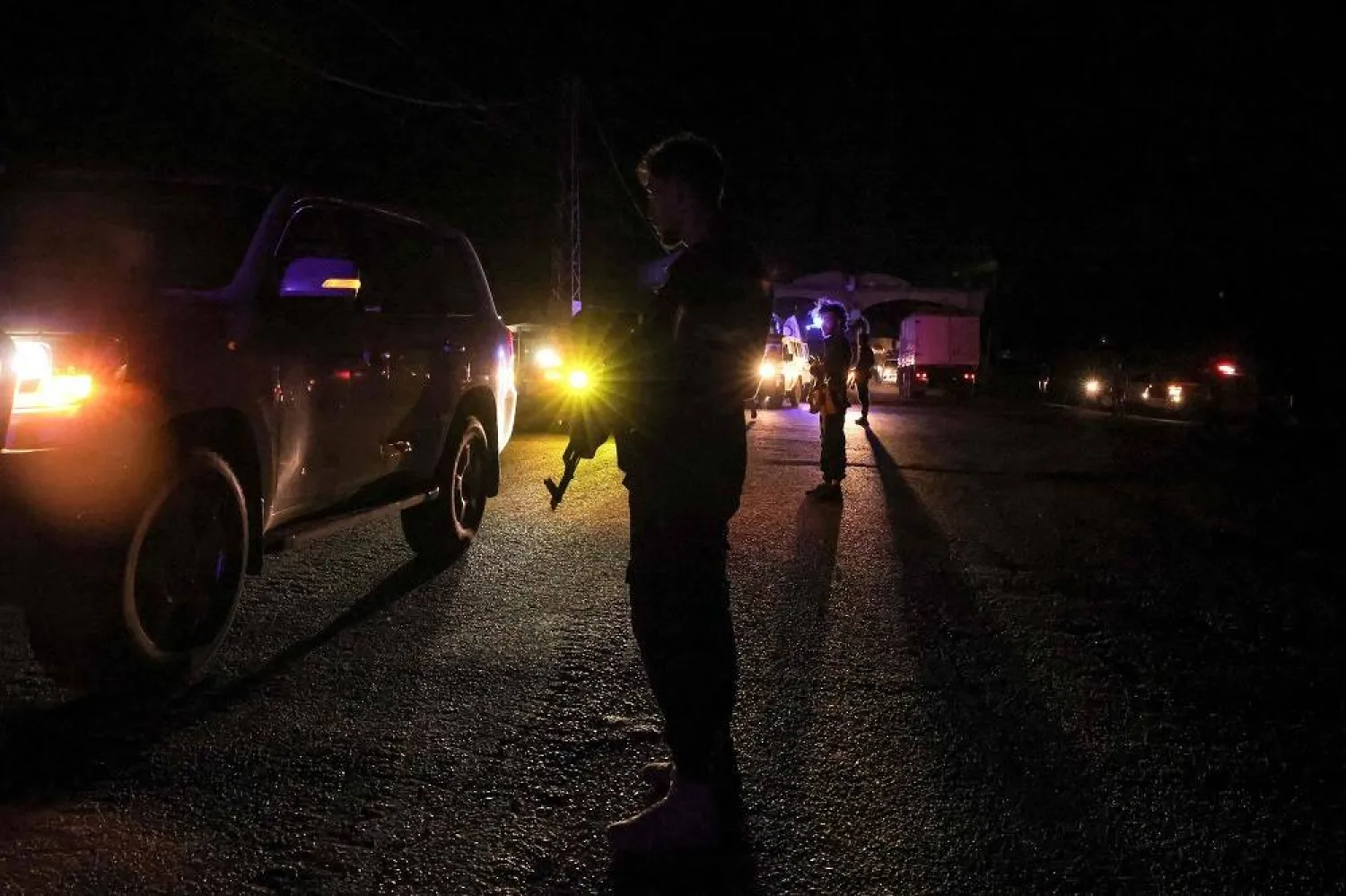
Syrian security forces stand by as a United Nations convoy evacuating families from Sweida moves through the buffer zone in Busra al-Harir in Syria's southern Daraa province on July 22, 2025. (AFP)
TT

Syrian Committee Reports 1,426 Killed in March Violence, Says Commanders Did Not Order It 

Syrian security forces stand by as a United Nations convoy evacuating families from Sweida moves through the buffer zone in Busra al-Harir in Syria's southern Daraa province on July 22, 2025. (AFP)

A Syrian government fact-finding committee said on Tuesday that 1,426 people had died in March in attacks on security forces and subsequent mass killings of Alawites, but concluded that commanders had not given orders for the revenge attacks.

The incidents in the coastal region were the worst violence to hit Syria since the downfall of President Bashar al-Assad last year. The fact-finding committee's work is seen as an important test of the new leadership, made up mainly of former anti-Assad opposition fighters, who are facing new unrest this month involving other minority groups in the southwest.

The committee concluded that Syrian commanders did not give orders to commit violations and, in fact, gave orders to halt them.

It came up with a list of 298 suspects involved in violations against Alawites and 265 involved in the initial attack on security forces, committee head Jumaa Al-Anzi said.

The names are not being released publicly for now and have been referred to courts for further investigations, spokesperson Yasser Farhan said. He added that 31 people who committed violations against civilians had been arrested, as well as six people he referred to as "remnants" of the former regime.

The Supreme Alawite Council condemned the committee's findings, describing it in a statement on Tuesday as an "impudent play." It said it rejects the findings of the committee, blaming the deadly attacks in March on the "de facto authority" represented by Syrian President Ahmed al-Sharaa and his government.

They called for an international and independent investigation under the direct supervision of the United Nations. A Reuters investigation last month identified 1,479 Syrian Alawites killed and dozens who were missing from 40 distinct sites of revenge killings, and found a chain of command leading from the attackers directly to men who serve alongside Syria’s new leaders in Damascus.

Syria's new leadership has long sought to reassure minorities they will be safe.

Safety of minorities has become a major issue again this month with hundreds of people killed in clashes between government security forces, Bedouin fighters, and militants from the Druze sect in the southern province of Sweida. The authorities have set up a new fact-finding committee in response.

'WIDESPREAD BUT NOT ORGANIZED'

The violence began on March 6 with attacks on Syrian security forces stationed in the region. It put hospitals and other state institutions out of operation and caused large areas to fall out of government control, Farhan said.

The committee found that 238 members of the security forces were killed in these attacks, perpetrated by forces aligned with the former Assad government, Farhan said.

In response, around 200,000 armed men mobilized from across Syria, pouring into the coastal region, he said.

This led to violations including killings, theft, and sectarian incitement that the committee found were "widespread but not organized," Farhan said.

He said the committee members had full cooperation from government forces as they carried out months of work, and it was now up to Sharaa whether to release their report in full.

Diana Semaan, Syria researcher at Amnesty International, called for the full findings to be released and for perpetrators to face prosecution.

"In terms of the fact-finding committee, acknowledging that atrocities against Alawite civilians happened is an important step towards justice," she told Reuters.

"Without the proper prosecution of perpetrators, then we have impunity. It won't be the justice and accountability that the victims deserve."



Israel Army Says Killed Six Gaza Gunmen Despite Ceasefire

 Internally displaced Palestinians move between the ruins of destroyed buildings at Al Rashid road in the west of Gaza City on, 06 January 2026, amid a ceasefire between Israel and Hamas. (EPA)
Internally displaced Palestinians move between the ruins of destroyed buildings at Al Rashid road in the west of Gaza City on, 06 January 2026, amid a ceasefire between Israel and Hamas. (EPA)
TT

Israel Army Says Killed Six Gaza Gunmen Despite Ceasefire

 Internally displaced Palestinians move between the ruins of destroyed buildings at Al Rashid road in the west of Gaza City on, 06 January 2026, amid a ceasefire between Israel and Hamas. (EPA)
Internally displaced Palestinians move between the ruins of destroyed buildings at Al Rashid road in the west of Gaza City on, 06 January 2026, amid a ceasefire between Israel and Hamas. (EPA)

The Israeli military said Wednesday it had killed six gunmen in an updated toll from an exchange of fire in Gaza the day before, accusing them of violating the ceasefire in the territory.

The military said in a statement late on Tuesday that it had killed two of six fighters it had identified adjacent to its troops in western Rafah and that tanks had fired on them.

It said they were killed in an ensuing exchange of fire, including aerial strikes, while troops continued to search for the rest.

In a statement on Wednesday, the military said that "following searches that were conducted in the area, it is now confirmed that troops eliminated the six terrorists during the exchange of fire".

It said the presence of the gunmen adjacent to troops and the subsequent incident were a "blatant violation of the ceasefire agreement".

A security source in Gaza reported late on Tuesday that Israeli forces had "opened fire west of Rafah city".

Under a truce that entered into force in October following two years of war between Israel and Hamas, Israeli forces in Gaza withdrew to positions behind a demarcation known as the "yellow line".

The city of Rafah is located behind the yellow line, under Israeli army control. The area beyond the yellow line remains under Hamas authority.

Both sides have repeatedly accused the other of violating the ceasefire.

According to the health ministry in Gaza, which operates under Hamas authority, at least 165 children have been killed in Israeli attacks since the ceasefire began on October 10.

The UN children's agency UNICEF said on Tuesday that at least 100 children -- 60 boys and 40 girls -- had been killed since the truce.

Israeli forces have killed a total of at least 447 Palestinians in Gaza since the ceasefire took effect, according to the ministry.

The Israeli army says gunmen have killed three of its soldiers during the same period.


Source Reveals to Asharq Al-Awsat Names of Some Members of Gaza Technocrat Committee

Palestinians displaced by the Israeli military offensive shelter in an UNRWA school, in Khan Younis, in the southern Gaza Strip, August 19, 2025. (Reuters)
TT

Source Reveals to Asharq Al-Awsat Names of Some Members of Gaza Technocrat Committee

Palestinians displaced by the Israeli military offensive shelter in an UNRWA school, in Khan Younis, in the southern Gaza Strip, August 19, 2025. (Reuters)

An informed Palestinian sources revealed that an agreement has been reached on the majority of the members of the technocratic committee will run the Gaza Strip.

The source, who is a member of the Palestinian civil society, told Asharq Al-Awsat that the 18-member committee will be comprised of Gaza residents who are businessmen, academics or involved in civil society.

The approved members have been informed to head to Cairo, which they will do on Wednesday.

Asharq Al-Awsat learned that the members include Ali Shaath, who served as secretary at the Palestinian Authority's Transportation Ministry, Abdulkarim Ashour, a civil society activist, Aed Yaghi, Director of the Palestinian Medical Relief Society (PMRS) in Gaza, Ayed Abou Ramadan, Chair of the Gaza Chamber of Commerce, and Jaber al-Daour, President of Palestine University.

Other members include Bashir al-Rayyes, an engineering consultant, Omar Shemali, engineer Ali Barhoum, and lawyer Hana Tarazi.

It remains to be seen if Israel has approved the names of the committee, said the source.

Changes could be introduced if objections are made.

Egypt has been intensifying its efforts with all Palestinian parties, American mediators and Israel to speed up the formation of the committee that will run Gaza temporarily and be affiliated with Palestinian President Mahmoud Abbas' government.

Hamas is gearing up to transfer control to the committee once it is finalized.


Aoun, Hezbollah Ties Cool as Contacts Stay at Minimum

Supporters of Hezbollah hold portraits of its general secretaries on the first anniversary of the assassination of Hassan Nasrallah. (Reuters file)
TT

Aoun, Hezbollah Ties Cool as Contacts Stay at Minimum

Supporters of Hezbollah hold portraits of its general secretaries on the first anniversary of the assassination of Hassan Nasrallah. (Reuters file)

Relations between Lebanese President Joseph Aoun and Hezbollah have grown visibly strained, with contacts confined to what ministerial sources described as “the bare minimum.”

The chill has deepened following Aoun’s recent remarks on Hezbollah’s weapons, which widened the rift between the two sides and triggered pointed criticism from the group at the president.

In a televised interview last week marking the first anniversary of his election, Aoun said that “the role of weapons outside the state has ended with the presence of the army, and their continued existence has become a burden on their own environment and on Lebanon as a whole, with no remaining deterrent role.”

In response, former Hezbollah-aligned minister Mohammed Fneish said in a television interview that the party had “reservations on the president’s recent positions,” adding: “We disagree with him in form and substance in some passages. We are not another party. We are a resistance force that played a major role in liberating Lebanon.”

Cool communication

Ministerial sources familiar with Aoun’s position stressed that “the stances he expressed are not new, but the current circumstances may differ from previous ones.”

Speaking to Asharq Al-Awsat, the sources said the remarks stem from the president’s conviction that weapons outside the framework of the state no longer serve any purpose, that their role has ended, and that they have become a burden on everyone, including the Shiite community and Hezbollah’s own base.

“This is, ultimately, a description of an existing reality,” the sources said.

They added that reactions from Hezbollah’s supporters were expected, but would not prevent communication from continuing, since maintaining contact serves the interests of both sides, particularly Hezbollah.

Aoun and Salam

In recent years, Hezbollah had sought to maintain good relations with Aoun. Its lawmakers voted for him during the presidential election session after months of backing Suleiman Franjieh’s candidacy.

The group’s leadership even opened discreet talks with Aoun on what became known as the “national security strategy,” though these discussions yielded no results. Channels of communication remain open on the issue of weapons north of the Litani River, amid Hezbollah’s refusal to cooperate on this file.

Since the cabinet approved a decision last August restricting weapons to the state, Hezbollah’s leadership and supporters have focused their criticism on the government in which the group is represented.

Ties have worsened between Hezbollah and Prime Minister Nawaf Salam, whom the group did not back during parliamentary consultations that named him as premier last year.

A natural reaction

Political writer Dr. Kassem Kassir, who closely follows Hezbollah’s position, said the reaction of the party's supporters to Aoun’s remarks was “a natural response,” particularly because the president did not take into account what he described as the "role of the resistance in protecting Lebanon."

He added that calls to end the role of weapons were made without offering guarantees for what would follow or proposing alternative options.

Kassir told Asharq Al-Awsat that the stance of Hezbollah’s supporters did not necessarily reflect the position of the leadership. Communication channels remain open, but contacts have failed to produce a unified vision.

He added that Hezbollah has formal reservations about the performance of the government and the state, especially regarding Israeli negotiations and what it views as concessions made without guarantees or tangible results.

Duality in rhetoric

University professor and lawyer Ali Murad said that segments of Hezbollah’s supporters on social media adopt an extreme accusatory tone toward anyone who disagrees with them, leaving no room for nuance.

However, he argued that the problem goes beyond the supporters themselves and lies in the political rhetoric and mobilization Hezbollah has relied on for decades, "which entrenched a culture that recognizes only black and white and promotes accusations of betrayal, either fully with us or fully against us."

Murad told Asharq Al-Awsat that the "real issue lies in Hezbollah’s dual rhetoric."

He said the party "is fully aware that the reality has become extremely difficult following major losses and a military defeat on one hand, and the broader retreat of the Axis of Resistance on the other. As a result, a clear contradiction has emerged between what Hezbollah says and what it actually believes."

This contradiction, Murad said, is evident in the speeches of Hezbollah’s secretary general Sheikh Naim Qassem, which reflect two parallel narratives. "One acknowledges reality to a degree while maintaining rejection of handing over weapons. The other is a mobilizing discourse rooted in an earlier era, before the pager operation and the 'support front' war."

“What Aoun said falls in this direction,” Murad said, arguing that Hezbollah in its former state has ended and has become a burden on Lebanon, the Shiite community, and the residents of the south.

"Persisting with the same rhetoric today amounts to rejecting reality and practicing denial, a form of political arrogance reflected by both supporters and the group’s media circles."

No interest in breaking ties

Murad said what angered Hezbollah’s supporters most was “the truth they do not want to acknowledge,” namely that Hezbollah’s role has ended, that it has exited the deterrence equation, and that it can no longer achieve Lebanon’s objectives on its own.

“The president stated a truth that needed to be said,” he said.

Asked whether the relationship between Hezbollah and Aoun was nearing a breaking point, Murad said it was not in Hezbollah’s interest to sever political ties with the president, or even with the prime minister.

He noted that the group understands that the actions of both officials serve Lebanon’s interests and, in particular, the interests of the south.

In some respects, he added, this approach also spares Hezbollah and its base the risks of "fatal choices that could lead to a bleak outcome if denial or political self-destruction were to prevail."