


IRGC Announces its Readiness to Confront Israel’s New Threats to Strike Iran

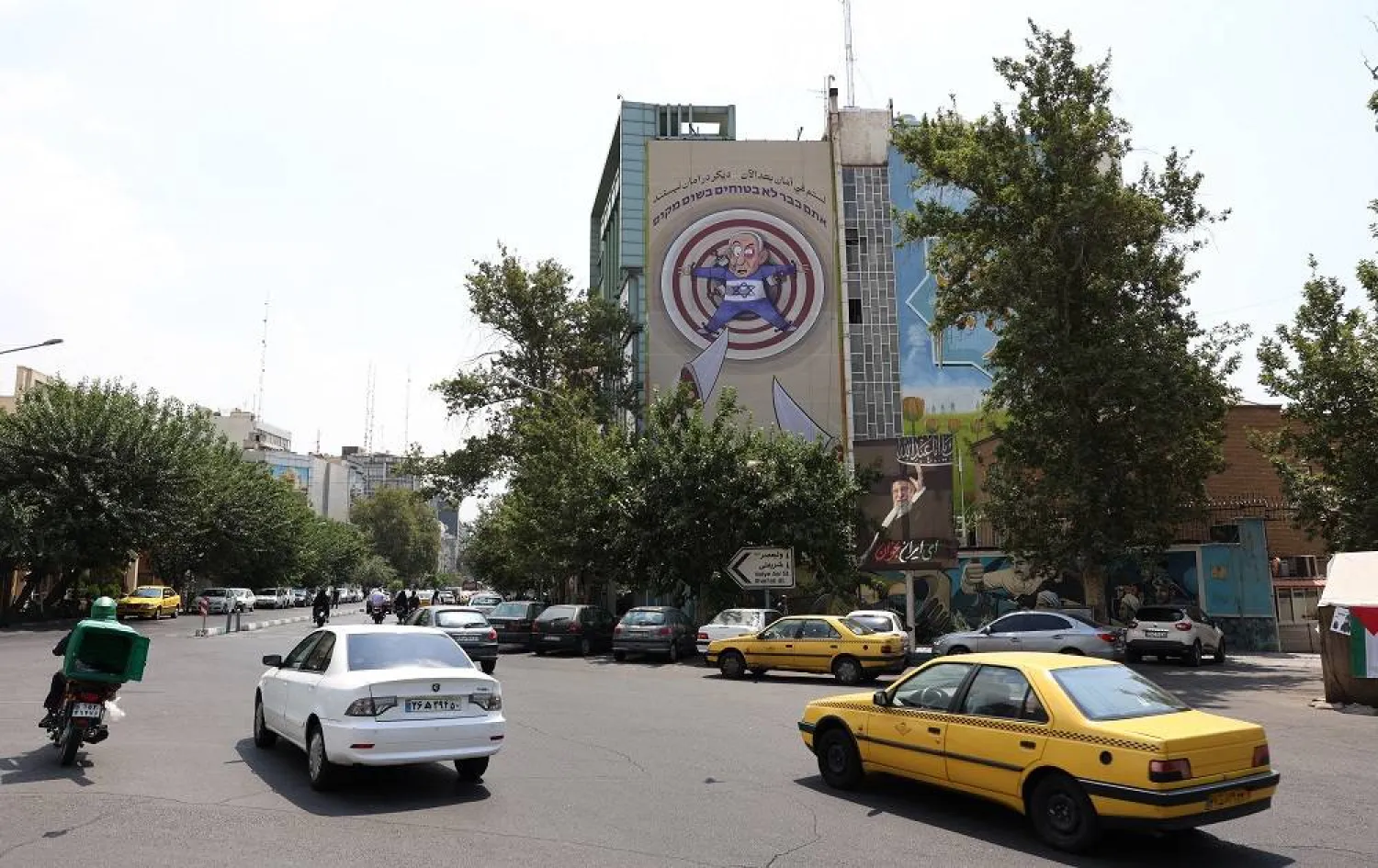
Cars drive past past an anti-Israel billboard featuring a cartoon of Israeli Prime Minister Benjamin Netanyahu reading in Persian "You are no longer safe" at Palestine Square in Tehran, Iran, 14 July 2025. (EPA)
TT

IRGC Announces its Readiness to Confront Israel’s New Threats to Strike Iran

Cars drive past past an anti-Israel billboard featuring a cartoon of Israeli Prime Minister Benjamin Netanyahu reading in Persian "You are no longer safe" at Palestine Square in Tehran, Iran, 14 July 2025. (EPA)

Commander of the Iranian Revolutionary Guards Corps’ (IRGC) Aerospace Force, Brigadier General Majid Mousavi said the Iranian armed forces “must prepare for any situation.”

His statement came shortly after Israeli officials and military commanders said Tel Aviv could wage new strikes on Iran.

In his inaugural televised interview on Tuesday evening, Mousavi said Iran’s armed forces “must prepare for any situation,” but added that “the most important task is the correct understanding of our responsibility in this arena.”

Mousavi described Iran’s resilience as “an ever-repeating Ashura,” signaling that the war with Israel could recur at any moment.

He vowed to uphold Iran’s deterrence doctrine “until blood flows in our veins, we will continue guarding the revolution.”

The newly appointed general then linked Iran’s operational readiness to spiritual destiny, “urging personnel to emulate martyrs who lived and fought for the ultimate goal: delivering this flag to its true owner, Imam Mahdi.”

On Tuesday, Israeli Defense Minister Israel Katz said there is a possibility of a renewed campaign against Iran, according to a statement from his office.

His statements came during a multi-scene situation assessment with several top Israeli military officials, including the chief of staff, Eyal Zamir.

Katz stressed the necessity of formulating an effective enforcement plan for the future to ensure that Iran does not restore its nuclear program.

He also addressed ongoing regional conflicts, saying “there are two open fronts - Gaza and Yemen - which must be decisively resolved under a firm offensive policy, as was done in Iran, Lebanon and Syria.”

On Wednesday, the New York Times reported that for more than two weeks, mysterious explosions and fires have erupted across Iran, setting ablaze apartment complexes and oil refineries, a road outside a major airport and even a shoe factory.

It wrote that in public, Iranian officials have shrugged off the events as mere coincidence or blamed aging infrastructure, trying to soothe the frayed nerves of a population still traumatized by the country’s war with Israel and the United States in June.

But in private, three Iranian officials, including a member of the IRGC told the newspaper they believed that many of them were acts of sabotage.

The three Iranian officials said they believed that saboteurs might have wanted to stoke panic among judges and prosecutors that they could be targeted, similar to the way Israel previously attacked scientists involved in Iran’s nuclear program.

The Guards member said that the cumulative effect of the near-daily explosions - even if some of them were accidents - was a growing sense of anxiety among both officials and Iranians more broadly.

A European official who deals with Iran said he had also assessed the attacks as sabotage and suspected Israel of involvement, based on its history in Iran - both as a form of psychological warfare and to take out targets.

The Iranian authorities who spoke publicly cited other causes for the explosions, including gas leaks, garbage fires and old infrastructure. But they have also not given the public a convincing explanation of why gas explosions are occurring at a rate of one to two per day across the country.

The national gas company released statistics that it argued showed no notable increase in explosions from gas leaks this year compared with last year’s.

To cope with the stress, many Iranians have turned to dark comedy. On social media, they have been sharing photoshopped pictures of Israel’s prime minister, Benjamin Netanyahu, wearing the uniform of Iran’s national gas company.

Meanwhile, Abdollah Haji Sadeghi, a representative of Iranian Supreme Leader Ali Khamenei, said Israel tried to “achieve all its goals” during the first 48 hours of the war.

“They thought that the economic pressures had exhausted the Iranian people and that the hand of the country in the region had been cut off,” he said.

“They bet on internal chaos and had planned to hit two power centers, the nuclear program and the missile system,” he said, adding that “their plan has miserably failed.”



Trump Moves to Block Courts from Seizing Venezuelan Oil Revenue in US Accounts

 The sun rises in Caracas, Venezuela, Saturday, Jan. 10, 2026, a week after US forces captured Venezuelan President Nicolas Maduro. (AP)
The sun rises in Caracas, Venezuela, Saturday, Jan. 10, 2026, a week after US forces captured Venezuelan President Nicolas Maduro. (AP)
TT

Trump Moves to Block Courts from Seizing Venezuelan Oil Revenue in US Accounts

 The sun rises in Caracas, Venezuela, Saturday, Jan. 10, 2026, a week after US forces captured Venezuelan President Nicolas Maduro. (AP)
The sun rises in Caracas, Venezuela, Saturday, Jan. 10, 2026, a week after US forces captured Venezuelan President Nicolas Maduro. (AP)

US President Donald Trump signed an executive order aimed at blocking courts or creditors from impounding revenue tied to the sale of Venezuelan oil held in US Treasury accounts, the White House said on Saturday.

The emergency order said the revenue, held in foreign government deposit funds, should be used in Venezuela to help create "peace, prosperity and stability."

The order was signed on ‌Friday, less ‌than a week after US ‌forces ⁠captured Venezuelan leader ‌Nicolas Maduro in Caracas. Several companies have longstanding claims against the country. Exxon Mobil and ConocoPhillips, for example, left Venezuela nearly 20 years ago after their assets were nationalized. Both are still owed billions of dollars.

The order does not mention any ⁠specific company. It declares that the money is the sovereign ‌property of Venezuela held in US ‍custody for governmental and ‍diplomatic purposes and is not subject to private ‍claims.

"President Trump is preventing the seizure of Venezuelan oil revenue that could undermine critical US efforts to ensure economic and political stability in Venezuela," the White House said in a fact sheet.

A US agreement with Venezuela's interim leaders would provide ⁠up to the US, where numerous refineries are specially equipped to refine it.

Trump cited the 1977 International Emergency Economic Powers Act and the 1976 National Emergencies Act as a legal justification.

Trump signed the order the same day he met in Washington with executives from Exxon, Conoco, Chevron and other oil companies as part of a bid to encourage them to invest $100 billion in Venezuela's oil ‌industry.


As Protests Rage, Iran Pulls the Plug on Contact with the World

 This frame grab from a video released Friday, Jan. 9, 2026, by Iranian state television shows a man holding a device to document burning vehicles during a night of mass protests in Zanjan, Iran. (Iranian state TV via AP)
This frame grab from a video released Friday, Jan. 9, 2026, by Iranian state television shows a man holding a device to document burning vehicles during a night of mass protests in Zanjan, Iran. (Iranian state TV via AP)
TT

As Protests Rage, Iran Pulls the Plug on Contact with the World

 This frame grab from a video released Friday, Jan. 9, 2026, by Iranian state television shows a man holding a device to document burning vehicles during a night of mass protests in Zanjan, Iran. (Iranian state TV via AP)
This frame grab from a video released Friday, Jan. 9, 2026, by Iranian state television shows a man holding a device to document burning vehicles during a night of mass protests in Zanjan, Iran. (Iranian state TV via AP)

Just after 8 p.m. Thursday, Iran's theocracy pulled the plug and disconnected the country's 85 million people from the rest of the world.

Following a playbook used both in demonstrations and in war, Iran severed the internet connections and telephone lines that connect its people to the vast diaspora in the United States, Europe and elsewhere. Until now, even while facing strict sanctions over the country's nuclear program, Iranians still could access mobile phone apps and even websites blocked by the theocracy, using virtual private networks to circumvent restrictions.

Thursday's decision sharply limits people from sharing images and witness accounts of the nationwide protests over Iran's ailing economy that have grown to pose the biggest challenge to the government in years. It also could provide cover for a violent crackdown after the Trump administration warned Iran's government about consequences for further deaths among demonstrators.

As the country effectively goes dark, loved ones abroad are frantic for any scrap of news, especially as Iran’s attorney general warned on Saturday that anyone taking part in protests will be considered an “enemy of God,” a death-penalty charge

“You can’t understand our feelings. My brothers, my cousins, they will go on the street. You can’t imagine the anxiety of the Iranian diaspora,” said Azam Jangravi, a cybersecurity expert in Toronto who opposes Iran's government. “I couldn’t work yesterday. I had meetings but I postponed them because I couldn’t focus. I was thinking of my family and friends.”

Her voice cracked as she added: “A lot of people are being killing and injured by Iran, and we don’t know who.”

Even Starlink is likely being jammed

This is the third time Iran has shut down the internet from the outside world. The first was in 2019, when demonstrators angry about a spike in government-subsidized gasoline prices took to the streets. Over 300 people reportedly were killed.

Then came the protests over the 2022 death of Mahsa Amini following her arrest by the country’s morality police over allegedly not wearing her hijab, or headscarf, to the liking of authorities. A monthslong crackdown killed more than 500 people.

While the connectivity offered by Starlink played a role in the Amini demonstrations, the deployment of its receivers is now far greater in Iran. That's despite the government never authorizing Starlink to function, making the service illegal to possess and use.

A year ago, an Iranian official estimated tens of thousands of Starlink receivers in the country, a figure that Los Angeles-based internet freedom activist Mehdi Yahyanejad said sounded right.

While many receivers likely are in the hands of business people and others wanting to stay in touch with the outside world for their livelihoods, Yahyanejad said some are now being used to share videos, photos and other reporting on the protests.

“In this case, because all those things have been disrupted, Starlink is playing the key for getting all these videos out,” Yahyanejad said.

However, Starlink receivers are facing challenges. Since its 12-day war with Israel last June, Iran has been disrupting GPS signals, likely in a bid to make drones less effective. Starlink receivers use GPS signals to position themselves to connect to a constellation of low-orbit satellites.

Amir Rashidi, director of digital rights and security at the Miaan Group and an expert on Iran, said that since Thursday he had seen about a 30% loss in packets being sent by Starlink devices — basically units of data that transmit across the internet. In some areas of Iran, Rashidi said there had been an 80% loss in packets.

“I believe the Iranian government is doing something beyond GPS jamming, like in Ukraine where Russia tried to jam Starlink,” Rashidi said. He suggested Iran may be using a mobile jammer, like it did in previous decades to disrupt satellite television receivers.

The International Telecommunication Union, a United Nations agency, has called on Iran to stop jamming in the past.

Meanwhile, Iran has been advocating at the ITU for Starlink service to the country to be stopped.

Help ‘needs to come soon’

It appears that the majority of information coming out of Iran since Thursday night is being transmitted via Starlink, which is now illegal. That carries dangers for those possessing the devices.

“It’s really hard to use it because if they arrest a person, they can execute the person and say this person is working for Israel or the United States,” Jangravi said.

Not using it, however, means the world knows even less about what's happening inside Iran at a pivotal moment.

“This sort of nonviolent protest is not sustainable when the violence (by security forces) is so extreme,” Yahyanejad said. “Unless something changes in the next two or three days, these protests can die down, too. If there’s any help, it needs to come soon.”


One Dead, Seven Missing After Migrant Boat Sinks off Türkiye

This photograph shows the oil tanker the "Maridive 703" sailing in the search-and-rescue zone of the international waters between Malta and Tunisia, on December 31, 2025. (AFP)
TT

One Dead, Seven Missing After Migrant Boat Sinks off Türkiye

This photograph shows the oil tanker the "Maridive 703" sailing in the search-and-rescue zone of the international waters between Malta and Tunisia, on December 31, 2025. (AFP)

One person died and seven others were missing Saturday after a migrant boat sank in the Aegean Sea off the coast of Türkiye, the Turkish coast guard said.

Thirty-seven passengers on a rubber dinghy which took on water before dawn off the western city of Dikili, north of Izmir, were rescued alive, the coast guard stated.

Dikili, a small seaside resort, faces the Greek island of Lesbos, some 20 kilometers (12 miles) away.

"Search operations ... are continuing to find the seven missing irregular migrants," the coast guard said.

Shipwrecks are common for perilous crossings to the Greek islands, which are a gateway to the European Union.

Nearly 1,900 migrants either disappeared or were found drowned in the Mediterranean in 2025, according to the International Organization for Migration.