


USAID Analysis Finds No Evidence of Massive Hamas Theft of Gaza Aid 

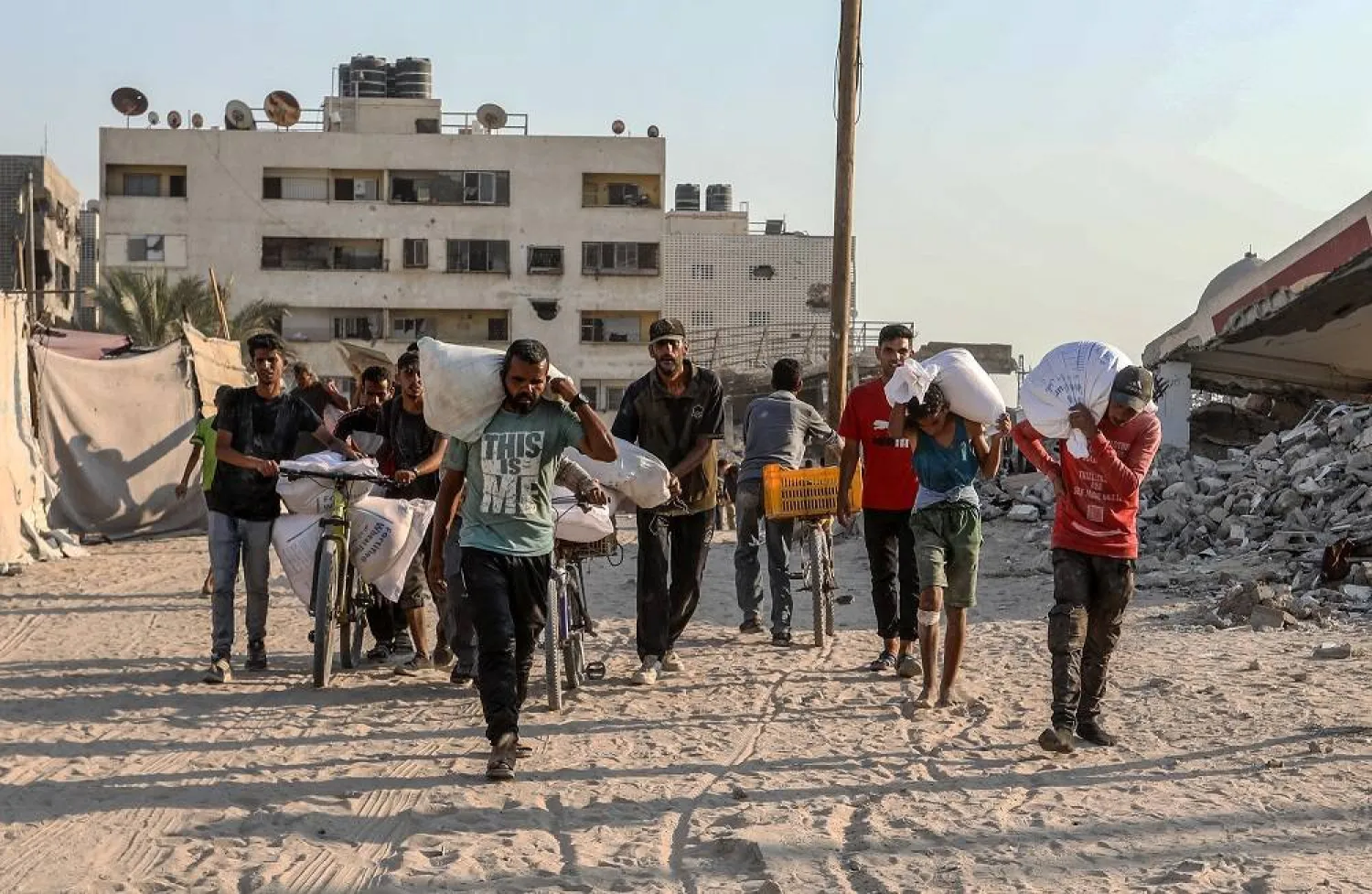
24 July 2025, Palestinian Territories, Khan Younis: Palestinians carrying bags of flour walk along a street in Khan Younis after trucks carrying humanitarian aid entered the southern Gaza Strip through the Israeli-controlled Kerem Shalom border crossing. (dpa)
TT

USAID Analysis Finds No Evidence of Massive Hamas Theft of Gaza Aid 

24 July 2025, Palestinian Territories, Khan Younis: Palestinians carrying bags of flour walk along a street in Khan Younis after trucks carrying humanitarian aid entered the southern Gaza Strip through the Israeli-controlled Kerem Shalom border crossing. (dpa)

An internal US government analysis found no evidence of systematic theft by the Palestinian group Hamas of US-funded humanitarian supplies, challenging the main rationale that Israel and the US give for backing a new armed private aid operation.

The analysis, which has not been previously reported, was conducted by a bureau within the US Agency for International Development and completed in late June. It examined 156 incidents of theft or loss of US-funded supplies reported by US aid partner organizations between October 2023 and this May.

It found "no reports alleging Hamas" benefited from US-funded supplies, according to a slide presentation of the findings seen by Reuters.

A State Department spokesperson disputed the findings, saying there is video evidence of Hamas looting aid, but provided no such videos. The spokesperson also accused traditional humanitarian groups of covering up "aid corruption."

The findings were shared with the USAID's inspector general's office and State Department officials involved in Middle East policy, said two sources familiar with the matter, and come as dire food shortages deepen in the devastated enclave.

Israel says it is committed to allowing in aid but must control it to prevent it from being stolen by Hamas, which it blames for the crisis.

The UN World Food Program says nearly a quarter of Gaza’s 2.1 million Palestinians face famine-like conditions, thousands are suffering acute malnutrition, and the World Health Organization and doctors in the enclave report starvation deaths of children and others.

The UN also estimates that Israeli forces have killed more than 1,000 people seeking food supplies, the majority near the militarized distribution sites of the Gaza Humanitarian Foundation (GHF), the new private aid group that uses a for-profit US logistics firm run by a former CIA officer and armed US military veterans.

The study was conducted by the Bureau of Humanitarian Assistance (BHA) of USAID, which was the largest funder of assistance to Gaza before the Trump administration froze all US foreign aid in January, terminating thousands of programs. It has also begun dismantling USAID, whose functions have been folded into the State Department.

The analysis found that at least 44 of the 156 incidents where aid supplies were reported stolen or lost were "either directly or indirectly" due to Israeli military actions, according to the briefing slides.

Israel's military did not respond to questions about those findings.

The study noted a limitation: because Palestinians who receive aid cannot be vetted, it was possible that US-funded supplies went to administrative officials of Hamas, the rulers of Gaza.

One source familiar with the study also cautioned that the absence of reports of widespread aid diversion by Hamas "does not mean that diversion has not occurred."

The war in Gaza began after Hamas attacked Israel in October 2023, killing 1,200 people and capturing 251 hostages, according to Israeli tallies. Nearly 60,000 Palestinians have been killed since the Israeli assault began, according to Palestinian health officials.

ISRAEL SAYS HAMAS DIVERTS HUMANITARIAN AID

Israel, which controls access to Gaza, has said that Hamas steals food supplies from UN and other organizations to use to control the civilian population and boost its finances, including by jacking up the prices of the goods and reselling them to civilians.

Asked about the USAID report, the Israeli military told Reuters that its allegations are based on intelligence reports that Hamas fighters seized cargoes by "both covertly and overtly" embedding themselves on aid trucks.

Those reports also show that Hamas has diverted up to 25% of aid supplies to its fighters or sold them to civilians, the Israeli military said, adding that GHF has ended the group's control of aid by distributing it directly to civilians.

Hamas denies the allegations. A Hamas security official said that Israel has killed more than 800 Hamas-affiliated police and security guards trying to protect aid vehicles and convoy routes. Their missions were coordinated with the UN.

Reuters could not independently verify the claims by Hamas and Israel, which has not made public proof that the fighters have systematically stolen aid.

GHF also accuses Hamas of massive aid theft in defending its distribution model. The UN and other groups have rejected calls by GHF, Israel and the US to cooperate with the foundation, saying it violates international humanitarian principles of neutrality.

In response to a request for comment, GHF referred Reuters to a July 2 Washington Post article that quoted an unidentified Gazan and anonymous Israeli officials as saying Hamas profited from the sales and taxing of pilfered humanitarian aid.

AID GROUPS REQUIRED TO REPORT LOSSES

The 156 reports of theft or losses of supplies reviewed by BHA were filed by UN agencies and other humanitarian groups working in Gaza as a condition of receiving US aid funds.

The second source familiar with the matter said that after receiving reports of US-funded aid thefts or losses, USAID staff followed up with partner organizations to try to determine if there was Hamas involvement.

Those organizations also would "redirect or pause" aid distributions if they learned that Hamas was in the vicinity, the source said. Aid organizations working in Gaza also are required to vet their personnel, sub-contractors and suppliers for ties to extremist groups before receiving US funds, a condition that the State Department waived in approving $30 million for GHF last month.

The slide presentation noted that USAID partners tended to over-report aid diversion and theft by groups sanctioned or designated by the US as foreign terrorist organizations - such as Hamas and Palestinian Islamic Jihad - because they want to avoid losing US funding.

Of the 156 incidents of loss or theft reported, 63 were attributed to unknown perpetrators, 35 to armed actors, 25 to unarmed people, 11 directly to Israeli military action, 11 to corrupt subcontractors, five to aid group personnel "engaging in corrupt activities," and six to "others," a category that accounted for "commodities stolen in unknown circumstances," according to the slide presentation.

The armed actors "included gangs and other miscellaneous individuals who may have had weapons," said a slide. Another slide said "a review of all 156 incidents found no affiliations with" US-designated foreign terrorist organizations, of which Hamas is one.

"The majority of incidents could not be definitively attributed to a specific actor," said another slide. "Partners often largely discovered the commodities had been stolen in transit without identifying the perpetrator."

It is possible there were classified intelligence reports on Hamas aid thefts, but BHA staff lost access to classified systems in the dismantlement of USAID, said a slide.

However, a source familiar with US intelligence assessments told Reuters that they knew of no US intelligence reports detailing Hamas aid diversions and that Washington was relying on Israeli reports.

The BHA analysis found that the Israeli military "directly or indirectly caused" a total of 44 incidents in which US-funded aid was lost or stolen. Those included the 11 attributed to direct Israeli military actions, such as airstrikes or orders to Palestinians to evacuate areas of the war-torn enclave.

Losses indirectly attributed to Israeli military included cases where they compelled aid groups to use delivery routes with high risks of theft or looting, ignoring requests for alternative routes, the analysis said.



Lebanese Army Discovers Hezbollah Tunnel in South

Lebanese army members stand on a military vehicle during a Lebanese army media tour, to review the army's operations in the southern Litani sector, in Alma Al-Shaab, near the border with Israel, southern Lebanon, November 28, 2025. (Reuters)
TT

Lebanese Army Discovers Hezbollah Tunnel in South

Lebanese army members stand on a military vehicle during a Lebanese army media tour, to review the army's operations in the southern Litani sector, in Alma Al-Shaab, near the border with Israel, southern Lebanon, November 28, 2025. (Reuters)

The Lebanese army has uncovered a tunnel built by Hezbollah in the southern town of Touline after carrying out an excavation at the request of the ceasefire oversight committee known as the Mechanism, Lebanese media reported. The site had previously been struck by an Israeli attack, according to the reports.

This was not the first time the Lebanese army has inspected sites at the request of the Mechanism or following Israeli threats, as part of coordination between the military, the committee overseeing the cessation of hostilities and the United Nations Interim Force in Lebanon (UNIFIL).

A similar inspection took place last week when the army conducted a thorough search of a building in the southern town of Yanouh after Israel threatened to strike the house.

No weapons were found. After the Lebanese army deployed, the Israeli military announced it had temporarily suspended the strike it had threatened on what it described as Hezbollah military infrastructure in the town.

The developments came as Israeli strikes on southern Lebanon continued, with an air raid on Wednesday hitting the town of Kfar Kila. No casualties were reported, said the state-run National News Agency.

Meanwhile, Deputy Prime Minister Tarek Mitri described the Mechanism as a “platform for discussion and a framework for oversight and verification of compliance with agreements”, stressing that Lebanon has adhered to its commitments since the first day of the 2024 ceasefire, while Israeli violations have continued.

On Hezbollah’s weapons, Mitri said during the opening session of the eighth conference of the Carnegie Middle East Center in Beirut that Lebanese army commander General Rodolphe Haykal had proposed a five-phase plan starting with strengthening the army’s capabilities.

He stressed that extending state authority in the area surrounding the Litani River was making gradual progress, with the army nearing completion of its mission south of the Litani in preparation for moving to later phases.

On reconstruction, Mitri added that the international community was making the extension of state authority a key condition for support. He hoped that Arab states would play a supportive role through their international relations.

The developments come ahead of a new meeting of the Mechanism tasked with monitoring the ceasefire, scheduled for Dec. 19.

It will be the second meeting attended by the head of the Lebanese delegation, Ambassador Simon Karam, after his participation alongside an Israeli civilian in the previous session earlier this month, marking the first direct talks between the two countries.

President Joseph Aoun met Karam on Wednesday and provided him with guidance ahead of the meeting.

The ceasefire monitoring committee includes Lebanon, Israel, France, the United States and the United Nations.

The ceasefire agreement stipulates a halt to hostilities, the withdrawal of Hezbollah north of the Litani River, leading to its disarmament across Lebanon, and the withdrawal of Israeli forces from positions they occupied during the latest war.

Israel, however, maintains a presence at five “strategic” sites inside Lebanese territory, while Hezbollah refuses to disarm.


Bahbah to Asharq Al-Awsat: Second Phase of Gaza Ceasefire Begins Next Month

 Palestinians walk along a street surrounded by buildings destroyed during Israeli air and ground operations in Gaza City, Wednesday, Dec. 17, 2025. (AP)
Palestinians walk along a street surrounded by buildings destroyed during Israeli air and ground operations in Gaza City, Wednesday, Dec. 17, 2025. (AP)
TT

Bahbah to Asharq Al-Awsat: Second Phase of Gaza Ceasefire Begins Next Month

 Palestinians walk along a street surrounded by buildings destroyed during Israeli air and ground operations in Gaza City, Wednesday, Dec. 17, 2025. (AP)
Palestinians walk along a street surrounded by buildings destroyed during Israeli air and ground operations in Gaza City, Wednesday, Dec. 17, 2025. (AP)

The second phase of the Gaza ceasefire agreement is expected to begin in January, likely in the first or second week, according to Bishara Bahbah, head of the Arab Americans for Peace Committee and a mediator closely aligned with the US administration on the Gaza file.

Bahbah told Asharq Al-Awsat on Wednesday that preparations for managing Gaza are already complete, with the names of the prospective committee finalized and Palestinian Health Minister Majed Abu Ramadan emerging as the most likely candidate to lead the body.

Bahbah, who remains close to White House deliberations on Gaza, said Washington supports the presence of Turkish forces as part of an international stabilization force, viewing them as the most capable of maintaining stability in the enclave.

He said the anticipated meeting between US President Donald Trump and Israeli Prime Minister Benjamin Netanyahu later this month will be decisive for the second phase, noting that the United States will press for its launch next month and for a decision on Türkiye’s participation in the stabilization force.

Defining the mission

Bahbah disclosed details of a meeting held on Tuesday in the Qatari capital Doha on the formation of an international stabilization force for Gaza.

He said one of the main objectives was for Washington to clearly identify which countries are prepared to participate and to determine the nature of each country’s contribution, whether through troops, training, or technical and logistical support.

He said the second objective of the meeting was to clarify how the forces would coordinate with one another and establish a command structure, noting that one proposal under discussion is for a US general to lead the international force.

Discussions also covered deployment locations and whether the force would be stationed outside the so-called yellow line separating Israeli-controlled areas from Hamas-held zones, within that line, or inside densely populated areas, as well as which parties would provide funding, he added.

Rejection of Israel’s approach

On deployment plans, Bahbah said discussions are ongoing but that the model sought by Israel was rejected by an overwhelming majority of participating countries, indicating broad agreement on monitoring rather than combat roles.

On the nature of the mission, he stated that most participating states are unwilling to play any role related to disarmament, instead seeking to act as a buffer between Israeli forces and populated areas in order to protect civilians.

The ultimate objective of the force’s presence is Israel’s gradual withdrawal from the Gaza Strip, he stressed.

“These forces will not act on Israel’s behalf, particularly on disarmament,” Bahbah said, adding that Hamas leaders had expressed to him a willingness to negotiate on the issue.

“Using force will not work,” he warned, noting that Israel had failed to disarm Hamas by force over the past two years and that no international party would succeed in doing so militarily.

A car is seen partially submerged next to a small boat in a flooded area after heavy rains in a makeshift camp for displaced Palestinians in Zawaida, central Gaza Strip, Wednesday, Dec. 17, 2025. (AP)

Türkiye’s participation pivotal

On Türkiye’s role, Bahbah described Ankara’s participation as pivotal, saying Türkiye is the closest country to Hamas and the most capable of engaging with the group over its weapons, something other states struggle to do.

He said the presence of Turkish forces in Gaza would be essential and would lead to greater stability, adding that Washington supports their involvement.

Bahbah said Trump is expected to pressure Netanyahu during their upcoming meeting in the United States later this month to accept Turkish participation.

He added that Israel is likely to seek conditions, possibly pushing for a compromise in which Türkiye’s role would be technical rather than armed, but stressed that pressure from the US administration would be decisive.

Second phase commitments

On the so-called Peace Council, Bahbah noted that Trump has spoken of many world leaders wanting to join it, stressing that membership would not be free and would entail commitments, including funding, providing security forces, or other obligations.

Asked about potential members, he said names he has seen for the executive council include US envoys Steve Witkoff and Trump’s son-in-law Jared Kushner, former British prime minister Tony Blair, former US ambassador Richard Grenell, and former Bulgarian diplomat Nickolay Mladenov.

On Gaza’s administration, Bahbah revealed that a list of 42 candidates for a technocratic committee has been approved by Hamas, Fatah, and Egypt, adding that Health Minister Abu Ramadan is likely to chair the committee.

Despite talk of obstacles to moving to the second phase, Bahbah said he expects it to be launched in the first or second week of January, specifically after the Trump-Netanyahu summit resolves outstanding issues.

He denied knowledge of any arrangements for Egyptian President Abdel Fattah al-Sisi to attend the summit.

Trump will not allow the agreement to fail, he remarked, describing this as “100 percent certain” and adding that Hamas remains committed to the ceasefire despite continued Israeli violations.

Bahbah said the movement understands that Israel is seeking any pretext to resume what he described as acts of annihilation in Gaza and is therefore showing greater restraint to deny it that opportunity.


Report: RSF Destroying Evidence of Atrocities in Sudan

The Sudanese flag flutters in Omdurman, part of greater Khartoum on December 13, 2025. (AFP)
TT

Report: RSF Destroying Evidence of Atrocities in Sudan

The Sudanese flag flutters in Omdurman, part of greater Khartoum on December 13, 2025. (AFP)

Sudan's paramilitary Rapid Support Forces destroyed and concealed evidence of mass killings they committed after overrunning the Darfur city of el-Fasher, a new report has found.

Yale University's Humanitarian Research Lab (HRL), which has used satellite imagery to monitor atrocities since the RSF's war with the army began, said on Tuesday the group "destroyed and concealed evidence of its widespread mass killings" in the North Darfur state capital.

The RSF's violent takeover of the army's last holdout position in the Darfur region in October led to international outrage over reports of summary executions, systematic rape and mass detention.

The HRL said that in the aftermath of the takeover, it had identified 150 clusters of objects consistent with human remains.

Dozens were consistent with reports of execution-style killings, and dozens more with reports of the RSF killing civilians as they fled.

Within a month, nearly 60 of those clusters were no longer visible, while eight earth disturbances appeared near the sites of mass killing, the HRL said.

It said the disturbances were not consistent with civilian burial practices.

"Largescale and systematic mass killing and body disposal has occurred," the report determined, estimating the death toll in the city to be in the tens of thousands.

Aid groups and the United Nations have repeatedly demanded safe access to el-Fasher, where communications remain cut and an estimated tens of thousands of survivors are trapped, many detained by the RSF.

The UN has called the Sudan conflict a "a war of atrocities".

There is no confirmed death toll from the Sudan war which began in April 2023, with estimates at more than 150,000.

The fighting has also displaced millions of people, and created the world's largest hunger and displacement crises.

Efforts to end the war have repeatedly faltered.