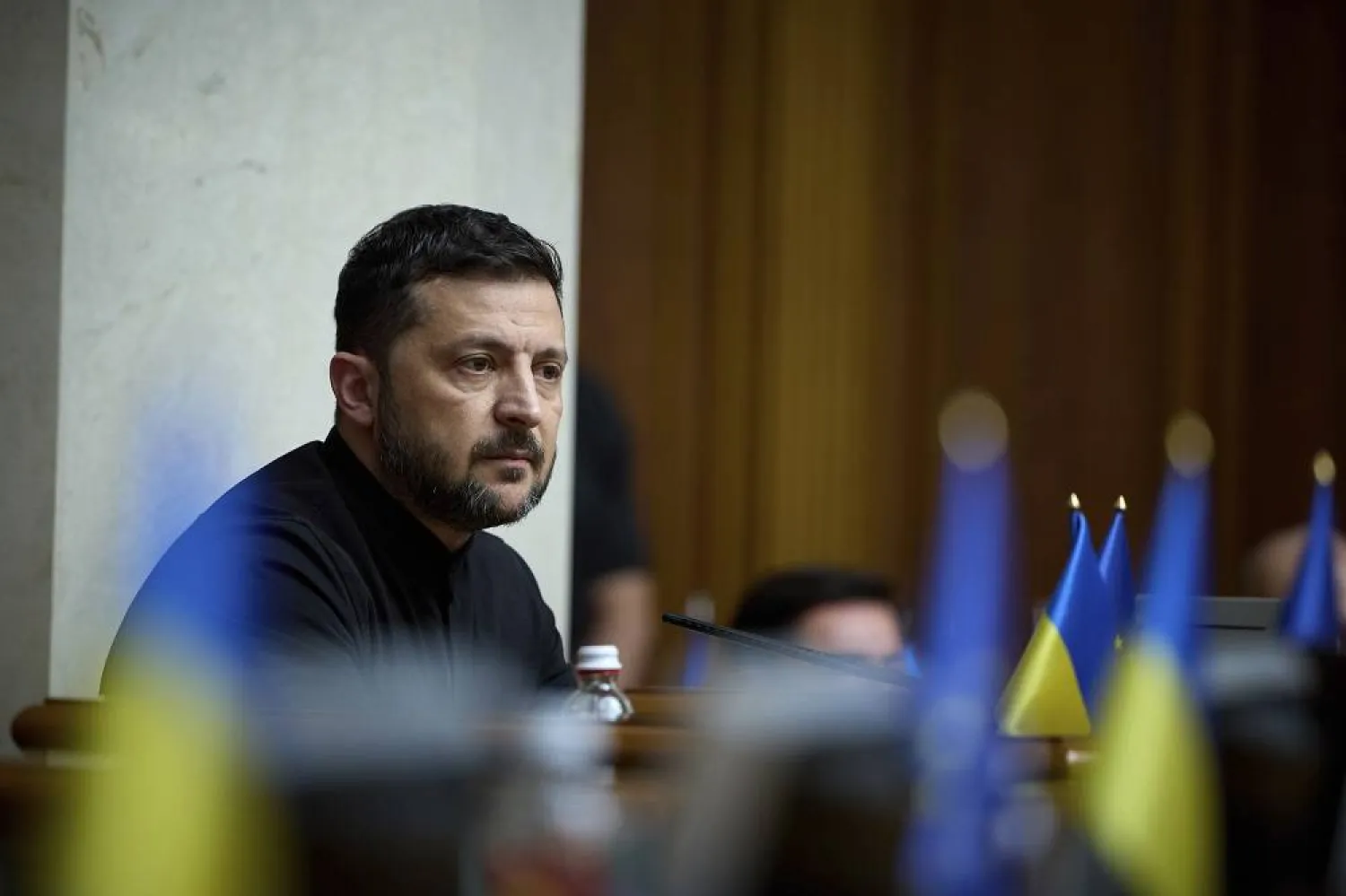
Zelenskiy Says Ukraine Has Secured Three Patriot Systems, Looking to Finance Seven More

President of Ukraine Volodymyr Zelenskyy attends the parliament session in Kyiv, Ukraine Thursday, July 17, 2025. (AP) 
TT

Zelenskiy Says Ukraine Has Secured Three Patriot Systems, Looking to Finance Seven More

President of Ukraine Volodymyr Zelenskyy attends the parliament session in Kyiv, Ukraine Thursday, July 17, 2025. (AP) 

Ukraine has received confirmation from partners that they will provide three Patriot missile defense systems and discussions are underway to obtain seven more, Ukrainian President Volodymyr Zelenskiy said on Thursday.

"I have officially received confirmation from Germany for two systems, and from Norway for one. We are currently working with Dutch partners," he told reporters.

President Donald Trump announced earlier this month that billions of dollars of US weapons would go to Ukraine, including Patriot missiles. This set off negotiations around which partners could contribute to the weapons purchasing scheme -- a process that will determine the support Ukraine receives, Reuters said.

The Patriot systems have proven effective at destroying Russian ballistic missiles aimed at Ukraine's cities.

In addition to securing air defense supplies, Ukraine needs to cover a financing gap of $40 billion next year, Zelenskiy said in remarks released by his office.

An additional $25 billion will be needed for missiles, drones and electronic warfare systems production, he added.


Iran Names Mojtaba Khamenei to Succeed His Slain Father as Supreme Leader

FILE PHOTO: Mojtaba Khamenei, the second son of Iran's Supreme Leader Ayatollah Ali Khamenei, visits Hezbollah's office in Tehran, Iran, October 1, 2024. Office of the Iranian Supreme Leader/WANA (West Asia News Agency)/Handout via REUTERS/File Photo
TT

Iran Names Mojtaba Khamenei to Succeed His Slain Father as Supreme Leader

FILE PHOTO: Mojtaba Khamenei, the second son of Iran's Supreme Leader Ayatollah Ali Khamenei, visits Hezbollah's office in Tehran, Iran, October 1, 2024. Office of the Iranian Supreme Leader/WANA (West Asia News Agency)/Handout via REUTERS/File Photo

Mojtaba Khamenei, a son of Iran's late supreme leader, has been named his successor, Iranian state TV announced early Monday, as the war that began a little over a week ago with his father's killing took a dramatic turn.

The younger Khamenei, who had not been seen or heard from publicly since the war started, had long been considered a contender for the post, even before an Israeli strike killed Ayatollah Ali Khamenei, and despite never being elected or appointed to a government position, The AP news reported.

His appointment came after signs of a rift among Iranian officials as the country awaited a decision by the Assembly of Experts, a group of clerics that selects the supreme leader. State TV read a statement from the assembly saying he was selected based on “strong” votes and urging the nation to unite behind him. The station broadcast scenes of people celebrating in parts of Tehran.

There has been only one other transfer of power in the office of supreme leader since the Islamic Revolution almost a half-century ago.

A secretive figure, the 56-year-old Khamenei now stands at the heart of Iran’s theocracy and will have final say over all matters of state. He will serve as commander-in-chief of the military and Revolutionary Guard. He also has authority over a stockpile of highly enriched uranium that could be used to build a nuclear weapon, if he chooses to decree it.


Macron to Visit Cyprus as France Deploys Warships to Mediterranean

This photograph shows screens broadcasting French President Emmanuel Macron's address on the war in Iran and its repercussions in the Middle East, from the Elysee Palace in Paris on March 3, 2026. (Photo by SEBASTIEN BOZON / AFP)
TT

Macron to Visit Cyprus as France Deploys Warships to Mediterranean

This photograph shows screens broadcasting French President Emmanuel Macron's address on the war in Iran and its repercussions in the Middle East, from the Elysee Palace in Paris on March 3, 2026. (Photo by SEBASTIEN BOZON / AFP)

President Emmanuel Macron will visit Cyprus on Monday, his office said, as France deploys warships to the Mediterranean following a drone attack on the island EU member days ago.

Macron will meet Cypriot counterpart Nikos Christodoulides and Greek Prime Minister Kyriakos Mitsotakis in Paphos to show "solidarity" and detail moves to "strengthen security around Cyprus and in the eastern Mediterranean", the Elysee said on Sunday.

The visit will take place as the war pitting US and Israel against Iran is in its second week, affecting much of the Middle East, AFP reported.

Cyprus on Monday was targeted by Iranian-made drones, leading Macron to order France's Charles de Gaulle aircraft carrier to the Mediterranean and a frigate and air defence units to Cyprus.

"This trip is intended to demonstrate France's solidarity with Cyprus, a member state of the European Union with which we have a strategic partnership" and which was recently hit "by several drones and missile strikes", the Elysee said.

France has insisted its stance in the region is "strictly defensive".

The visit to Cyprus will also allow Macron "to emphasize the importance of guaranteeing freedom of navigation and maritime security in the Red Sea and the Strait of Hormuz, in particular through the European Union's Aspides maritime operation," it added.

There have been numerous attacks on ships navigating the Strait of Hormuz since the US-Israeli war on Iran started on February 28.

A government spokesman for Cyprus, Konstantinos Letymbiotis, said the visit will allow the leaders of Cyprus, Greece, and France to assess the "high level of coordination" between their nations.

Letymbiotis also highlighted the role of Italy, which like the United Kingdom, has deployed a warship to Cyprus.

On Sunday, Macron wrote on X that he had also spoken with the Qatari Emir Sheikh Tamim bin Hamad Al Thani and the president of Azerbaijan.

Discussing the region with the Qatari ruler, Macron said he highlighted France's "defensive military support," particularly in the air, which he noted is deployed to the "benefit of Qatar."

"Qatar and France share the same conviction: beyond the clamour of arms, lasting stability for all must come through de-escalation and negotiation," Macron added.

Macron also said he offered France's "support and solidarity" to Azerbaijan's President Ilham Aliyev after a drone strike on the country, which neighbors Iran, raised fears that the Middle East war could spill into the Caucasus.


Iran Prepares to Name New Leader as Tehran Fuel Dumps Burn

A billboard shows a portrait of the late Iranian Supreme Leader Ali Khamenei, who was killed during ongoing joint US-Israeli military strikes, in Tehran, Iran, Thursday, March 5, 2026. (AP Photo/Vahid Salemi)
TT

Iran Prepares to Name New Leader as Tehran Fuel Dumps Burn

A billboard shows a portrait of the late Iranian Supreme Leader Ali Khamenei, who was killed during ongoing joint US-Israeli military strikes, in Tehran, Iran, Thursday, March 5, 2026. (AP Photo/Vahid Salemi)

Iran was preparing to name a successor to its slain supreme leader on Sunday, after US-backed Israeli strikes destroyed fuel depots in Tehran, sparking blazes that covered the city in acrid smoke.

Nine days after US-Israeli strikes on his compound killed Ali Khamenei and plunged the Middle East into war, Iran's Assembly of Experts met privately and chose their next leader, members of the body said.

The clerics did not say who had been selected, only that a name would be announced soon. Some suggested Khamenei's 56-year old son Mojtaba Khamenei would succeed his father, AFP reported.

US President Donald Trump had demanded a say in the nomination, while Israel's military warned any successor that "we will not hesitate to target you".

But Tehran's top diplomat said Sunday that the decision was Iran's alone, adding it would "allow nobody to interfere in our domestic affairs".

Speaking on NBC's "Meet the Press", Foreign Minister Abbas Araghchi went on to demand Trump "apologise to people of the region and the Iranian people for the killings and destruction".

The younger Khamenei is regarded as a conservative figure, notably because of his ties with the Revolutionary Guards, the ideological arm of the Islamic republic's military.

Israel's reach was underlined by two new operations overnight -- strikes against fuel dumps in and around Tehran, and an attack on a hotel in the heart of Lebanon's capital Beirut that targeted suspected Iranian commanders.

Warplanes hit five oil facilities in and around the Iranian capital, killing at least four people, according to a state oil executive.

Tehran's governor told the IRNA news agency that fuel distribution had been "temporarily interrupted" in the capital.

A dark haze hung over the city of 10 million people, blocking out the sun, and the smell of burning fuel lingered in the air.

Authorities warned the fumes could be toxic and urged citizens to stay indoors, but many windows were blown out by the force of the blasts.

"The blaze has been burning for more than 12 hours, the air has become unbreathable. I can't even go out to do the daily shopping," said one 35-year-old from Tehran.

"At first, I supported this war. After Khamenei's death, I celebrated with my friends: we drank wine and we danced.

"But since yesterday... people say there's not even any gasoline left at the gas stations," she said in a text message to Europe.

As the war extended into its ninth day, Iran's Revolutionary Guards said they had enough supplies to continue their drone and missile war over the Middle East for up to six months.

Several blasts were heard over Israel's commercial hub Tel Aviv after the Israeli military said it had detected a salvo of missiles from Iran. The Magen David Adom emergency services said six people were wounded in central Israel.

Trump again refused to rule out sending American ground troops into Iran, but continued to insist that the war was all but won despite the ongoing Iranian missile and drone strikes.

Guards spokesman Ali Mohammad Naini said Iran had so far used only first- and second-generation missiles, but would use "advanced and less-used long-range missiles" in the coming days.

Saudi Arabia intercepted a wave of drones headed for targets including the diplomatic quarter in its capital Riyadh, Kuwait said an attack hit fuel tanks at its international airport and Bahrain reported a water desalination plant had been damaged.

Iran's health ministry said Sunday that at least 1,200 civilians had been killed and around 10,000 wounded -- figures AFP could not independently verify.

Lebanon's health minister said at least 394 people had been killed in Israeli air strikes since Lebanon was dragged into the war a week ago, including 83 children and 42 women.

Two Israeli soldiers have been killed during the fighting in southern Lebanon, the military said.

Trump, meanwhile, attended the return of the bodies of six American service members killed in a drone strike on a US base in Kuwait last Sunday.

Analysts warn there is still no clear path to ending a conflict that US and Israeli officials say could last a month or longer.

Trump has suggested Iran's economy could be rebuilt if a leader "acceptable" to Washington replaces the late supreme leader.

China and Russia have largely stayed on the sidelines despite close ties with Tehran.

China's top diplomat Wang Yi said the war in the Middle East should "never have happened", telling a press conference in Beijing: "The world cannot return to the law of the jungle."

On Sunday, Pope Leo XIV prayed "that the roar of the bombs may cease, the weapons may fall silent, and a space for dialogue may open".