


Tradition Meets AI in Nishijinori Weaving Style from Japan’s Ancient Capital 

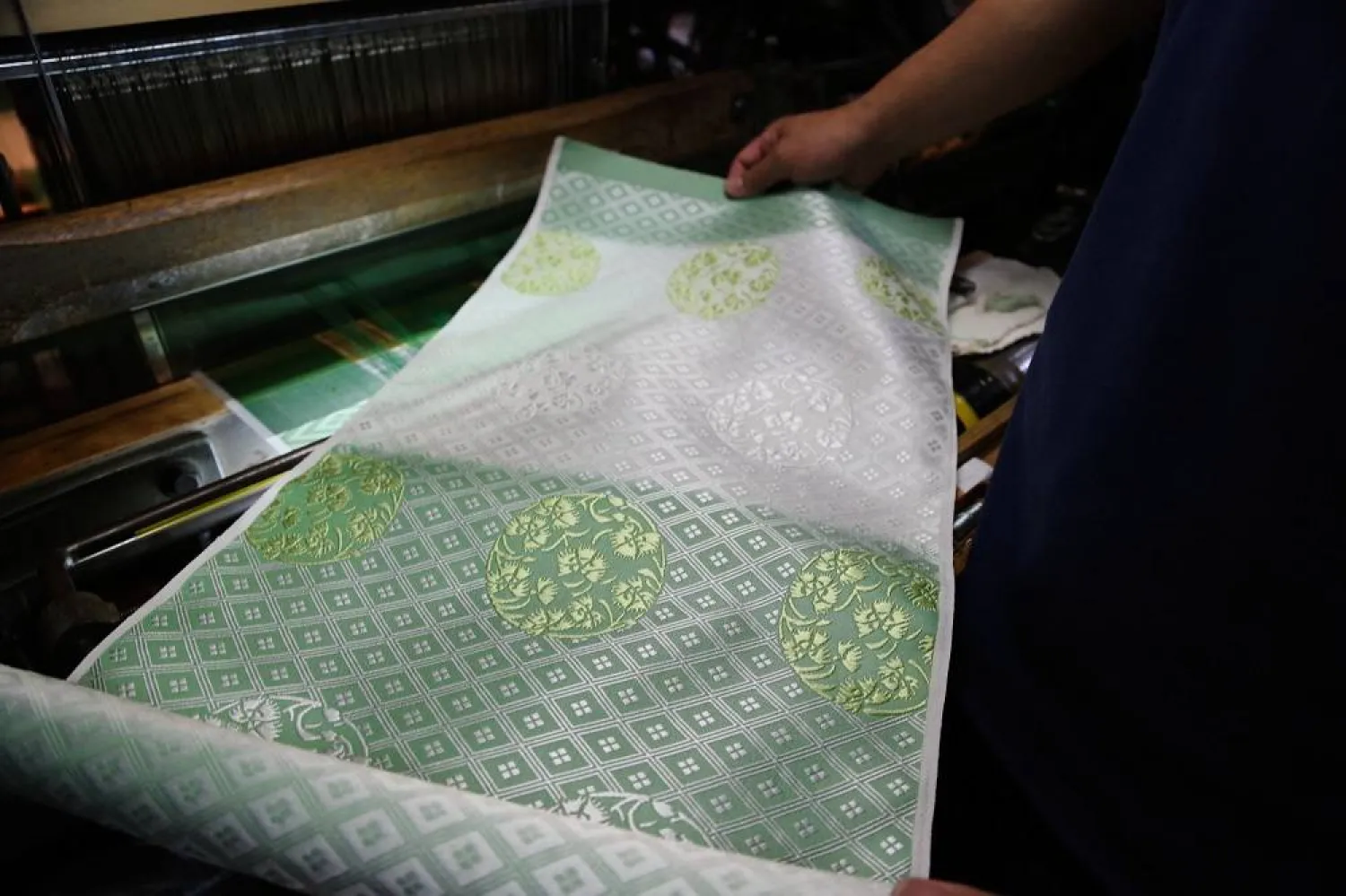
Hironori Fukuoka, the fourth-generation successor to his Nishijinori business, looks at the fabric that is a collaboration with AI in Kyoto, western Japan on July 3, 2025. (AP)
TT

Tradition Meets AI in Nishijinori Weaving Style from Japan’s Ancient Capital 

Hironori Fukuoka, the fourth-generation successor to his Nishijinori business, looks at the fabric that is a collaboration with AI in Kyoto, western Japan on July 3, 2025. (AP)

Nishijinori, the intricate weaving technique for kimonos that dates back more than a thousand years in Japan’s ancient capital of Kyoto, is getting a high-tech collaborator: artificial intelligence.

The revered colorful weaving style associated with “The Tale of Genji” of the 11th-century Heian era, has gone through its share of ups and downs. But its survival is more perilous than ever today, as demand for kimonos nose-dives among Japanese grappling with modernization.

Hironori Fukuoka, the fourth-generation successor to his Nishijinori business, is determined to keep alive the art he’s inherited, even if that means turning to AI.

“I want to leave to legacy what my father has left for me,” he said in his rickety shop in the Nishijin district of Kyoto, a city with statue-filled temples and sculpted gardens that never seems to change.

“I’ve been pondering how the art of Nishijinori can stay relevant to the needs of today,” said Fukuoka.

Besides the AI project, Fukuoka is also working on using his weaving technique to make super-durable materials for fishing rods and aircraft.

Where tradition and technology meet

Giant looms clatter at his shop, called Fukuoka Weaving. The patterns on the gorgeous fabric, slowly turning out from the loom, are repetitive and geometric, which makes it conducive to translating into digital data. Deciding which hand-dyed color thread goes where to make the patterns is much like the on-or-off digital signals of a computer.

Such similarity is what Fukuoka focuses on in exploring how AI might work for Nishijinori, with the help of Sony Computer Science Laboratories, an independent research arm of electronics and entertainment company Sony Corp.

AI only makes suggestions for the designs and doesn’t do any of the actual production work. But that doesn’t bother Fukuoka or the researchers.

“Our research stems from the idea that human life gets truly enriched only if it has both what’s newly innovated and what never changes,” said Jun Rekimoto, chief science officer at Sony CSL, which is also studying how AI can be used to document and relay the moves of a traditional Japanese tea ceremony.

“We don’t believe AI can do everything. Nishijinori is a massive, complicated industry and so it starts with figuring out where AI can help out,” said Rekimoto, also a professor at the University of Tokyo.

What has come of it is a startling but logical turn in thinking, fitting of the art adorning kimonos worn by Japan's imperial family.

The AI was fed various Nishijinori patterns that already existed and instructed to come up with its own suggestions. One was a bold pattern of black and orange that seemed to evoke a tropical motif.

Striking a balance

To Fukuoka, some of AI’s ideas are interesting but simply off. The difference between AI and the human effort is that the former can come up with multiple suggestions in a matter of seconds.

Fukuoka immediately gravitates toward the one that uses a motif of a leaf to define the angular lines of a traditional pattern, something he says a human wouldn’t have thought of. He finds that ingenious.

The kimono the AI collaboration has produced is a luscious soft green, although it doesn’t have a price tag and isn’t in production yet.

The weaving is carried out by the old-style machine under the guidance of the human artist in the traditional way.

Nishijinori kimonos sell for as much as a million yen ($6,700). Many Japanese these days don’t bother buying a kimono and may rent it for special occasions like weddings, if at all.

Putting one on is an arduous, complicated affair, often requiring professional help, making kimonos even less accessible.

A creative partnership

Dr. Lana Sinapayen, associate researcher at Sony CSL, believes AI often gets assigned the creative, fun work, leaving tedious tasks to people, when it should be the other way around.

“That was my goal,” she said in an interview at Fukuoka Weaving, of her intent to use AI in assistant roles, not leadership positions.

Digital technology can’t automatically represent all the color gradations of Nishijinori. But AI can figure out how to best do that digitally, and it can also learn how the human artist fixes the patterns it has produced.

Once that’s all done, AI can tackle arduous tasks in a matter of seconds, doing a pretty good job, according to the researchers.

Artificial intelligence is being used widely in factories, offices, schools and homes, because it can do tasks faster and in greater volume, and is usually quite accurate and unbiased, compared to human efforts.

Its spread has been faster in the US and other Western nations than in Japan, which tends to be cautious about change and prefers carefully made, consensus-based decisions.

But the use of AI in arts and crafts is promising, such as text-to-image generative AI for the creation of visual images from text prompts, according to a study by Henriikka Vartiainen and Matti Tedre, who looked at the use of AI by craft educators in Finland.

“As computers have taken over many routine-like and boring tasks that were previously performed by people, the computer revolution has also been said to liberate time and offer new opportunities for human imagination and creativity,” they said.



French Eyewear Maker in Spotlight After Presidential Showing

 28 January 2026, France, Paris: French President Emmanuel Macron waits to welcome Danish Prime Minister Mette Frederiksen and Greenlandic Prime Minister Jans-Fredrik Nielsen at the Elysee Palace. (Le Pictorium via ZUMA Press/dpa)
28 January 2026, France, Paris: French President Emmanuel Macron waits to welcome Danish Prime Minister Mette Frederiksen and Greenlandic Prime Minister Jans-Fredrik Nielsen at the Elysee Palace. (Le Pictorium via ZUMA Press/dpa)
TT

French Eyewear Maker in Spotlight After Presidential Showing

 28 January 2026, France, Paris: French President Emmanuel Macron waits to welcome Danish Prime Minister Mette Frederiksen and Greenlandic Prime Minister Jans-Fredrik Nielsen at the Elysee Palace. (Le Pictorium via ZUMA Press/dpa)
28 January 2026, France, Paris: French President Emmanuel Macron waits to welcome Danish Prime Minister Mette Frederiksen and Greenlandic Prime Minister Jans-Fredrik Nielsen at the Elysee Palace. (Le Pictorium via ZUMA Press/dpa)

The aviator sunglasses that captured the world's attention when French President Emmanuel Macron wore a pair on stage in Davos in a faceoff with US counterpart Donald Trump have become an unexpected success for the Italian owner of the France-based manufacturer that has watched sales soar.

Despite the hype, eyewear maker Henry Jullien has struggled in a declining French industry that was established in the eastern Jura region in the late 1700s, facing competition from far cheaper Asian manufacturers.

Henry Jullien's "Top Gun"-style shades with blue lenses and a silver frame, priced at 659 euros ($784), are now featured on the French presidency's online store.

Since last week's World Economic Forum in Switzerland, "we've been getting calls from all over the world, it's given us incredible publicity," said Stefano Fulchir, CEO of the Italian company iVision Tech which owns Henry Jullien.

More than 500 sunglasses have already been sold online -- a significant jump for the high-end brand that typically produces just a thousand pairs per year, including 200 of the aviator Pacific S01 model, in Jura.

The brand's website crashed with the surge in traffic so a temporary webpage dedicated solely to the presidential model was launched, while iVision Tech's stock soared 70 percent in a matter of days, Fulchir said.

Macron had ordered the sunglasses in 2024 "to give a gift to a minister during the G20" along with the pair for himself, Fulchir said.

Made with a gold wire, the aviators are crafted in an intricate 279-step process over four months.

"We pampered both pairs, of course," said Herve Basset, 60, who has spent more than half his life at Henry Jullien.

The eyewear makers all received thank-you letters from the president, recalled Karine Pelissard, who has spent 30 years in the trade.

- Shrinking industry -

The eyewear maker had about 180 employees 15 years ago but was down to just 15 when iVision Tech bought it in 2023, according to the mayor where the manufacturing facility is located.

Further cuts were made. Ten employees remain in Jura, iVision Tech said, and its site in the Italian town of Martignacco has had to take on the surge in orders.

To assure authenticity, Fulchir said the glasses are stamped with either "Made in France" or "Made in Italy" depending on which site they come from -- the "most important" labels in the eyewear world, signifying quality.

Yet Julien Forestier, head of the eyewear makers' union in Jura, said the buzz will "bring nothing" to the local industry.

"There are only a few companies left fighting for French manufacturing," and even opticians no longer really believe in the Made in France label anymore, he lamented.

While the sector still produces 2 million frames a year, there are only around 50 companies and about 800 employees in Jura, compared with 10,000 in the 1950s.


Phan Huy: The Fashion Prodigy Putting Vietnam on the Map

Claire Foy, Penelope Cruz, Dua Lipa, Kim Go-eun, Tilda Swinton, Anna Wintour, Nicole Kidman, Arthur Jafa, and Guillaume Diop attend the Chanel Haute Couture Spring/Summer 2026 collection show in Paris, France, January 27, 2026. REUTERS/Gonzalo Fuentes
TT

Phan Huy: The Fashion Prodigy Putting Vietnam on the Map

Claire Foy, Penelope Cruz, Dua Lipa, Kim Go-eun, Tilda Swinton, Anna Wintour, Nicole Kidman, Arthur Jafa, and Guillaume Diop attend the Chanel Haute Couture Spring/Summer 2026 collection show in Paris, France, January 27, 2026. REUTERS/Gonzalo Fuentes

Phan Huy has had a thrilling -- but quite stressful -- journey to making history at Paris Haute Couture Week on Thursday where he will become the youngest and the first Vietnamese designer to present a collection on the official calendar.

The early part of his week was spent anxiously waiting for his designs to arrive in France from Vietnam after they were held up in customs.

"I was very nervous," the soft-spoken 27-year-old told AFP on Tuesday just hours after his elaborate hand-made dresses were finally released, meaning he could begin fitting the models.

"We had a paperwork issue," his co-founder and brand chief executive Steven Doan, 40, explained.

The delays have complicated an already daunting task for the duo who have been catapulted into Paris Haute Couture Week and the fashion stratosphere, which some designers spend a lifetime hoping to enter.

They created the label less than three years ago, but have been fast-tracked into a field that includes corporate giants like Chanel, Dior or Armani, which have billions in annual sales.

Phan and Doan have more limited resources and prepared to unveil their designs on Thursday at 1230 GMT in a cramped basement apartment in western Paris.

"The first collection completely sold out and from that we reinvested," Doan explained. "We were very lucky that we've received a lot of orders from customers around the world, not just in Vietnam."

- 'A dream' -

The origins of the brand go back to Phan's final collection at the Ho Chi Minh City University which became a viral sensation, drawing attention from local celebrities including singers My Tam and Ho Ngoc Ha.

"It was a dream because I was a young student," said Phan, who only turned 27 this week.

Doan, a former model and a stylist in London, also reached out from his then-home in the British capital to suggest they work together.

"I was really struck by Huy's talent. In Vietnam there's a level of designing that is very similar and then when you see a different collection, it really stands out," Doan said.

While he grew up in the coastal city of Nha Trang, Phan hails from a village in the central Quang Tri province.

Phan credits his first interest in fabrics to his parents' curtain shop, where material was always abundant.

He would transform some of it into doll dresses.

"I was into fashion and clothing when I was six years old. I was always very picky with my own outfits," he explained.

- 'Fashion as well' -

The invitation to Paris Haute Couture Week came from France's FHCM fashion federation, which is the guardian of the country's highly protected Fashion Weeks and a key tastemaker.

Alongside the permanent French couture houses, the federation invites guest designers from around the world who have both the skill and commitment to handmade craft that form the basis of the business.

Phan Huy will take his place alongside other designers such as Rami Al Ali from Syria, Imane Ayissi from Cameroon and Hong Kong-born Robert Wun who have brought diversity and freshness to the program.

"I'm very happy and very proud because I can represent and bring the culture and creativity of Vietnam to the world," Phan said.

Doan stressed that their home country is known as a global manufacturing hub that produces mass-market clothes for Western brands.

"We want to prove that we can do fashion as well," he said.

The last Phan Huy collection, which was shown off-calendar in Paris last July, included references to everyday rural Vietnamese life from fans, fishing nets, straw bundles to banana leaves.

This upcoming Spring/Summer 2026 season has been inspired by Vietnam's former ruling Nguyen dynasty, notably Emperor Khai Dinh and the last empress consort, Nam Phuong, who both lived under colonial French rule.

"I want to be inspired by people like Empress consort Nam Phuong, King Khai Dinh, with their fashion style and the interaction between the West and the East," explained Phan.


Puma’s Long Slide: The Rise and Fall of a German Sports Icon

A Puma logo is seen on a Puma Speedcat OG sneaker displayed at the Puma Mostro House in Paris, France, January 24, 2025. (Reuters)
TT

Puma’s Long Slide: The Rise and Fall of a German Sports Icon

A Puma logo is seen on a Puma Speedcat OG sneaker displayed at the Puma Mostro House in Paris, France, January 24, 2025. (Reuters)

Germany's Puma and fierce rival Adidas have their roots in the ​very same house where brothers Rudolf and Adolf Dassler launched their shoe business a century ago, before a major fall-out between the siblings split the company in two.

From the split of the original company Geda, Rudolf founded Ruda - later renamed Puma - while Adolf founded Adidas. The two firms' headquarters remain just a short walk from each other in the Bavarian town of Herzogenaurach.

Now Puma is set to come under the wings of China's top sportswear firm Anta, which would become its biggest shareholder in a $1.8 billion deal aimed at turning around one of Europe's most iconic sports brands that has fallen sharply from grace.

Puma, with its leaping wildcat logo, has struggled to win consumers to ‌its sportswear and ‌Speedcat sneakers, even as Adidas has streaked ahead with its retro Terrace ‌shoes - widening ⁠a ​sales gap ‌between the two firms.

"Puma became ... too dependent on maybe lifestyle products rather than performance sports shoes, which really drove this industry," said Morningstar analyst David Swartz, adding its lower revenues meant it had less to spend on star names boosting the brand.

"So they don't have the visibility."

CHALLENGES FROM EMERGING BRANDS

Puma was the no. 3 in sportswear after Nike and Adidas until recent years, competing to churn out cool sneakers and win top athletes and soccer-team sponsorships. But as newer brands like On Running and Hoka grew, Puma fell off the pace.

"Puma has become too commercial, over-exposed in the wrong channels, with ⁠too many discounts," Puma's CEO Arthur Hoeld, formerly sales chief at arch-rival Adidas, said in October.

The Anta deal for the 29% stake held by ‌the Pinault family behind Gucci-owner Kering, could give the firm an opportunity to ‍regain some ground lost, including in China. The deal pushed ‍Puma's shares up 9% on Tuesday.

"We have a lot of insight how to make Puma more ‍successful in China," Wei Lin, global vice president for sustainability and investor relations at Anta, told Reuters. "It is one of the most valuable brands in this industry."

The Anta deal values Puma at some $6.2 billion. Its enterprise value is around one times its forecast sales for 2027 using Visible Alpha analyst estimates, relatively cheap compared to rivals including Adidas, Nike and Swiss firm On.

SPEEDCAT VERSUS ​SAMBA

Puma, founded in 1948, has a long history of outfitting athletes with track spikes and soccer boots, then made in its Herzogenaurach factory and now mostly sourced from factories in China, Vietnam, ⁠and Indonesia.

While Adidas boomed, Puma climbed too and its stock hit a peak of 115 euros in late 2021. Since then, though, it's slid, losing 80% of its value. Its market cap on Tuesday was 3.2 billion euros ($3.8 billion), an eighth of the size of Adidas.

Trade war uncertainties have hit the retail sector as a whole in recent years, but Puma has particularly suffered.

It has been under pressure as sportswear competition intensified and its recent sneaker launches, including the Speedcat, have been overshadowed by Adidas' Samba and other "terrace" shoes - retro models inspired by soccer fans' footwear in the 1970s and 1980s.

CEO Hoeld, in charge since July last year, announced in October a turnaround plan aiming to cut 900 corporate jobs, to discount less, improve marketing and reduce its product range.

Felix Dennl, retail analyst at German bank Metzler, said Adidas had put pressure on Puma by getting a "head start" on sneakers.

"Adidas was a first mover in capitalizing on the retro sneaker ‌trend, roughly six months before Puma," he said.

"This not only allowed Adidas to get a head start... but also transfer the brand heat generated across lifestyle footwear into performance franchises."