

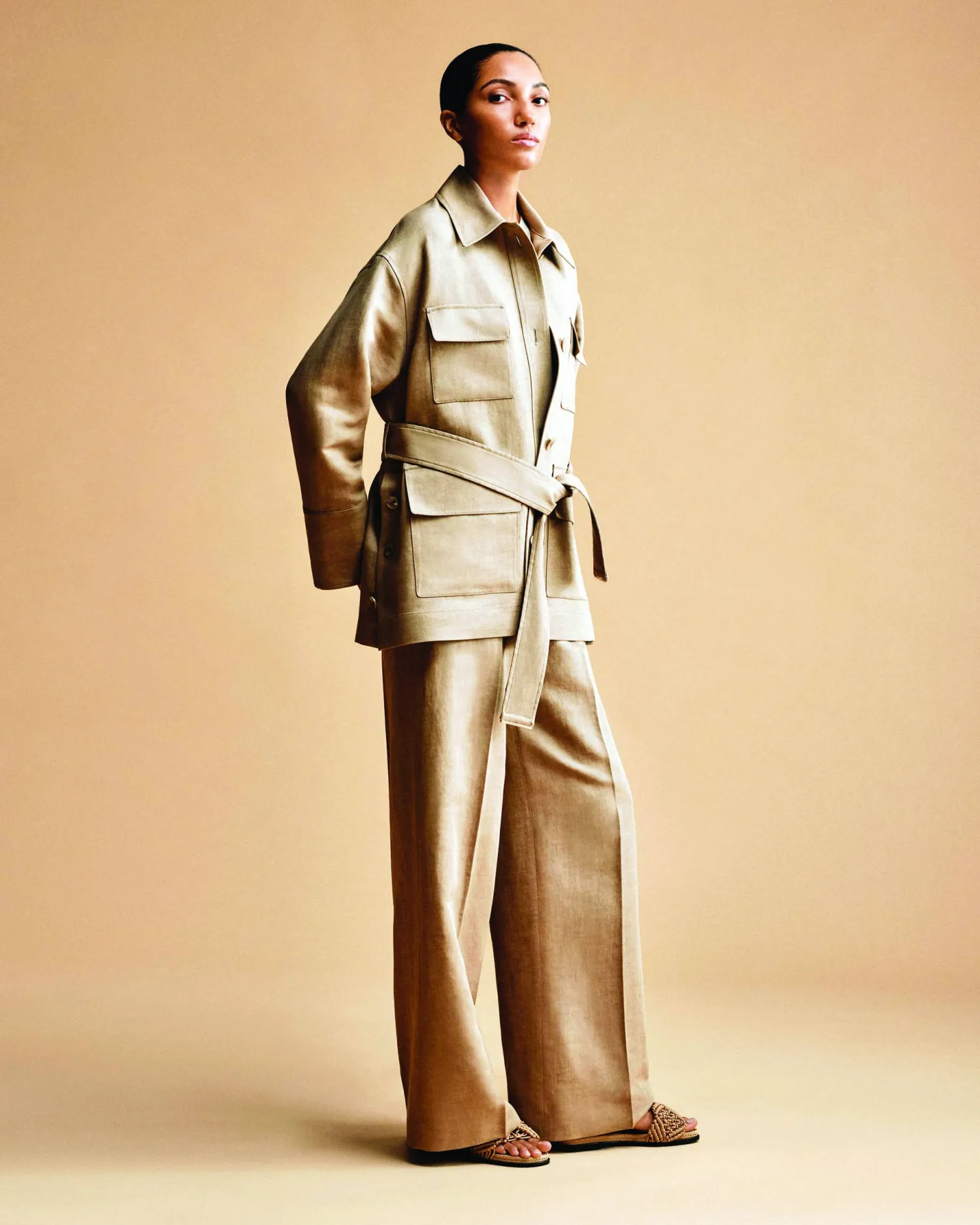

Italy's Agnona Brand: Lamb among the Fashion Wolves

Italy's Agnona Brand: Lamb among the Fashion Wolves
TT

Italy's Agnona Brand: Lamb among the Fashion Wolves

Italy's Agnona Brand: Lamb among the Fashion Wolves

At Milan Fashion Week, headlines go to splashy names, over-the-top fashions and celebrities posing by catwalks.

But behind the scenes, Italy's smaller and medium-sized brands, the often family-owned lifeblood of the industry, are doggedly defending their craft, striving to keep alive long traditions of excellence.

One of them, Agnona, began in 1953 as a wool mill in Italy's northern Piedmont region, producing luxurious textiles in natural fabrics like cashmere, lambswool and angora that supplied top haute couture houses in Paris, from Christian Dior to Givenchy to Yves Saint Laurent.

Acquired in 1999 by the Ermengildo Zegna Group, Agnona switched from textiles to apparel and was sold in 2020 to Zegna family members Stefano Aimone, the chief executive and creative director, and his father Roberto.

Agnona, which is opening its first flagship store in Milan next month, envisions a global network of owned and franchised stores in future.

Stefano Aimone sat down with AFP to explain the challenges facing smaller names amid competition from the big fashion conglomerates, changes in consumer habits and the race towards retail.

- 'Overwhelmed by demand' -

"If you want to aim for quality and certain types of craftsmanship you have to stay here in our Italian boot. But many companies have closed. Many closed because of Covid, post-Covid they were absorbed into larger groups because costs went up, prices fluctuated, they had periods of no sales -- no work at all -- followed by excess work. Financially they didn't have the reserves.

"The businesses that remain are now extremely overwhelmed by demand from the big French groups and the Italian brands.

"The problem isn't just cut-and-sew, it's also the production of materials, because everything cascades down... the dye houses that are still around are clogged up, which creates delays, and delays weaken the quality of the entire industrial process."

- 'Made in Italy' -

"I'd say 'Made in Italy' is becoming relatively less important to them (customers); the customer now identifies more with the brand itself, with its values, with what the brand represents...

"Made in Türkiye, Made in Italy, Made in France -- it can be important, but it's definitely not as important as it once was, because brands have been very active in communicating many other values they embody, which provide justification beyond geography.

"And in a way that's right, because a brand isn't just its product -- it's also what it stands for and what it does beyond the product itself."

- 'Sowing seeds' -

"We're just under 15 million euros in revenue but we expect to reach 20 million and beyond within three years.

"We still have many markets that we haven't even started talking to, for example, all of China, the entire Middle East, all of Latin America, the whole APAC region including Australia.

"Since we took over the brand, there have been years of rebuilding: not only rebuilding our premises -- the industrial site and the headquarters -- but working on the collection.

"We introduced menswear, so we focused heavily on internal work, and we didn't necessarily want to push revenue right away. Because if you go out to market without a solid product, you risk ruining everything you're trying to achieve -- it can be counterproductive.

"So those were years of sowing seeds, and now that we're ready, we're beginning to address the global market."

Zalando Says AI Drives Productivity and Expects Higher Profit, Shares Jump

FILED - 22 October 2013, Thuringia, Erfurt: A general view of the logistics center of online retailer Zalando in Erfurt. Photo: Marc Tirl/dpa-Zentralbild/dpa
TT

Zalando Says AI Drives Productivity and Expects Higher Profit, Shares Jump

FILED - 22 October 2013, Thuringia, Erfurt: A general view of the logistics center of online retailer Zalando in Erfurt. Photo: Marc Tirl/dpa-Zentralbild/dpa

European online fashion retailer Zalando said on Thursday its use of artificial intelligence was making its business more efficient and productive, as it forecast full-year adjusted operating profit to grow in 2026 and launched an up to 300-million-euro ($346 million) share buyback.

Zalando shares jumped 7% in early trading as investors welcomed the positive outlook, providing some succour to the stock that had tumbled sharply from peaks in 2021 when the pandemic boosted online shopping.

Zalando ⁠said AI-generated product ⁠images were saving money and time on ad creation and enabling it to publish 70% more content, while an AI virtual try-on was also helping shoppers pick their correct size, reducing size-related returns - a major headache for online shopping platforms.

Analysts said concerns had been growing over the risk to Zalando from AI, with some worried consumers could use large-language models like ⁠ChatGPT to research products and shop online, bypassing the company's platform.

The Berlin-based company, which sells clothes, shoes and accessories from thousands of brands including Nike, Hugo Boss, and Coach, expects adjusted earnings before interest and taxes (EBIT) of 660 million to 740 million euros in 2026, compared with 591 million euros in 2025.

"We are providing our customers and partners with experiences and services that seemed impossible just a few years ago while making our own operations more efficient," Robert Gentz, co-CEO of Zalando, said in a statement.

Zalando, whose business-to-business arm sells services to other retailers and ⁠brands, also announced ⁠its software unit Scayle signed a deal with Levi's to run its worldwide ecommerce, which JP Morgan analysts said investors would welcome given the brand's status and size.

The company expects gross merchandise volume growth of 12% to 17% in 2026, after GMV - a key revenue metric measuring the value of all goods sold - grew 14.7% to 17.56 billion euros in 2025.

Zalando's active customer numbers increased to 62 million in 2025 from 51.8 million in 2024, while the average order value was 62.8 euros, up from 61 euros a year earlier.

The company said it would repurchase up to 20 million shares with a total price of up to 300 million euros.


Zara Owner Inditex Posts Record Profit in 2025

Shoppers walk past a Zara clothes store, part of the Spanish group Inditex, in Las Palmas de Gran Canaria, Spain, December 13, 2022. REUTERS/Borja Suarez
TT

Zara Owner Inditex Posts Record Profit in 2025

Shoppers walk past a Zara clothes store, part of the Spanish group Inditex, in Las Palmas de Gran Canaria, Spain, December 13, 2022. REUTERS/Borja Suarez

Zara owner Inditex, the world's leading low-cost fashion retailer, posted a record annual profit for the third year running on Wednesday, seeing off strong international competition.

The Spanish group, which includes top brands such as Massimo Dutti, Pull & Bear and Bershka, reported a profit of 6.22 billion euros ($7.23 billion) in the fiscal year ending January 31.

That marked a six percent rise on the 5.9 billion it raked in in 2024, which was also a group record, Inditex said.


Margot Robbie, Oprah Watch Blazy Transform Chanel with Color and Craft

Models present creations from the Fall/Winter 2026 collection of French-Belgian designer Matthieu Blazy for Chanel during Paris Fashion Week, in Paris, France, 09 March 2026. (EPA)
TT

Margot Robbie, Oprah Watch Blazy Transform Chanel with Color and Craft

Models present creations from the Fall/Winter 2026 collection of French-Belgian designer Matthieu Blazy for Chanel during Paris Fashion Week, in Paris, France, 09 March 2026. (EPA)

Chanel 's Matthieu Blazy is still building. Six months into his tenure at the Parisian stalwart, the designer staged his second ready-to-wear collection at Paris Fashion Week Monday, where brightly colored cranes rose from a holographic floor — a deliberate signal that the construction is ongoing.

For Parisians who have spent years staring at the real thing above Notre-Dame cathedral, the set was perhaps less dreamy than intended.

The audience inside the Grand Palais suggested the foundations are solid: Margot Robbie, Oprah, Jennie, Kylie Minogue, Lily-Rose Depp, Teyana Taylor and Olivia Dean all turned up to watch the next floor go on.

Blazy took his cue from a quote from Gabrielle “Coco” Chanel: “We need dresses that crawl and dresses that fly.”

The collection was structured around that tension — plain against spectacular, function against fantasy — with a discipline his sprawling debut last October sometimes lacked.

The opening looks were austere by design. Black knit zip-ups, tweed blousons and boxy overshirts arrived with little more than four gold buttons to signal they belonged to Chanel.

In the vast runway space, they could read as underwhelming. But Blazy’s point was architectural: the suit, he said, is “the first brick” — and everything else rises from it.

That logic tracks to the founder.

In her apartment on Rue Cambon, a wall is covered in gauze painted gold — something poor made precious.

Chanel built a house on that idea, borrowing from everyday dress and elevating it. Blazy is doing the same with her codes, stripping the suit to a knit shirt jacket or pressed-tweed blouson before rebuilding it in silicone-woven fabric and metallic mesh.

The collection’s most provocative move was its silhouette. Blazy pulled waistlines dramatically low — belts slung to mid-thigh, pleated skirts starting where blazers ended.

The references were retro flapper filtered through a modern lens: drop-waisted twinsets, patchwork dresses with floral embroidery, vivid patterned knits with a twenties pulse.

A furry coat in bold geometric color could have been worn in a chic part of London's Camden.

Whether the ultra-low waistlines will land with the well-heeled clients who pack Chanel’s front rows is another question. Selling a radically new proportion to women with deep loyalty to the house is a different challenge than winning critical praise.

The final stretch answered that concern with force. Sequined plaid suits arrived in dazzling color. Beaded coats glinted with star-chart embroidery. Metallic mesh was woven to mimic tweed motifs, and several models wore pastel-tinted hair to match their looks.

Fabric flowers burst from bodices. Trailing ribbons, layered ruffles, and insect-wing detailing turned the runway into something closer to spectacle than commerce.

Blazy cast wide — teens through to women in their fifties — and let the show breathe, with a runway circuit that took models the better part of five minutes. He framed it all with seven pared-back black and cream looks, as if to say: whatever else changes, the Chanel you know isn’t going anywhere.

If this second outing holds — on the penultimate day of fashion week — Blazy has found something rare at a heritage house: a way to honor the founder’s voice without simply echoing it.