International Criminal Court Refers Hungary to Its Oversight Body for Failing to Arrest Netanyahu 

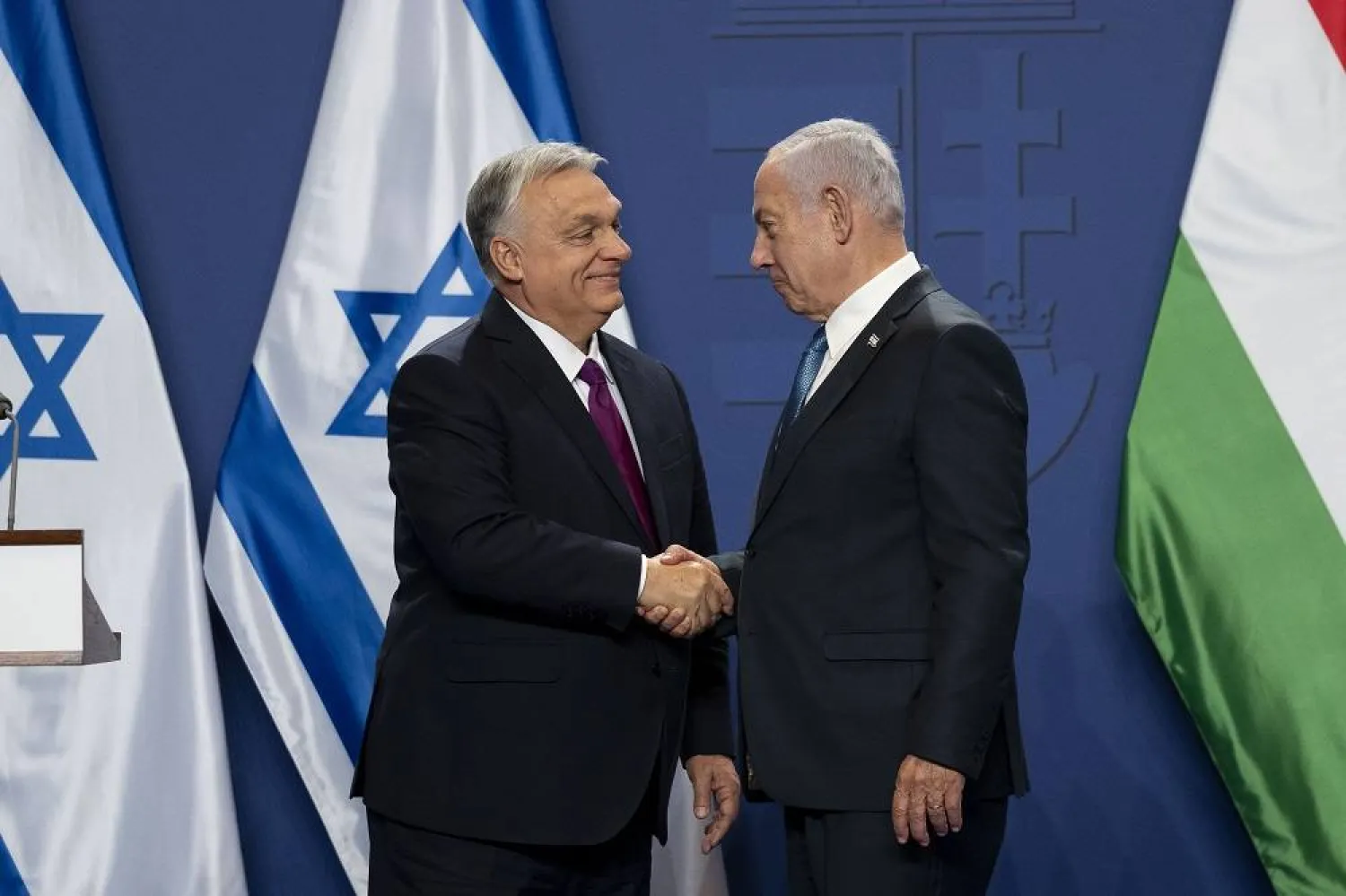
Hungarian Prime Minister Viktor Orbán, left, and Israeli Prime Minister Benjamin Netanyahu, right, shake hands after a press statement at the Carmelite Monastery in the Buda Castle in Budapest, Hungary, April 3, 2025. (AP) 
TT

International Criminal Court Refers Hungary to Its Oversight Body for Failing to Arrest Netanyahu 

Hungarian Prime Minister Viktor Orbán, left, and Israeli Prime Minister Benjamin Netanyahu, right, shake hands after a press statement at the Carmelite Monastery in the Buda Castle in Budapest, Hungary, April 3, 2025. (AP) 

A panel of judges at the International Criminal Court reported Hungary to the court’s oversight organization for failing to arrest Israeli Prime Minister Benjamin Netanyahu when he visited Budapest in April, saying the move undercut the court's ability to bring suspects to justice.

The Israeli leader received a red carpet welcome from Hungarian Prime Minister Viktor Orbán during a state visit, in defiance of an ICC arrest warrant. Netanyahu and his former Defense Minister Yoav Gallant are accused of crimes against humanity in connection with the war in Gaza.

Israel is not a member of the court and staunchly rejects the charges.

In a filing released late Thursday, the three-judge panel wrote that “the obligation to cooperate was sufficiently clear to Hungary” and the failure to arrest Netanyahu “severely undermines the Court’s ability to carry out its mandate.”

The ICC has no police force and relies on countries around the world to execute arrest warrants.

The court's oversight body, the Assembly of States Parties has limited powers to sanction Hungary. It will consider the next steps during its annual meeting in December.

The Hungarian leader, regarded by critics as an autocrat and the EU’s most intransigent spoiler in the bloc’s decision-making, has defended his decision to not arrest Netanyahu. During the visit, Orbán said his country’s commitment to the ICC was “ half-hearted ” and began the process to withdraw Hungary from the court.

Orbán signed the Rome Statute, the treaty which created the court, in 2001 during his first term as prime minister.

The court dismissed arguments from Hungary that Parliament never incorporated the court’s statute into Hungarian law, writing “it was Hungary’s responsibility to ensure that such legislation was in place.”

The decision comes as Gaza’s population of more than 2 million Palestinians is in a catastrophic humanitarian crisis, now relying largely on the limited aid allowed into the territory.

Netanyahu and Gallant are accused of using “starvation as a method of warfare” by restricting humanitarian aid, and of intentionally targeting civilians in Israel’s campaign against Hamas in Gaza.


Europe Swelters under Record-breaking Heatwave

Tourists protecting themselves from the sun under umbrellas walk past the glass Pyramid of the Louvre museum as the museum closes early due to the heatwave as temperatures rise in Paris, France, June 24, 2026. REUTERS/Alice Sacco
TT

Europe Swelters under Record-breaking Heatwave

Tourists protecting themselves from the sun under umbrellas walk past the glass Pyramid of the Louvre museum as the museum closes early due to the heatwave as temperatures rise in Paris, France, June 24, 2026. REUTERS/Alice Sacco

Europe struggled to cope with a record-breaking heatwave on Wednesday, with at least 94 million people expected to experience temperatures above 35C, most of them in France and Spain.

AFP estimates based on analysis of forecasts from the German weather service and 2025 population projections from Europe's Joint Research Center suggest maximum temperatures will surpass 30C for over 350 million people -- more than two-thirds of the continent's population.

The effects of the extreme weather, with temperatures hotter than parts of east and west Africa, have been made worse by buildings and infrastructure not designed to cope with high temperatures.

A scientific study published this week said the current heatwave was "significantly exacerbated by human-induced climate change", without which the current temperatures would have been 2-4C cooler.

At a care home on the edge of London, elderly residents struggled to keep cool as Britain recorded its highest ever June temperature of 36.1C.

"We have to find means and ways to protect ourselves and do whatever nature wants. Nature is angry with us because we destroy everything," 97-year-old resident Lucine Nazikian said.

The World Health Organization's head Tedros Adhanom Ghebreyesus warned that the heatwave was putting the health of Europeans at risk.

- 'Swimming in my own sweat' -

Around 44 million of the nearly 67 million people in France are currently under the highest red alert level for heat, according to an AFP estimate.

France on Wednesday experienced its hottest day since measurements began in 1947, the national weather agency said, breaking a record set just a day earlier.

The national temperature indicator -- an average of daytime and night-time temperatures across 30 stations -- reached 30C, Meteo-France said, citing provisional data.

"We insulated the windows, installed ceiling fans... but without air conditioning it's tough," said Manon Langlois, 34, a teacher in the southwestern city of Bordeaux, where the temperature reached 41.8C.

Spain also broke its June heat record, according to the Aemet weather agency, with an average temperature of 28.17C on Tuesday.

Conditions at many schools, offices and factories across the continent have become unbearable as temperatures rise, forcing early closures and employees to work from home.

"I'm practically swimming in my own sweat, which is not pleasant," 25-year-old decorator Aaron Timothy told AFP in London while cooling off in the shade.

In Italy, where 16 cities are under red alert, the advocacy group Greenpeace said it had detected surface temperatures of 80C in the heavily asphalted area around Rome's Termini railway station.

Despite restrictions for outdoor workers, the area was still buzzing with delivery riders, many of whom are self-employed, who said they had to work to survive.

- Power cuts -

Power outages have been reported in France, including in the northwest department of Finistere, where high temperatures knocked out a transformer late on Tuesday, leaving about 68,000 households without electricity.

In Britain, electricity grid operator Neso warned that supply could be squeezed due to pressure on the system.

Sales of fans and air conditioners have skyrocketed as people try to keep cool.

June is a key month for tourism in Europe but popular landmarks, including the Eiffel Tower and Louvre museum in Paris, and the stainless steel Atomium in Brussels, have been shutting early because of the heat.

American engineer John Beeler, wearing a fisherman's hat and holding a small fan, said visiting Paris in such conditions was "awful".

"We're suffocating in the streets, we're suffocating in the subway and we're even suffocating in our rental," he said, adding that they would be moving to an air-conditioned hotel room.

- Heading east -

The heatwave has pushed up temperatures even in usually milder northern countries such as Denmark, while Austria could see 40C and neighboring Slovakia was on its highest extreme heat alert.

Further east, Poland's weather service issued high-level heat warnings for the western part of the country from Thursday to Saturday, and predicted temperatures could break the record of 40.2C set in 1921.

Croatia's popular Adriatic coast was also put under red alert for Friday and Saturday, while Hungary said it was imposing a maximum level alert from Saturday to Tuesday.

The head of the UN's IPCC climate experts panel, Jim Skea, said the current temperatures were above some scientific projections, and warned that the continent would inevitably face more extremes as the planet warms.


Iran’s Guards in Lebanon: From War Rooms to Front Lines

Billboards showing Iranian Supreme Leader Mojtaba Khamenei and his father, Ali Khamenei, with the slogan “Thank you, Iran,” are displayed on the airport road toward southern Lebanon. (Reuters)
TT

Iran’s Guards in Lebanon: From War Rooms to Front Lines

Billboards showing Iranian Supreme Leader Mojtaba Khamenei and his father, Ali Khamenei, with the slogan “Thank you, Iran,” are displayed on the airport road toward southern Lebanon. (Reuters)

Since the latest war erupted in Lebanon, evidence has mounted of a direct role by Iran’s Revolutionary Guards in managing the fight alongside Hezbollah. But the scale and nature of that role, and the number of Iranians involved, remain unclear.

With no precise figures available, several accounts point to the presence of Iranian personnel and officers in Lebanon during the war, both in command roles and on the battlefield.

Revolutionary Guards officers in the battle

In March, Prime Minister Nawaf Salam moved to curb what was seen as the Revolutionary Guards’ chaotic access to Beirut.

He asked the authorities to take the necessary steps to prevent any military or security activity by members of the Revolutionary Guards in Lebanon ahead of their deportation. The Cabinet also decided to reinstate visa requirements for Iranians entering Lebanon.

One of the strongest signs of Revolutionary Guards' involvement was the killing of Guards officers in an Israeli strike on the Ramada Hotel in Beirut’s Raouche district on March 8.

Iran announced the deaths in a letter to the UN secretary-general. Iran’s permanent representative to the United Nations, Amir Saeid Iravani, said four Iranian diplomats had been killed in the attack. They were later mourned in Iran as Revolutionary Guards officers.

Information in Beirut indicated that the Iranians entered the capital using genuine Lebanese passports issued under different names. Additional passports belonging to others linked to the Revolutionary Guards were found inside the targeted room.

That prompted MP Ghada Ayoub to file a report with the Public Prosecutor’s Office at the Court of Cassation, requesting an investigation into information alleging that Lebanese passports had been issued under false names or in violation of legal procedures to people linked to armed groups.

The report also cited evidence that Lebanese travel documents were used to conceal the real identities of Revolutionary Guards personnel.

Other reports also pointed to a direct Iranian presence in the fighting.

During the battle over what is known as the Ali al-Taher Heights, media outlets quoted a senior Israeli security source as saying on Monday that several Iranian officers were in the area in southern Lebanon. The source said they held key positions in managing the battle and coordinating operations on the Lebanese front.

According to that information, one main reason behind Iran’s insistence on halting the Israeli ground operation there was concern for the lives of those officers, or fear they could be captured if the field advance continued.

At the same time, media outlets and online platforms in the past two days circulated posts attributed to the Revolutionary Guards offering salaries of up to $1,000 to those willing to fight alongside Hezbollah.

The posts were seen as another sign of the scale of Iranian involvement in the war in Lebanon.

“One front and a joint operations room”

Retired Brig. Gen. Hassan Jouni, a military expert, said the organic relationship between Hezbollah and Iran makes it difficult to separate the Lebanese and Iranian fronts.

“What happened in the war clearly showed that the two fronts were managed as one front, within a joint operations room and under a unified operational plan aimed at scattering and exhausting Israeli air-defense systems,” he told Asharq Al-Awsat.

He said that the pattern reflected unified battle management and decision-making. It showed, he added, that the confrontation was not two separate fronts, but one linked theater of operations coordinated directly by Iran and Hezbollah.

From operations rooms to the battlefield

While the presence of Iranian officers in operations rooms now appears settled, the number of Iranian fighters on the ground remains unclear.

Political analyst Kassem Kassir, who is close to Hezbollah, stirred controversy two days ago when he spoke of 50,000 Iranian fighters taking part in the war in Lebanon and 10,000 of them being killed. The remarks triggered surprise and questions in Lebanon.

Kassir later said his comments were made in response to accounts portraying the war as a direct Iranian-Israeli confrontation on Lebanese soil. He said the exaggerated figures were meant to show how unrealistic such claims were.

“The exaggeration in the figures I mentioned is proof that the matter is not true,” he told Asharq Al-Awsat.

Political analyst Ali al-Amine offered a different reading. He said the latest war had carried, from the start, the character of an Iranian-Israeli confrontation on Lebanese soil. He pointed first to the Revolutionary Guards officers killed in the Beirut hotel.

“After the assassination of Hezbollah’s first-tier leaders in 2024, foremost among them Hezbollah Secretary-General Hassan Nasrallah, along with a number of elite commanders and Radwan Force leaders, a major vacuum emerged inside the party’s command structure,” al-Amine told Asharq Al-Awsat.

“That required Revolutionary Guards leaders and officers to come to Lebanon to manage the battle and oversee operations. They were not ordinary fighters, but high-level specialized officers who took charge of command, coordination and field axes.”

He said the Revolutionary Guards and Hezbollah have an intertwined organizational and military structure, not merely an alliance between two separate partners.

Non-Lebanese bodies in the south

Al-Amine also spoke of a large number of non-Lebanese fighters in the south.

“After the ceasefire, operations began to recover bodies from southern villages, but in some areas, residents were initially asked not to go there,” he said.

“The scale of destruction was one main reason. But there was another reason: a large number of bodies under the rubble of homes. It emerged that some of the dead were not Lebanese, including Iranians and Palestinians from the camps, in addition to information about Iraqis who took part in the battles.”

He said the Iranians, as a core part of battle management, were not only in operations rooms but also present on some field axes.

At the same time, he said, there was a broad blackout on the scale of human losses. Hezbollah no longer publishes detailed death notices as it did in the past, he said, limiting itself to announcing the deaths of senior figures. That raised questions about the real number of dead and the identities of some of them.

He said body-recovery operations were being carried out only by Hezbollah and the Islamic Health Association, while the Red Cross was kept away.

“If that indicates anything, it is that there are people whose real identities or nationalities are not meant to be revealed, or who are not meant to be included on the official lists of Lebanese dead,” he said.

1,000 Hezbollah dead and 500 missing

Kassir, however, denied that Hezbollah faced a shortage of fighters. He said the nature of the current battle no longer required the same numbers as previous stages, and that Hezbollah had enough fighters to carry out its missions.

Hezbollah does not announce its death toll and has stopped issuing death notices since the start of this war. Kassir estimated that about 1,000 Hezbollah fighters had been killed in the latest war, with about 500 more missing.

He said the death of any Iranian fighters or officers in battle could not be hidden. The announcement of the deaths of the four Iranian officers at the Raouche hotel, he said, proved that any similar Iranian losses would have been officially announced.


‘Inhumane’: Gaza Flotilla Activists Recount Israeli Detention Ordeal

Boats of a new humanitarian flotilla bound for the Gaza Strip make a symbolic leave from Barcelona's Port Vell on April 12, 2026 as the departure of the flotilla has been postponed due to bad weather. (AFP)
TT

‘Inhumane’: Gaza Flotilla Activists Recount Israeli Detention Ordeal

Boats of a new humanitarian flotilla bound for the Gaza Strip make a symbolic leave from Barcelona's Port Vell on April 12, 2026 as the departure of the flotilla has been postponed due to bad weather. (AFP)

Cracked bones, humiliation, sexual assault: Pro-Palestinian activists recounted the abuse they say they suffered from Israeli authorities for taking part in a Gaza-bound aid flotilla last month, which has sparked multiple investigations and international outcry.

France, Italy and Australia have launched probes into the allegations of abuse, which Israeli authorities deny, after more than 430 activists from around the world were detained during the latest attempt by an aid flotilla to break the blockade of the war-battered Gaza Strip.

French nationals Meriem Hadjal, Noe Tissot and Malika Baouya were on the boat Peluxo carrying school supplies, infant formula and medicines when Israeli speedboats intercepted them in international waters.

The activists said they were taken from the boat and violently herded together at sea onto what some called the "torture prison ship".

"I was dragged by the arm and lifted up with my hands tied behind my back. I screamed in pain, I thought my arm had been torn off," said nurse Baouya.

"We walked with our heads down, hands behind our necks. We were made to lie on the floor, in stagnant seawater. Men were tased," she added.

Stripped to little clothing and fitted with numbered wristbands, the activists -- backs bent and limbs shackled -- say they were led one by one towards a dark container.

- 'Afraid they would kill me' -

"When the door opened, I saw a fellow prisoner lying on the floor with his trousers down," said Hadjal, 38.

"A soldier started groping my breasts... I was slapped hard. Then again. Some soldiers tried to push me towards the back of the container. I was afraid they would kill me."

Baouya said she saw an activist on the ground being beaten before three men grabbed her.

One soldier "lifted me up by my hair", while another "tried to rip off my underwear", she said.

The Israeli army told AFP it "rejects allegations of abuse by Israeli soldiers during the operations to protect the legal naval security blockade", saying it requires "respectful and appropriate treatment of flotilla participants on the intercepted vessels".

Speaking to AFP in Melbourne, Australia, activist Violet Coco said soldiers had laughed as they "bashed" her, hitting her in the head and kicking her repeatedly.

Her hand was injured as she tried to protect herself from their blows, she said.

"They were groping into my private parts, I ended up with bruises on my breasts and other places."

The activists were confined for several days to a part of the ship's deck surrounded by containers topped with barbed wire, visible in a highly criticized video released by Israel's far-right National Security Minister Itamar Ben Gvir.

There, Baouya -- who says she suffered a cervical spine fracture after the ordeal -- was with "around a hundred others with disheveled hair and bloodied faces".

Hadjal, who says her foot was injured, said she saw another detainee "come out of the torture container with a swollen face, in a state of shock".

The activists said they slept on the freezing metal and wood floors of the containers, lacking water, hygiene and food, as seawater seeped everywhere.

They accused soldiers of aiming stun grenades and rubber bullets at them.

- 'Speaking out' -

The activists were taken ashore in Israel and detained in Ktziot prison, where they said they met further abuse -- allegations the Israeli prison service has denied.

Security personnel "were insulting us, making animal noises and hitting us with their rifle butts" as we arrived near the port, 32-year-old Tissot told officers of France's crimes against humanity unit.

Inside a tent, "a soldier landed a massive punch on my head and ribs", cracking one, he said in his official statement.

Back in Germany after his release, 29-year-old social worker Johannes Happel told AFP his head had been "slammed against a tent pole" and he "saw a friend being punched and repeatedly thrown to the ground".

"Cruel, sadistic and inhumane are the adjectives that spring to mind for everything I saw," he added.

Another Australian activist, Neve O'Connor, described being forcefully taken off the boat and thrown onto a concrete floor.

"All you can hear is the Israeli national anthem as they're playing it on repeat," she said. "It's so loud and you can hear your friends screaming."

"What we experienced, protected by our passports, is just a taste of what Palestinian prisoners go through," said Hadjal, who sees her testimony as "a weapon".

Baouya, who will give evidence in the French investigation, said she and others were "speaking out not for ourselves, but for the Palestinians".