

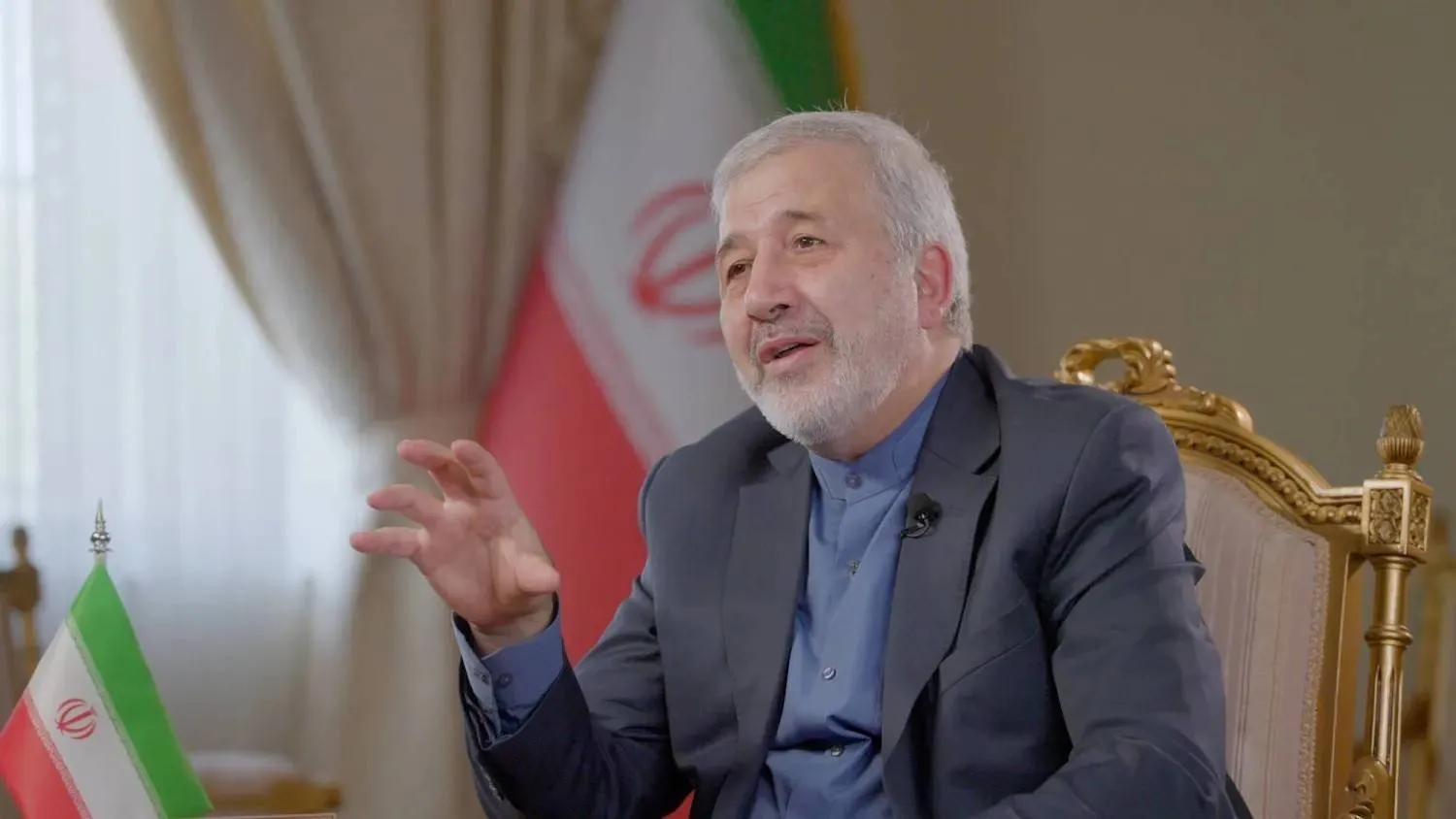

Iran Envoy: Jareesh is Part of Our Culture, I Prefer It to Mandi

Enayati says regional ties run deep through shared history (Photo: Turki Al-Oqaili)
TT

Iran Envoy: Jareesh is Part of Our Culture, I Prefer It to Mandi

Enayati says regional ties run deep through shared history (Photo: Turki Al-Oqaili)

With a warm smile and a calm tone, Dr. Alireza Enayati, Iran’s ambassador to Saudi Arabia, reflects on nearly two years in Riyadh, describing a personal journey shaped by culture, cuisine, and diplomacy.

“I’ve visited different regions and tasted traditional Saudi dishes,” Enayati told Asharq Al-Awsat in an interview. “Jareesh –a dish made from cracked wheat and cooked with meat, spices, and vegetables– has become my favorite—I choose it over mandi and other dishes on any occasion.”

According to the Iranian envoy, the two countries share more than just geography. “There are many common dishes between Saudi Arabia and Iran,” he said.

But food is only one layer of the ambassador’s experience. Enayati, who has spent over two decades immersed in Middle East diplomacy, sees deep historical ties binding the region’s peoples together.

“I recently read Al-Hadaqi, a novel about Al-Jahiz—Abu Uthman Amr ibn Bahr—and his life between Baghdad, Basra, and Iran. It left me with a strong sense that the relationships among peoples in this region go far back in history,” he said. “Reading it felt like tracing our steps backward to better understand the present.”

“These are not new connections,” he added. “We’re not creating the relationship—we’re nurturing what has always existed. The cultural and civilizational dialogue has never ceased.”

His comments come against the backdrop of a thaw in relations between Tehran and Riyadh, after both sides agreed in March 2023—under Chinese mediation—to restore diplomatic ties following a seven-year rift.

The ambassador pointed to culinary overlaps as another reflection of cultural convergence. “Stews, for example, are common in both countries,” he said. “Jareesh is part of Iranian culture too, as are lamb and camel meat. And as everyone knows, kebab originated in Iran, but it’s also very popular here in the Kingdom.”

Enayati has built his career around the region. “I’ve spent more than 20 years working on regional affairs and never served outside this part of the world,” he said with a smile. “I’m not sure if that’s a strength or a limitation, but my focus has always been here.”

Appointed to Riyadh as part of a diplomatic breakthrough, Enayati said he is proud to represent Iran in Saudi Arabia. “It’s a great honor. I dedicate my efforts to enhancing bilateral ties and supporting regional peace and stability.”

Looking ahead, Enayati hopes to help build stronger cultural bridges—not only between Saudi Arabia and Iran, but across the broader region. “Arabic and Persian cultures both occupy a distinguished place,” he said. “We must deepen mutual understanding between them.”

He concluded with a nod to Tehran’s long-term vision for cooperation with Riyadh. “Iran and Saudi Arabia are both pillars of regional stability,” he said. “This region belongs to its people, and we view our relationship with the Kingdom through that lens.”



Surgery Begins in Riyadh for Most Complex Conjoined Twins Cases in the World

The Filipino conjoined twins (SPA)
TT

Surgery Begins in Riyadh for Most Complex Conjoined Twins Cases in the World

The Filipino conjoined twins (SPA)

The medical and surgical team of the Saudi Conjoined Twins Program began on Thursday the separation surgery for the Filipino conjoined twins Klea and Maurice Ann, who are joined at the head, at King Abdullah Specialist Children’s Hospital in King Abdulaziz Medical City in Riyadh.

The surgery is in implementation of the directives of Custodian of the Two Holy Mosques King Salman bin Abdulaziz Al Saud and Prince Mohammed bin Salman bin Abdulaziz Al Saud, Saudi Crown Prince and Prime Minister.

Supervisor-General of the King Salman Humanitarian Aid and Relief Center and head of the medical and surgical team Dr. Abdullah Al Rabeeah stated in a press briefing that the conjoined Filipino twins arrived in the Kingdom on May 17, 2025.

He explained that following their admission, the medical team conducted extensive examinations and held multiple consultations, ultimately determining that the case was among the most complex in the world.

This was due to several critical medical factors, including the complex angle of the twins’ heads, extensive sharing of cerebral venous sinuses, and overlapping brain tissue.

He further noted that one of the twins, Klea, was suffering from heart failure and severe kidney atrophy leading to complete renal failure, which significantly increased the surgical risks associated with the separation procedure.

Al Rabeeah stated that the surgical team decided to carry out the operation in five stages, with the participation of 30 consultants, specialists, and nursing and technical staff across multiple disciplines, and noted that the procedure is expected to last approximately 24 hours.

He pointed out that this operation is the 70th procedure in the program, which, since its launch in 1990, has assessed and provided care for 157 conjoined twins from 28 countries across five continents.


Turkish Parliament Passes Bill to Restrict Social Media Access for Under-15s

FILED - 16 May 2024, Mecklenburg-Western Pomerania, Schwerin: The Instagram, Facebook, and WhatsApp apps can be seen on a smartphone display in front of the logo of the internet company Meta. Photo: Jens Büttner/dpa
TT

Turkish Parliament Passes Bill to Restrict Social Media Access for Under-15s

FILED - 16 May 2024, Mecklenburg-Western Pomerania, Schwerin: The Instagram, Facebook, and WhatsApp apps can be seen on a smartphone display in front of the logo of the internet company Meta. Photo: Jens Büttner/dpa

Turkish lawmakers passed a bill late Wednesday that includes restricting access to social media platforms for children under 15, state media reported.

The legislation is the latest in a global trend to protect young people from dangerous online activity.

Its passage comes a week after a 14-year-old boy killed nine students and a teacher at a middle school in Kahramanmaras, southern Türkiye, in a gun attack. Police are investigating the online activity of the perpetrator, who also died, in a bid to uncover his motivation for the attack.

The bill will force social media platforms to install age verification systems, provide parental control tools and require companies to rapidly respond to content deemed harmful, the state-run Anadolu news agency said, according to The Associated Press.

Turkish President Recep Tayyip Erdogan must now accept the bill within 15 days for it to pass into law. He spoke in the wake of the Kahramanmaras killings of the need to mitigate the online risks to children’s safety and privacy.

“We are living in a period where some digital sharing applications are corrupting our children's minds and social media platforms have, to put it bluntly, become cesspools,” he said in a televised address Monday.

The main opposition party - the Republican People’s Party, or CHP - has criticized the proposal, saying children should be protected “not with bans but with rights-based policies.”

Under the law, digital platforms - such as YouTube, TikTok, Facebook, Instagram and others - would have to block children under 15 from opening accounts and introduce parental controls that would manage children’s access.

Online game companies will also be required to appoint a representative in Türkiye to ensure they abide by the new regulations. Potential penalties include internet bandwidth reductions and fines imposed by Türkiye’s communications watchdog.

Restrictions on social media access for children under 16 first began in December in Australia, where social media companies revoked access to about 4.7 million accounts identified as belonging to children.

Last month, Indonesia began implementing a new government regulation banning children younger than 16 from access to digital platforms that could expose them to pornography, cyberbullying, online scams and addiction.

Some other countries — including Spain, France and the United Kingdom — are also taking or considering measures to restrict children’s access to social media amid growing concern that they are being harmed by exposure to unregulated social media content.


Asian Elephant Calf Makes her Public Debut at DC's National Zoo

Linh Mai, a 10-week-old Asian elephant calf, copies "auntie" Swarna reaching into the hay feeder during her public debut at the National Zoo, in Washington, Wednesday, April 22, 2026. (AP Photo/Jacquelyn Martin)
TT

Asian Elephant Calf Makes her Public Debut at DC's National Zoo

Linh Mai, a 10-week-old Asian elephant calf, copies "auntie" Swarna reaching into the hay feeder during her public debut at the National Zoo, in Washington, Wednesday, April 22, 2026. (AP Photo/Jacquelyn Martin)

The hottest new celebrity in Washington, D.C., is Asian elephant calf Linh Mai, who made her public debut Wednesday at the Smithsonian’s National Zoo. She is the first elephant calf born at the zoo in 25 years.

Mother elephant Nhi Linh gave birth to Linh Mai on Feb. 2 after nearly two years of pregnancy.

Robbie Clark, the zoo's elephant manager, said, “Linh Mai is a hoot, she's a fantastic little elephant to get to know.”

“She's very curious,” Clark added, according to The Associated Press. “She's learning how to be quite playful with the enrichment and the environment that she's living in, and she's confident.”

The Asian elephants at the National Zoo live in an expansive area called Elephant Trails, which contains outdoor walkways and pools. Fans who can't visit Washington can check out Linh Mai on the zoo's elephant cam.