

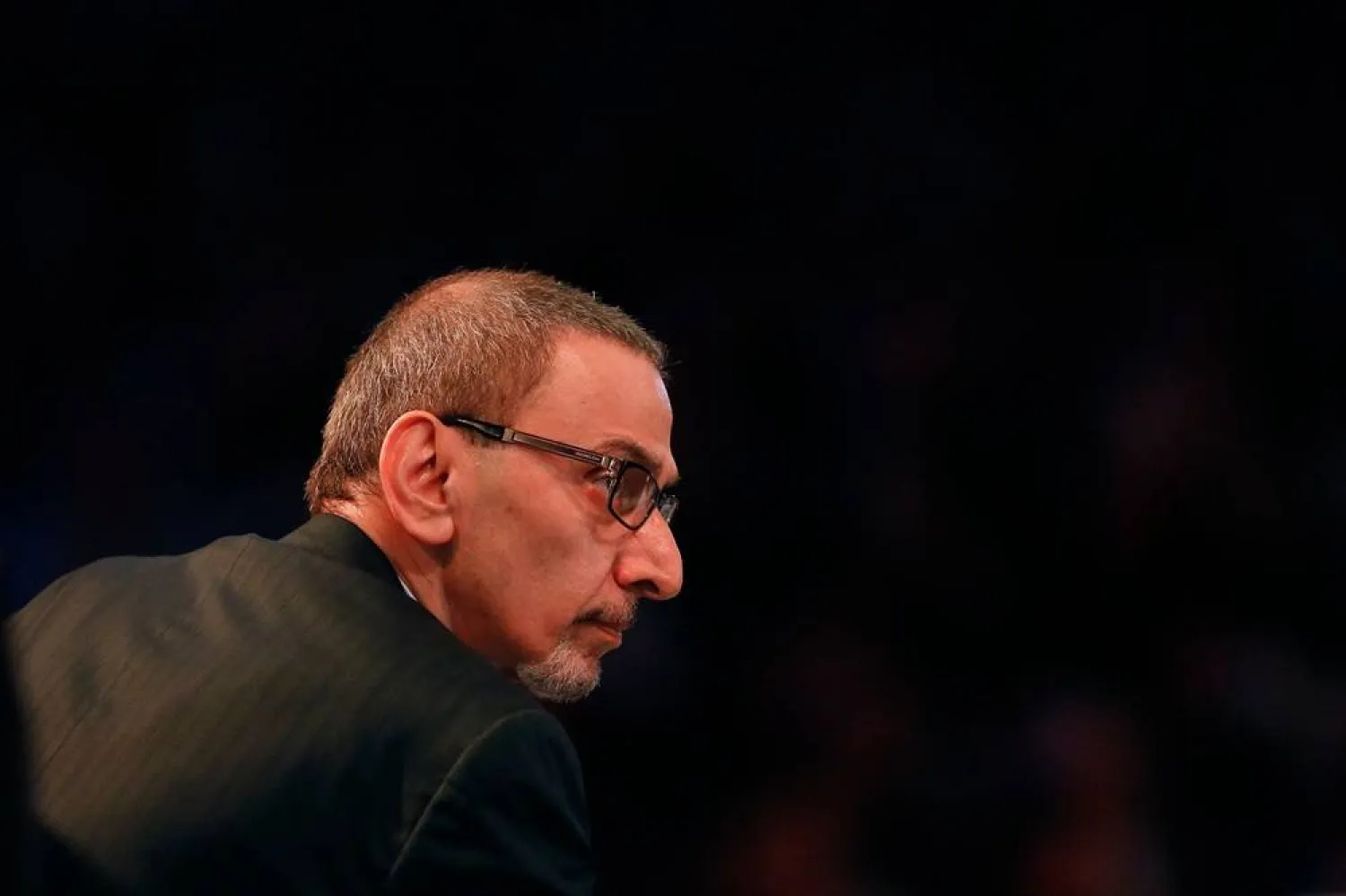

Ziad Rahbani, Lebanese Composer and Son of Icon Fairouz, Dies at 69

Lebanese artist Ziad Rahbani performs at the Beiteddine Palace in Lebanon's Chouf mountains, south of the capital Beirut, during the Beiteddine International Art Festival on July 12, 2018. (AFP)
TT

Ziad Rahbani, Lebanese Composer and Son of Icon Fairouz, Dies at 69

Lebanese artist Ziad Rahbani performs at the Beiteddine Palace in Lebanon's Chouf mountains, south of the capital Beirut, during the Beiteddine International Art Festival on July 12, 2018. (AFP)

Ziad Rahbani, the visionary Lebanese composer, playwright, pianist and political provocateur, died on Saturday, at the age of 69, according to the state-run National News Agency.

The death was confirmed by a person close to Rahbani who spoke on condition of anonymity. The cause of death was not immediately clear.

Born in 1956 in Antelias, near Beirut, Ziad was the eldest son of legendary Lebanese singer Fairouz and composer Assi Rahbani, one half of the famed Rahbani Brothers. From a young age, he showed signs of prodigious talent, composing his first musical work at just 17 years old. Raised among artistic royalty, his world was steeped in music, theater, and political consciousness — a combination that would define his life’s work.

His mother performed some of his compositions at her sellout concerts, blending Lebanese folklore with Western syncopation and phrasing.

Lebanese President Joseph Aoun mourned Rahbani’s passing as a national loss, describing him as “not just an artist, but a complete intellectual and cultural phenomenon.” In a statement, Aoun praised Rahbani as “a living conscience, a rebellious voice against injustice, and an honest mirror reflecting the suffering and marginalized.”

He highlighted how Rahbani’s fusion of classical, jazz and Oriental music “opened new windows for Lebanese cultural expression” and elevated it to global levels. “Ziad was a natural extension of the Rahbani family, which gave Lebanon much beauty and dignity,” the president added.

While his parents helped construct a golden era of Lebanese musical theater steeped in idealism and nostalgia, Rahbani charged onto the scene with irreverent satire, unflinching political critique and jazz-inflected scores that mirrored the chaos and contradictions of a Lebanon at war with itself.

His breakout play, Nazl el-Sourour (Happiness Hotel), premiered in 1974 when he was only 17 and portrayed a society disfigured by class inequality and repression. The tragicomic narrative follows a group of workers who hijack a restaurant to demand their rights, only to be dismissed by the political elite. With this bold debut, Rahbani revealed his enduring theme: that Lebanese society was fractured not only by war but by entrenched power.

Rahbani’s subsequent plays solidified his reputation as the voice of the disenchanted. In Bennesbeh La Bokra Chou? (What About Tomorrow?), he plays a jaded bar pianist in post-civil war Beirut who drifts through a surreal landscape of broken dreams, corruption and absurdity. The work features some of Rahbani’s most poignant music and biting commentary, including the famous line, “They say tomorrow will be better, but what about today?”

More than just a playwright, Rahbani was a composer of staggering range. He infused traditional Arabic melodies with jazz, funk and classical influences, creating a hybrid sound that became instantly recognizable. His live performances were legendary, whether playing piano in smoky clubs in Hamra, one of Beirut's major commercial districts that harbors a multifaceted identity, or orchestrating large-scale productions.

His collaborations with Fairouz, especially during the late 1970s and 1980s, ushered in a darker, more politically charged phase in her career. Songs like Ouverture 83, Bala Wala Chi (Without Anything), and Kifak Inta (How Are You) reflected Ziad’s brooding compositions and lyrical introspection.

Rahbani came under fire from Arab traditionalists for his pioneering efforts to bridge the gap between Arab and Western culture with music.


‘Sinners,’ ‘Wicked: For Good,’ ‘KPop Demon Hunters’ Advance in Oscars Shortlists 

US film director Ryan Coogler poses on the red carpet upon arrival for the European Premiere of "Sinners" at Cineworld Leicester Square, central London, on April 14, 2025. (AFP)
TT

‘Sinners,’ ‘Wicked: For Good,’ ‘KPop Demon Hunters’ Advance in Oscars Shortlists 

US film director Ryan Coogler poses on the red carpet upon arrival for the European Premiere of "Sinners" at Cineworld Leicester Square, central London, on April 14, 2025. (AFP)

Ryan Coogler’s bluesy vampire thriller “Sinners,” the big screen musical “Wicked: For Good” and the Netflix phenomenon “KPop Demon Hunters” are all a step closer to an Oscar nomination.

The Academy of Motion Picture Arts and Sciences released shortlists for 12 categories Tuesday, including for best song, score, international and documentary film, cinematography and this year’s new prize, casting.

“Sinners” and “Wicked: For Good” received the most shortlist mentions with eight each, including makeup and hair, sound, visual effects, score, casting and cinematography. Both have two original songs advancing as well. For “Wicked” it’s Stephen Schwartz’s “The Girl in the Bubble” and “No Place Like Home.” For “Sinners,” it’s Ludwig Göransson, Miles Caton and Alice Smith’s “Last Time (I Seen the Sun),” and Göransson and Raphael Saadiq’s “I Lied to You.”

The “KPop Demon Hunters” hit “Golden,” by EJAE and Mark Sonnenblick, was another shortlisted song alongside other notable artists like: Nick Cave and Bryce Dessner for “Train Dreams”; John Mayer, Ed Sheeran and Blake Slatkin for the “F1” song “Drive”; Sara Bareilles, Brandi Carlile and Andrea Gibson for “Salt Then Sour Then Sweet” from “Come See Me In the Good Light"; and Miley Cyrus, Simon Franglen, Mark Ronson and Andrew Wyatt for “Dream as One” from “Avatar: Fire and Ash.” Diane Warren also might be on her way to a 17th nomination with “Dear Me” from “Diane Warren: Relentless.”

One of the highest profile shortlist categories is the best international feature, where 15 films were named including “Sentimental Value” (Norway), “Sirât” (Spain), “No Other Choice” (South Korea), “The Secret Agent” (Brazil), “It Was Just an Accident” (France), “The Voice of Hind Rajab” (Tunisia), “Sound of Falling” (Germany) and “The President's Cake” (Iraq).

Notable documentaries among the 15 include “My Undesirable Friends: Part I — Last Air in Moscow,” “The Perfect Neighbor,” “The Alabama Solution,” “Come See Me in the Good Light,” “Cover-Up” and Mstyslav Chernov’s “2000 Meters to Andriivka,” a co-production between The Associated Press and PBS Frontline.

The Oscars' new award for casting shortlisted 10 films that will vie for the five nomination slots: “Frankenstein,” “Hamnet,” “Marty Supreme,” “One Battle After Another,” “The Secret Agent,” “Sentimental Value,” “Sinners,” “Sirāt,” “Weapons,” and “Wicked: For Good.” Notably “Jay Kelly and “Wake Up Dead Man: A Knives Out Mystery” did not make the list.

Composers who made the shortlist for best score include Göransson (“Sinners”), Jonny Greenwood (“One Battle After Another”), Max Richter (“Hamnet”), Alexandre Desplat (“Frankenstein”) and Kangding Ray (“Sirāt”).

For the most part, shortlists are determined by members in their respective categories, though the specifics vary from branch to branch: Some have committees, some have minimum viewing requirements.

As most of the shortlists are in below-the-line categories celebrating crafts like sound and visual effects, there are also films that aren’t necessarily the most obvious of Oscar contenders like “The Alto Knights,” shortlisted in hair and makeup, as well as the widely panned “Tron: Ares” and “The Electric State,” both shortlisted for visual effects. “Tron: Ares” also made the lists for score and song with Nine Inch Nails' “As Alive As You Need Me To Be”

The lists will narrow to five when final nominations are announced on Jan. 22. The 98th Oscars, hosted by Conan O’Brien, will air live on ABC on March 15.


Netflix Boss Promises Warner Bros Films Would Still be Seen in Cinemas

Netflix CEO Ted Sarandos poses during the avant-premiere of TV serie "Emily in Paris" season 5, at the Grand Rex, in Paris on December 15, 2025. (Photo by Blanca CRUZ / AFP)
TT

Netflix Boss Promises Warner Bros Films Would Still be Seen in Cinemas

Netflix CEO Ted Sarandos poses during the avant-premiere of TV serie "Emily in Paris" season 5, at the Grand Rex, in Paris on December 15, 2025. (Photo by Blanca CRUZ / AFP)

Netflix will continue to distribute Warner Bros. films in cinemas if its takeover bid for the storied studio is successful, the streaming service's chief executive Ted Sarandos said in an interview Tuesday in Paris.

"We're going to continue to operate Warner Bros. studios independently and release the movies traditionally in cinema," he said during an event in the French capital, while admitting his past comments on theatrical distribution "now confuse people".

Previously, Sarandos had suggested that the cinema experience was outdated, surpassed by the convenience of streaming.

The Netflix boss was being interviewed by Maxime Saada, head of France's Canal+ media group, in a Paris theater that was presenting Canal+'s projects for 2026, Agence France Presse reported.

Netflix only began to produce its own programs a dozen years ago, Sarandos explained, so "our library only extends back a decade, where Warner Bros. extends back 100 years. So they know a lot about things that we haven't ever done, like theatrical distribution."

In early December, Netflix announced that it had reached an agreement with Warner Bros. Discovery (WBD) to acquire most of the group for $83 billion.

However, doubts remain about whether the deal will be approved by regulators, and in the meantime television and film group Paramount Skydance has made a counter-offer valued at $108.4 billion.

If Netflix's bid is successful, it would acquire HBO Max, one of the world's largest media platforms, and it would find itself at the head of a movie catalogue including the Harry Potter and Lord of the Rings sagas, as well as the superheroes of DC Studios.


Donna Summer Is Posthumously Inducted into the Songwriters Hall of Fame

Donna Summer. (Reuters)
TT

Donna Summer Is Posthumously Inducted into the Songwriters Hall of Fame

Donna Summer. (Reuters)

There are giants, and then there is Donna Summer. The Queen of Disco and then some, known for such timeless tunes as “Love to Love You Baby,” “I Feel Love,” “Bad Girls,” “Dim All the Lights,” “On the Radio” and “She Works Hard for the Money,” has been posthumously inducted into the Songwriters Hall of Fame, the hall said.

Summer, who died in 2012 at age 63, was welcomed into the Songwriters Hall on Monday at a ceremony at The Butterfly Room at Cecconi’s in Los Angeles. It was led by Academy Award-winning songwriter Paul Williams. Summer's husband, Bruce Sudano and their daughters Brooklyn Sudano and Amanda Sudano Ramirez were in attendance.

“Donna Summer is not only one of the defining voices and performers of the 20th century; she is one of the great songwriters of all time who changed the course of music,” said Williams in a statement. “She wrote timeless and transcendent songs that continue to captivate our souls and imaginations, inspiring the world to dance and, above all, feel love.”

Summer's smooth blend of R&B, soul, pop, funk, rock, disco and electronica launched numerous chart-topping hits in the ‘70s and ’80s as well as three multiplatinum albums. She won five Grammys. She was unstoppable — both as a performer and a writer.

“It’s important to me because I know how important it was for Donna,” said Sudano in a press release. “The backstory is, with all the accolades that she received over her career, being respected as a songwriter was always the thing that she felt was overlooked. So, for her to be accepted into the Songwriters Hall of Fame I know that she’s very happy ... somewhere.”

The Songwriters Hall of Fame was established in 1969. A songwriter with a notable catalog of songs qualifies for induction 20 years after the first commercial release of a song.

The annual Songwriters Hall of Fame gala does not usually include posthumous inductions; those are reserved for separate events.

Songwriter Pete Bellotte — known for his work with Summer on “Hot Stuff,” “I Feel Love” and “Love To Love You Baby” — is a current nominee for the 2026 Songwriters Hall of Fame class. “Love To Love You Baby” was co-written with Summer and producer Giorgio Moroder. One of Summer's best-known hits, the song has been sampled many times, including in tracks by Beyoncé, LL Cool J and Timbaland.

The 2026 inductees will be announced in early 2026.