
Tunisia Plastic Collectors Spread as Economic, Migration Woes Deepen

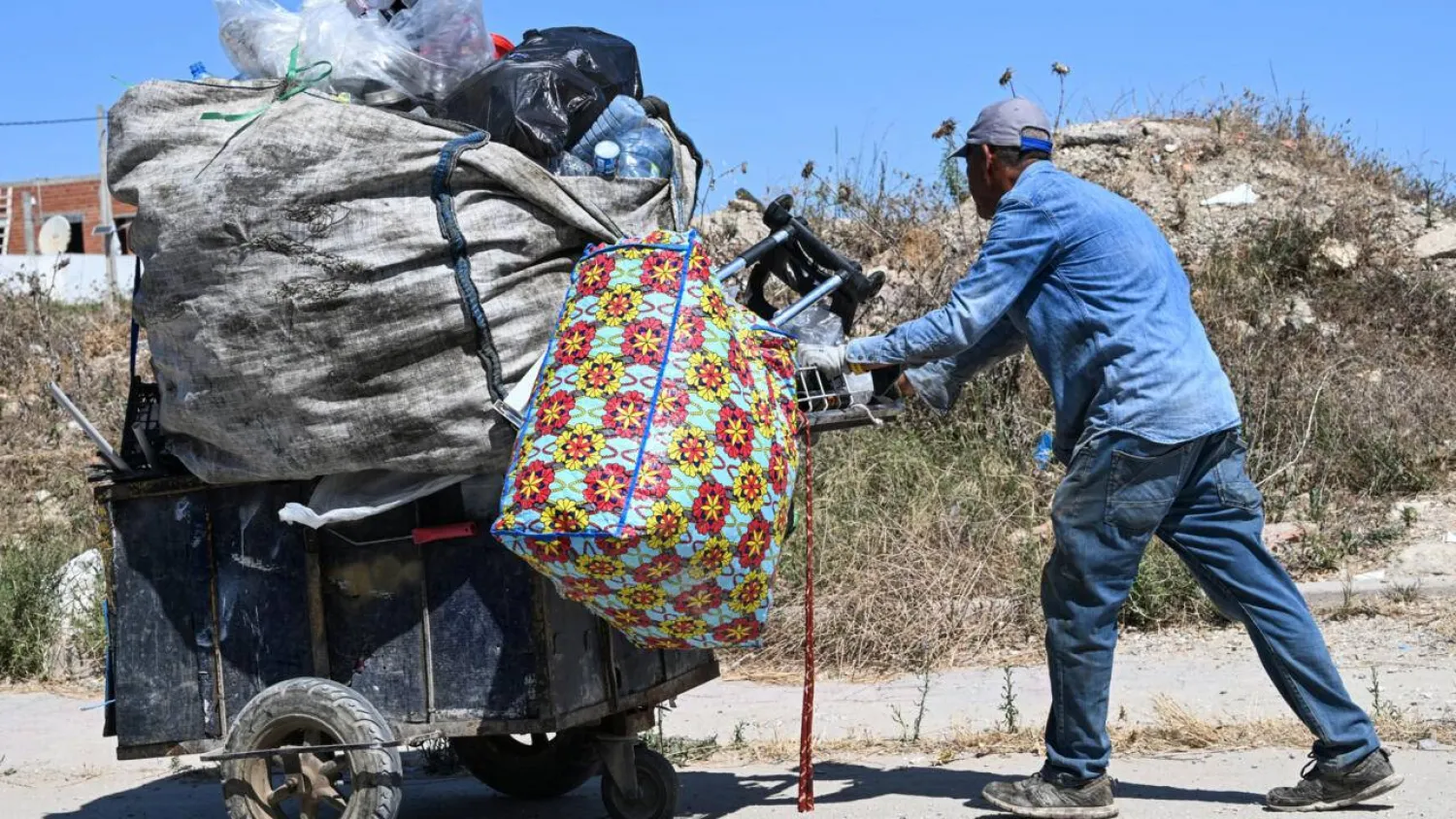
It's common to see people in Tunis weighed down by bags of plastic bottles along the roadside. FETHI BELAID / AFP
TT

Tunisia Plastic Collectors Spread as Economic, Migration Woes Deepen

It's common to see people in Tunis weighed down by bags of plastic bottles along the roadside. FETHI BELAID / AFP

A towel draped over his head, Hamza Jabbari sets bags of plastic bottles onto a scale. He is among Tunisia's "barbechas", informal plastic recyclers whose increasing numbers reflect the country's economic -- and migratory -- woes.

The 40-something-year-old said he starts the day off at dawn, hunching over bins and hunting for plastic before the rubbish trucks and other plastic collectors come.

"It's the most accessible work in Tunisia when there are no job offers," Jabbari said, weighing a day's haul in Bhar Lazreg, a working-class neighborhood north of the capital, Tunis.

The work is often grueling, with a kilogram of plastic bottles worth only 0.5 to 0.7 Tunisian dinar -- less than $0.25, AFP said.

In Tunis, it's common to see women weighed down by bags of plastic bottles along the roadside, or men weaving through traffic with towering loads strapped to their motorcycles.

"Everyone does it," said Jabbari.

'Supplementary job'

Hamza Chaouch, head of the National Chamber of Recyclable Waste Collectors, estimated that there were roughly 25,000 plastic collectors across Tunisia, with 40 percent of them in the capital.

Yet, with the job an informal one, there is no official count of how many plastic collectors operate in Tunisia.

One thing is certain: their number has increased in recent years, said Chaouch, who also runs a plastic collection center south of Tunis.

"It's because of the cost of living," he explained.

"At first, it was people with no income, but for the past two years, workers, retirees and cleaning women have also turned to this work as a supplementary job."

Around 16 percent of Tunisians lived under the poverty line as of 2021, the latest available official figures.

Unemployment currently hovers around 16 percent, with inflation at 5.4 percent.

The ranks of these recyclers have also grown with the arrival of migrants from sub-Saharan Africa -- often hoping to reach Europe but caught in limbo with both the EU and Tunis cracking down on Mediterranean crossings.

Tunisia is a key transit country for thousands of sub-Saharan migrants seeking to reach Europe by sea each year, with the Italian island of Lampedusa only 150 kilometers (90 miles) away.

Abdelkoudouss, a 24-year-old from Guinea, said he began collecting plastic to make ends meet but also to save up enough money to return home after failing two crossing attempts to Europe.

For the past two months, he has worked at a car wash, he said, but the low pay forced him to start recycling on the side.

"Life here is not easy," said Abdelkoudouss, adding he came to the capital after receiving "a lot of threats" amid tension between migrants and locals in Sfax, a coastal city in central Tunisia.

'Just trying to survive'

Thousands of migrants had set up camp on the outskirts of Sfax, before authorities began dismantling the makeshift neighborhoods this year.

Tensions flared in early 2023 when President Kais Saied said "hordes of sub-Saharan migrants" were threatening the country's demographic composition.

Saied's statement was widely circulated online and unleashed a wave of hostility that many migrants feel still lingers.

"There's a strong rivalry in this work," said Jabbari, glancing at a group of sub-Saharan African migrants nearby.

"These people have made life even more difficult for us. I can't collect enough plastic because of them."

Chaouch, the collection center manager, was even more blunt: "We don't accept sub-Saharans at our center. Priority goes to Tunisians."

In contrast, 79-year-old Abdallah Omri, who heads another center in Bhar Lazreg, said he "welcomes everyone".

"The people who do this work are just trying to survive, whether they're Tunisian, sub-Saharan or otherwise," he said.

"We're cleaning up the country and feeding families," he added proudly.


How to Protect Yourself from Food Poisoning

Food poisoning usually resolves within a few days without severe symptoms (Pexels)
TT

How to Protect Yourself from Food Poisoning

Food poisoning usually resolves within a few days without severe symptoms (Pexels)

Many people around the world suffer from food poisoning, a condition that occurs after consuming contaminated food or beverages.

Symptoms of food poisoning may appear in some people immediately after eating contaminated food, while others may not experience them until several days later.

Food poisoning usually resolves within a few days without severe or long-lasting symptoms. Treatment focuses on drinking enough fluids and reducing symptoms like nausea and diarrhea. Prevention strategies, such as eating well-cooked and properly stored food, can reduce the risk of food poisoning.

Symptoms of Food Poisoning

The symptoms of food poisoning are very similar to those of viral gastroenteritis. Symptoms may disappear in as little as 24 hours or last for up to a week.

According to the Health website, symptoms of food poisoning include:

Diarrhea

Fever

Nausea

Stomach cramps

Vomiting

Symptoms in infants and children include:

Changes in mental state, such as increased nervousness

Lack of energy

Diarrhea that lasts more than 24 hours

Frequent loose stools or vomiting

Some symptoms of food poisoning are more severe and require medical attention. These symptoms include:

Blood in the stool

Diarrhea that lasts more than three days

Symptoms of dehydration, such as severe dry mouth, little or no urination, and dizziness

A high fever above 39 degrees Celsius

Persistent vomiting that prevents you from drinking fluids

Causes

Food poisoning most often results from eating food or beverages contaminated with bacteria, viruses, or parasites. The cause can be determined by knowing what you ate or drank and how quickly symptoms appeared.

Potential causes of food poisoning include:

Escherichia coli (E. coli): A bacterium that causes symptoms about three to four days after eating raw or undercooked ground beef, vegetables, or sprouts. Unpasteurized milk is another possible source of E. coli.

Salmonella: A bacterium that causes symptoms from six hours to six days after eating raw fruits or vegetables, or raw or undercooked meat or eggs. Unpasteurized milk is another possible source of Salmonella.

Staphylococcus aureus: A bacterium that causes symptoms 30 minutes to eight hours after consuming food that was handled improperly, such as sliced meats or sandwiches.

Vibrio: A bacterium that causes symptoms within 24 hours, usually from eating raw or undercooked shellfish.

Norovirus: A virus that causes symptoms 12 to 48 hours after touching contaminated cooking surfaces or eating contaminated green leafy vegetables, fruits, or shellfish. Norovirus may also cause intestinal infections.

Food poisoning can also occur from exposure to:

Parasites such as protozoa, nematodes, and tapeworms

Mold or toxins

Food allergies that trigger the immune system to respond after eating certain foods, including nuts, eggs, fish, wheat, and soybeans

Ways to Prevent Food Poisoning

Food poisoning cannot always be prevented, but you can reduce the risk by following food safety recommendations:

Wash your hands frequently while preparing and handling food.

Sanitize and wash cooking surfaces regularly.

Use separate surfaces for preparing raw meats.

Wash fruits and vegetables before eating, cutting, or cooking them.

Use a food thermometer to ensure food is cooked to the proper internal temperature. For example, cook meat to an internal temperature of at least 60 degrees Celsius or higher, depending on the type of meat.

Refrigerate perishable foods within two hours of cooking them, and store them in airtight containers when necessary to limit bacterial growth.

If the outside temperature is above 32 degrees Celsius, do not leave foods that may spoil unrefrigerated for more than one hour (for example, during a picnic).

When traveling, always drink bottled or treated water to reduce the risk of traveler’s diarrhea, a condition that may occur when traveling to places with untreated water sources.


Social Media Users Mobilize to Find Boro, a Dog Who Survived Spain’s Train Crash

A sign is pictured reading in Spanish, "Missing Boro. Lost during the Adamuz accident. Any information is helpful," about a dog that went missing during a train crash in Adamuz, southern Spain, Wednesday, Jan. 21, 2026. (AP Photo/Manu Fernandez)
TT

Social Media Users Mobilize to Find Boro, a Dog Who Survived Spain’s Train Crash

A sign is pictured reading in Spanish, "Missing Boro. Lost during the Adamuz accident. Any information is helpful," about a dog that went missing during a train crash in Adamuz, southern Spain, Wednesday, Jan. 21, 2026. (AP Photo/Manu Fernandez)

Blanket draped over her shoulders and a bandage on her cheek, Ana García issued a desperate plea: she needed help finding her dog, Boro.

Hours earlier, 26-year-old García and her pregnant sister had been traveling with Boro by high-speed train from Malaga, their hometown in southern Spain, to capital Madrid. The tail of their train car jumped the rails for reasons that remain unclear, then was smashed into by a train coming in the opposite direction and that tumbled down an adjacent slope.

At least 42 people died in the crash and more than 150 were injured, including some right in front of García. Rescue crews helped her and her sister out of the tilted train car.
García saw Boro briefly, then he bolted.

After receiving medical treatment, a limping García told reporters she was going back to find him.

“Please, if you can help, look for the animals,” she said, choked up and holding back tears. “We were coming back from a family weekend with the little dog, who’s family, too.”

In the aftermath of one of Spain’s worst railway disasters, Spaniards on social media rallied to find Boro and major Spanish media outlets have reported on the search for the missing mutt.

Thousands amplified García’s call, sharing video of her interview. Photos of Boro, a medium-sized black dog with white eyebrows and a tuft of white fur on his chest, went viral alongside phone numbers for García and her family. The Associated Press was not able to reach anyone through these numbers.

Television broadcaster TVE’s filming of the crash site Monday afternoon brought a jolt of hope: for a few short seconds, a dog resembling Boro could be seen running through a nearby field — an area fenced off while investigators and rescuers continue their search for victims and evidence. But no one managed to locate the elusive pup.

Spain’s animal rights political party received permission from the Interior Ministry to send an animal rescue patrol inside the perimeter and will do so on Wednesday, its president, Javier Luna, said in a video posted on X.

“I want to send a message to the family, who are going through a very difficult time (...) I am giving you hope because I am sure we will find him,” Luna said.


Former Flight Attendant Posed as Pilot, Received Hundreds of Free Flights, US Authorities Say

A United Airlines plane takes off from San Francisco International Airport on January 20, 2026 in San Francisco, California. (Getty Images/AFP)
TT

Former Flight Attendant Posed as Pilot, Received Hundreds of Free Flights, US Authorities Say

A United Airlines plane takes off from San Francisco International Airport on January 20, 2026 in San Francisco, California. (Getty Images/AFP)

A former flight attendant for a Canadian airline posed as a commercial pilot and as a current flight attendant to obtain hundreds of free flights from US airlines, authorities said.

Dallas Pokornik, 33, of Toronto, was arrested in Panama after being indicted on wire fraud charges in federal court in Hawaii last October. He pleaded not guilty Tuesday following his extradition.

According to court documents, Pokornik was a flight attendant for a Toronto-based airline from 2017 to 2019, then used fake employee identification from that carrier to obtain tickets reserved for pilots and flight attendants on three other airlines.

US prosecutors said Tuesday that Pokornik even requested to sit in an extra seat in the cockpit — the “jump seat” — typically reserved for off-duty pilots. It was not clear from court documents whether he ever actually rode in a plane’s cockpit, and the US Attorney’s Office declined to say.

The indictment did not identify the airlines except to say they are based in Honolulu, Chicago and Fort Worth, Texas. Representatives for Hawaiian Airlines, United Airlines and American Airlines — which are respectively based in those cities — didn’t immediately respond to emails from The Associated Press seeking comment.

Air Canada, which is based in Toronto, also did not respond to an email seeking comment.

The scheme lasted four years, the US prosecutors in Hawaii said.

A US magistrate judge on Tuesday ordered Pokornik to remain in custody. His federal defender declined to comment.

In 2023, an off-duty airline pilot riding in the cockpit of a Horizon Air flight said “I’m not OK” just before trying to cut the engines midflight. That pilot, Joseph Emerson, later told police he had been struggling with depression.

A federal judge sentenced him to time served last November.

The allegations against Pokornik are reminiscent of “Catch Me If You Can,” the movie starring Leonardo DiCaprio that tells the story of Frank Abagnale posing as a pilot to defraud an airline and obtain free flights.