


Europe Hopes for 'No Surprises' as US Weighs Force Withdrawals

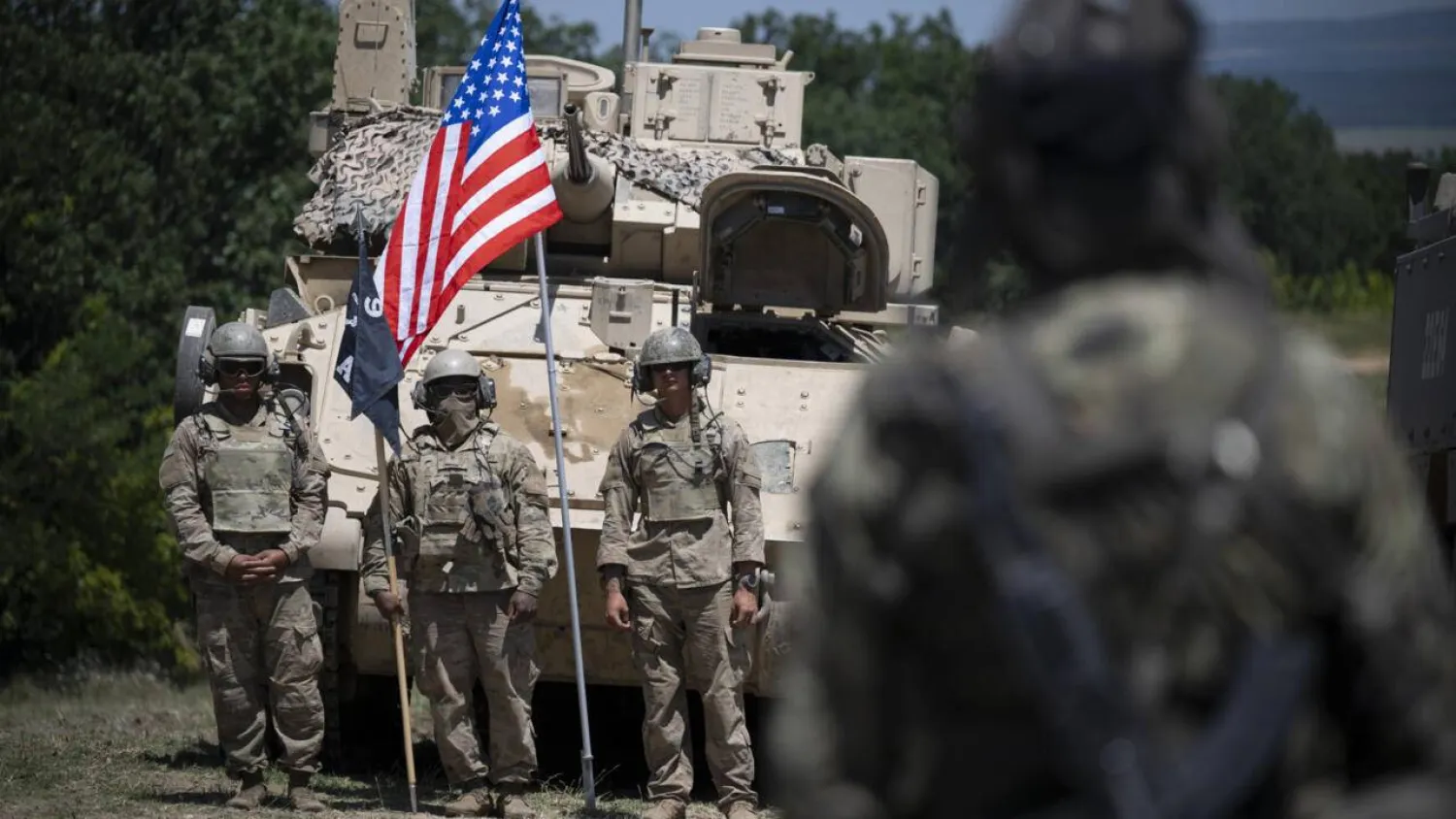
The United States is conducting a review of its military deployments worldwide. Nikolay DOYCHINOV / AFP
TT

Europe Hopes for 'No Surprises' as US Weighs Force Withdrawals

The United States is conducting a review of its military deployments worldwide. Nikolay DOYCHINOV / AFP

After keeping Donald Trump happy with a pledge to up defense spending at NATO's summit, Europe is now bracing for a key decision from the US president on the future of American forces on the continent.

Washington is currently conducting a review of its military deployments worldwide -- set to be unveiled in coming months -- and the expectation is it will lead to drawdowns in Europe.

That prospect is fraying the nerves of US allies, especially as fears swirl that Russia could look to attack a NATO country within the next few years if the war in Ukraine dies down.

However, the alliance is basking in Trump's newfound goodwill following its June summit in The Hague, and his officials are making encouraging noises that Europe will not be left in the lurch.

"We've agreed to no surprises and no gaps in the strategic framework of Europe," said Matthew Whitaker, US ambassador to NATO, adding he expected the review to come out in "late summer, early fall".

"I have daily conversations with our allies about the process," he said.

While successive US governments have mulled scaling back in Europe to focus more on China, Trump has insisted more forcefully than his predecessors that the continent should handle its own defense.

"There's every reason to expect a withdrawal from Europe," said Marta Mucznik from the International Crisis Group. "The question is not whether it's going to happen, but how fast."

When Trump returned to office in January many felt he was about to blow a hole in the seven-decade-old alliance.

But the vibe in NATO circles is now far more upbeat than those desperate days.

"There's a sanguine mood, a lot of guesswork, but the early signals are quite positive," one senior European diplomat told AFP, talking as others on condition of anonymity.

"Certainly no panic or doom and gloom."

'Inevitable'

The Pentagon says there are nearly 85,000 US military personnel in Europe -- a number that has fluctuated between 75,000 and 105,000 since Russia's 2022 invasion of Ukraine.

"I think it is inevitable that they pull out some of their forces," a second European diplomat told AFP.

"But I don't expect this to be like a dramatic overhaul. I think it's going to be gradual. I think it's going to be based on consultations."

Trump's first target is likely to be the troops left over from a surge ordered by his predecessor Joe Biden after Moscow's tanks rolled into Ukraine.

Officials say relocating the rump of that 20,000-strong deployment would not hurt NATO's deterrence too much -- but alarm bells would ring if Trump looked to cut too deep into personnel numbers or close key bases.

The issue is not just troop numbers -- the US has capabilities such as air defenses, long-range missiles and satellite surveillance that allies would struggle to replace in the short-term.

"The kinds of defense investments by Europe that are being made coming out of The Hague summit may only be felt in real capability terms over many years," said Ian Lesser from the German Marshall Fund think tank.

"So the question of timing really does matter."

'Inopportune moment'

Washington's desire to pull back from Europe may be tempered by Trump now taking a tougher line with Russia -- and Moscow's reluctance to bow to his demands to end the Ukraine war.

"It seems an inopportune moment to send signals of weakness and reductions in the American security presence in Europe," Lesser said.

He also pointed to Trump's struggles during his first term to pull troops out of Germany -- the potential bill for relocating them along with political resistance in Washington scuppering the plan.

While European diplomats are feeling more confident than before about the troop review, they admit nothing can be certain with the mercurial US president.

Other issues such as Washington's trade negotiations with the EU could rock transatlantic ties in the meantime and upend the good vibes.

"It seems positive for now," said a third European diplomat.

"But what if we are all wrong and a force decrease will start in 2026. To be honest, there isn't much to go on at this stage."



Iran President Says Any Attack on Supreme Leader Would Be Declaration of War

 In this photo released by an official website of the office of the Iranian supreme leader, Supreme Leader Ali Khamenei speaks in a meeting, in Tehran, Iran, Saturday, Jan. 17, 2026. (Office of the Iranian Supreme Leader via AP)
In this photo released by an official website of the office of the Iranian supreme leader, Supreme Leader Ali Khamenei speaks in a meeting, in Tehran, Iran, Saturday, Jan. 17, 2026. (Office of the Iranian Supreme Leader via AP)
TT

Iran President Says Any Attack on Supreme Leader Would Be Declaration of War

 In this photo released by an official website of the office of the Iranian supreme leader, Supreme Leader Ali Khamenei speaks in a meeting, in Tehran, Iran, Saturday, Jan. 17, 2026. (Office of the Iranian Supreme Leader via AP)
In this photo released by an official website of the office of the Iranian supreme leader, Supreme Leader Ali Khamenei speaks in a meeting, in Tehran, Iran, Saturday, Jan. 17, 2026. (Office of the Iranian Supreme Leader via AP)

Iranian President Masoud Pezeshkian warned on Sunday that any attack on the country's supreme leader Ali Khamenei would mean a declaration of war.

"An attack on the great leader of our country is tantamount to a full-scale war with the Iranian nation," Pezeshkian said in a post on X in an apparent response to US President Donald Trump saying it was time to look for a new leader in Iran.


Quake Hits Northeast Sicily, No Damage Reported

 A man feeds seagulls in Syracuse, Sicily, southern Italy on January 10, 2026. (AFP)
A man feeds seagulls in Syracuse, Sicily, southern Italy on January 10, 2026. (AFP)
TT

Quake Hits Northeast Sicily, No Damage Reported

 A man feeds seagulls in Syracuse, Sicily, southern Italy on January 10, 2026. (AFP)
A man feeds seagulls in Syracuse, Sicily, southern Italy on January 10, 2026. (AFP)

A light earthquake hit the northeastern corner of Sicily on Sunday, authorities said, but no damage was immediately reported.

The quake registering 4.0 on the Richter and Moment Magnitude scales was centered two kilometers (just over a mile) from Militello Rosmarino in the northeastern province of Messina, according to the National Institute of Geophysics and Vulcanology (INGV).

It occurred at 2:54 pm local time (1354 GMT) and had a depth of eight kilometers, INGV said.

Il Mattino newspaper said the earthquake was felt throughout the Messina area but no damage to people or buildings had been reported.

The town of approximately 1,200 inhabitants is located just north of the Nebrodi park, Sicily's largest protected area.

Tremors occur frequently in the northeast of Sicily, with a 2.5 magnitude quake occurring at Piraino, to the east, on Saturday.


EU States Condemn Trump Tariff Threats, Consider Countermeasures

Military personnel from the German armed Forces Bundeswehr board Icelandair flight leaving Nuuk airport for Reykjavik on January 18, 2026 in Nuuk, Greenland. (AFP)
TT

EU States Condemn Trump Tariff Threats, Consider Countermeasures

Military personnel from the German armed Forces Bundeswehr board Icelandair flight leaving Nuuk airport for Reykjavik on January 18, 2026 in Nuuk, Greenland. (AFP)

Major European Union states decried US President Donald Trump's tariff threats against European allies over Greenland as blackmail on Sunday, as France proposed responding with a range of previously untested economic countermeasures.

Trump vowed on Saturday to implement a wave of increasing tariffs on EU members Denmark, Sweden, France, Germany, the Netherlands and Finland, along with Britain and Norway, until the US is allowed to buy Greenland.

All eight countries, already subject to US tariffs of 10% and 15%, have sent small numbers of military personnel to Greenland, as a row with the United States over the future of Denmark's vast Arctic island escalates.

"Tariff threats undermine transatlantic relations and risk a dangerous downward spiral," the eight-nations said in a joint statement published on Sunday.

They said the Danish exercise was ‌designed to strengthen Arctic ‌security and posed no threat to anyone. They said they were ready to ‌engage ⁠in dialogue, based ‌on principles of sovereignty and territorial integrity.

Danish Prime Minister Mette Frederiksen said in a written statement that she was pleased with the consistent messages from the rest of the continent, adding: "Europe will not be blackmailed", a view echoed by Germany's finance minister and Sweden's prime minister.

"It's blackmail what he's doing," Dutch Foreign Minister David van Weel said on Dutch television of Trump's threat.

COORDINATED EUROPEAN RESPONSE

Cyprus, holder of the rotating six-month EU presidency, summoned ambassadors to an emergency meeting in Brussels on Sunday, which diplomats said was due to start at 5 p.m. (1600 GMT) as EU leaders stepped up contacts.

A source close to French President Emmanuel Macron said he was pushing for ⁠activation of the "Anti-Coercion Instrument", which could limit access to public tenders, investments or banking activity or restrict trade in services, in which the US has a surplus with ‌the bloc, including digital services.

Bernd Lange, the German Social Democrat who ‍chairs the European Parliament's trade committee, and Valerie Hayer, head of ‍the centrist Renew Europe group, echoed Macron's call, as did Germany's engineering association.

Meanwhile, Irish Prime Minister Micheal Martin said ‍that while there should be no doubt that the EU would retaliate, it was "a bit premature" to activate the anti-coercion instrument.

And Italian Prime Minister Giorgia Meloni, who is closer to the US President than some other EU leaders, described the tariff threat on Sunday as "a mistake", adding she had spoken to Trump a few hours earlier and told him what she thought.

"He seemed interested in listening," she told a briefing with reporters during a trip to Korea, adding she planned to call other European leaders later on Sunday.

Italy has not sent troops to Greenland.

BRITAIN'S POSITION 'NON-NEGOTIABLE'

Asked how Britain would respond to new ⁠tariffs, Culture Secretary Lisa Nandy said allies needed to work with the United States to resolve the dispute.

"Our position on Greenland is non-negotiable ... It is in our collective interest to work together and not to start a war of words," she told Sky News on Sunday.

The tariff threats do though call into question trade deals the US struck with Britain in May and the EU in July.

The limited agreements have already faced criticism about their lopsided nature, with the US maintaining broad tariffs, while their partners are required to remove import duties.

The European Parliament looks likely now to suspend its work on the EU-US trade deal. It had been due to vote on removing many EU import duties on January 26-27, but Manfred Weber, head of the European People's Party, the largest group in parliament, said late on Saturday that approval was not possible for now.

German Christian Democrat lawmaker Juergen Hardt also mooted what he told Bild newspaper could be a last resort "to bring President Trump to his senses on the Greenland issue", ‌a boycott of the soccer World Cup that the US is hosting this year.