


Saudi Arabia Stresses Ongoing Efforts to Advance Regional, International Stability

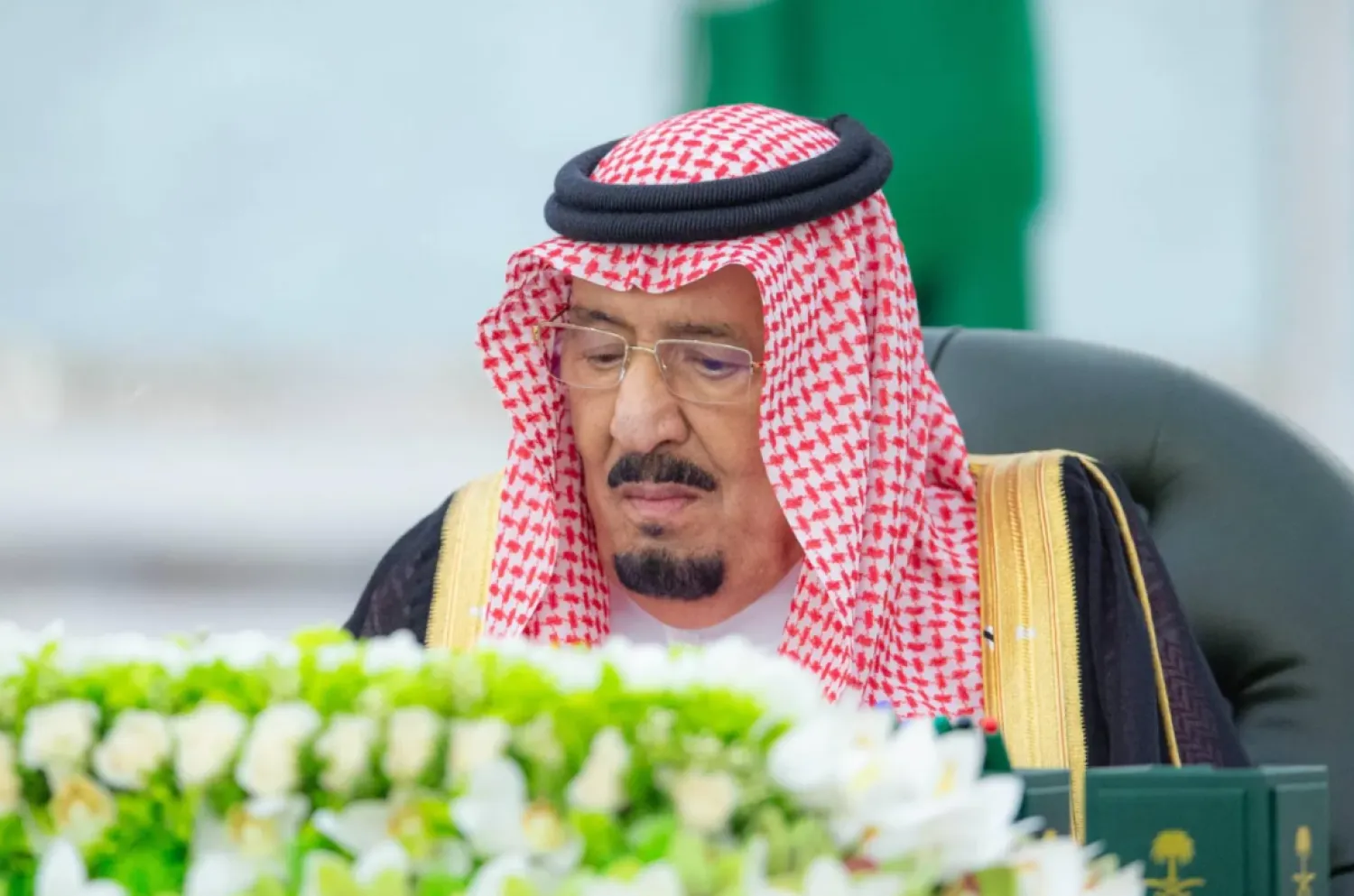
Custodian of the Two Holy Mosques Chairs Cabinet Session - SPA
TT

Saudi Arabia Stresses Ongoing Efforts to Advance Regional, International Stability

Custodian of the Two Holy Mosques Chairs Cabinet Session - SPA

Custodian of the Two Holy Mosques King Salman bin Abdulaziz Al Saud chaired the Cabinet session held Tuesday in Jeddah.

The Cabinet was briefed on the recent talks and communications between the Kingdom of Saudi Arabia and various countries, focusing on solidifying relations and advancing bilateral and multilateral coordination across diverse fields to achieve common interests and mutual benefits, SPA reported.

It also closely followed regional and international developments, reaffirming the Kingdom’s ongoing efforts to establish a just peace in the Middle East, promote international security and stability, and end the cycle of violence that has claimed the lives of tens of thousands of innocent civilians.

The Cabinet commended the outcomes of the Saudi delegation’s visit to the Syrian Arab Republic. The visit, carried out under the directives of His Royal Highness Prince Mohammed bin Salman bin Abdulaziz Al Saud, Crown Prince and Prime Minister, reaffirmed the Kingdom’s steadfast support for Syria’s path toward economic growth.

The Cabinet noted that the visit culminated in the signing of 47 investment agreements valued at approximately SAR24 billion across several sectors, along with the announcement of a joint business council to foster mutual cooperation and activate partnerships between private sector institutions in both countries.

In a statement to the Saudi Press Agency following the session, Minister of Media Salman Al-Dossary said that the Cabinet addressed the Kingdom's participation in the United Nations High-Level Political Forum, during which the Kingdom highlighted the significant achievements of its vision, positioning the Kingdom as the fastest-advancing among the G20 countries in sustainable development indicators over the past decade.

The Kingdom’s participation also underscored its international contributions and initiatives aimed at promoting global progress and prosperity.

The Cabinet expressed its hope that the High-Level International Conference on the Peaceful Settlement of the Palestinian Question, co-chaired by Saudi Arabia in partnership with France, would contribute to accelerating the recognition of the State of Palestine and establishing a consensual path toward implementing the two-state solution, while enhancing the security and stability of countries in the region.

The Cabinet reiterated the Kingdom of Saudi Arabia’s welcome of the announcement by President Emmanuel Macron of the French Republic regarding his country’s intention to recognize the State of Palestine. It also called on other countries to take similar steps in support of peace and the legitimate rights of the Palestinian people.

The Cabinet strongly condemned the Israeli Knesset’s call to impose control over the occupied West Bank and the Jordan Valley, stressing that such actions undermine peace efforts and reflect a persistence in sabotage and destruction. It reiterated the Kingdom’s categorical rejection of the occupation authorities’ violations of international law and United Nations resolutions.

On domestic affairs, the Cabinet reviewed the latest developments in the Kingdom’s efforts to develop circular carbon economy technologies, including the successful operation of a Direct Air Capture (DAC) testing unit in Riyadh. This initiative reflects the Kingdom’s ongoing commitment to exploring innovative and promising technical solutions in this field, reaffirming its leadership and dedication to achieving its climate goals in line with Vision 2030.



Saudi Arabia, Arab and Islamic Countries Condemn Statements by the US Ambassador to Israel

Saudi Arabia, Arab and Islamic Countries Condemn Statements by the US Ambassador to Israel
TT

Saudi Arabia, Arab and Islamic Countries Condemn Statements by the US Ambassador to Israel

Saudi Arabia, Arab and Islamic Countries Condemn Statements by the US Ambassador to Israel

The Ministries of Foreign Affairs of the Kingdom of Saudi Arabia, Jordan, the United Arab Emirates, Qatar, Indonesia, Pakistan, Egypt, Türkiye, Syria, Palestine, Kuwait, Lebanon, the Sultanate of Oman, and the Kingdom of Bahrain, together with League of Arab States (LAS), expressed their strong condemnation and profound concern regarding the statements made by the United States Ambassador to Israel, in which he indicated that it would be acceptable for Israel to exercise control over territories belonging to Arab states, including the occupied West Bank.

The Saudi Press Agency (SPA) reported "their categorical rejection of such dangerous and inflammatory remarks, which constitute a flagrant violation of the principles of international law and the Charter of the United Nations, and pose a grave threat to the security and stability of the region."

The ministries stressed that these statements directly contradict the vision put forward by US President Donald Trump, as well as the Comprehensive Plan to End the Gaza Conflict, which are based on containing escalation and creating a political horizon for a comprehensive settlement that ensures the Palestinian people have their own independent state.

They underscored that the plan is grounded in promoting tolerance and peaceful coexistence, and that remarks seeking to legitimize control over the lands of others undermine these objectives, fuel tensions, and constitute incitement rather than advancing peace.

The ministries reaffirmed that Israel has no sovereignty whatsoever over the Occupied Palestinian Territory or any other occupied Arab lands. They reiterated their firm rejection of any attempts to annex the West Bank or separate it from the Gaza Strip, their strong opposition to the expansion of settlement activities in the Occupied Palestinian Territory, and their categorical rejection of any threat to the sovereignty of Arab states.

They further warned that the continuation of Israel’s expansionist policies and unlawful measures will only inflame violence and conflict in the region and undermine the prospects for peace and called for an end to these incendiary statements, according to SPA.

The ministries underscored their countries’ steadfast commitment to the inalienable right of the Palestinian people to self-determination and to the establishment of their independent state along the lines of 4 June 1967, and the end of the occupation of all Arab lands.


Saudi Crown Prince Visits Quba Mosque in Madinah

Saudi Crown Prince Mohammed bin Salman bin Abdulaziz Al Saud - SPA
TT

Saudi Crown Prince Visits Quba Mosque in Madinah

Saudi Crown Prince Mohammed bin Salman bin Abdulaziz Al Saud - SPA

Saudi Prince Mohammed bin Salman bin Abdulaziz Al Saud, Crown Prince and Prime Minister, visited Quba Mosque in Madinah and performed the two-unit prayer of greeting, SPA reported.

He was accompanied by Governor of Madinah Region Prince Salman bin Sultan bin Abdulaziz, Minister of State and Cabinet Member Prince Turki bin Mohammed bin Fahd bin Abdulaziz, Deputy Governor of Riyadh Region Prince Mohammed bin Abdulrahman bin Abdulaziz, Deputy Governor of Madinah Region Prince Saud bin Nahar bin Saud bin Abdulaziz, and several other officials.


GCC, OIC Condemn Statements by US Ambassador to Israel

GCC, OIC Condemn Statements by US Ambassador to Israel
TT

GCC, OIC Condemn Statements by US Ambassador to Israel

GCC, OIC Condemn Statements by US Ambassador to Israel

Secretary General of the Gulf Cooperation Council (GCC) Jasem Mohamed Albudaiwi expressed rejection and condemnation of the irresponsible and unacceptable statements made by the United States Ambassador to the government of the Israeli occupation forces.

The statements included acceptance of the occupation’s control over lands belonging to Arab states, including the occupied West Bank.

The Secretary General stressed that the statements constitute a clear violation of international law and the UN Charter, which affirm the sovereignty of states and the unity and full sovereignty of their territories, SPA reported.

He noted that these unprecedented remarks are inconsistent with the United States' directions and the vision put forward by US President Donald Trump for regional and international partners. The vision aims to achieve peace and reach a lasting solution to the Palestinian issue, contributing to enhanced security and stability in the region and worldwide.

He reaffirmed the GCC’s firm commitment to supporting the Palestinian people and the establishment of an independent Palestinian state along the June 4, 1967 borders, with East Jerusalem as its capital. This position aligns with international legitimacy resolutions and the Arab Peace Initiative.

Also, the General Secretariat of the Organization of Islamic Cooperation (OIC) expressed its condemnation of those statements, saying they were "dangerous and irresponsible," describing them as an unacceptable call for Israel, the occupying power, to expand and seize more Palestinian and Arab lands.

The OIC General Secretariat stressed that such remarks are based on false and rejected historical and ideological claims that violate the sovereignty of states, diplomatic norms, principles of international law, United Nations (UN) resolutions, and the UN Charter.

According to SPA, it also warned that this extremist ideological discourse is liable to fuel extremism and encourage the Israeli occupation to persist in its unlawful practices of displacement, settlement, annexation, and attempts to impose sovereignty over the occupied Palestinian territory – actions that threaten security and stability throughout the entire region.

Additionally, the OIC General Secretariat reaffirmed its firm and absolute support for the legitimate rights of the Palestinian people, foremost among them their right to self-determination and to establish their independent, sovereign state on the borders of June 4, 1967, with East Jerusalem as its capital.