Lebanon's President Aoun Urges Hezbollah to Give Up Arms

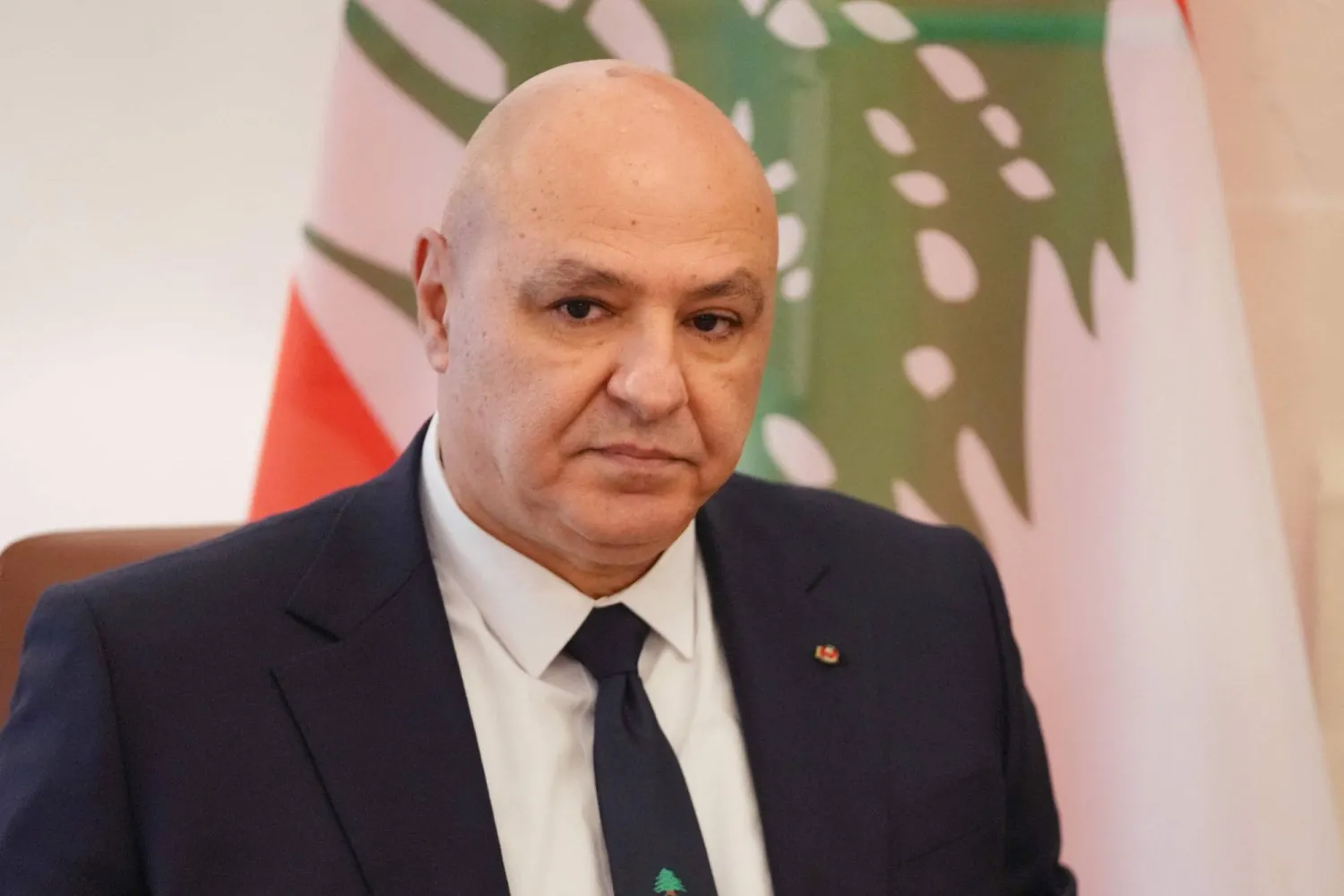
File photo: Lebanon's President Joseph Aoun is pictured during a meeting with his Cypriot counterpart Nikos Christodoulides at the presidential palace in Nicosia during a his first official visit to the east Mediterranean island on July 9, 2025. (Photo by Petros Karadjias / POOL / AFP)
TT

Lebanon's President Aoun Urges Hezbollah to Give Up Arms

File photo: Lebanon's President Joseph Aoun is pictured during a meeting with his Cypriot counterpart Nikos Christodoulides at the presidential palace in Nicosia during a his first official visit to the east Mediterranean island on July 9, 2025. (Photo by Petros Karadjias / POOL / AFP)

Lebanon's President Joseph Aoun called on Hezbollah and other political parties on Thursday to hand over their weapons to the army, a move the powerful militant group is resisting as Washington ramps up pressures for it to remove its arsenal.

"It is the duty of all political parties... to seize this historic opportunity without hesitation and push for the exclusivity of weapons in the hands of the army and security forces and no one else," Aoun said in a televised speech in the defense ministry's headquarters.

Hezbollah, which emerged badly damaged from its war with Israel last year, has said calls for the Iran-aligned group to disarm only serve Israel.

"Those who call for submitting arms practically demand submitting them to Israel ... We will not submit to Israel," the group's chief Sheikh Naim Qassem said on Wednesday.

The US has been pushing Lebanon to issue a formal cabinet decision committing to disarm Hezbollah before talks can resume on a halt to Israeli military operations in the country, five sources familiar with the matter told Reuters.

Aoun said a proposal to Washington that will be presented to the cabinet next week stated that Israel should stop its attacks on Lebanon and withdraw from the posts it occupies in the south of the country, along with Hezbollah handing over its weaponry to the Lebanese army.

The proposal seeks to secure $1 billion annually for 10 years to support the army and the security forces and includes plans for an international conference to take place later in the year to support reconstruction efforts in Lebanon.


Iran’s Top Diplomat Speaks with Hamas

Iran's Foreign Minister Abbas Araghchi arrives for a bilateral meeting with Switzerland's counterpart at the Burgenstock luxury hotel complex overlooking Lake Lucerne, Switzerland, on June 21, 2026, ahead of high-level talks aimed at advancing a deal to end the Middle East conflict. (AFP)
TT

Iran’s Top Diplomat Speaks with Hamas

Iran's Foreign Minister Abbas Araghchi arrives for a bilateral meeting with Switzerland's counterpart at the Burgenstock luxury hotel complex overlooking Lake Lucerne, Switzerland, on June 21, 2026, ahead of high-level talks aimed at advancing a deal to end the Middle East conflict. (AFP)

Iran's top diplomat spoke with a senior official from the Palestinian group Hamas regarding talks between Iran and the United States, state television reported on Wednesday.

Abbas Araghchi discussed the "latest developments" in the region with Basem Naeem, a member of Hamas's political bureau, Iranian television said.

The call follows the signing last week of a memorandum of understanding between Iran and the United States aimed at bringing a lasting end to hostilities in the Middle East.

The text does not mention Gaza but stipulates "an immediate and permanent cessation of military operations on all fronts, including in Lebanon".

Hamas has welcomed the agreement and expressed hope that it would also help end the violence in the Gaza Strip, which has been devastated by over two years of war with Israel.

Iran is a staunch supporter of the Palestinian cause, making it a cornerstone of its foreign policy since the 1979 revolution.

During the call, Araghchi "reaffirmed Iran's continued support for Palestinians and their just cause until their legitimate national rights are fully realized", according to a transcript reported by Iranian television.

On Tuesday, the Iranian foreign minister accompanied President Masoud Pezeshkian on a visit to neighboring Pakistan, which has been acting as a mediator in the talks between Tehran and Washington.


Nabil Fahmy’s Priorities at Arab League Helm: Reform and Strengthening Arab Coordination

New Secretary-General of the Arab League Nabil Fahmy. (Facebook)
TT

Nabil Fahmy’s Priorities at Arab League Helm: Reform and Strengthening Arab Coordination

New Secretary-General of the Arab League Nabil Fahmy. (Facebook)

In his first statement as the newly appointed secretary-general of the Arab League, Nabil Fahmy outlined what he sees as the organization’s key priorities for the coming years: modernizing its mechanisms and deepening Arab consultation and coordination.

After the Arab League approved his appointment on Monday, Fahmy said his five-year term, which begins on July 1, would focus on updating the organization and adapting its working methods to keep pace with rapid regional and international changes.

He stressed that the current phase requires closer Arab coordination to confront the crises and security threats facing the region, while strengthening cooperation to capitalize on emerging opportunities and turn existing challenges into drivers of stability and development.

Describing his unanimous selection as a “historic responsibility at a sensitive and pivotal moment,” Fahmy said the Arab world is confronting major challenges amid fast-moving regional and global transformations.

These conditions, he argued, demand stronger collective action, the defense of Arab interests, and a renewed commitment to solidarity among member states.

Fahmy underlined respect for the sovereignty, security, and territorial integrity of Arab states, as well as support for national efforts to achieve sustainable development and improve living standards.

He pledged that the Arab League would remain “the common home of the Arabs” and continue serving as a platform for dialogue, consultation, and coordination.

Egyptian President Abdel Fattah al-Sisi meets the new Secretary-General of the Arab League Nabil Fahmy (Egyptian Presidency)

Changing strategic landscape

Speaking to Asharq Al-Awsat, Egyptian diplomat Mohamed Hegazy, a member of the Egyptian Council for Foreign Affairs and a former assistant foreign minister, said Fahmy’s priorities reflect a clear reading of the region’s realities.

“The Arab League must evolve in ways that add real value to collective Arab action,” Hegazy said, arguing that deeper consultation among Arab states will be essential to rebuilding confidence in the institution.

He pointed to a rapidly shifting strategic environment marked by the repercussions of the US-Iran conflict, the ongoing war in Gaza, the protracted crises in Sudan, Libya, and Yemen, and broader changes in the international order.

According to Hegazy, Fahmy’s unanimous election reflects broad confidence in his diplomatic experience, extensive regional and international ties, and ability to help reposition the Arab League at a particularly complex moment.

Fahmy succeeds fellow Egyptian Ahmed Aboul Gheit, who led the organization from 2016 to 2026. He will become the Arab League’s ninth secretary-general since its founding in 1945 and the eighth Egyptian to hold the post.

Rebuilding trust

Hegazy said that Fahmy’s first challenge will be restoring political confidence in the Arab League as a forum for Arab consensus rather than a body confined to meetings and communiques.

“The real challenge is not administrative reform, but convincing member states that the League can generate political value and manage disagreements through institutional mechanisms,” he explained.

According to Hegazy, institutional reform is also likely to include a review of decision-making procedures, a stronger role for research centers, and greater use of technology and artificial intelligence to support policymaking.

The League may also place greater emphasis on development, economic integration, digital transformation, energy, and food and water security - issues increasingly viewed as central to modern Arab national security.

Ultimately, Hegazy said, Fahmy’s success will depend on his ability to transform the Arab League from an institution that reflects Arab divisions into one that helps overcome them, forging a common Arab vision for security, development, and engagement with a rapidly changing world.


Israel, Lebanon Discuss Proposal for Transfer of Some Southern Territory to Lebanese Army

A woman inspects the rubble of a collapsed building in the town of Nabatieh al-Fawqa in southern Lebanon on June 23, 2026. (Photo by Fadel ITANI / AFP)
TT

Israel, Lebanon Discuss Proposal for Transfer of Some Southern Territory to Lebanese Army

A woman inspects the rubble of a collapsed building in the town of Nabatieh al-Fawqa in southern Lebanon on June 23, 2026. (Photo by Fadel ITANI / AFP)

Talks between Israel and Lebanon include discussion of a US-backed proposal for Israeli forces to hand over some of the territory they have invaded during the war with Hezbollah to the Lebanese military, according to Israeli and Lebanese officials.

The Israeli officials said the Lebanese troops involved would undergo US training and vetting to ensure they are not linked to Hezbollah, while Israel would maintain a military presence in a buffer zone along the border.

The proposed "pilot" project is being discussed in the latest round ⁠of talks between Lebanese ⁠and Israeli officials, which got underway in Washington on Tuesday, Reuters reported.

Rejected by Hezbollah, this diplomatic track has been overshadowed as Tehran has made Lebanon a focal point of its negotiations with the US.

Asked about the Israeli officials' comments, a senior Lebanese security official said discussions were ongoing in Washington ⁠and that Wednesday would see specific military-to-military discussions, including on the pilot zones.

The Lebanese official said the discussions would focus on a timeline for withdrawal and that any plan would emerge only after the final day of talks on Thursday. The official did not respond to a request for comment on the Israeli officials' account of US vetting of Lebanese troops.

The latest war between Hezbollah and Israel erupted when the group opened fire at Israel in solidarity with ⁠Tehran in ⁠the early days of the US-Israeli war on Iran.

A ceasefire has largely held since Sunday, even as Israeli forces have remained deployed deep inside southern Lebanon, where they have seized a self-declared security zone, saying they need this to shield northern Israel from a Hezbollah attack.

The interim agreement signed by Iran and the US last week requires both countries and their allies to declare an immediate and permanent end of military operations on all fronts, including Lebanon, and to ensure Lebanon's "territorial integrity and sovereignty."