
US Envoy Witkoff Visits Aid Operation in Gaza Rejected by UN as Unsafe

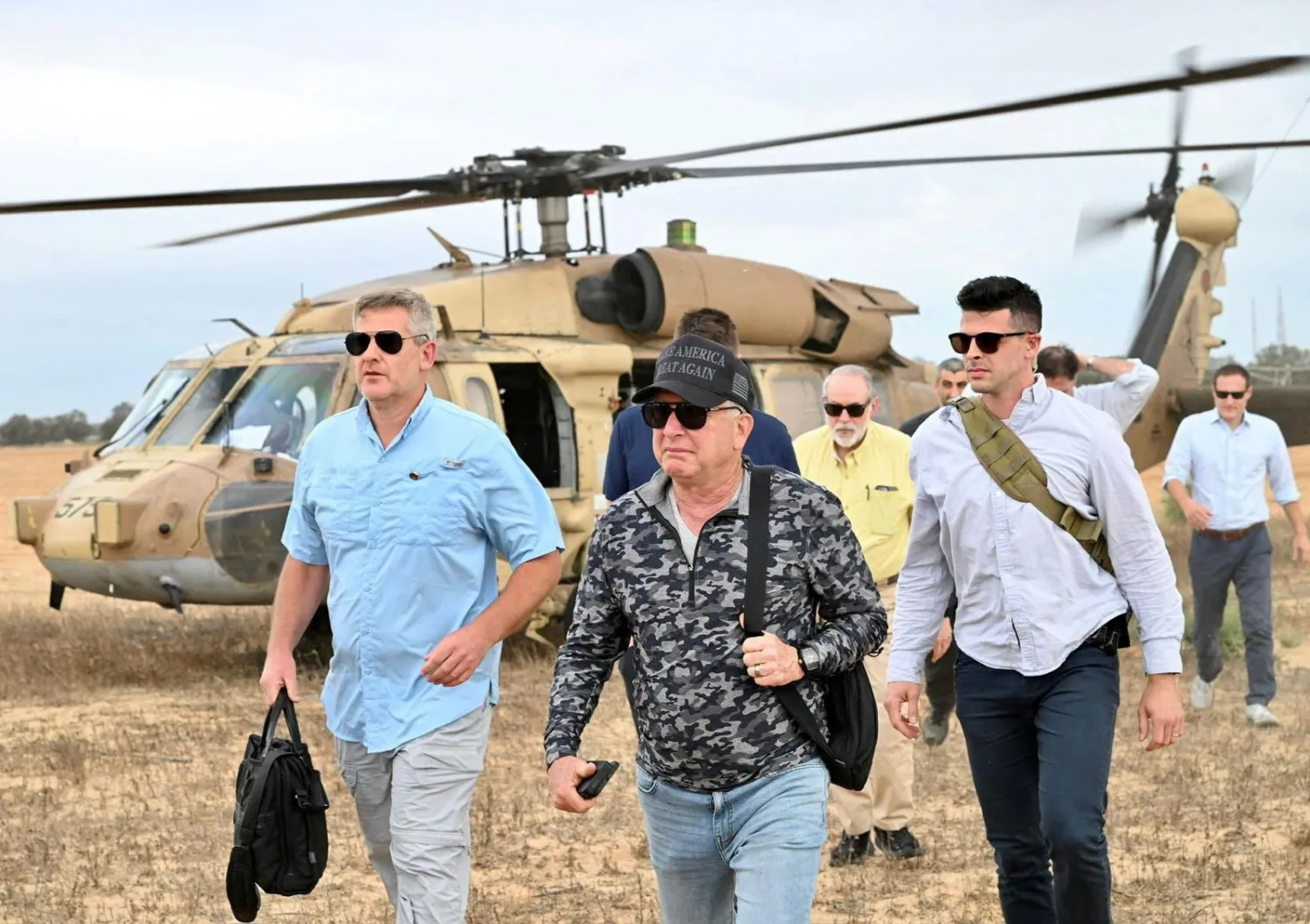
US Special Envoy to the Middle East Steve Witkoff and US Ambassador to Israel, Mike Huckabee walk during their visit to the Gaza Strip, August 1, 2025. (Ambassador Mike Huckabee via X/Handout via Reuters)
TT

US Envoy Witkoff Visits Aid Operation in Gaza Rejected by UN as Unsafe

US Special Envoy to the Middle East Steve Witkoff and US Ambassador to Israel, Mike Huckabee walk during their visit to the Gaza Strip, August 1, 2025. (Ambassador Mike Huckabee via X/Handout via Reuters)

President Donald Trump's Middle East envoy became the first high-profile US official to visit Gaza since the war began, touring a US-backed aid operation on Friday that the United Nations says is partly to blame for deadly conditions in the enclave.  

Steve Witkoff visited a site run by the US and Israel--backed Gaza Humanitarian Foundation in Rafah in what he said was an effort to create a new aid plan for the war-shattered Palestinian territory, where Israel has been fighting the Hamas group. 

Humanitarian organizations and many foreign governments have been strongly critical of the GHF, which began operations in late May. A global hunger monitor warned this week that famine is unfolding in Gaza. 

Hours after Witkoff's visit, Palestinian medics reported Israeli forces had shot dead three Palestinians near one of the group's sites in the city on Gaza's southern edge. Reuters could not immediately verify whether it was the same location. 

The Israeli military said it was still looking into the incident in which soldiers had fired warning shots at what it described as a "gathering of suspects" approaching its troops, hundreds of meters from the aid site. 

The United Nations says more than 1,000 people have been killed trying to receive aid in Gaza since the GHF began operating there, most of them shot by Israeli forces operating near GHF sites. 

The Israeli military has acknowledged that its forces have killed some Palestinians seeking aid and says it has given its troops new orders to improve their response. 

The UN has declined to work with the GHF, which it says distributes aid in ways that are inherently dangerous and violate humanitarian neutrality principles, contributing to the hunger crisis across the territory. 

The GHF says nobody has been killed at its distribution points, and that it is doing a better job of protecting aid deliveries than the UN. 

Israel blames Hamas and the UN for the failure of food to get to desperate Palestinians in Gaza and introduced the GHF distribution system saying it would prevent aid supplies being seized by Hamas. Hamas denies stealing aid. 

US Ambassador to Israel Mike Huckabee, who traveled with Witkoff to Gaza on Friday, posted on X a picture showing hungry Gazans behind razor wire with a GHF poster with a big American flag that read "100,000,000 meals delivered". 

"President Trump understands the stakes in Gaza and that feeding civilians, not Hamas, must be the priority," GHF spokesperson Chapin Fay said in a statement, accompanied by images of Witkoff in a grey camouflage top, flak jacket and "Make America Great Again" baseball cap with Trump's name stitched on the back. 

"We were honored to brief his delegation, share our operations, and demonstrate the impact of delivering 100 million meals to those who need them most," Fay said. 

Witkoff said on X that he had also met with other agencies. 

"The purpose of the visit was to give @POTUS (Trump) a clear understanding of the humanitarian situation and help craft a plan to deliver food and medical aid to the people of Gaza," Witkoff said. 

He visited Gaza a day after meeting with Israeli Prime Minister Benjamin Netanyahu. Israel is under mounting international pressure over the devastation of Gaza since the start of the war in October 2023 and growing starvation among its 2.2 million inhabitants. 

MALNUTRITION 

Gaza medics say dozens have died of malnutrition in recent days as hunger sets in, after Israel cut off all supplies to the enclave for nearly three months from March-May. 

Israel says it is taking steps to let in more aid, including pausing fighting for part of the day in some areas and announcing protected routes for aid convoys. 

The worsening humanitarian crisis has prompted France, Britain and Canada to announce plans to potentially recognize a Palestinian state, a move already taken by most countries but not by major Western powers. 

The Israeli military's statistics show that an average of around 140 aid trucks have entered Gaza daily during the course of the war, about a quarter of what international humanitarian agencies say is required. 

On Friday, the Israeli military said that 200 trucks of aid were distributed by the UN and other organizations on Thursday, with hundreds more waiting to be picked up from the border crossings inside Gaza. 

The United Nations says it has thousands of trucks still waiting, if Israel would let them in without the stringent security measures that aid groups say have prevented the entry of much-needed humanitarian assistance throughout the war. 

Israel has begun allowing food air drops this week, but UN agencies say these are a poor alternative to letting in more trucks. On Friday, the Israeli military said that 126 food packages were airdropped by six countries, including for the first time France, Spain, and Germany. 

"If there is political will to allow airdrops - which are highly costly, insufficient & inefficient, there should be similar political will to open the road crossings," UN Palestinian aid agency chief Philippe Lazzarini wrote on X. 

In addition to the three shot near a GHF site, medics said at least 12 other Palestinians were killed in air strikes across the Gaza Strip on Friday. The Israeli military did not immediately comment. 

The Gaza war, which began after Hamas killed more than 1,200 people and took 251 hostage in an attack on southern Israel on October 7, 2023, has killed more than 60,000 Palestinians, most of them in Israeli airstrikes. 

Ceasefire talks in Qatar ended last week in deadlock. 


Lebanese Army Chief to Make Pivotal Visit to Washington Next Month

Lebanese army chief General Rodolphe Haykal. Photo: Army command
TT

Lebanese Army Chief to Make Pivotal Visit to Washington Next Month

Lebanese army chief General Rodolphe Haykal. Photo: Army command

Lebanese army chief General Rodolphe Haykal is gearing up for an official visit to Washington in early February, after the US cancelled meetings with him in November.

The visit comes at a sensitive time, preceding the Paris conference to supporting the Lebanese army in March.

Ministerial sources told Asharq Al-Awsat that Haykal’s visit to Washington has been set for between February 3 and 5, saying the army’s needs, cooperation between the US and Lebanese militaries, and continued American support for the Lebanese army will be high on the agenda of the talks.

Military sources said that the visit’s postponement in November has not frozen contacts between the two sides. On the contrary, intense contacts have since been made to reschedule the visit, resulting in setting a new date next month.

The army’s plan to confiscate all unauthorized arms and extend state authority over all Lebanese territory will most likely top the agenda of the visit. This plan has drawn broad international attention.

A statement issued by the army command on January 8 regarding the achievement of the objectives of the first phase of the weapons-control plan will constitute a key component of Haykal’s briefing to US officials.

The army said in that statement that it had achieved the initial goal to clear non-state weaponry from the southern area near the Israeli border by the end of 2025.

It said it secured areas south of the Litani River, excluding positions still held by Israeli forces, though there was more work to be done clearing unexploded ordnance and tunnels.

Haykal’s briefing will most likely refer to the challenges hindering the full implementation of the plan, foremost among them ongoing Israeli attacks and the occupation of a number of sites inside Lebanese territory, in addition to the establishment of buffer zones that restrict freedom of movement, as well as the daily violations of the ceasefire agreement of November 27, 2024.

The army chief will also stress continued close cooperation with the United Nations Interim Force in Lebanon (UNIFIL) and with the ceasefire monitoring committee known as the mechanism, which held its last meeting on January 7 at the military level in the absence of civilians.

Ministerial sources told Asharq Al-Awsat that the mechanism will not hold meetings this month. “We are awaiting the return of the US general who is abroad, as well as the appointment of a civilian representative to replace US envoy Morgan Ortagus, who has been relieved of her duties,” they said.

Meanwhile, Lebanon continues its preparations for the Paris conference to support the army, scheduled for March 5.

Lebanese President Joseph Aoun told a recent security meeting that the army and security forces should prepare accurate reports on their needs and brief the conferees to secure the required assistance for their institutions.


Al-Khanbashi: Hadramout Has Been Liberated from Al-Zubaidi, UAE's Hegemony

Hadramout Governor and a member of the Yemeni Presidential Leadership Council, Salem al-Khanbashi gives a media briefing in the port city of Mukalla in Hadramout, Yemen, January 19, 2026. (Reuters)
TT

Al-Khanbashi: Hadramout Has Been Liberated from Al-Zubaidi, UAE's Hegemony

Hadramout Governor and a member of the Yemeni Presidential Leadership Council, Salem al-Khanbashi gives a media briefing in the port city of Mukalla in Hadramout, Yemen, January 19, 2026. (Reuters)

Presidential Leadership Council (PLC) member and Governor of Yemen's eastern Hadramout province Salem al-Khanbashi accused on Monday the United Arab Emirates of exploiting its participation in the coalition to support legitimacy in Yemen to pursue its own agenda.

Speaking at a press conference in Mukalla city, he said the UAE's actions in Hadramout were a shock to the people and local authorities.

The authorities had hoped that the UAE would act as a supporter to the Yemeni people as part of the coalition, but its actions on the ground went against those expectations, he remarked.

Hadramout has suffered from the hegemony of armed factions affiliated with Aidarous al-Zubaidi, leader of the Southern Transitional Council, with direct support from the UAE, added all-Khanbashi.

Hadramout has been liberated from al-Zubaidi and the UAE's hegemony, he stressed.

He accused groups loyal to al-Zubaidi of looting public institutions, terrorizing the people and committing wide violations against them, leading to instability in Hadramout.

He vowed that the authorities will take "all legal measures" against the UAE and al-Zubaidi's armed groups.

Justice will prevail, he declared, pledging to support the victims of the violations and hold to account the perpetrators.

Moreover, al-Khanbashi revealed that the UAE was running "several large secret prisons" in Hadramout. Explosives were also stored in the al-Riyan airbase that were going to be used to in assassinations and attacks in the province.

He said that Hadramout has closed a "dangerous and bitter chapter" in its history through direct support from Saudi Arabia.

This backing has helped restore stability, boost the state's authority and end a period of chaos and violations, he continued.


Syria Says Sharaa, Trump Discuss Kurdish Rights as Forces Deploy in Country’s North, East

Syrian government forces brandish their weapons as they take possession of the SDF military base as they enter the city of Raqqa on January 19, 2026. (AFP)
TT

Syria Says Sharaa, Trump Discuss Kurdish Rights as Forces Deploy in Country’s North, East

Syrian government forces brandish their weapons as they take possession of the SDF military base as they enter the city of Raqqa on January 19, 2026. (AFP)

Syrian President Ahmed al-Sharaa and US President Donald Trump discussed guaranteeing Kurdish rights in a phone call on Monday, Syria's presidency said, a day after Damascus reached a deal with Kurdish forces including a truce.

Sharaa met Mazloum Abdi, head of the Kurdish-led Syrian Democratic Forces, to discuss the agreement, which includes integrating the Kurds' administration into the state, but a Kurdish source with knowledge of the talks told AFP they were not positive.

Analysts said the deal -- following rapid government gains in Kurdish-controlled territory after driving Kurdish fighters out of Aleppo city earlier this month -- marked a blow for the minority's long-held ambitions of preserving the de facto autonomy they had exercised in swathes of north and northeast Syria for over a decade.

In the phone call, Sharaa and Trump, "emphasized the need to guarantee the Kurdish people's rights and protection within the framework of the Syrian state", the Syrian presidency said.

They "affirmed the importance of preserving the unity and independence of Syrian territory" and discussed "cooperation on combating" the ISIS extremist group, it added.

Requesting anonymity, the Kurdish source with knowledge of Monday's talks between Sharaa and Abdi said differences concerned "the mechanism for implementing the terms of the agreement".

Despite the ceasefire, brief clashes erupted on Monday evening in Raqqa city, with an AFP correspondent hearing heavy bombardment.

The SDF said government forces shelled the Al-Aqtan prison "which holds ISIS members and leaders, in an attempt to storm it".

Raqqa was once the extremist group's de facto capital in Syria.

A defense ministry source later told AFP that the clashes had halted, without elaborating.

- 'Stability' -

Sunday's agreement included the Kurdish administration's immediate handover of Arab-majority Deir Ezzor and Raqqa provinces to the government, which will also take responsibility for ISIS prisoners and their families held in Kurdish-run jails and camps.

A defense ministry map published on Monday showed the government controlled all of Deir Ezzor and Raqqa provinces, while the eastern parts of Hasakeh province were still under Kurdish control.

In Deir Ezzor province, an AFP correspondent saw military vehicles heading east of the Euphrates, while cars and pedestrians waited at a bridge leading to the eastern bank.

Driver Mohammed Khalil, 50, told AFP that "we hope things will be better than before. There was... no freedom" under the SDF.

Teacher Safia Keddo, 49, said that "we're not asking for a miracle, we just want stability and a normal life".

Authorities announced a curfew in Hasakeh province's Shadadi after the army said the SDF released ISIS detainees from the town's prison, while the Kurds said they lost control of the facility after an attack by Damascus.

The sides had earlier traded blame for attacks that the military said killed three soldiers.

The SDF had seized swathes of Deir Ezzor and Raqqa provinces as they expelled ISIS during Syria's civil war, supported by an international coalition led by Washington.

- 'Protecting civilian lives' -

Raqqa resident Khaled al-Afnan, 34, said "we support Kurdish civil rights... but we don't support them having a military role".

Turkish President Recep Tayyip Erdogan, a close ally of Damascus who is hostile to the SDF, hailed Syria's army for its "careful" offensive despite what he called "provocations".

EU foreign policy chief Kaja Kallas instead said "all military activities must cease immediately".

The SDF on Sunday withdrew from areas under its control including the Al-Omar oil field, the country's largest, and the Tanak field.

Local fighters from tribes in the Arab-majority Deir Ezzor province sided with Damascus and seized the areas before the arrival of government forces.

The SDF's Abdi said Sunday he agreed to the deal to avoid civil war and end a conflict "imposed" on the Kurds.

Mutlu Civiroglu, a Washington-based analyst and expert on the Kurds, said the government's advance had raised "serious doubts about the durability" of the ceasefire and a March agreement between the government and the Kurds.

Sharaa had on Friday issued a decree granting the Kurds official recognition, but the Kurds said it fell short of their expectations.

In Qamishli, the main Kurdish city in the country's northeast, activist Hevi Ahmed, 40, said Sunday's deal was "a disappointment after years of hope that the Syrian constitution might contain a better future for the Kurds".