


US, Russian Space Chiefs Talk Moon, ISS Cooperation in Rare Florida Meeting 

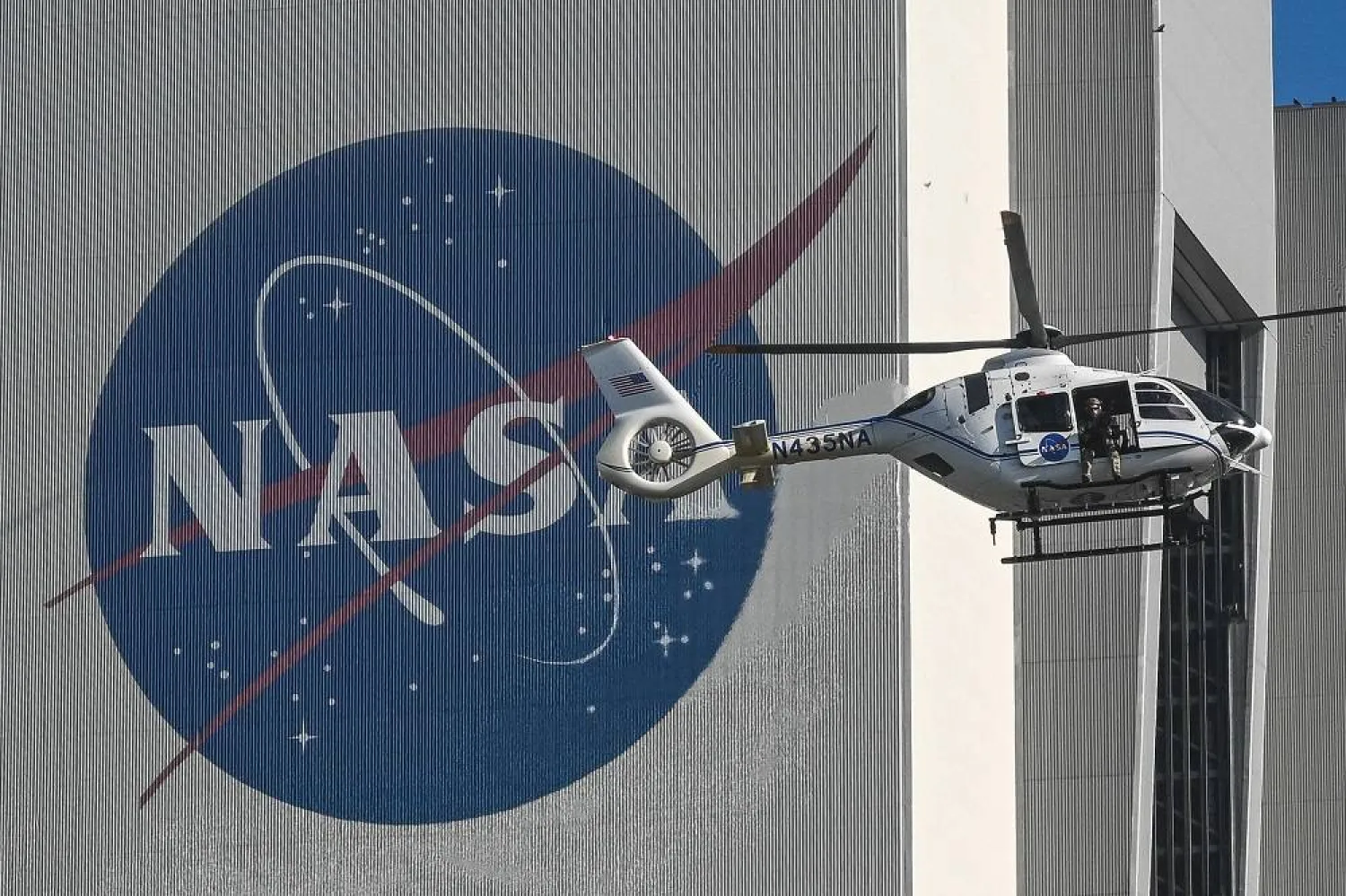
A NASA helicopter with armed security escorts the Crew-11 motorcade to launch pad LC-39A at Kennedy Space Center ahead of the Crew-11 Mission in Cape Canaveral, Florida, on July 31, 2025. (AFP)
TT

US, Russian Space Chiefs Talk Moon, ISS Cooperation in Rare Florida Meeting 

A NASA helicopter with armed security escorts the Crew-11 motorcade to launch pad LC-39A at Kennedy Space Center ahead of the Crew-11 Mission in Cape Canaveral, Florida, on July 31, 2025. (AFP)

NASA's new temporary administrator on Thursday held a rare face-to-face meeting in Florida with Russia's space agency chief, where they discussed cooperation on the moon and maintaining the space powers' longstanding relationship on the International Space Station, Roscosmos said.

The talks between Sean Duffy and Dmitry Bakanov at the US space agency's Kennedy Space Center represented the first in-person meeting between the heads of NASA and Russia's space agency, Roscosmos, since 2018.

NASA said late on Thursday the two chiefs "discuss continued cooperation and collaboration in space," without providing further details.

The meeting coincided with an attempt to launch a joint astronaut crew from Florida to the ISS that was postponed due to weather. It was a significant moment for Washington's bifurcated space relations with Russia, especially for Duffy, an acting NASA administrator who was assigned to the role just this month while also overseeing the Transportation Department.

Roscosmos showed on Telegram a video of the meeting between Duffy and Bakanov, each flanked by staff, and other events where Bakanov and his delegation can be seen mingling with US officials.

The Russian space agency said: "The parties discussed further work on the ISS, cooperation on lunar programs, joint exploration of deep space, continued interaction on other space projects."

Roscosmos and NASA did not respond to questions about the nature of the lunar program or deep space discussions. Such talks could signal thawing relations between the two countries' civil space programs and represent a shift in global space relations.

UKRAINE WAR ISOLATES RUSSIA

Russia had plans to participate in NASA's flagship Artemis moon program until it invaded Ukraine in February 2022. It became a partner on China's moon program, the International Lunar Research Station, a direct rival to the US Artemis program.

The war in Ukraine has led to a vastly isolated Russian space program, which has since boosted investments in military space efforts while nearly all of its joint space exploration projects with the West collapsed.

The Russian delegation visited NASA's Johnson Space Center in Houston on Wednesday and on Thursday was poised to watch the launch of Crew-11, a routine mission to the ISS featuring two US astronauts, a Russian cosmonaut and a Japanese astronaut. But bad weather pushed the launch to Friday morning, SpaceX said.

While US-Russian tensions over the war in Ukraine have limited contact between NASA and Roscosmos, they have continued to share astronaut flights and cooperate on the ISS, a 25-year-old totem of scientific diplomacy crucial to maintaining the two space powers' storied human spaceflight capabilities.

Amity on the $100 billion ISS is buoyed primarily by a technical interdependency: the Russian segment relies on power generated by American solar panels, while the task of maintaining the station's altitude is assigned to Russia's thrusters. Multiple other countries depend on the ISS for microgravity research, prominently the European Space Agency, Canada and Japan.

The military space programs of the US and Russia meanwhile have an adversarial relationship. The US has accused Russia of developing a nuclear space weapon and deploying counterspace weapons and spy satellites near American spy satellites. Russia has denied many of Washington's space allegations.

Bakanov and Duffy were expected to discuss extending the two countries' astronaut seat exchange agreement - in which US astronauts fly on Russian Soyuz capsules in exchange for Russian astronauts flying on US capsules - and the planned disposal of the ISS in 2030, according to Russian news agency TASS.



Three Million Pounds to Save Polar Explorer Shackleton's Villa

A person taking a photo of Ernest Shackleton's grave, polar explorer, who died after a heart attach in 1922 (Shutterstock)
TT

Three Million Pounds to Save Polar Explorer Shackleton's Villa

A person taking a photo of Ernest Shackleton's grave, polar explorer, who died after a heart attach in 1922 (Shutterstock)

Work is under way on a South Atlantic island to preserve a key building in the story of polar explorer Ernest Shackleton.

Shackleton famosly reached the whaling station of Stromness on South Georgia in 1916 after spending 18 months stranded on Antarctica with his crew.

The now-dilapidated Stromness Manager's Villa was used as a base by Shackleton while he orchestrated the rescue of his men.

The Dundee-based South Georgia Heritage Trust have been working to stabilize the structure, with plans to create a digital “twin” of the building for people around the world to see it.

A 2022 survey found the building was very close to collapse.

Alison Neil, chief executive of the South Georgia Heritage Trust, said: “The reason for that is rotting timbers. This is an old-fashioned version of a flat-pack house. They would've been brought down from Norway on ships and then assembled on the island.”

The trust raised more than £3 million to send a team to South Georgia.
They arrived in October and have been working on stabilizing the structure.

Alison said: “It's in the middle of a whaling station that's full of asbestos, dangerous debris, and is not accessible to the public. Our plan is not to open it up to the public, our plan is to maintain it for the future.”

Shackleton's extraordinary story of survival has fascinated and inspired people for more than a century.

His most famous mission was his plan to cross Antarctica through the South Pole after travelling on board his ship The Endurance.

In 1915, The Endurance became trapped in ice, and his crew abandoned ship, crossing onto floating ice, which they hoped would drift towards land.

But by April 1916, the ice floes were breaking up, so Shackleton took his crew in lifeboats first to Elephant Island, then led a smaller group to find help for the others.

They crossed about 800 miles (1,300km) of ocean in the open boat before reaching the island of South Georgia.

Leaving three of the men behind with the boat, Shackleton, Frank Worsley and Tom Crean trekked across the island for three days until they reached Stromness whaling station on the far side of the island.

Alison said the men made it to the villa in a dishevelled state.

She said: “No-one recognized them, they must've looked terrifying. They knocked on the door of the villa and famously the whaling manager opened the door and said, 'who the hell are you?' Shackleton allegedly said: 'My name is Shackleton'.”

It was the men's first contact with the outside world for 17 months.

Shackleton, Worsley and Crean were invited in to the villa where they had a hot meal and a bath, before immediately starting the rescue of the rest of their crew with the help of the whalers.

Alison said: “That's a really important part of The Endurance story and it effectively is the next chapter on from the sinking of the vessel.”


James Cameron Describes Strategy for Surviving Titanic Disaster

Titanic ocean liner after it struck an iceberg in 1912 off the coast of Newfoundland in the Atlantic Ocean (Shutterstock/3d illustration)
TT

James Cameron Describes Strategy for Surviving Titanic Disaster

Titanic ocean liner after it struck an iceberg in 1912 off the coast of Newfoundland in the Atlantic Ocean (Shutterstock/3d illustration)

James Cameron, the filmmaker behind the hit 1997 disaster movie Titanic, has revealed his strategy for hypothetically surviving the famed 1912 cruise liner sinking.

Titanic starred Leonardo DiCaprio and Kate Winslet and is one of the highest-grossing films of all time. The film was set during the sinking of the RMS Titanic, which claimed the lives of more than 1,500 people.

In a new interview with The Hollywood Reporter, Cameron was asked: “If you were traveling by yourself as a second-class passenger on Titanic when it hit an iceberg, what would you have done?”

As the filmmaker explained, third-class passengers were trapped below decks, while first-class passengers were more likely to secure a spot on the lifeboats, according to the interview reported by The Independent.

“I think there were interesting ways to what-if or second-guess the whole thing,” Cameron replied. “One I like to play with my Titanic experts is – with what we know now, and if you had the captain’s ear – how could you save everybody?

“The other is: What if you’re a time traveler, you go back and want to experience the sinking, and your little time-travel thing that gets you back fails, and you’re like, ‘I’m really on the ship, I’ve got to get off it.'”

In this latter scenario, Cameron argued that the best thing to do would be to stand by the edge of the deck, and wait for a lifeboat to launch during the early stages of the evacuation. At this point, he would jump off, and swim to the boat, relying on the passengers to pull him aboard.

“Most people wouldn’t have had the courage to jump into the water,” he continued. “They couldn’t quite believe that the ship was really going to sink. But if you knew for sure it was going to sink and you weren’t on a lifeboat, you jump in the water next to the boat the second it casts off."


Hiker Killed in Rare Suspected Mountain Lion Attack in Colorado

FILE - The General Store is seen Oct. 24, 2006, in Glen Haven, Colo. (AP Photo/The Denver Post, Karl Gehring, File)
TT

Hiker Killed in Rare Suspected Mountain Lion Attack in Colorado

FILE - The General Store is seen Oct. 24, 2006, in Glen Haven, Colo. (AP Photo/The Denver Post, Karl Gehring, File)

A hiker in Colorado has died in the state's first suspected fatal mountain lion attack in over 25 years, authorities said.

The woman was found unresponsive by other hikers on the Crosier Mountain trail northeast of Estes Park around noon on Thursday.

The hikers saw a mountain lion near the woman's body and scared it away by throwing rocks. A doctor was among the hikers and attended to the woman but found no pulse, Colorado Parks and Wildlife spokesperson Kara Van Hoose told reporters, according to Reuters.

CPW officers responded to the ⁠scene and shot dead two lions in the area. It is not known whether one or multiple animals were involved in the suspected attack, the agency said in a statement. It is believed the woman was hiking alone.

“There were signs that this was consistent with a mountain lion attack,” Van Hoose told a press ⁠conference.

Mountain lion attacks on humans in Colorado are rare, with 28 reported to CPW since 1990. The last fatal attack was in 1999.

CPW pathologists are performing necropsies on the dead animals to check for abnormalities and neurological diseases like rabies and avian influenza, as well as human DNA, Van Hoose said.

CPW policy mandates the killing of any mountain lion involved in an attack on a human so as to prevent repeat incidents. If human DNA is not found on either dead lion, authorities will continue to ⁠search for animals that may have been involved, Van Hoose said.

Larimer County Coroner will release the identity of the victim and cause of death, she said.

Colorado has a healthy mountain lion population, estimated by CPW to be between 3,800 and 4,400 adults. Conservation efforts have brought the species back from near extinction in the 1960s due to bounty hunting.

Mountain lions are common in the Front Range area where the woman was found, Van Hoose said. The animals go down to lower elevations in winter in search of prey like deer and elk, increasing chances of encounters with humans.