


Ukrainian Drone Attack Sets Russian Oil Depot on Fire as Zelenskyy Announces Prisoner Exchange

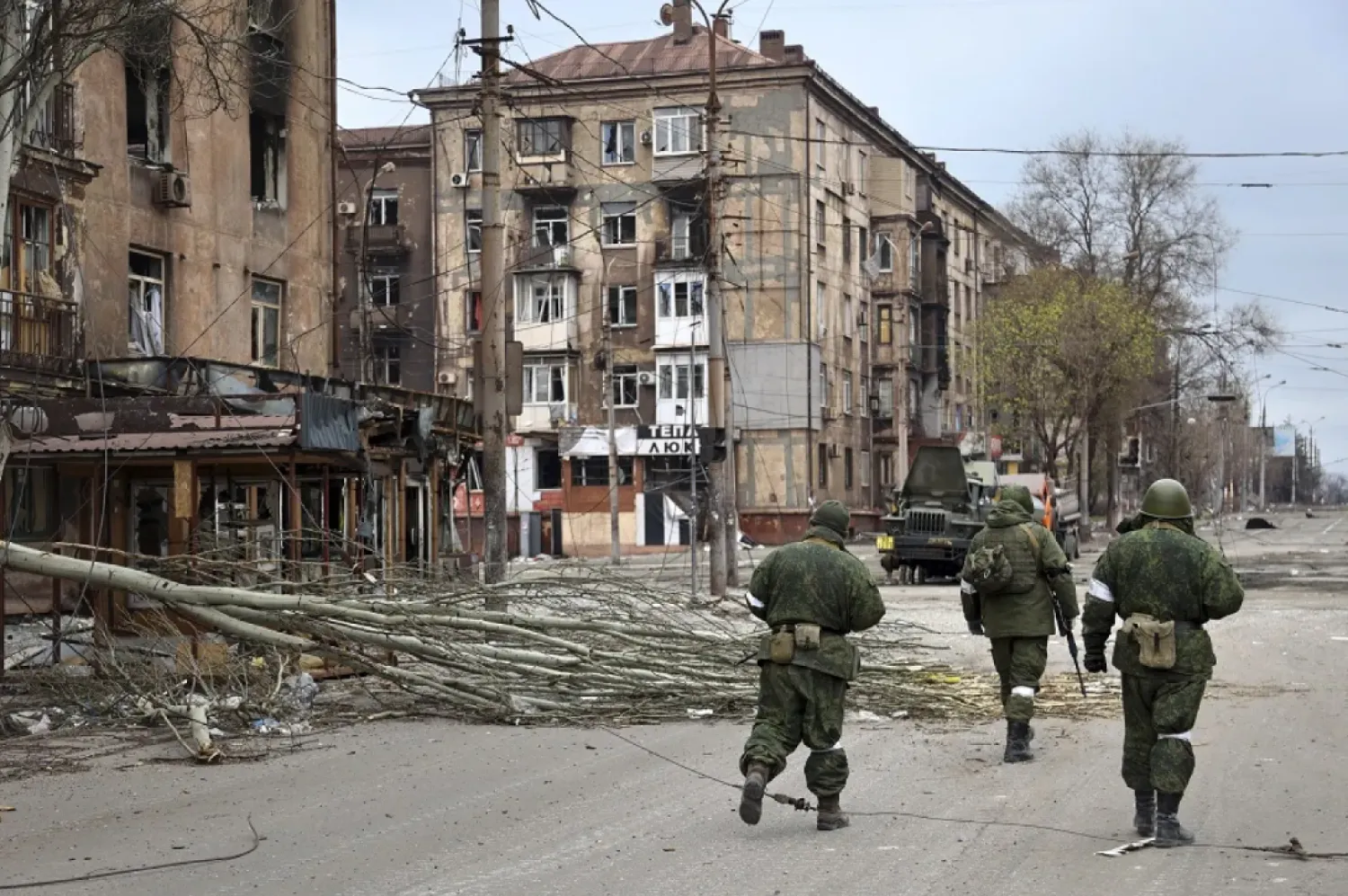
Servicemen of the militia from the Donetsk People's Republic walk past damaged apartment buildings near the Illich Iron & Steel Works Metallurgical Plant, the second-largest metallurgical enterprise in Ukraine, in an area controlled by Russian-backed separatist forces in Mariupol, Ukraine, Saturday, April 16, 2022. (AP)
TT

Ukrainian Drone Attack Sets Russian Oil Depot on Fire as Zelenskyy Announces Prisoner Exchange

Servicemen of the militia from the Donetsk People's Republic walk past damaged apartment buildings near the Illich Iron & Steel Works Metallurgical Plant, the second-largest metallurgical enterprise in Ukraine, in an area controlled by Russian-backed separatist forces in Mariupol, Ukraine, Saturday, April 16, 2022. (AP)

An overnight Ukrainian drone attack on an oil depot near Russia’s Black Sea resort of Sochi sparked a major fire, Russian officials said Sunday, as the two countries traded strikes and the Ukrainian president announced a prisoner exchange.

More than 120 firefighters attempted to extinguish the blaze, sparked after debris from a downed drone struck a fuel tank, Krasnodar regional Gov. Veniamin Kondratyev said on Telegram. Videos on social media appeared to show huge pillars of smoke billowing above the oil depot, The AP news reported.

Russia’s civil aviation authority, Rosaviatsia, temporarily stopped flights at Sochi’s airport.

Further north, authorities in the Voronezh region reported that four people were wounded in another Ukrainian drone strike.

Russia’s Defense Ministry said its air defenses shot down 93 Ukrainian drones over Russia and the Black Sea overnight into Sunday.

Meanwhile, in southern Ukraine, a Russian missile strike hit a residential area in the city of Mykolaiv, according to the State Emergency Services, wounding seven people.

The Ukrainian air force said Sunday Russia launched 76 drones and seven missiles against Ukraine. It said 60 drones and one missile were intercepted, but 16 others and six missiles hit targets across eight locations.

The reciprocal attacks came at the end of one of the deadliest weeks in Ukraine in recent months, after a Russian drone and missile attack on Thursday killed 31 people, including five children, and wounded over 150.

The continued attacks come after U.S. President Donald Trump gave on Tuesday Russian President Vladimir Putin a shorter deadline — Aug. 8 — for peace efforts to make progress.

Trump said Thursday that special envoy Steve Witkoff is heading to Russia to push Moscow to agree to a ceasefire in its war with Ukraine and has threatened new economic sanctions if progress is not made.

Ukrainian President Volodymyr Zelenskyy said Sunday that Ukraine and Russia have agreed to exchange 1,200 prisoners following their latest round of negotiations in Istanbul in July.

“There is an agreement to exchange 1,200 people," he wrote on X, saying that the lists of individuals to be swapped were being worked on and that they were working to “unblock the return of our civilians.”

There was no immediate comment from Russia.

Zelenskyy also said he discussed with top Ukrainian officials “the negotiation track – specifically, the implementation of the agreements reached during the meetings with the Russian side in Istanbul, as well as preparations for a new meeting.”

Each of the three rounds of talks between the countries this year has resulted in prisoner exchanges but yielded no breakthrough in reaching a ceasefire.



Venezuela Reshapes Military in Shift Toward Washington

Handout picture released on March, 20, 2026 by the Venezuelan presidency press office showing Venezuela's interim President Delcy Rodriguez( C) during a meeting with outgoing Defense Minister Padrino Lopez (2nd L) and the new Defense Minister General-in-Chief Gustavo Gonzalez Lopez (2nd R) at the Miraflores presidential palace in Caracas, on March 19, 2026. (Handout / Venezuelan Presidency / AFP)
TT

Venezuela Reshapes Military in Shift Toward Washington

Handout picture released on March, 20, 2026 by the Venezuelan presidency press office showing Venezuela's interim President Delcy Rodriguez( C) during a meeting with outgoing Defense Minister Padrino Lopez (2nd L) and the new Defense Minister General-in-Chief Gustavo Gonzalez Lopez (2nd R) at the Miraflores presidential palace in Caracas, on March 19, 2026. (Handout / Venezuelan Presidency / AFP)

A sweeping overhaul of Venezuela's top brass is designed to remake the armed forces and draw them closer to Washington, multiple military and political sources told AFP.

Delcy Rodriguez has been in power for less than three months, but has already taken major steps to overhaul Venezuela's economy and politics.

Since her former boss and fierce US foe president Nicolas Maduro was toppled in January, Rodriguez has allowed more US investment in Venezuela's vast energy sector and pardoned hundreds of political prisoners.

This week, she turned to reforming Venezuela's all-powerful military and intelligence services, replacing a slew of entrenched commanders with officers seen as acceptable to Washington.

The most dramatic step was removing long-serving Defense Minister Vladimir Padrino and installing former intelligence chief Gustavo Gonzalez Lopez in his place.

"Gonzalez Lopez is now the United States' man in the armed forces," said Sebastiana Barraez, a journalist who covers military affairs.

"He is pragmatic and not ideologically tied to the left."

A retired Venezuelan general told AFP that Washington wanted to restore the pro-US military doctrine abandoned under the leftist firebrand Hugo Chavez.

For decades, Venezuela maintained close military ties with the United States, buying weapons and sending officers north for training.

Chavez broke those links and turned heavily to Moscow.

The former general said the shift aimed to roll back two decades of cooperation with Russia and Cuba, whose advisers helped reshape the armed forces and supplied weapons from rifles to Sukhoi fighter jets.

He said much of that Russian equipment would soon need replacing if Venezuela were to return to US technology and training systems, once common before the Chavez era.

The retired general said the United States might even open a temporary base in Venezuela to secure the transition, a move that would cut against years of anti-imperialist rhetoric from the former government.

Cleberth Delgado, a former intelligence official now in exile, said the changes marked a transition guided by "instructions" from Washington, though the United States has not publicly confirmed any such role.

"These appointments would not have been possible without US approval," he said.

- Power moves -

Rodriguez's allies say the changes are needed to stabilize the country after Maduro's ouster, amid lingering fears of a coup and uncertainty over how long the transition government will last.

Before becoming defense minister, Gonzalez Lopez led the presidential guard, the DGCIM counterintelligence service, and twice headed the SEBIN intelligence service.

Rights group Provea described his return to a top security post as "recycling impunity", noting he is under US sanctions for alleged human rights violations.

During his tenure at SEBIN, opposition figure Fernando Alban died in custody after falling from a tenth-floor window. Authorities called it suicide; the opposition said he was murdered.

A retired general said Gonzalez Lopez previously aligned with Interior Minister Diosdado Cabello, a powerful Chavista figure, before shifting his loyalty to Rodriguez as the purge unfolded.


US Allows 30-Day Sale of Iran Oil at Sea in Bid to Tame Prices

US Treasury Secretary Scott Bessent looks on as he speaks to the media after two days of meetings with a Chinese delegation, in Paris, France March 16, 2026. (Reuters)
TT

US Allows 30-Day Sale of Iran Oil at Sea in Bid to Tame Prices

US Treasury Secretary Scott Bessent looks on as he speaks to the media after two days of meetings with a Chinese delegation, in Paris, France March 16, 2026. (Reuters)

The Trump administration waived sanctions on the purchase of Iranian oil at sea for 30 days on Friday in its latest attempt to ease oil prices that have been driven up by the US-Israeli war on Iran.

The waiver will bring some 140 million barrels of oil to global markets and help relieve pressure on energy supply, Treasury Secretary Scott Bessent posted on X.

The move reflects White House worries that the surge in oil prices after nearly three weeks of US and Israeli strikes on Iran will hurt US businesses and consumers ahead of the November midterm elections, when President Donald Trump's fellow Republicans hope to retain control of Congress.

THIRD SANCTIONS WAIVER DURING IRAN WAR

The license, posted to the Treasury Department's website after market hours, says Iranian oil can be imported into the United States under the waiver when necessary to complete its sale or delivery.

The US has not meaningfully imported Iranian oil since Washington imposed ‌measures after the ‌1979 revolution. It was unclear whether any Iranian oil would end up in the country ‌as ⁠a result of the ⁠waiver.

Cuba, North Korea and Crimea are among regions excluded from the license, which will remain in effect until April 19.

The move is expected to benefit Asia, the top buyer of Middle Eastern oil. Energy Secretary Chris Wright said supplies could get to Asia within three or four days and hit the market after being refined over the coming month and a half.

Independent Chinese refiners have been the main buyers of sanctioned Iranian oil, taking advantage of deep discounts as others avoided such purchases. India, South Korea, Japan, Italy, Greece, Taiwan and Türkiye were also major buyers of Iranian crude before US sanctions were reimposed in 2018.

This is the third time the Treasury Department has temporarily waived ⁠sanctions on oil from US adversaries in a little more than two weeks. The moves ‌are part of the administration's attempts to tame energy prices that have soared above $100 ‌a barrel to the highest levels since 2022.

The US previously eased sanctions on Russian oil and on Friday issued a general license allowing ‌the sale of Iranian crude oil and petroleum products loaded on vessels by Friday.

"In essence, we will be using the ‌Iranian barrels against Tehran to keep the price down as we continue Operation Epic Fury," Bessent said.

Bessent had telegraphed the move in an interview with Fox Business on Thursday, saying the release of the sanctioned Iranian oil into global supplies would help keep oil prices down for 10 to 14 days.

He said on Friday that Iran will have difficulty accessing any revenue generated by the move and Washington will maintain maximum pressure on Iran and ‌its ability to access the international financial system.

'RUNNING OUT OF OPTIONS'

Oil prices have jumped about 50% since the US and Israel launched their attacks on February 28. Tehran has responded ⁠with attacks on Israel and Gulf ⁠states that host US bases.

Vital energy infrastructure in Iran and neighboring Gulf states has been attacked, and Iran has effectively closed the Strait of Hormuz, conduit for some 20% of the world's oil and liquefied natural gas.

In its effort to tame oil prices, the Trump administration on Wednesday announced a 60-day waiver of the Jones Act shipping law, temporarily allowing foreign-flagged vessels to move fuel, fertilizer and other goods between US ports.

Energy analysts including Brett Erickson, a managing principal at Obsidian Risk Advisors, have said the administration's efforts to control prices will not have a meaningful impact until the strait is opened to vessels.

"The easing of sanctions raises concerns about the rapid depletion of Washington's economic toolkit," to dampen oil prices, Erickson said. "If we've reached the point of loosening sanctions on the country we are at war with, we're really running out of options."

The US issued a 30-day waiver for countries to buy sanctioned Russian oil stranded at sea after a 30-day license on March 5 specifically for India to buy Russian oil.

Mark Dubowitz, CEO of the Foundation for the Defense of Democracies, a nonprofit research institute considered hawkish on Iran, praised the decision.

"We've worked on sanctioning Iran’s oil industry for years. This is a smart move ... to help win the fight against the regime," Dubowitz said on X.


Report: Iran Ready to Let Japanese Vessels Transit Hormuz

 Cargo ships sail in the Arabian Gulf towards Strait of Hormuz in the United Arab Emirates, Thursday, March 19, 2026. (AP)
Cargo ships sail in the Arabian Gulf towards Strait of Hormuz in the United Arab Emirates, Thursday, March 19, 2026. (AP)
TT

Report: Iran Ready to Let Japanese Vessels Transit Hormuz

 Cargo ships sail in the Arabian Gulf towards Strait of Hormuz in the United Arab Emirates, Thursday, March 19, 2026. (AP)
Cargo ships sail in the Arabian Gulf towards Strait of Hormuz in the United Arab Emirates, Thursday, March 19, 2026. (AP)

Iran is ready to let Japanese-related vessels pass through the Strait of Hormuz, a vital artery for global oil supplies, Kyodo news reported, citing Iranian Foreign Minister Abbas Araqchi.

Tehran has started talks with Tokyo, including with Foreign Minister Toshimitsu Motegi, about possibly opening the strait, Araqchi told the Japanese news agency in a phone interview on Friday.

Japan's foreign and trade ministries and the Prime Minister's Office did not pick up calls from Reuters on Saturday seeking comment on ‌the report.

"Iran ‌is, of course, ready to support ‌the ⁠passing of Japan-related vessels ⁠through the Strait of Hormuz," if Japan seeks its reopening of the strait, Araqchi told Kyodo.

Japan gets around 90% of its oil shipments via the strait, which Tehran has largely closed during the US-Israeli war on Iran. A spike in global oil prices sparked by the war, which enters ⁠its fourth week on Saturday, has prompted ‌Japan and other countries to ‌release oil from their reserves.

US President Donald Trump met Japanese Prime ‌Minister Sanae Takaichi on Thursday, urging her to "step up" ‌as he presses allies - so far unsuccessfully - to send warships to help open the strait.

Takaichi told reporters after the Washington summit that she had briefed Trump on what support Japan could and could ‌not provide in the strait under its laws.

Japan's actions are limited under its postwar ⁠pacifist constitution, but ⁠2015 security legislation allows Japan to use force overseas if an attack, including on a close security partner, threatens Japan's survival and no other means are available to address it.

Araqchi, a former ambassador to Japan, said Tokyo has a friendly relationship with Tehran, expressing hope that it would play a role in ending what he called unjustifiable and illegal "invasion" of his country.

The US does not seem ready to open conversations, Araqchi said, adding that Iran wants an end to the war, not a ceasefire, and is seeking a commitment that it would not be attacked.