


Venezuela Reshapes Military in Shift Toward Washington

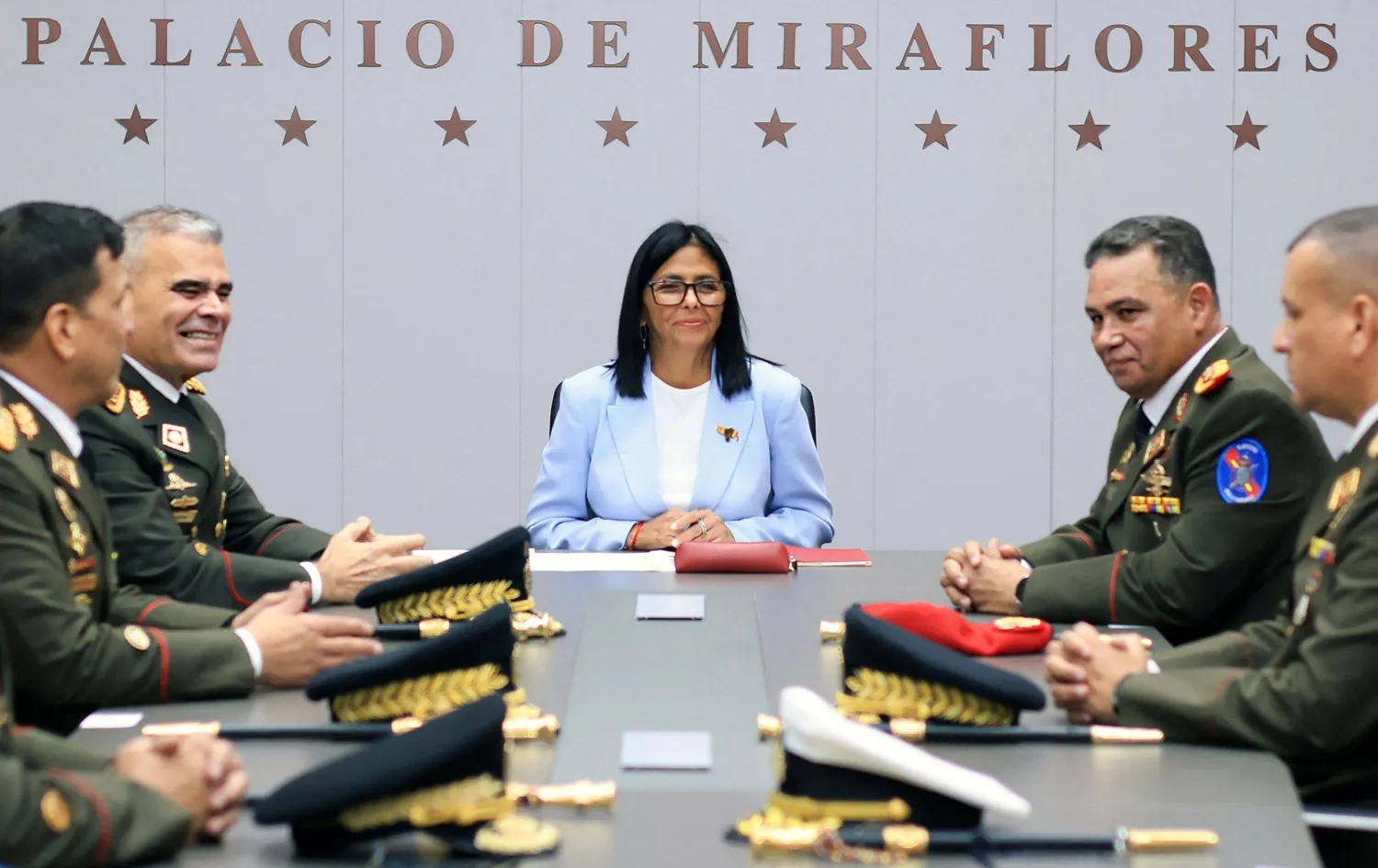
Handout picture released on March, 20, 2026 by the Venezuelan presidency press office showing Venezuela's interim President Delcy Rodriguez( C) during a meeting with outgoing Defense Minister Padrino Lopez (2nd L) and the new Defense Minister General-in-Chief Gustavo Gonzalez Lopez (2nd R) at the Miraflores presidential palace in Caracas, on March 19, 2026. (Handout / Venezuelan Presidency / AFP)
TT

Venezuela Reshapes Military in Shift Toward Washington

Handout picture released on March, 20, 2026 by the Venezuelan presidency press office showing Venezuela's interim President Delcy Rodriguez( C) during a meeting with outgoing Defense Minister Padrino Lopez (2nd L) and the new Defense Minister General-in-Chief Gustavo Gonzalez Lopez (2nd R) at the Miraflores presidential palace in Caracas, on March 19, 2026. (Handout / Venezuelan Presidency / AFP)

A sweeping overhaul of Venezuela's top brass is designed to remake the armed forces and draw them closer to Washington, multiple military and political sources told AFP.

Delcy Rodriguez has been in power for less than three months, but has already taken major steps to overhaul Venezuela's economy and politics.

Since her former boss and fierce US foe president Nicolas Maduro was toppled in January, Rodriguez has allowed more US investment in Venezuela's vast energy sector and pardoned hundreds of political prisoners.

This week, she turned to reforming Venezuela's all-powerful military and intelligence services, replacing a slew of entrenched commanders with officers seen as acceptable to Washington.

The most dramatic step was removing long-serving Defense Minister Vladimir Padrino and installing former intelligence chief Gustavo Gonzalez Lopez in his place.

"Gonzalez Lopez is now the United States' man in the armed forces," said Sebastiana Barraez, a journalist who covers military affairs.

"He is pragmatic and not ideologically tied to the left."

A retired Venezuelan general told AFP that Washington wanted to restore the pro-US military doctrine abandoned under the leftist firebrand Hugo Chavez.

For decades, Venezuela maintained close military ties with the United States, buying weapons and sending officers north for training.

Chavez broke those links and turned heavily to Moscow.

The former general said the shift aimed to roll back two decades of cooperation with Russia and Cuba, whose advisers helped reshape the armed forces and supplied weapons from rifles to Sukhoi fighter jets.

He said much of that Russian equipment would soon need replacing if Venezuela were to return to US technology and training systems, once common before the Chavez era.

The retired general said the United States might even open a temporary base in Venezuela to secure the transition, a move that would cut against years of anti-imperialist rhetoric from the former government.

Cleberth Delgado, a former intelligence official now in exile, said the changes marked a transition guided by "instructions" from Washington, though the United States has not publicly confirmed any such role.

"These appointments would not have been possible without US approval," he said.

- Power moves -

Rodriguez's allies say the changes are needed to stabilize the country after Maduro's ouster, amid lingering fears of a coup and uncertainty over how long the transition government will last.

Before becoming defense minister, Gonzalez Lopez led the presidential guard, the DGCIM counterintelligence service, and twice headed the SEBIN intelligence service.

Rights group Provea described his return to a top security post as "recycling impunity", noting he is under US sanctions for alleged human rights violations.

During his tenure at SEBIN, opposition figure Fernando Alban died in custody after falling from a tenth-floor window. Authorities called it suicide; the opposition said he was murdered.

A retired general said Gonzalez Lopez previously aligned with Interior Minister Diosdado Cabello, a powerful Chavista figure, before shifting his loyalty to Rodriguez as the purge unfolded.



Israel Army Confirms Struck Two Nuclear Sites in Iran

Emergency responders inspect the site of a residential building damaged by a strike, amid the US-Israeli conflict with Iran, in Tehran, Iran, March 27, 2026. Majid Asgaripour/WANA (West Asia News Agency) via Reuters
TT

Israel Army Confirms Struck Two Nuclear Sites in Iran

Emergency responders inspect the site of a residential building damaged by a strike, amid the US-Israeli conflict with Iran, in Tehran, Iran, March 27, 2026. Majid Asgaripour/WANA (West Asia News Agency) via Reuters

The Israeli military confirmed it struck a heavy water reactor and a uranium processing plant in central Iran on Friday, as it targeted nuclear sites in the country.

"A short while ago, the Israeli Air Force... struck the heavy water plant in Arak, central Iran," the military said in a statement, describing the site as a "key plutonium production site for nuclear weapons".

Iranian media had earlier reported that US-Israeli strikes hit the Khondab heavy water complex, saying they caused no casualties or radiation leak from the site.

Work on the reactor on the outskirts of the village of Khondab began in the 2000s, but was halted under the terms of a now-abandoned 2015 nuclear deal struck between Iran and world powers.

The core of the reactor was removed and concrete was poured into it, rendering it inoperative.

The research reactor was officially intended to produce plutonium for medical research and the site includes a production plant for heavy water.

The Israeli military also confirmed it struck a uranium processing site in central Iran's Yazd on Friday, after the country’s atomic energy organization said US-Israeli strikes hit the facility.

"A short while ago, the Israeli Air Force... struck a uranium extraction plant located in Yazd, central Iran," the military said in a statement, describing the site as a "unique facility in Iran used for the production of raw materials required for the uranium enrichment process".

Iran's atomic energy organization said the strike on the plant "did not result in the release of any radioactive material."

Israel and the US accuse Iran of seeking to acquire nuclear weapons, while Tehran maintains that its program is for civilian purposes.

The heavy water plant in Arak was targeted by Israeli strikes during the 12-day war between Iran and Israel last June, during which the US also carried out bombings.

The International Atomic Energy Agency (IAEA) says the site was "damaged" during the attacks and "is assessed not to have been fully operational since that time."

But the agency said it has not had access to the site since May 2025.

The Middle East was plunged into war on February 28 when the US and Israel launched joint strikes on Iran, triggering retaliatory missile and drone attacks targeting Israel and several countries in the region.


US, Israel Unlikely to Achieve ‘Regime Change’ in Iran, Says Merz

 27 March 2026, Hesse, Frankfurt/Main: Germany's Chancellor Friedrich Merz speaks at the "FAZ" Congress. (dpa)
27 March 2026, Hesse, Frankfurt/Main: Germany's Chancellor Friedrich Merz speaks at the "FAZ" Congress. (dpa)
TT

US, Israel Unlikely to Achieve ‘Regime Change’ in Iran, Says Merz

 27 March 2026, Hesse, Frankfurt/Main: Germany's Chancellor Friedrich Merz speaks at the "FAZ" Congress. (dpa)
27 March 2026, Hesse, Frankfurt/Main: Germany's Chancellor Friedrich Merz speaks at the "FAZ" Congress. (dpa)

The US-Israeli war against Iran is unlikely to lead to "regime change", German Chancellor Friedrich Merz said Friday, as the month-long conflict showed no signs of abating.

"Is regime change really the goal?" he said at a forum in Frankfurt organized by the FAZ newspaper.

"If that's the goal, I don't think you'll achieve it. It's mostly gone wrong" in past conflicts, he said, pointing to the Afghanistan war.

"I have serious doubts as to whether there is a strategy and whether that strategy is being successfully implemented," he added. "In that respect, it could take even longer."

Germany has pushed back at US President Donald Trump's criticisms of NATO members for failing to join the attacks on Iran, insisting that it is not their war.

Merz however said Friday he believed that Trump had accepted this stance.

He also said Germany would be open to helping provide military protection in the Strait of Hormuz, a key route for oil and gas, which has been nearly totally blocked, in the event of a ceasefire.

"This requires an international mandate, it requires approval from the German parliament and, prior to that, a cabinet decision. And we are far from that."


More Than 300 US Troops Injured Since Start of Iran War

US Navy sailors taxi an F/A-18F Super Hornet on the flight deck aboard Nimitz-class aircraft carrier USS Abraham Lincoln in support of the Operation Epic Fury attack on Iran from an undisclosed location March 17, 2026. (US Navy/Handout via Reuters)
TT

More Than 300 US Troops Injured Since Start of Iran War

US Navy sailors taxi an F/A-18F Super Hornet on the flight deck aboard Nimitz-class aircraft carrier USS Abraham Lincoln in support of the Operation Epic Fury attack on Iran from an undisclosed location March 17, 2026. (US Navy/Handout via Reuters)

More than 300 US troops have been wounded since the start of the Iran war on February 28, US Central Command said on Friday.

"Since the start of Operation Epic Fury, approximately 303 US service members have been wounded. The vast majority of these injuries have been minor, and 273 troops have returned to duty," US Navy Captain Tim Hawkins said.

A US official who asked not to be identified told AFP that 10 troops remain seriously wounded.

A further 13 troops have been killed in the war, according to the latest figures, with seven killed in the Gulf and six in Iraq.

In a separate development Friday, Iran's military said that hotels housing US soldiers in the region would be considered targets.

"When all the Americans (forces) go into a hotel, then from our perspective that hotel becomes American," armed forces spokesman Abolfazl Shekarchi told state television on Thursday.

Iran's government has not released an updated casualty toll, but a US-based activist group said on March 23 that some 1,167 Iranian troops had been killed and 658 troops' status is unknown. AFP is not able to independently verify tolls in Iran due to reporting restrictions.

The war began on February 28 when the United States and Israel launched strikes on Iran, killing its supreme leader Ali Khamenei.

Since then, the conflict has spread across the Middle East. Iran has fired drone and missiles at Gulf states home to American military bases and other interests.

US President Donald Trump insisted on Thursday that talks to end the conflict were "ongoing" and "going very well".