

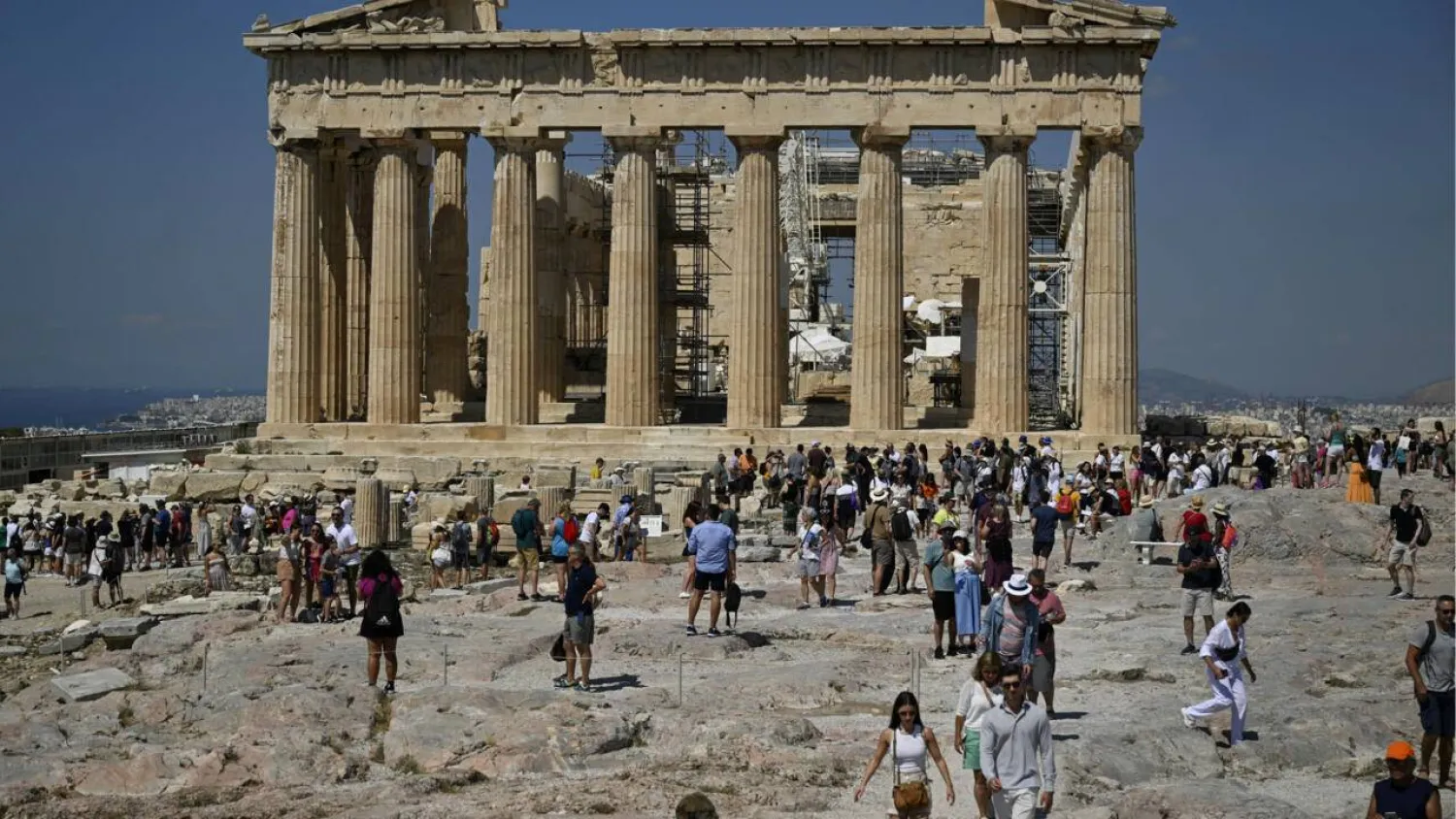

Tourism Boom Sparks Backlash in Historic Heart of Athens

Ten million people are expected to visit Athens in 2025. Louisa GOULIAMAKI / AFP/File
TT

Tourism Boom Sparks Backlash in Historic Heart of Athens

Ten million people are expected to visit Athens in 2025. Louisa GOULIAMAKI / AFP/File

Surrounded by a hubbub of blaring music, restaurant terraces and rumbling suitcase wheels slaloming between overflowing litter bins, Giorgos Zafeiriou believes surging tourism has made his historic Athens neighborhood unrecognizable.

The Greek capital's Plaka district "is threatened by overtourism", said Zafeiriou, who has lived there for more than three decades and leads its residents' association.

This year, 10 million people are expected to visit Athens, an increase of two million from 2024 which reflects the city's growing popularity as a tourist destination since the Covid-19 pandemic ended.

Despite its label as the cradle of Western civilization, Athens was previously regarded as a mere stopping point between the airport and the port of Piraeus, from where tourists explore Greece's myriad of picturesque islands.

Nicknamed "the neighborhood of the gods", Plaka is nestled below the ancient Acropolis hill, a world heritage site hosting the millennia-old Parthenon temple which welcomed almost 4.5 million visitors last year.

Plaka is now awash with tourists who navigate its warren of narrow streets lined with cafes, taverns, souvenir shops, small Byzantine churches and relics from Antiquity and the Ottoman era.

Plaka "is Europe's oldest neighborhood which has been inhabited continuously since Antiquity", said Lydia Carras, head of the Ellet association working to preserve the environment and cultural heritage.

"We cannot see it lose its soul," she added.

'Saturated with tourists'

Tourism is a pillar of the Greek economy, which endured years of painful austerity following the 2008 global financial crash and the ensuing eurozone debt crisis.

For souvenir shop seller Konstantinos Marinakis, "Greece is finally doing better thanks to the good health of tourism which allowed the economy to recover and create jobs."

But the flourishing sector has generated a backlash in Europe's most sought-after locations, with locals complaining of soaring housing prices and the impact on their neighborhoods.

Protesters have targeted tourists with water pistols in Spain's Barcelona, while the Italian city of Venice has introduced a charge in a bid to control visitor numbers.

Mayor Haris Doukas told AFP with pride that Athens was now one of the world's 10 most-visited cities, but acknowledged "areas like Plaka which are saturated with tourists".

"We are not yet at the stage of Barcelona, but we must act before it is too late," he said.

An "intervention unit" for Plaka was recently created to enforce rules with the support of the police.

Any resident who spots a restaurant terrace encroaching on public space or cars parked on the pavement can report the offenders to this team.

"Between 1960 and 1980, Plaka was overwhelmed by discos and bouzoukias," and "many residents had already left," explained Carras, referring to clubs that play traditional Greek music.

A 1993 presidential decree shut the clubs, protected homes and specified the use of each building in the neighborhood, with hotels only allowed on certain streets.

Rules 'dodged'

But "these rules have been dodged", with "entire houses converted into several apartments" advertised on short-term rental platforms, said Dimitris Melissas, a lawyer specializing in urban planning.

Plaka's population of 2,000 can be swamped by up to four times as many tourists in the summer, added Melissas, although no official statistics exist because the census measures Athens as a whole.

Representing Ellet, the lawyer has taken a case over the legality of 16 buildings converted entirely into seasonal rentals to the Council of State, Greece's top administrative court.

He argued they are actually hotel premises in disguise because they have receptions or serve breakfast on terraces. A decision, which could set an important legal precedent, is expected by the end of September.

The conservative government has banned new registrations of apartments on short-term rental platforms for at least a year in central Athens, where more than 12,000 seasonal lets existed in 2024, fueling rent rises.

"But when I still read adverts in newspapers to invest in apartments that can be converted into Airbnbs, I doubt the effectiveness of this measure," said Melissas.

"The problem in Greece is not voting laws but enforcing them."


Scientists Discover Secrets of Ancient Roman Concrete at Pompeii

The archaeological site of the ancient Roman city of Pompeii is seen in Pompeii, Italy, May 26, 2020. (Reuters)
TT

Scientists Discover Secrets of Ancient Roman Concrete at Pompeii

The archaeological site of the ancient Roman city of Pompeii is seen in Pompeii, Italy, May 26, 2020. (Reuters)

Scientists excavating the ruins of Pompeii have discovered a construction site left frozen in time by the eruption of Italy's Mount Vesuvius volcano in 79 AD, clarifying the ingredients and methods behind the durable self-healing concrete the ancient Romans used to revolutionize architecture.

The site represents a building project that was underway when the eruption buried Pompeii under volcanic ash and rock. The researchers came across rooms where the walls were unfinished and piles of premixed dry material and tools for weighing and measuring were in place for preparing concrete.

"Studying it truly felt as if I had traveled back in time and was standing beside the workers as they mixed and placed their concrete," said Admir Masic, a Massachusetts Institute of Technology professor of civil and environmental engineering and leader of the study published on Tuesday in the journal Nature Communications.

An indispensable building material, concrete helped the Romans erect structures including stadiums like the Colosseum, domed temples like the Pantheon, public baths and other big buildings, aqueducts and bridges unlike any fashioned to that point in history. Because the concrete could harden underwater, it also was vital for constructing harbors and breakwaters.

The precise method they used to make their concrete has been a matter of debate, with recent archaeological discoveries appearing to contradict accounts given in a 1st century BC treatise by Roman architect and engineer Vitruvius.

The Pompeii discovery showed the Romans used a technique called "hot mixing" in which a material called quicklime - dry limestone that was previously heated - is combined directly with water and a blend of volcanic rock and ash, producing a chemical reaction that naturally heats the mixture. That differs from the method described by Vitruvius, who wrote about a century earlier.

"Pompeii preserves buildings, materials and even work in progress in the precise state they were in when the eruption occurred. Unlike finished structures that have undergone centuries of repair or weathering, this site captures construction processes as they happened," Masic said.

"For studying ancient technologies, there is simply no parallel," Masic said. "Its exceptional preservation offers a true 'snapshot' of Roman building practice in action."

The building under construction combined domestic rooms with a working bakery with ovens, grain-washing basins and storage. The evidence there indicated that the technique outlined by Vitruvius, known as slaked lime, was not used for building walls.

That method may have been outdated by the time of the project in Pompeii.

"Imagine what 100 years of difference could mean for the building technology. A good analogy could be the early telephones. In the 1920s-30s: rotary dialing, long-distance copper lines. In the 2020s: smartphones using packet-switched digital signals and wireless networks," Masic said.

The hot-mixing technique contributed to the self-healing properties of the concrete, chemically repairing cracks. The concrete contains white remnants of the lime used to make it, called "lime clasts," which can dissolve and recrystallize, healing cracks that may form with the infiltration of water.

The Romans industrialized concrete, beginning in the 1st centuries BC and AD.

"This allowed builders to construct massive monolithic structures, complex vaults and domes, and harbors with concrete that cured underwater. Concrete fundamentally expanded what could be built and how cities and infrastructures were conceived," Masic said.

The new understanding of Roman concrete may have relevance for modern architects.

"Modern concretes generally lack intrinsic self-healing capability, which is increasingly important as we seek longer-lasting, lower-maintenance infrastructure," Masic said. "So while the ancient process itself is not a direct replacement for modern standards, the principles revealed can inform the design of next-generation durable, low-carbon concretes."


Culture Ministry Signs Partnership with SOAS University of London for Riyadh University of Arts

 SOAS will collaborate with RUA’s College of Heritage and Civilization Studies - SPA
SOAS will collaborate with RUA’s College of Heritage and Civilization Studies - SPA
TT

Culture Ministry Signs Partnership with SOAS University of London for Riyadh University of Arts

 SOAS will collaborate with RUA’s College of Heritage and Civilization Studies - SPA
SOAS will collaborate with RUA’s College of Heritage and Civilization Studies - SPA

The Ministry of Culture today signed a partnership with SOAS University of London, for Riyadh University of Arts (RUA)’s College of Heritage and Civilization Studies, to support further creative development and drive cultural diversity through exchange.

According to the ministry, the signing ceremony took place during Saudi Arabia’s inaugural Digital Heritage Conference, a national event dedicated to digital preservation and heritage innovation.

As part of the partnership, SOAS will collaborate with RUA’s College of Heritage and Civilization Studies to design and deliver specialized academic programs that drive excellence in heritage and cultural education, SPA reported.

Deputy Culture Minister for National Partnerships and Talent Development Noha Kattan signed for Riyadh University of Arts, while SOAS was represented by Dean of the College of Humanities Professor Graeme Earl.

SOAS is a world-renowned academic and research institution specializing in the study of Asia, Africa, and the Middle East, the only university in Europe with this unique regional focus. Its interdisciplinary approach integrates the humanities, social sciences and the arts providing a globally informed perspective on cultural, societal and intellectual traditions.

This partnership is part of a series of partnerships and MoUs to be signed by Riyadh University of Arts with leading international institutions for the development of academic programs, research collaboration and the creation of enriching opportunities for cultural education and professional development.


Beyond Pizza and Pasta: Italy’s Culinary Heritage Awaits UNESCO Nod 

Sicilian cannoli are served at Pasticceria Cappello as Italian cuisine awaits a crucial UNESCO decision that could recognize it as an Intangible Cultural Heritage of Humanity in Palermo, Italy, December 5, 2025. (Reuters)
TT

Beyond Pizza and Pasta: Italy’s Culinary Heritage Awaits UNESCO Nod 

Sicilian cannoli are served at Pasticceria Cappello as Italian cuisine awaits a crucial UNESCO decision that could recognize it as an Intangible Cultural Heritage of Humanity in Palermo, Italy, December 5, 2025. (Reuters)

Italian cooking, already celebrated around the world, is poised for a new accolade: formal recognition as a cultural treasure from the United Nations' cultural agency, UNESCO.

A preliminary UNESCO assessment has cleared Italian cuisine to be added to UNESCO's "Intangible Cultural Heritage" lists and a final decision is expected on Wednesday.

Launched in March 2023 by Italy’s agriculture and culture ministries, the bid casts Italian cuisine - from pasta and pizza to risotto and cannoli - as a social ritual that binds families and communities together.

"There is no single Italian cuisine, but a mosaic of local expressive diversities," the government said.

From Lombardy's ossobuco - braised veal shanks with gremolata, to Puglia's orecchiette con cime di rapa - ear-shaped pasta with turnip greens, each region showcases Italian biodiversity and creativity, it said.

CULTURAL AND ECONOMIC FOOTPRINT

Prime Minister Giorgia Meloni has championed the effort, calling Italian food a symbol of "culture, identity, tradition and strength."

Industry groups estimate UNESCO recognition could boost tourism by up to 8% in two years, adding 18 million overnight stays. Italian cuisine also connects 59 million residents with up to 85 million people of Italian descent worldwide.

Globally, the Italian food service market hit 251 billion euros ($293 billion) in 2024, or 19% of the global restaurant market, Deloitte said. But imitation products abroad cost Italy an estimated 120 billion euros annually.

CRITICISM AND DEBATE

Not everyone in Italy supports the bid to join UNESCO lists, which already feature almost 800 items including Italian opera singing and truffle hunting.

Alberto Grandi, a food historian, called the UNESCO candidacy "just a marketing operation" in an interview with website Mantovauno last month.

In his 2024 book "La cucina italiana non esiste" ("Italian cuisine doesn't exist"), Grandi argued that many dishes considered traditional, including pasta alla carbonara, are relatively modern inventions influenced by foreign cultures.

Grandi's remarks have sparked a backlash from farmers' association Coldiretti, which called his claims "surreal attacks on national culinary tradition."

'THE ART OF CARING'

For restaurateurs like Luigina Pantalone, owner of Rome's historic Da Sabatino, a UNESCO nod from Wednesday's meeting in India would be a source of pride.

"Authentic Italian cuisine needs to be protected," she said, recalling childhood days washing dishes with her brothers and proudly noting that she is the fourth generation of her family to run the restaurant.

Three-Michelin-star chef Massimo Bottura summed it up: "Italian cuisine is an ancient, daily, sacred ritual – the art of caring and loving without saying a word."
