


Gabon Forest Cave Reveals Clues About Prehistoric Central Africa

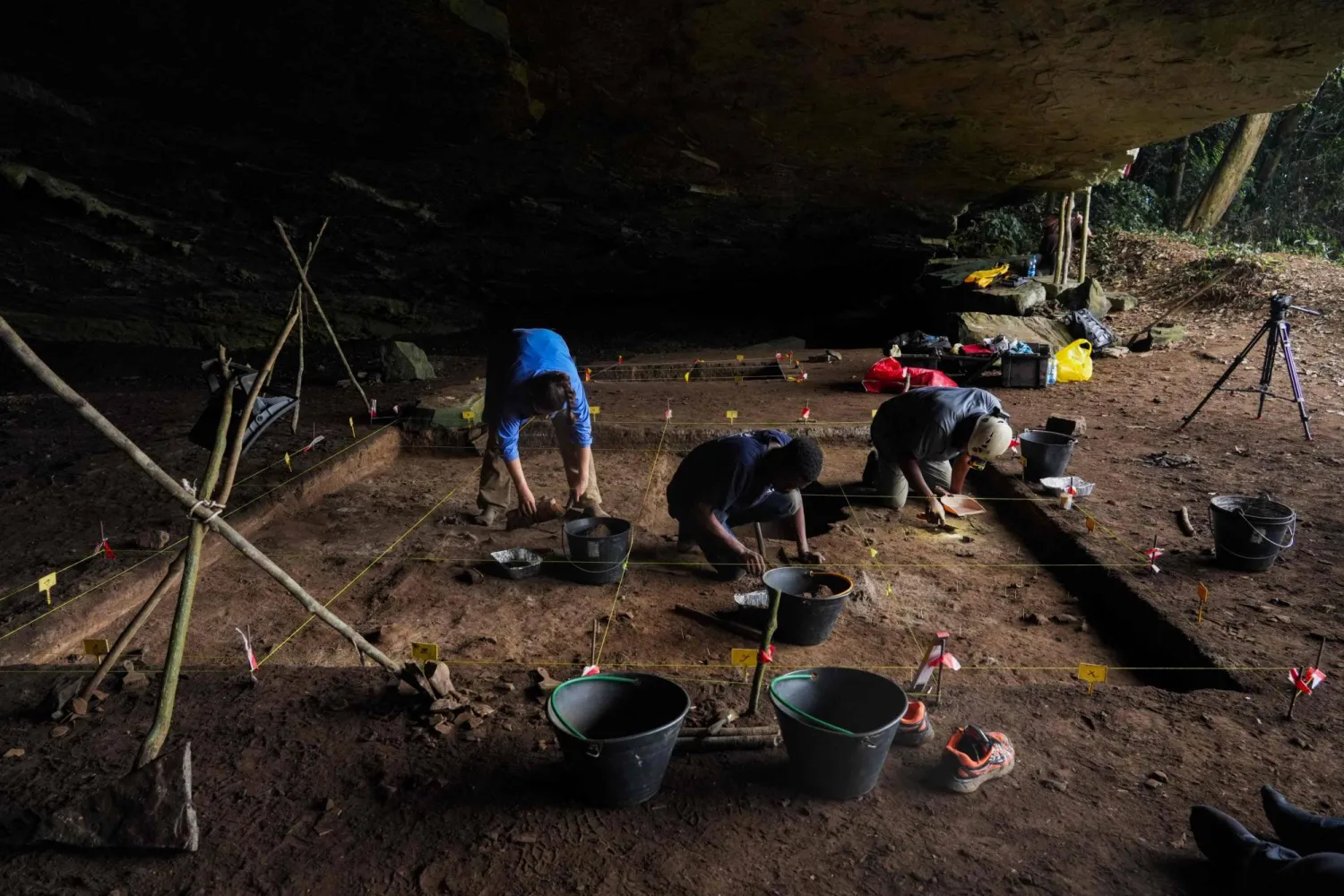
Archaeology students actively participate in archaeological excavations within a marked square inside Youmbidi Cave in Lastourville, on June 27, 2025. (Photo by Nao Mukadi / AFP)
TT

Gabon Forest Cave Reveals Clues About Prehistoric Central Africa

Archaeology students actively participate in archaeological excavations within a marked square inside Youmbidi Cave in Lastourville, on June 27, 2025. (Photo by Nao Mukadi / AFP)

In Gabon's sprawling forest, archaeologists dig for ancient clues that could unlock the secrets of how prehistoric humans lived and interacted in the changing landscape of central Africa.

Two billion years ago, the eastern Gabonese region of Lastourville was covered by a vast ocean.

But that has long given way to dense forest and dolomite cliffs dotted with caves, within which scientists have unearthed traces of human life dating back to 25,000 years BC.

Off the beaten track even for archaeologists, the Youmbidi rock shelter, a cavern typical of those chosen by prehistoric humans to set up their homes, is the focus for French geoarchaeologist Richard Oslisly's team, AFP reported.

Among their finds: a stone tool which could have been used for cutting or making fibers dating to before 10,000 BC.

An arrowhead has also been unearthed, as has a collection of dolomite, quartz and jasper shards, cut up to 10,000 years ago by the cave's inhabitants.

"The vast majority of research in Africa has taken place in open landscapes such as the Sahara, Sahel or Egypt," said Oslisly, who has spent 45 years working in central Africa.

"They said to me 'there's nothing in the forest' (but) I took up the challenge of finding out what was happening there," he added.

"We realize there is a very close relationship between man and nature in these forests, where people have lived for a very long time," Oslisly said.

The Youmbidi cave -- where scientists have recorded 12,000 years of continuous human habitation -- is an enticing spot for the archeologists.

"We don't know at all how these people lived, what their way of life was, what their names were, what their languages were," said Geoffroy de Saulieu from France's IRD Research Institute for Development.

"Our research will help us to know a little more," he added.

After a month of digging and careful sorting of every stone, charcoal remnant, bone and other treasure buried below the cave, the team has elements to help decipher the past.
De Saulieu said it was like a jigsaw puzzle.

"You have to... gather the smallest clues, place them end to end to gradually reconstruct a whole universe that has disappeared and which is, nevertheless, at the origin of the way of life in central Africa today," said the expert, currently attached to the National Agency of National Parks of Gabon.

One of the oldest bits of pottery found in central Africa, which dated to more than 6,500 years ago, is among this year's finds.

Human-looking teeth that could allow DNA to be extracted in what would prove a significant leap in research have also excited archaeologists.

And, like all the artifacts, a bead likely made between 3,300 and 4,900 years ago from a snail shell also offers precious insight as a "very humble but beautiful witness" of the epoch in question.

Dispelling stereotypical images of prehistoric Man, it suggests people had "real customs, a real civilization and art of living," de Saulieu said.

The pottery "shows that these societies weren't immobile, they had launched themselves into technical innovations", he added.

The discoveries fan his fascination for the richness of "the social life which existed in the region's forests".

Glimpses into an ancient lost world can also be useful for tackling present-day challenges, the experts said.

During the Holocene period which dates back the past 12,000 years, "central Africa has experienced very significant changes in climate, hydrology and vegetation," said paleoclimatologist Yannick Garcin, also from the IRD and involved in the Youmbidi dig.

The hope is that the cave will unlock an understanding of "the resilience of human populations in the past and how they were able to adapt to climate changes that could have been drastic", he said.

Central Africa for that reason "deserves major development in terms of research", Oslisly argued.

Understanding what happened in prehistoric times can help scientists today react to modern-day issues, he added.

"Good studies on the relationship between Man and the environment in the past will allow us to react better to the environmental changes that are ahead of us," he said.



Shark Mauls Boy in Sydney Harbor

 This photo shows an aerial view of Bondi Beach and Sydney Harbor as seen from a plane flying over Sydney on January 14, 2026. (AFP)
This photo shows an aerial view of Bondi Beach and Sydney Harbor as seen from a plane flying over Sydney on January 14, 2026. (AFP)
TT

Shark Mauls Boy in Sydney Harbor

 This photo shows an aerial view of Bondi Beach and Sydney Harbor as seen from a plane flying over Sydney on January 14, 2026. (AFP)
This photo shows an aerial view of Bondi Beach and Sydney Harbor as seen from a plane flying over Sydney on January 14, 2026. (AFP)

A shark mauled a boy swimming in Sydney Harbor on Sunday, leaving him in critical condition with serious leg injuries, authorities said.

The predator bit the boy, believed to be about 13 years old, during the late afternoon off Shark Beach, New South Wales state police said.

"The injuries are consistent with what is believed to have been a large shark," police said in a statement.

Officers pulled the boy from the water off the harbor beach within minutes of being alerted to the incident, police said.

They gave the boy first aid for "serious" leg injuries while he was aboard a police boat, applying two medical tourniquets.

Paramedics transported him to Sydney Children's Hospital, where he was said to be in critical condition.

"Swimmers are advised to avoid entering nearby waters at this time," police said.

Shark Beach, in Sydney's eastern suburb of Vaucluse, was closed and police evacuated nearby beaches in the harbor, the state government said.

Wildlife experts were working to identify the shark species involved, it said in a statement.

"This is a tragic shark attack on a young boy having a swim on a Sunday afternoon near a harbor beach in Sydney's east," New South Wales Agriculture Minister Tara Moriarty said.

"Our thoughts are with the young boy and his family. I understand there were also other young people with him at the time of the attack, our thoughts are also with them."

There have been more than 1,280 shark incidents around Australia since 1791, of which more than 250 resulted in death, according to a database of the predators' encounters with humans.

Increasingly crowded waters and rising ocean temperatures that appear to be swaying sharks' migratory patterns may be contributing to a rise in attacks despite overfishing depleting some species, scientists say.

A great white shark mauled surfer Mercury Psillakis to death at a popular northern Sydney ocean beach in September.

Two months later, a bull shark killed a woman swimming off a remote beach north of Sydney.


Social Media Addiction's Surprising Challenger? Anti-doomscrolling Influencers

A 13-year-old boy poses at his home as he looks at social media on his mobile phone in Sydney on December 8, 2025.  (Photo by Saeed KHAN / AFP)
A 13-year-old boy poses at his home as he looks at social media on his mobile phone in Sydney on December 8, 2025. (Photo by Saeed KHAN / AFP)
TT

Social Media Addiction's Surprising Challenger? Anti-doomscrolling Influencers

A 13-year-old boy poses at his home as he looks at social media on his mobile phone in Sydney on December 8, 2025.  (Photo by Saeed KHAN / AFP)
A 13-year-old boy poses at his home as he looks at social media on his mobile phone in Sydney on December 8, 2025. (Photo by Saeed KHAN / AFP)

It’s simple to accidentally become entranced by an endless loop of videos on Instagram or TikTok. But sometimes, that mindless scroll is interrupted by a reminder that what you thought was a 10-minute break spent on your phone was closer to 30 minutes.

Olivia Yokubonis, armed with a kind voice and scientific research, often pops up in feeds on social platforms, gently reminding viewers that they might not remember the video they saw two videos before she appeared on the screen.

Yokubonis is a content creator who goes by the name Olivia Unplugged online, making videos to combat overuse or mindless use of social media. For the most part, people who view her videos welcome the disruption from the endless loop of content, treating it as a wake-up call to get off their phones. Other times, they are snarky, The Associated Press said.

“People will comment and they’ll be like, ’Oh, (it’s) ironic that you’re posting. And I’m like, ‘Where else am I supposed to find you, Kyle? Outside? You’re not outside. You are here, sitting here,’” she said. “For us to actually be seen, we have to be where people are.”

Yokubonis’ content responds to the feeling many people have, that they spend too much time on social media or apps.

“Most people have no clue how much time they spend on social media,” said Ofir Turel, a professor of information systems management at the University of Melbourne who has been studying social media use for years. Through his research, Turel found that when he presented people with their screen time information, they were practically “in a state of shock” and many people voluntarily reduced their usage afterwards.

Yokubonis is part of a growing group of content creators who make videos encouraging viewers to close out the app they’re on. Some are aggressive in their approach, some more tame; some only occasionally post about social media overuse, and some, like Yokubonis, devote their accounts to it.

She works for Opal, a screen time app designed to help users “reclaim their focus,” she said, but those who engage with her content might not have any idea she is working for the company. Brand logos, constant plugs to download the app and other signs of branding are almost entirely absent from her page. “People love hearing from people,” she said. Millions of views on her videos point to that being true.

“It’s a fine line and a balance of finding a way to be able to cut through that noise but also not adding to the noise,” she added.

Ian A. Anderson, a postdoctoral scholar at California Institute of Technology, said he finds this kind of content interesting, but is curious whether it's disruptive enough to prompt action. He also said he wonders whether those with the strongest scrolling habits are “thoughtless about the way (they're) intaking information.”

“If they're paying full attention, I feel like it could be an effective disruption, but I also think there is a degree to which, if you are really a habitual scroller, maybe you aren’t fully engaging with it,” he said. “I can think of all sorts of different variables that could change the effectiveness, but it does sound like an interesting way to intervene from the inside.”

With billions of active users across TikTok, Instagram, YouTube and other social media platforms, talk of cutting down on screen time is perennial, as is the idea of addiction to social platforms. But there’s tremendous disagreement over whether social media addiction actually exists.

Is social media “addiction” real? Researchers, psychologists and other experts agree some people spend too much time on social media, but the agreement tends to stop there. Some researchers question whether addiction is the appropriate term to describe heavy use of social media, arguing that a person must be experiencing identifiable symptoms, like strong, sometimes uncontrollable urges and withdrawal, to qualify as addiction. Others, like Turel, acknowledge the term seems to resonate with more people and is often used colloquially.

Anderson said he recognized the prevalence of casual mentions of being addicted to phones and was curious to see if that talk was “benign.”

A recent study of his suggests the debate extends further than academic discourse. In a representative sample of active Instagram users, Anderson found that people often overestimate whether they are “addicted” to the app. On a self-report scale, 18% of participants agreed that they were at least somewhat addicted to Instagram and 5% indicated substantial agreement, but only 2% of participants were deemed at risk of addiction based on their symptoms. Believing you are addicted also impacts how you address that issue, Anderson said.

“If you perceive yourself as more addicted, it actually hurts your ability to control your use or your perception of that ability and makes you kind of blame yourself more for overuse,” Anderson said. “There are these negative consequences to addiction perception.”

Cutting down on screen time

For those looking to curb their social media habits, Anderson suggests making small, meaningful, changes to stop from opening your social media app of choice. Moving the app’s place on your phone or turning off notifications are “light touch interventions,” but more involved options, like not bringing your phone into the bedroom — or other places where you often use it — could also help.

Plenty of intervention methods have been offered to consumers in the form of products or services. But those interventions require self awareness and a desire to cut down on use. Content creators who infiltrate social media feeds with information about the psychology behind why people scroll for hours a day can plant those early seeds.

Cat Goetze, who goes by CatGPT online, makes “non-pretentious, non-patronizing” content about artificial intelligence, building off her experience in the tech industry. But she’s also been on a lengthy road to cut down her own screen time. She often makes videos about why the platforms are so compelling and why we tend to spend longer than we anticipate on them.

“There’s a whole infrastructure — there’s an army of nerds whose only job is to get you to increase your time spent on that platform,” she said. “There’s a whole machine that’s trying to get you to be that way and it’s not your fault and you’re not going to win this just (through) willpower.”

Goetze also founded the business Physical Phones, which makes Bluetooth landline phones that connect to smartphones, encouraging people to spend less time on their devices. The inside of the packaging reads “offline is the new luxury.”

She was able to build the business at an accelerated pace thanks to her social media audience. But the early success of Physical Phones also demonstrates the demand for solutions to high screen time, she said.

“Social media will always play a part in our lives. I don’t necessarily think that’s a bad thing. If we can get the average screen time down from, if it’s 10 hours for a person to one hour, or from three hours to 30 minutes, that is going to be a net positive benefit for that individual and for society,” Goetze said. “That being said, I’d love to be the person that they’re watching for those 30 minutes.”


German Killed in Swiss Avalanche, 4 Other Skiers Hurt

Swiss Air Force's aerobatic team "The Patrouille Suisse" perform prior to the FIS alpine skiing Men's World Cup Super G event in Wengen, Swiss Alps, on January 19, 2026. (Photo by Dimitar DILKOFF / AFP)
TT

German Killed in Swiss Avalanche, 4 Other Skiers Hurt

Swiss Air Force's aerobatic team "The Patrouille Suisse" perform prior to the FIS alpine skiing Men's World Cup Super G event in Wengen, Swiss Alps, on January 19, 2026. (Photo by Dimitar DILKOFF / AFP)

A German man has been killed in an avalanche in the Swiss alps and four other people were hurt as they were cross-country skiing, Swiss police said Saturday.

The incident happened on Friday, on the Piz Badus peak near the village of Tujetsch in the center-south of the country, AFP reported.

Police said a group of seven cross-country skiers were swept up in the avalanche, with five of them buried underneath.

One member of the party raised the alarm in a phone call to local police, who deployed helicopters with rescue workers and dogs to the site.

The German man was found lifeless under the snow and ice, the police said, adding that the four others hurt -- whose nationalities were not given -- suffered light injuries and were flown to nearby hospitals.