
Netanyahu Meets Security Officials as Israel Considers Full Gaza Takeover

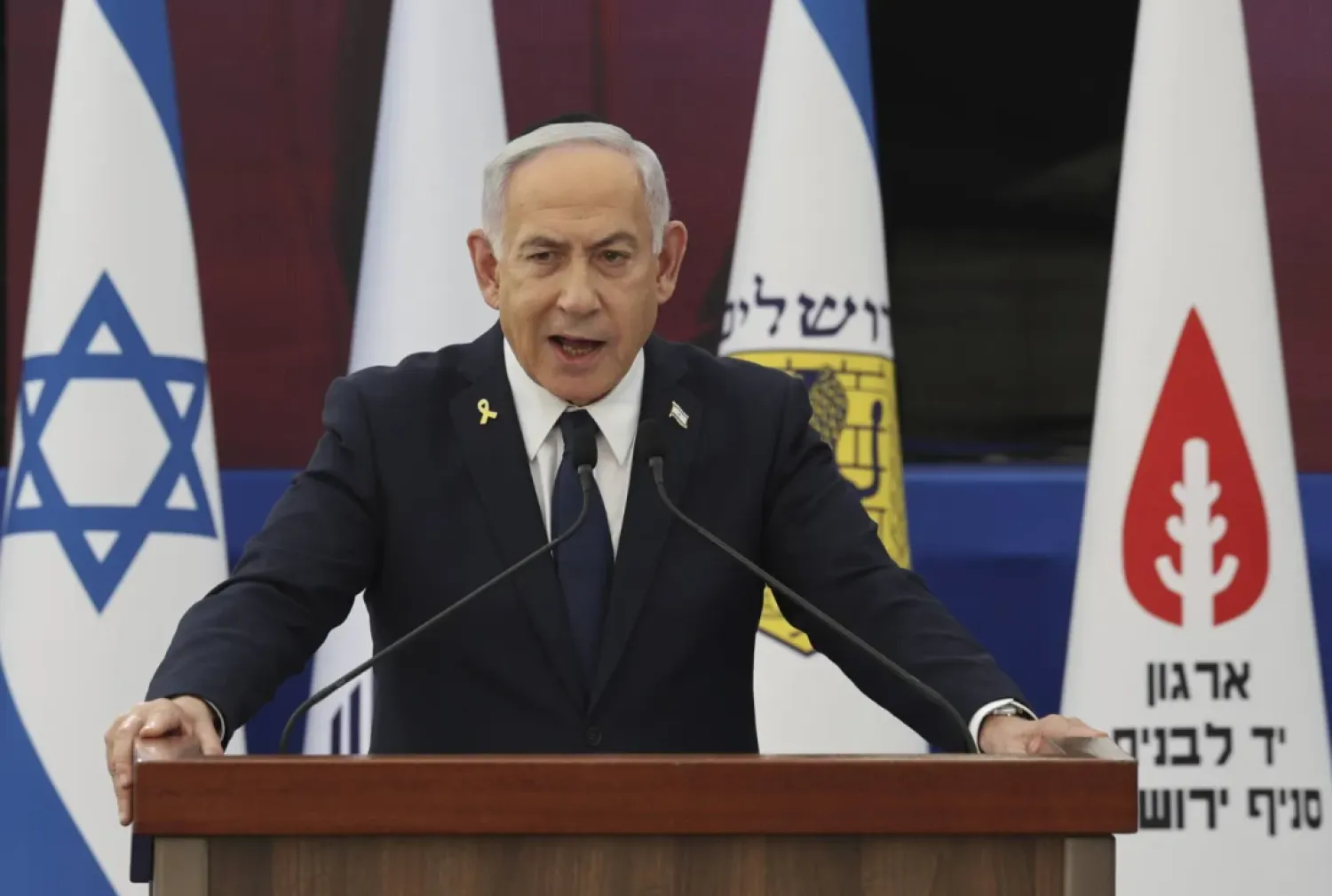
Israeli Prime Minister Benjamin Netanyahu speaks during the annual ceremony at the eve of Israel's Remembrance Day for fallen soldiers (Yom HaZikaron) at the Yad LaBanim Memorial in Jerusalem on Tuesday, April 29, 2025. (Abir Sultan/Pool Photo via AP)
TT

Netanyahu Meets Security Officials as Israel Considers Full Gaza Takeover

Israeli Prime Minister Benjamin Netanyahu speaks during the annual ceremony at the eve of Israel's Remembrance Day for fallen soldiers (Yom HaZikaron) at the Yad LaBanim Memorial in Jerusalem on Tuesday, April 29, 2025. (Abir Sultan/Pool Photo via AP)

Israeli Prime Minister Benjamin Netanyahu met senior security officials to finalize a new strategy for the 22-month war in Gaza, his office said on Tuesday, with media reporting he favored a complete military takeover of the Strip. 

Despite intense international pressure for a ceasefire to ease hunger and appalling conditions in the besieged Palestinian enclave, efforts to mediate a truce between Israel and Palestinian group Hamas have collapsed. 

Eight more people died of starvation or malnutrition in the past 24 hours, Gaza's health ministry said, while another 79 died in the latest Israeli firing. 

The prime minister's office said in statement that Netanyahu had held a "limited security discussion" lasting about three hours during which military Chief of Staff Eyal Zamir "presented the options for continuing the campaign in Gaza". 

An Israeli official had earlier told Reuters that Defense Minister Israel Katz and Strategic Affairs Minister Ron Dermer, a confidant of Netanyahu, would also attend the meeting to decide on a strategy to take to cabinet this week. 

Israel's Channel 12, citing an official from Netanyahu's office, had said the prime minister was leaning towards taking control of the entire territory. That would reverse a 2005 decision to withdraw from Gaza, while retaining control over its borders, a move right-wing parties blame for Hamas gaining power there. 

It was unclear, however, whether Netanyahu was foreseeing a prolonged occupation or a short-term operation aimed at dismantling Hamas and freeing Israeli hostages. The prime minister's office declined to comment on the Channel 12 report. 

"It is still necessary to complete the defeat of the enemy in Gaza, release our hostages and ensure that Gaza never again constitutes a threat to Israel," Netanyahu told new recruits at a military base. "We are not giving up on any of these missions." 

On Saturday, Hamas released a video of Evyatar David, one of 50 hostages still held in Gaza, appearing emaciated in what seemed to be an underground tunnel. The images shocked Israelis and sparked international condemnation. 

Throughout the war, there has been sustained international pressure on Hamas to release the remaining hostages, of whom Israeli officials estimate 20 are still alive. Most hostages have been released during ceasefires following diplomatic negotiations. Israel broke the last ceasefire. 

PRESSURE TACTIC? 

A Palestinian official said the suggestion of a full takeover of Gaza may be a tactic to pressure Hamas into concessions, while the Palestinian Foreign Ministry urged foreign nations to take heed of the reports. 

"The ministry urges countries and the international community to treat these leaks with utmost seriousness and to intervene urgently to prevent their implementation, whether these leaks are meant to exert pressure, test international reactions, or are genuine and serious," it said. 

Israel's coalition government, the most right-wing and religiously conservative in its history, includes far-right politicians who advocate the annexation of both Gaza and the West Bank and encourage Palestinians to leave their homeland. 

Nearly two years of fighting in Gaza has strained the military, which has a small standing army and has had to repeatedly mobilize reservists. It has throughout the war pushed back against the idea of Israel fully occupying Gaza. 

In a sign of differences between some members of Israel's ruling coalition and the military, far-right National Security Minister Itamar Ben Gvir on X challenged military head Zamir to state he would comply with government directives even if a decision was made to take all of Gaza. 

The statement from Netanyahu's office said the Israeli Defense Forces were "prepared to implement any decision that will be made by the Political-Security Cabinet". 

HUNGER 

The war was triggered when Hamas-led fighters attacked Israel on October 7, 2023, killing around 1,200 people, mostly civilians, and capturing 251 hostages. 

Israel's military response has devastated the tiny, crowded enclave, killing more than 61,000 people - mostly civilians - according to Palestinian health authorities. 

Israel's campaign has forced nearly all of Gaza's more than 2 million people from their homes and caused what a global hunger monitor called last week an unfolding famine. 

Some 188 Palestinians, including 94 children, have died from hunger since the war began, according to Gaza authorities. 

An Israeli security official, in a briefing to reporters, acknowledged there may be hunger in some parts of Gaza but rejected reports of famine or starvation. 

On Tuesday, Israeli tanks pushed into central Gaza, but it was not clear if the move was part of a larger ground offensive. 

Palestinians living in the last quarter of territory where Israel has not yet taken military control - via ground incursions or orders for civilians to leave - said any new push would be catastrophic. 

"If the tanks pushed through, where would we go, into the sea? This will be like a death sentence to the entire population," said Abu Jehad, a Gaza wood merchant. 


Gaza Ceasefire Enters Phase Two Despite Unresolved Issues

 Palestinians walk amid buildings destroyed by Israeli air and ground operations in Gaza City Thursday, Jan. 15, 2026. (AP)
Palestinians walk amid buildings destroyed by Israeli air and ground operations in Gaza City Thursday, Jan. 15, 2026. (AP)
TT

Gaza Ceasefire Enters Phase Two Despite Unresolved Issues

 Palestinians walk amid buildings destroyed by Israeli air and ground operations in Gaza City Thursday, Jan. 15, 2026. (AP)
Palestinians walk amid buildings destroyed by Israeli air and ground operations in Gaza City Thursday, Jan. 15, 2026. (AP)

A US-backed plan to end the war in Gaza has entered its second phase despite unresolved disputes between Israel and Hamas over alleged ceasefire violations and issues unaddressed in the first stage.

The most contentious questions remain Hamas's refusal to publicly commit to full disarmament, a non-negotiable demand from Israel, and Israel's lack of clarity over whether it will fully withdraw its forces from Gaza.

The creation of a Palestinian technocratic committee, announced on Wednesday, is intended to manage day-to-day governance in post-war Gaza, but it leaves unresolved broader political and security questions.

Below is a breakdown of developments from phase one to the newly launched second stage.

- Gains and gaps in phase one -

The first phase of the plan, part of a 20-point proposal unveiled by US President Donald Trump, began on October 10 and aimed primarily to stop the fighting in the Gaza Strip, allow in aid and secure the return of all remaining living and deceased hostages held by Hamas and allied Palestinian armed groups.

All hostages have since been returned, except for the remains of one Israeli, Ran Gvili.

Israel has accused Hamas of delaying the handover of Gvili's body, while Hamas has said widespread destruction in Gaza made locating the remains difficult.

Gvili's family had urged mediators to delay the transition to phase two.

"Moving on breaks my heart. Have we given up? Ran did not give up on anyone," his sister, Shira Gvili, said after mediators announced the move.

Israeli Prime Minister Benjamin Netanyahu said efforts to recover Gvili's remains would continue but has not publicly commented on the launch of phase two.

Hamas has accused Israel of repeated ceasefire violations, including air strikes, firing on civilians and advancing the so-called "Yellow Line," an informal boundary separating areas under Israeli military control from those under Hamas authority.

Gaza's Hamas-run health ministry said Israeli forces had killed 451 people since the ceasefire took effect.

Israel's military said it had targeted suspected fighters who crossed into restricted zones near the Yellow Line, adding that three Israeli soldiers were also killed by fighters during the same period.

Aid agencies say Israel has not allowed the volume of humanitarian assistance envisaged under phase one, a claim Israel rejects.

Gaza, whose borders and access points remain under Israeli control, continues to face severe shortages of food, clean water, medicine and fuel.

Israel and the United Nations have repeatedly disputed figures on the number of aid trucks permitted to enter the Palestinian territory.

- Disarmament, governance in phase two -

Under the second phase, Gaza is to be administered by a 15-member Palestinian technocratic committee operating under the supervision of a so-called "Board of Peace," to be chaired by Trump.

"The ball is now in the court of the mediators, the American guarantor and the international community to empower the committee," Bassem Naim, a senior Hamas leader, said in a statement on Thursday.

Mediators Egypt, Türkiye and Qatar said Ali Shaath, a former deputy minister in the Ramallah-based Palestinian Authority, had been appointed to lead the committee.

Shaath, in an interview, said the committee would rely on "brains rather than weapons" and would not coordinate with armed groups.

US Middle East envoy Steve Witkoff said phase two aims for the "full demilitarization and reconstruction of Gaza," including the disarmament of all unauthorized armed factions.

Witkoff said Washington expected Hamas to fulfill its remaining obligations, including the return of Gvili's body, warning that failure to do so would bring "serious consequences".

The plan also calls for the deployment of an International Stabilization Force to help secure Gaza and train vetted Palestinian police units.

For Palestinians, the central issue remains Israel's full military withdrawal from Gaza - a step included in the framework but for which no detailed timetable has been announced.

With fundamental disagreements persisting over disarmament, withdrawal and governance, diplomats say the success of phase two will depend on sustained pressure from mediators and whether both sides are willing - or able - to move beyond long-standing red lines.


Lebanon Charges Four Accused of Kidnapping for Israel’s Mossad

A handout photo from Israeli television made available on July 13, 2008, shows a photograph of Ron Arad, an Israeli Air Force navigator who was captured after his fighter jet was shot down in Lebanon in 1986. (Handout / AFP)
TT

Lebanon Charges Four Accused of Kidnapping for Israel’s Mossad

A handout photo from Israeli television made available on July 13, 2008, shows a photograph of Ron Arad, an Israeli Air Force navigator who was captured after his fighter jet was shot down in Lebanon in 1986. (Handout / AFP)

Four people accused of a kidnapping in Lebanon for Israel's Mossad spy agency last month have been charged, a judicial official said on Thursday, after a retired security officer whose brother was linked to an Israeli airman's disappearance went missing.

Israel has apprehended suspects in Lebanon before and Mossad is accused of regularly attempting to contact Lebanese people to facilitate its operations, while Lebanon has arrested dozens of people on suspicion of collaborating with Israel over the years.

Lebanese authorities believe the agency known for espionage operations outside of Israel's borders was behind the disappearance of retired security officer Ahmad Shukr last month.

Shukr, whose brother Hassan is suspected of involvement in the 1986 capture of Israeli air force navigator Ron Arad, disappeared in the Bekaa region of eastern Lebanon.

Authorities have arrested and charged one Lebanese man and charged three more who remain at large.

The four were charged with "communicating with and working for Mossad within Lebanon in exchange for money, and carrying out the kidnapping of Ahmad Shukr", a judicial official told AFP on condition of anonymity.

The three are "a Lebanese woman, a Lebanese-French man, and a Syrian-Swedish man," the official said.

The Israeli airman Ron Arad, whose plane went down in southern Lebanon during the country's civil war between 1975 and 1990, is now presumed dead and his remains were never returned.

Hassan Shukr was killed in 1988 in a battle between Israeli forces and local fighters, including from the Iran-backed Hezbollah group, a source close to the family told AFP last month, requesting anonymity.


Israeli Strikes Kill Five in Gaza, Say Local Health Authorities

 Makeshift tents shelter displaced Palestinians stand among buildings destroyed by Israeli air and ground operations in Gaza City Thursday, Jan. 15, 2026. (AP)
Makeshift tents shelter displaced Palestinians stand among buildings destroyed by Israeli air and ground operations in Gaza City Thursday, Jan. 15, 2026. (AP)
TT

Israeli Strikes Kill Five in Gaza, Say Local Health Authorities

 Makeshift tents shelter displaced Palestinians stand among buildings destroyed by Israeli air and ground operations in Gaza City Thursday, Jan. 15, 2026. (AP)
Makeshift tents shelter displaced Palestinians stand among buildings destroyed by Israeli air and ground operations in Gaza City Thursday, Jan. 15, 2026. (AP)

Two Israeli airstrikes killed five people, including a 16-year-old, in Deir al-Balah on Thursday, said local health authorities.

The Israeli military did not immediately respond to a Reuters request for comment on the incident.

It was not immediately clear what triggered the attacks, which were in areas outside the control of Israeli forces in the strip.

More than 400 Palestinians ‌and three Israeli ‌soldiers have been reported ‌killed ⁠since a ‌fragile ceasefire took effect in October.

Israel has razed buildings and ordered residents out of more than half of Gaza where its troops remain. Nearly all of the territory's more than 2 million people now live in ⁠makeshift homes or damaged buildings in a sliver of ‌territory where Israeli troops have withdrawn ‍and Hamas has ‍reasserted control.

The United Nations children agency ‍said on Tuesday that over 100 children have been killed in Gaza since the ceasefire, including victims of drone and quadcopter attacks.

Israel and Hamas have traded blame for violations of the ceasefire and remain far apart ⁠from each other on key issues, despite the United States announcing the second phase of the ceasefire on Wednesday.

Israel launched its operations in Gaza in the wake of an attack by Hamas-led fighters on October, 2023 which killed 1,200 people, according to Israeli tallies. Israel's assault has killed 71,000 people, according to health authorities in the strip, ‌and left much of Gaza in ruins.