


Hezbollah Rejects Deadline for its Disarmament as Lebanese Govt Holds Crucial Meeting

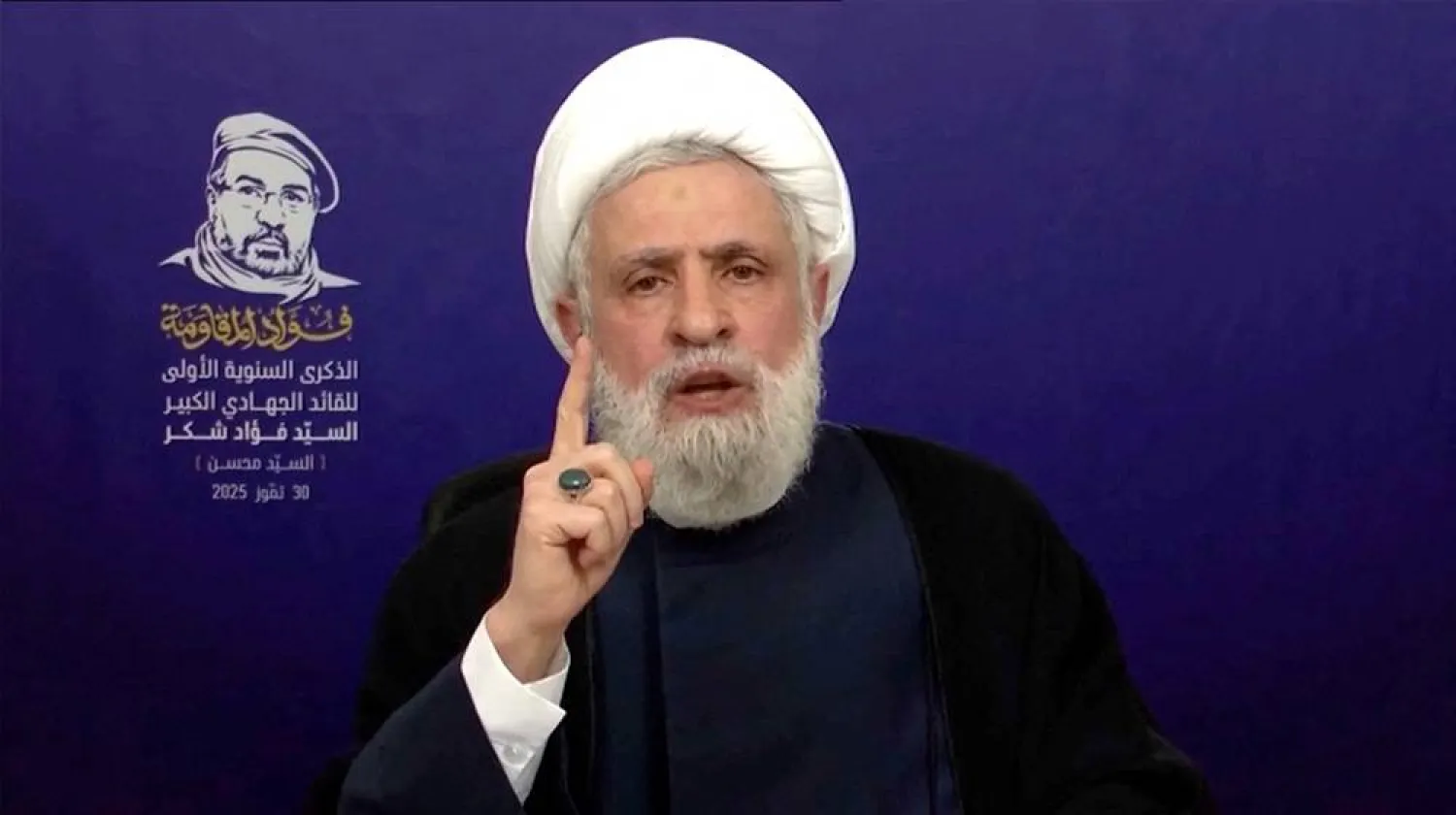
 Hezbollah chief Sheikh Naim Qassem gives a televised speech from an unknown location, July 30, 2025 in this screen grab from video. (Al Manar TV/Reuters TV/via Reuters)
Hezbollah chief Sheikh Naim Qassem gives a televised speech from an unknown location, July 30, 2025 in this screen grab from video. (Al Manar TV/Reuters TV/via Reuters)
TT

Hezbollah Rejects Deadline for its Disarmament as Lebanese Govt Holds Crucial Meeting

 Hezbollah chief Sheikh Naim Qassem gives a televised speech from an unknown location, July 30, 2025 in this screen grab from video. (Al Manar TV/Reuters TV/via Reuters)
Hezbollah chief Sheikh Naim Qassem gives a televised speech from an unknown location, July 30, 2025 in this screen grab from video. (Al Manar TV/Reuters TV/via Reuters)

Hezbollah Secretary General Sheikh Naim Qassem declared on Tuesday that his party will not agree to any timeframe for its disarmament as long as "Israel continues its aggression" against Lebanon.  

Lebanon's cabinet was meeting on Tuesday to discuss Hezbollah's arsenal, after Washington ramped up pressure on ministers to publicly commit to disarming the Iran-backed group and amid fears Israel could intensify strikes if they fail to do so.  

The session at Lebanon's presidential palace was the first time that cabinet would discuss the fate of Hezbollah's weapons - unimaginable when the group was at the zenith of its power just two years ago.  

In a televised address, Qassem urged the state to set "plans to confront the pressure and threats". It must not "strip its resistance (Hezbollah) of its abilities and strength," he added. 

Qassem threatened Israel directly for the first time in months, saying missiles would fall on it if it resumed a broad war on Lebanon. 

He said that, should Israel engage in a "large-scale aggression" against Lebanon, Hezbollah, Lebanon's army and Lebanon's people would defend themselves. 

"This defense will lead to missiles falling inside the Israeli entity, and all the security they have built over eight months will collapse within an hour," he said. 

A US-brokered ceasefire in November brought an end to months of fighting between Hezbollah and Israel. The war killed much of Hezbollah's leadership - including Qassem's predecessor Hassan Nasrallah - and destroyed much of its arsenal. 

Qassem said the war had killed 5,000 Hezbollah fighters and wounded 13,000, the first official toll the group has given. But he said the organization remained in good order, with fighters ready to make "the harshest sacrifices" if needed. 

Minutes after he spoke, dozens of men on motorcycles carrying Hezbollah's yellow flags emerged from its strongholds in Beirut's southern suburbs for the second day in a row. 

Pressure from the US and Hezbollah's domestic rivals for the group to relinquish its arms has spiked following last year's war with Israel.  

In June, US envoy Thomas Barrack proposed a roadmap to Lebanese officials to fully disarm Hezbollah, in exchange for Israel halting its strikes on Lebanon and withdrawing its troops from five points they still occupy in southern Lebanon.  

That proposal included a condition that Lebanon's government pass a cabinet decision clearly pledging to disarm Hezbollah.  

After Barrack made several trips to Lebanon to urge progress on the plan, Washington's patience began wearing thin, Reuters reported last week. It pressured Lebanon's ministers to swiftly make the public pledge so that talks could continue.  

But Lebanese officials and diplomats say such an explicit vow could spark communal tensions in Lebanon, where Hezbollah and its arsenal retain significant support among the country's Shiite community.  

Addressing Lebanese officials, Qassem said: "I hope you don't waste time on the storms stirred up by external dictates." 

PROPOSED WORDING  

On Monday evening, a group of dozens of motorcycles set out from a neighborhood in Beirut's suburbs where Hezbollah has strong support, carrying the party's flags.  

Hezbollah's main ally, Lebanese Parliament Speaker Nabih Berri, has been in talks with President Joseph Aoun and Prime Minister Nawaf Salam ahead of Tuesday's session to agree on a general phrase to include in a cabinet decision to appease the US and buy Lebanon more time, two Lebanese officials said.  

Berri's proposed wording would commit Lebanon to forming a national defense strategy and maintaining a ceasefire with Israel, but would avoid an explicit pledge to disarm Hezbollah across Lebanon, the officials said.  

But other Lebanese ministers plan to propose a formulation that commits Lebanon to a deadline to disarm Hezbollah, said Kamal Shehadi, a minister affiliated with the anti-Hezbollah Lebanese Forces party.  

"There's frankly no need to kick the can down the road and postpone a decision. We have to put Lebanon's interest first and take a decision today," Shehadi told Reuters.  

Lebanese officials and foreign envoys say Lebanese leaders fear that a failure to issue a clear decision on Tuesday could prompt Israel to escalate its strikes, including on Beirut.  

Since the ceasefire, Israel has continued to carry out strikes on what it says are Hezbollah arms depots and fighters, mostly in southern Lebanon. 


Syrian Authorities Say Captured ISIS-linked Cell Behind Blasts

Syrian security personnel inspect a burned vehicle near the Four Seasons Hotel after two explosions rocked the area earlier in Damascus, Syria, Tuesday, July 7, 2026. (AP Photo/Omar Albam)
TT

Syrian Authorities Say Captured ISIS-linked Cell Behind Blasts

Syrian security personnel inspect a burned vehicle near the Four Seasons Hotel after two explosions rocked the area earlier in Damascus, Syria, Tuesday, July 7, 2026. (AP Photo/Omar Albam)

Syrian officials said late Thursday the country had captured an ISIS-linked cell responsible for two bomb blasts during French President Emmanuel Macron's visit to Damascus earlier this week.

In a joint press conference with his Syrian counterpart, Macron said we must "not let ourselves be destabilized" by such attacks, and the two leaders vowed to boost ties with new ambassadors to be installed in each country.

Syria's Interior Minister Anas Khattab said that "the cell responsible for the terrorist bombings that targeted Damascus two days ago is now in our custody".

"Once the investigations are completed, we will reveal to the public the identities of the cell's members, their roles, and all of their affiliations and connections," he wrote on X.

Ahmad Dalati, head of interior security for the Damascus region, said on Syrian state television that preliminary investigations indicated "the cell was affiliated with the ISIS group".

The interior ministry said in a statement that the cell had been captured following a series of raids "carried out at the same time against the suspects' different locations across Damascus and its countryside".

The statement said the raids occurred in four neighborhoods.

Two blasts hit central Damascus on Tuesday, killing one person and wounding dozens during the French president's first visit to Syria.

The explosives had been planted near the Four Seasons Hotel, where Macron had spent the night, with Syria's interior ministry saying one was placed in a garbage container and the other in a vehicle near the hotel in the heart of the capital.


Hamas Shifts Its Center of Gravity to Türkiye, Seeks Rapprochement with Syria

Turkish Foreign Minister Hakan Fidan meets a Hamas delegation led by Khalil al-Hayya in Istanbul. (Hamas)
TT

Hamas Shifts Its Center of Gravity to Türkiye, Seeks Rapprochement with Syria

Turkish Foreign Minister Hakan Fidan meets a Hamas delegation led by Khalil al-Hayya in Istanbul. (Hamas)

Hamas has shifted much of its organizational center of gravity toward Türkiye in recent months, according to meetings, activities and public positions by the group, after years in which it kept its operations there at a distance and reduced its presence.

The shift has coincided with statements of condemnation and solidarity after bombings in Syria, whose new government Hamas is seeking to approach.

The clearest sign of Hamas’s growing reliance on Ankara came in May, when the group chose Türkiye as the venue for internal elections to select the head of its political bureau. The vote ended without a decisive result.

Three Hamas sources abroad told Asharq Al-Awsat that the group had recently resumed holding its meetings in Türkiye, after using the Qatari capital Doha in recent years for meetings and internal elections.

In recent years, Turkish security agencies have announced the dismantling of “espionage networks working for Israel’s Mossad”. Turkish media reports, citing investigations, said some of the networks’ activities involved tracking Hamas members and activity in Türkiye, along with other missions.

Israel had repeatedly demanded that Türkiye deport senior Hamas figures, including prisoners freed in a 2011 exchange deal for Israeli soldier Gilad Shalit.

The most prominent among them was Saleh al-Arouri, deputy head of Hamas’s political bureau, who was in Türkiye from 2011 to 2015. He moved almost permanently to Beirut’s southern suburbs in 2017 and remained there until Israel assassinated him in January 2024.

The three sources said in separate accounts that the recent election for head of the political bureau, which ended without a decision, was held in Istanbul with leaders from the political bureau and the Shura Council present. They said the process would also resume there soon if the voting inside the Palestinian territories is completed after its recent renewal.

A dispute with Qatar?

The sources said the vast majority of Hamas leaders have recently been based in Türkiye and have stayed there for extended periods, including leaders whose families live in Qatar.

They said all meetings now being held, whether on ceasefire discussions, internal affairs or other files, are taking place in Türkiye.

Israel targeted a meeting of Hamas leaders in Doha last September. Hamas said its senior officials survived, but five of its members were killed, along with a member of Qatar’s security forces.

Asked by Asharq Al-Awsat whether the transfer of most meetings to Türkiye reflected security concerns or a dispute with Qatar, one senior source said: “This does not amount to a dispute with Qatar; rather, it came to ease the burden on Qatar in the face of US pressure, driven by Israel, demanding the expulsion of the movement’s leaders.”

A second source said: “The Hamas leadership still maintains a solid and strong relationship with Qatari officials, who continue to welcome the movement’s leadership.”

The third source said Türkiye was now a safer destination after the Israeli attack on Hamas leaders in Doha. “Israel, at least, cannot attack targets in Türkiye from the air, although it can carry out assassinations by other means. But its options are also limited,” the source said.

The source said the security situation in Qatar, amid continuing tension and strikes between Iran and the United States, could create a gap that Israel might exploit to carry out its plan to assassinate the group’s leaders, “as it did last time.”

Although Israel pledged to US President Donald Trump’s administration not to repeat the attack, the source said, “it cannot be trusted and may do it again.”

Moves toward Syria

The activity in Türkiye has notably coincided with two Hamas statements issued about a week apart, condemning two bombings in Damascus. The first took place near the Palace of Justice, while the second coincided with French President Emmanuel Macron’s visit to Syria.

Syria and Türkiye have had strong ties since the overthrow of ousted President Bashar al-Assad. Hamas’s condemnations came as Islamic Jihad, which is closely linked to Iran, remained silent.

In its statement condemning the first blast, Hamas said that “targeting innocent civilians and terrorizing peaceful people is a crime condemned by all standards, and serves only projects of chaos and the destabilization of security and stability.”

It offered condolences to “the families of the victims, and to the Syrian Arab Republic, its leadership, government and people.”

Hamas also declared its “full solidarity with sisterly Syria in confronting this crime” and said it was confident in “the ability of Syria, its leadership and people, to overcome this ordeal and preserve its security and stability.”

The second statement used almost the same language. Hamas said that “targeting Syria’s security and stability represents a blatant assault that serves suspicious agendas aimed at undermining the region’s security and stirring chaos in it.”

The senior Hamas source said “openness to the new Syrian government, or to other Arab, Islamic and international countries, is natural, since the movement is a national liberation movement seeking normal relations with everyone based on mutual respect, in line with the interests of each party, and in a way that guarantees everyone’s safety and non-interference in the affairs of others.”

Asked whether any further step was expected in the rapprochement, the source said: “So far, there is no plan for any official visit by a delegation from the movement, but such an option appears likely after the internal situation of the new government improves and it rearranges its domestic and foreign priorities.”

According to a source from one of the Palestinian factions that had been active in Syria before suspending its activities there, Hamas has what he described as “good relations with the Syrian government”.

The source said Hamas had mediated in cases involving Palestinians from several factions who were detained over their previous activities before being released and moving to other countries. Others, he said, were forced to leave voluntarily for several countries.

The Hamas sources declined to confirm or deny the information.


Iraq Moves to Mend Gulf Ties, Al-Zaidi Proposes New Partnership

Iraqi Prime Minister Ali al-Zaidi. (Reuters)
TT

Iraq Moves to Mend Gulf Ties, Al-Zaidi Proposes New Partnership

Iraqi Prime Minister Ali al-Zaidi. (Reuters)

The Iraqi government is intensifying diplomatic engagement with its Arab neighbors, especially Gulf Arab states, ahead of an expected visit by Iraqi Prime Minister Ali al-Zaidi to the United States.

It is an effort to strengthen regional and international partnerships, address economic and security issues, and recover funds linked to corruption cases.

As part of that push, Deputy Prime Minister and Foreign Minister Fuad Hussein began a visit to Kuwait at the head of a delegation that included the national security adviser, the governor of Basra and senior Foreign Ministry officials.

Hussein said in a post on X that the visit aimed to “discuss developing relations with Kuwait in a way that serves the interests of the two brotherly peoples.”

Hours after his arrival, Hussein said in a separate statement that Kuwaiti authorities had agreed to release Iraqi fishermen detained by the Kuwaiti coast guard last week. He said they would return to Basra province with the Basra governor after legal procedures were completed.

The Iraqi minister said the decision came in response to a request made by the Iraqi delegation during its meeting with Kuwaiti First Deputy Prime Minister and Interior Minister Sheikh Fahad Yusuf Saud al-Sabah.

A government source said the Iraqi government was “keen to maximize its relations with its Arab surroundings, especially the Gulf, which requires sending positive messages that reinforce this direction,” adding that the foreign minister carried several important files with him during the visit.

The source told Asharq Al-Awsat that the delegation also discussed economic files, including strengthening investment partnerships and the possibility of Kuwait supplying Iraq with gas to operate power plants, as Iraq faces chronic challenges in its energy sector, particularly during the summer months.

‘Iraq will not join any axis’

The diplomatic moves come as al-Zaidi prepares to visit the United States. In press remarks on Thursday, he said Washington’s release of cash dollar shipments to Iraq after a suspension lasting several months represented “a gesture of goodwill” toward Baghdad.

Al-Zaidi said his expected visit would include “an announcement of economic and political partnership with Washington,” adding that the two countries could expand the exchange of security information.

He stressed that Iraq “will not join any axis” amid regional tensions, but said Baghdad continued to seek to bring the United States and Iran closer together to help resolve their disputes and achieve stability in the region.

The prime minister said his foreign tour would not be limited to Washington and would be followed by visits to several Arab countries. He said it was “important for Iraq to be part of the Arab incubator.”

He added that Baghdad sought to establish an economic partnership with Saudi Arabia during an expected visit to Riyadh before heading to Damascus, citing the importance of strengthening economic cooperation with neighboring Syria.

On energy, al-Zaidi denied reports that Iraq intended to withdraw from OPEC, saying his country would remain a member of the organization but was seeking a “fair share” of oil exports.

Impact of Iranian influence

Observers say Iraq’s moves toward Gulf states are part of an effort to rebalance its foreign policy, alongside its opening to the United States, as the regional environment grows more complex.

Issam al-Fayli, a professor of political science at Mustansiriyah University, told Asharq Al-Awsat that the government faced the challenge of balancing Iranian influence inside Iraq with the prospects of relations with the United States.

He said the prime minister was “serious about limiting the influence of Iranian arms in preparation for a new Iraqi project based on economic openness and energy projects in the region.”

Ihsan al-Shammari, head of the Political Thinking Center, said Iraq could repair its relations with Gulf states if it adopted a new vision to redefine those ties, adding that previous governments had not achieved tangible progress on that front.

He said Baghdad needed to restore Gulf Arab trust by reducing the impact of Iranian influence and addressing the issue of armed factions, opening the way for broader economic and trade partnerships.

Ghalib al-Daami, a professor of political science at Mustansiriyah University, said “loose weapons” represented the biggest obstacle to developing relations with Gulf states. He said the current government appeared serious about fighting corruption and addressing the issue of armed factions.

Talib Mohammed Karim, a professor of political science, told Asharq Al-Awsat that Iraq had a real opportunity to strengthen relations with its Arab surroundings, especially Gulf states, amid regional shifts.

But he said the success of that path depended on the state’s ability to entrench stability, strengthen its sovereignty and provide an environment attractive to investment.

Muhannad Salloum, a professor of security studies, said Baghdad’s success in rebuilding trust with Gulf states first required the state to monopolize the use of force and address the issue of militias and armed factions.

Second, he said, Iraq needed to expand economic links with Gulf states through projects such as railway connectivity, the Development Road and security cooperation systems.

Third, it needed to take confidence-building steps, address mutual accusations of attacks that some Gulf states attribute to Iraqi factions, and strengthen mutual understanding between the two sides.
