


Germany Halts Arms Exports That Israel Can Use in Gaza

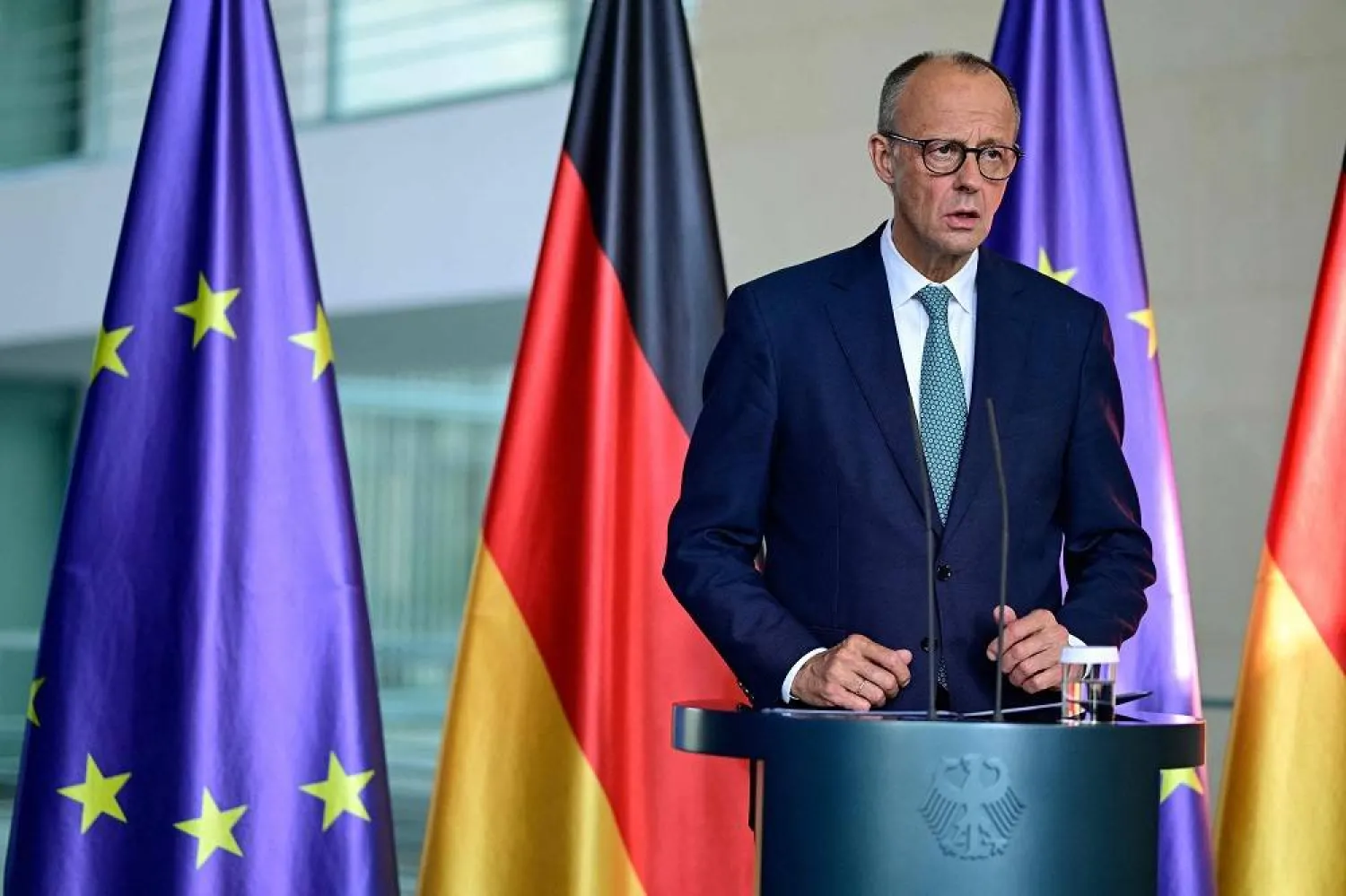
German Chancellor Friedrich Merz makes a statement to journalists following a meeting of the security Cabinet of the German government at the Chancellery in Berlin on July 28, 2025. (AFP)
TT

Germany Halts Arms Exports That Israel Can Use in Gaza

German Chancellor Friedrich Merz makes a statement to journalists following a meeting of the security Cabinet of the German government at the Chancellery in Berlin on July 28, 2025. (AFP)

Germany is to suspend exports of weaponry that could be used in the Gaza Strip because of Israel's plan to expand its operations there - the first time united Germany has acknowledged denying military support to its long-time ally. 

Chancellor Friedrich Merz's sudden about-turn on Friday followed mounting pressure from the public and his junior coalition partner over the manmade humanitarian crisis in Gaza, where Israel has severely restricted supplies of food and water. 

In a statement, Merz acknowledged Israel's right to disarm Hamas and seek the release of Israeli hostages, but said the Israeli decision "makes it increasingly difficult to see how these goals can be achieved". 

Germany is Israel's second biggest weapons supplier after the US, and has long been one of its staunchest supporters, principally because of historical guilt for the Nazi Holocaust - a policy known as the "Staatsraison". 

But an opinion poll in June indicated that 73% of Germans want tighter controls on arms exports, including 30% who favored a total ban. 

"This is the right decision. The humanitarian suffering in Gaza is unbearable," said vice chancellor and finance minister Lars Klingbeil of the Social Democrats, who govern alongside Merz's conservatives. 

Israel's Prime Minister Benjamin Netanyahu slammed the decision, saying the move would bolster Palestinian group Hamas.  

"Instead of supporting Israel's just war against Hamas, which carried out the most horrific attack against the Jewish people since the Holocaust, Germany is rewarding Hamas terrorism by embargoing arms to Israel," said a statement from Netanyahu's office, which added that the Israeli premier expressed his "disappointment" in a call with Merz. 

GERMANY'S REVERSAL A BLOW FOR ISRAEL 

"Politically and morally, this is certainly a hard blow for Netanyahu and his policies," said Meron Mendel, the director of the Anne Frank Education Center in Frankfurt. 

According to the Stockholm International Peace Research Institute, Germany provided 30% of Israel's major arms imports in 2019-2023, primarily naval equipment including Sa’ar 6-class frigates (MEKO A-100 Light Frigates), which have been used in the Gaza war. 

Merz said the release of hostages and ceasefire negotiations were Germany's top priorities, along with civilian suffering. He also urged the Israeli government not to take any further steps towards annexing parts of the West Bank. 

Far-right members of Netanyahu's coalition have been pushing for a total takeover of Gaza, though the military has warned this could jeopardize the lives of surviving hostages. 

Germany's parliament reported in June that export licenses for 485 million euros ($564 million) of military equipment for Israel had been granted between the day of the Hamas attack that triggered the Gaza war, October 7, 2023, and May 13, 2025. 

In the months after the Hamas attack, Germany increased its arms exports to Israel roughly tenfold. Human rights groups launched legal challenges, saying the weapons could be used in the Gaza war, but none has succeeded so far. 


NATO: Ukraine Still Receiving Arms Despite Mideast War

NATO Secretary General Mark Rutte via Reuters/File
TT

NATO: Ukraine Still Receiving Arms Despite Mideast War

NATO Secretary General Mark Rutte via Reuters/File

Ukraine is still getting essential defense equipment despite the war in the Middle East, which is depleting stockpiles in Europe and the United States, NATO Secretary General Mark Rutte said Thursday.

"The good news is that essential equipment into Ukraine continues to flow," he told reporters. That included American-made Patriot missile interceptors, which Ukraine desperately needs, he added, AFP reported.

The PURL program, launched last year, allows Ukraine to receive US equipment financed by European countries.

Some 75 percent of the missiles used by Patriot batteries in Ukraine have been supplied through the program, and 90 percent of the munitions used by other air-defense systems, Rutte added.

Rutte called on European countries to increase their own production capacity.

"They need to produce more extra production lines, extra shifts, opening new factories. The money is there," he said.


Germany FM Says 'Encouraging' if US Speaking Directly to Iran

German Foreign Minister Johann Wadephul. (Reuters: File Photo)
TT

Germany FM Says 'Encouraging' if US Speaking Directly to Iran

German Foreign Minister Johann Wadephul. (Reuters: File Photo)

Germany's foreign minister Thursday said it was encouraging if the United States was talking directly to Iran to end the war in the Middle East, but Washington should make its intentions clear.

"I hear that there are signs that the US is speaking directly to Iran. I think that this is encouraging and this is welcome," Johann Wadephul told reporters before heading into the meeting of G7 foreign ministers outside Paris, AFP reported.

With US Secretary of State Marco Rubio set to join the discussions from Friday, he added: "For the German government it is of great importance to know precisely what our American partners are intending."


US Envoy Witkoff Says Iran is Seeking an Off-ramp

US Special Envoy Steve Witkoff speaks during a cabinet meeting at the White House in Washington, DC, US, March 26, 2026. REUTERS/Evelyn Hockstein
TT

US Envoy Witkoff Says Iran is Seeking an Off-ramp

US Special Envoy Steve Witkoff speaks during a cabinet meeting at the White House in Washington, DC, US, March 26, 2026. REUTERS/Evelyn Hockstein

The United States has sent Iran a "15-point action list" as a basis for negotiations to end the current conflict, US Special Envoy Steve Witkoff said on Thursday, adding that there are signs that Tehran was interested in making a deal.


Witkoff, speaking during a cabinet meeting at the White House, said that the nascent talks could be successful if the Iranians realize there were no good alternatives - a realization Tehran might be coming to, he argued, Reuters reported.


"We will see where things lead, and if we can convince Iran that this is the inflection point with no good alternatives for them other than more death and destruction," Witkoff told reporters.


"We have strong signs that this is a possibility."


Witkoff said Pakistan had been acting as a mediator, confirming statements from Pakistani officials.
