


Detained Sailors Reveal Houthi Smuggling Routes from Iran to Yemen

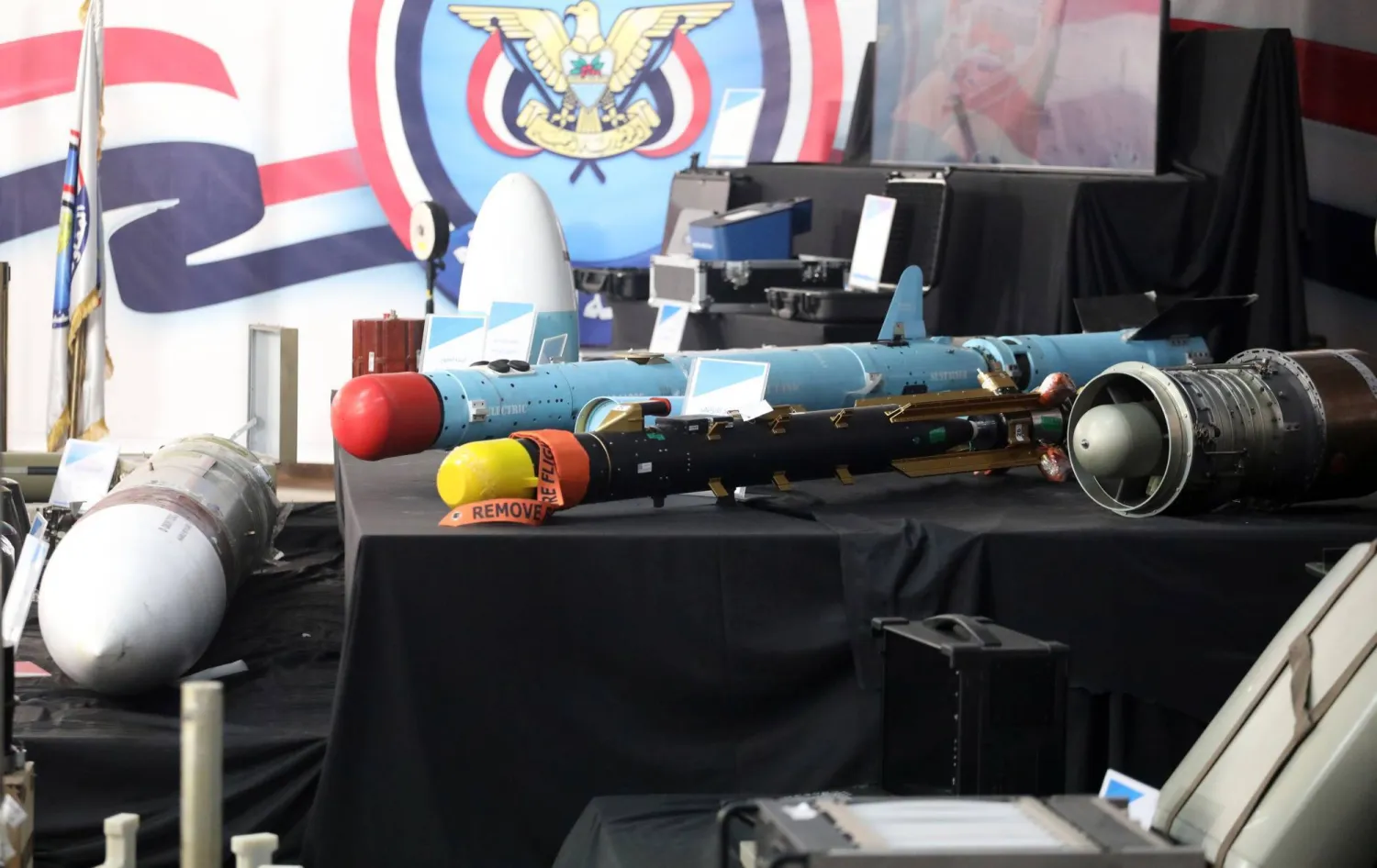
Smuggled rockets that were part of a shipment of Iranian weapons seized by Yemeni forces in the Red Sea. (EPA)
TT

Detained Sailors Reveal Houthi Smuggling Routes from Iran to Yemen

Smuggled rockets that were part of a shipment of Iranian weapons seized by Yemeni forces in the Red Sea. (EPA)

Confessions by detained sailors have revealed the smuggling routes used by the Houthi militants in Yemen to smuggle weapons from Iran.

Yemeni forces arrested in July seven people on board a ship they intercepted in the Red Sea. The sailors revealed the details of a significant smuggling network run by Iran’s Revolutionary Guards Corps (IRGC) that ran routes through Beirut, Damascus, Somalia and Djibouti to reach the Houthi-held ports of Hodeidah.

The confessions were aired by al-Joumhouriya television that is run by the Yemeni national resistance that is based on the western Yemeni coast.

Four sailors confessed to smuggling arms shipments from Iran’s Bandar Abbas port to Hodeidah. They have been identified as Amer Masawa, Ali Qassir, Issa Qassir and Abdullah Afifi.

Masawa revealed that a Houthi official in Hodeidah had tasked him back in 2023 to return a ship from Iran to Yemen. Masawa headed to Houthi-held Sanaa with others where they were granted passports. From there, they boarded a Yemenia Airways flight to the Jordanian capital Amman.

From there, they continued on to the Lebanese capital Beirut where a man in his 60s escorted them to an apartment that was ready to receive them. They remained there for three days before being transported by car to the Syrian capital Damascus and from there they flew to Tehran, Iran.

In Tehran, a man escorted the travelers to a Houthi camp run by leading Houthi member Mohammed al-Talebi. Yemeni authorities identify him as a Houthi representative of the smuggling network from Iran.

After ten days in Tehran, they were flown to Bandar Abbas city where they stayed in a villa owned by Talebi who explained to them their mission. Soon after, they were joined by ten Somali sailors.

Oman route

The second sailor, Ali Qassir, recalled how he was recruited by people affiliated with a Houthi official at Hodeidah’s al-Salif port, Hussein al-Attas, to bring a ship from Iran to Yemen.

Ali Qassir and others were taken to the Jowf province east of Sanaa where they met with another smuggler who escorted them along a desert route through Jawf, Marib and Hadramawt to the al-Mahra province bordering Oman.

At the Sarfait border crossing, a smuggler escorted them to Oman where another person took them to Salalah city. Three days later, they were transported to Muscat where they were flown to Bandar Abbas.

They were taken to a camp run by the Houthis and where they joined their fellow sailors, as well as the ten Somalis. Talebi then set about explaining their missions.

Issa Qassir, Ali’s brother, said they were divided into two groups to sail with the illegal cargo back to Yemen. They were informed that they were transporting children’s toys, power generators and boxes of cancer treatment, which they were instructed must remain refrigerated.

As they sailed off the Omani coast, their vessel broke down. They contacted Omani authorities that transported them to Muscat, where they stayed for ten days until the ship was repaired, after which they headed to Yemen.

A third sailor said the people on the ship were unaware of the true nature of the cargo they were carrying, assuming it was battering and construction equipment. The coastguard eventually stopped their vessel and boarded it to discover the illegal shipment that included rockets and other weapons.

Further confessions revealed that the IRGC used three smuggling routes from Iran. The first was a direct route from Bandar Abbas to al-Salif, the second ran through Somalia and the third through Djibouti to al-Salif.

The sailors revealed that international patrols in the Gulf of Aden and Red Sea never intercepted their vessels. While sailing at night, they would cross the Bab al-Mandeb Strait and sail west of the international shipping route to avoid detection by Yemen’s coastguard and national resistance.



In a First, Armed Gang in Gaza Forces Displacement of Residents

 A Palestinian woman receives donated food at a community kitchen in Deir al-Balah, central Gaza Strip, Thursday, Dec. 25, 2025. (AP)
A Palestinian woman receives donated food at a community kitchen in Deir al-Balah, central Gaza Strip, Thursday, Dec. 25, 2025. (AP)
TT

In a First, Armed Gang in Gaza Forces Displacement of Residents

 A Palestinian woman receives donated food at a community kitchen in Deir al-Balah, central Gaza Strip, Thursday, Dec. 25, 2025. (AP)
A Palestinian woman receives donated food at a community kitchen in Deir al-Balah, central Gaza Strip, Thursday, Dec. 25, 2025. (AP)

In an unprecedented development, an armed gang active in Gaza City forced inhabitants of residential bloc to evacuate their homes under threat of arms.

Field sources told Asharq Al-Awsat that identified the gang as the “Rami Halas Group”. At dawn on Thursday, its members opened fire in the air in the Hayy al-Tuffah neighborhood in eastern Gaza City. The area is located near Israel’s so-called yellow line that separates Hamas- and Israel-held parts of Gaza.

The gang members came back hours later at noon and demanded that the residents evacuate, giving them until sunset to comply and threatening to shoot anyone who doesn’t.

The sources said the gunmen did not directly approach any of the residents for fear of being attacked. They used loudspeakers to demand that they evacuate to areas a few hundred meters away, claiming these were Israeli orders.

Israeli forces are deployed some 150 meters from the area where the residents were located.

The residents, who had only just returned to their homes after the ceasefire, indeed started to evacuate towards western parts of Gaza City.

The sources said over 240 residents were forced to quit what remains of their damaged homes.

They revealed that Israeli forces had on Tuesday and Wednesday night dropped yellow barrels, devoid of explosives, in those regions. They did not ask residents to evacuate.

The sources said the gang made the evacuation order ahead of Israel’s plan to occupy the area, which had been previously declared as safe.

They accused Israeli forces of resorting to such tactics in recent weeks to further expand the yellow line border and occupy more areas in Gaza.


Syria Says Kills Senior ISIS Leader, Arrests Operative Near Damascus

A photo of a Public Security operation in Aleppo against an ISIS cell (File – Facebook)
TT

Syria Says Kills Senior ISIS Leader, Arrests Operative Near Damascus

A photo of a Public Security operation in Aleppo against an ISIS cell (File – Facebook)

Syrian authorities on Thursday said forces killed a senior leader in the ISIS group and arrested another operative in fresh operations near capital Damascus in coordination with the US-led coalition.

Syrian security and intelligence forces, working in coordination with the international coalition, conducted what the interior ministry described as a "precise security operation" in the Damascus countryside, AFP reported.

"The operation resulted in neutralising the terrorist Mohammad Shahada, known as 'Abu Omar Shaddad', who is considered one of the prominent ISIS leaders in Syria," it added.

"This operation comes as confirmation of the effectiveness of joint coordination between the national security agencies and international partners."

Later Thursday, the interior ministry said security forces "in joint coordination with international coalition forces" arrested "the leader of a terrorist cell affiliated with the ISIS organization" elsewhere near Damascus, seizing weapons and ammunition.

Late Wednesday, authorities said they captured Taha al-Zoubi, also known as Abu Omar Tabiya, an ISIS leader in the Damascus region, along with several of his men, also in a joint operation with the US-led coalition.

The interior ministry also said on Thursday that security forces had arrested three members of an ISIS-affiliated cell in Aleppo province.

A December 13 attack killed two US soldiers and an American civilian. Washington blamed the attack on a lone ISIS gunman in Syria's Palmyra.

In retaliation, US forces conducted strikes targeting scores of ISIS targets in Syria.

The strikes killed five members of the militant group, according to the Syrian Observatory for Human Rights.

In November, during a visit by interim President Ahmed al-Sharaa to Washington, Syria officially joined the US-led coalition against ISIS.


Israeli Settler Attack Injures Palestinian Baby, Five Arrested

Israeli settlers attacked farmers and volunteers harvesting olives on a Palestinian farm in Burin, near Nablus, on November 8, 2025. © Observers
TT

Israeli Settler Attack Injures Palestinian Baby, Five Arrested

Israeli settlers attacked farmers and volunteers harvesting olives on a Palestinian farm in Burin, near Nablus, on November 8, 2025. © Observers

Israeli security forces announced on Thursday the arrest of five Israeli settlers over their alleged involvement in an attack on a Palestinian home that injured a baby girl in the occupied West Bank.

The eight-month-old infant suffered "moderate injuries to the face and head" in the late Wednesday attack, according to the official Palestinian news agency Wafa.

It blamed the attack on "a group of armed settlers", accusing them of "throwing stones at homes and property" in the town of Sair, north of Hebron, AFP reported.

A statement from the Israeli police said that five suspects had been arrested for their "alleged involvement in serious, violent incidents in the village of Sair".

Israeli security forces had received reports of "stones being thrown by Israeli civilians toward a Palestinian home", adding a Palestinian girl was injured.

"The preliminary investigation determined the involvement of several suspects who came from a nearby outpost," the statement said, referring to Israeli settlements not officially recognized by Israeli authorities.

All Israeli settlements in the West Bank are considered illegal by the international community.

Some are also illegal under Israeli law, though many of those are later given official recognition.

Almost none of the perpetrators of previous attacks by settlers have been held to account by the Israeli authorities.

A Telegram group linked to the "Hilltop Youth", a movement of hardline settlers who advocate direct action against Palestinians, posted a video showing property damage in Sair.

More than 500,000 Israelis currently live in settlements in the West Bank, occupied since 1967, as do around three million Palestinians.

Violence involving settlers has risen in recent years, according to the United Nations, and October was the worst month since it began recording such incidents in 2006, with 264 attacks that caused casualties or property damage.

The violence in the West Bank, a territory occupied by Israel since 1967, has surged since Hamas' October 7, 2023 attack, which triggered the Gaza war.

Since the start of the war, Israeli troops and settlers have killed more than 1,000 Palestinians in the West Bank, including many militants as well as dozens of civilians, according to an AFP tally based on figures from the Palestinian health ministry.

According to official Israeli figures, at least 44 Israelis, both soldiers and civilians, have been killed in Palestinian attacks or Israeli military operations in the same period.