


Head of Iran Top Security Body Heads to Iraq, Lebanon

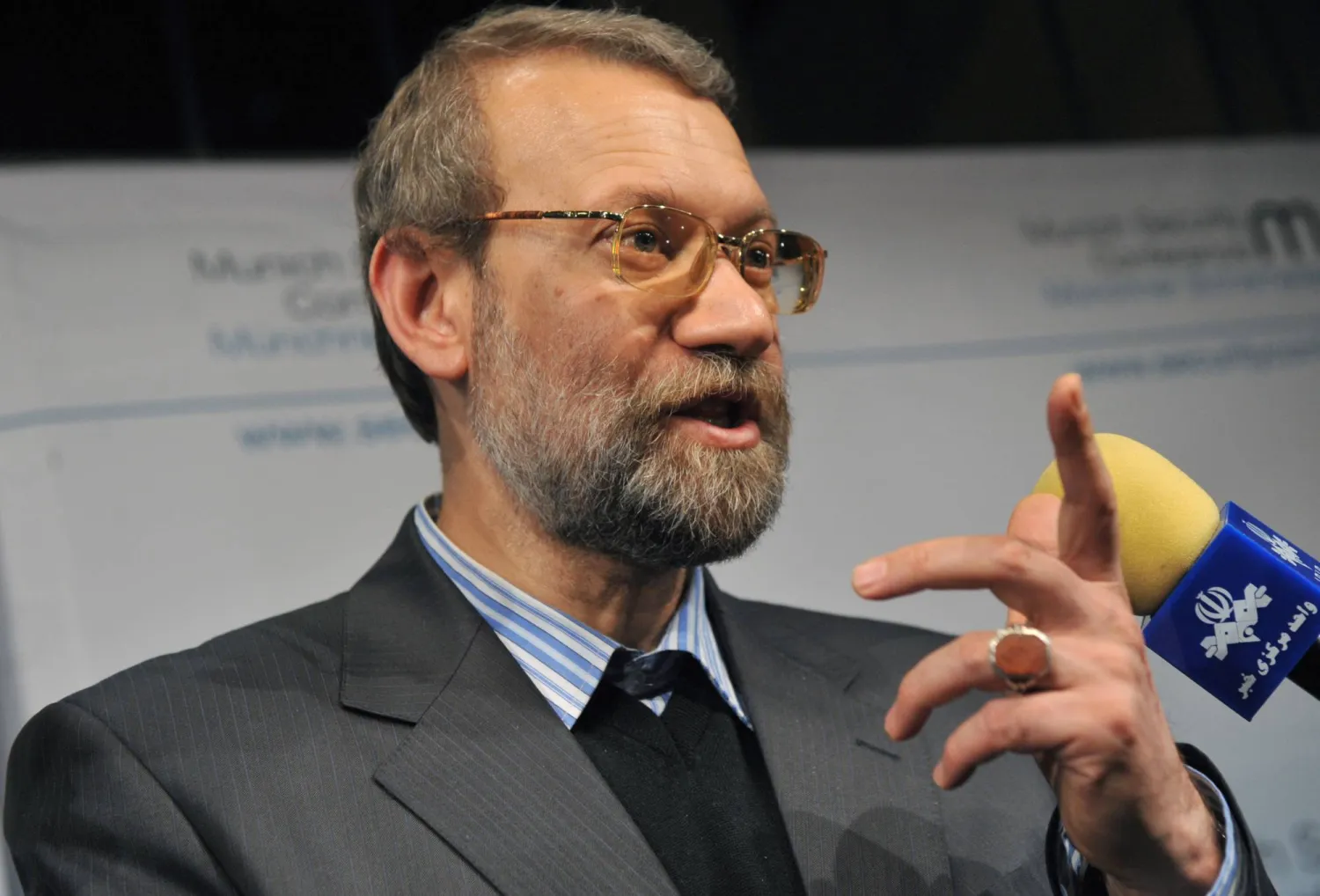
FILED - 06 February 2009, Bavaria, Munich: Ali Larijani, then chairman of the Iranian parliament, speaks at the 45th Munich Security Conference in Munich. Photo: Andreas Gebert/dpa
TT

Head of Iran Top Security Body Heads to Iraq, Lebanon

FILED - 06 February 2009, Bavaria, Munich: Ali Larijani, then chairman of the Iranian parliament, speaks at the 45th Munich Security Conference in Munich. Photo: Andreas Gebert/dpa

The head of Iran's top security body, Ali Larijani, will visit Iraq on Monday before heading to Lebanon, where the government has approved a plan to disarm Tehran's ally Hezbollah, state media said.

"Ali Larijani departs today (Monday) for Iraq and then Lebanon on a three-day visit, his first foreign trip since taking office last week," state television reported.

Larijani will sign a bilateral security agreement in Iraq before heading to Lebanon, where he will meet senior Lebanese officials and figures, AFP said.

His trip to Lebanon comes after Tehran expressed strong opposition to a Lebanese government plan to disarm Hezbollah, a stance condemned by Beirut as a "flagrant and unacceptable interference".

"Our cooperation with the Lebanese government is long and deep. We consult on various regional issues. In this particular context, we are talking to Lebanese officials and influential figures in Lebanon," Larijani told state TV before departing.

"In Lebanon, our positions are already clear. Lebanese national unity is important and must be preserved in all circumstances. Lebanon's independence is still important to us and we will contribute to it."

On Monday, Iran's foreign ministry spokesman Esmaeil Baqaei said Larijani's trip "aims to contribute to the maintenance of peace in the Middle East region".

He said that Iran recognized Lebanon's "right to defend itself against the aggression of the Zionist regime (Israel)," adding that this would be "impossible without military capabilities and weapons".

On Saturday, Ali Akbar Velayati, a senior advisor to Iran's supreme leader, described the plan to disarm Hezbollah as compliance "to the will of the United States and Israel".

The disarmament push followed last year's war between Israel and Hezbollah, which left the group, once a powerful political and military force, weakened.



Yemen Consultation, Reconciliation Body Says National Shield Camp Takeover is Peaceful

Yemen Consultation, Reconciliation Body Says National Shield Camp Takeover is Peaceful
TT

Yemen Consultation, Reconciliation Body Says National Shield Camp Takeover is Peaceful

Yemen Consultation, Reconciliation Body Says National Shield Camp Takeover is Peaceful

Akram al-Amri, deputy head of Yemen’s Consultation and Reconciliation Commission, stated that the operation to take over military camps, led by the National Shield forces under the command of Salem al-Khanbashi, Governor of Hadhramaut and head of the security committee, is not a military offensive operation.

Al-Amri said the move is peaceful in nature and aims to take over “military and security sites occupied by forces of the Southern Transitional Council (STC) that came from outside Hadhramaut.”

He said that all directives had been issued and all possible means had been exhausted to have the sites vacated voluntarily, in response to the demands of the people of the governorate.

Al-Amri, who also serves as secretary general of the Hadhramaut Inclusive Conference, called on the people of the governorate to stand by the National Shield forces and welcome them.

He also urged the STC leadership in Hadhramaut to opt for peace and preserve their land, saying, “There is no cause for concern. We are brothers, united by Hadhramaut.”

“Hadhramaut has launched a new political, economic, and development phase with comprehensive support from our brothers in the Kingdom of Saudi Arabia, which will be announced soon,” he revealed.

Separately, the Hadhramaut Inclusive Conference welcomed the announcement by al-Khanbashi, launching the “camp takeover” operation, describing it as a responsible step aimed at assuming control of military sites in a peaceful and orderly manner that strengthens state authority and preserves Hadhramaut’s security and stability.

In a statement, the conference stressed that the operation does not target any specific political or social group, does not impact civilians or citizens’ interests, and does not constitute an escalation or a declaration of war.

It stated that the move is a preventive measure to protect Hadhramaut from chaos and to prevent the use of military camps from threatening its security.

The conference commended the efforts of the legitimate state authorities, with the support of Saudi Arabia, to establish channels of dialogue and understanding, emphasizing that political solutions remain the most effective way to address disputes.

It added that obstructing these efforts compels the state to assume its constitutional responsibilities to protect citizens and prevent a slide into chaos.

The Hadhramaut Inclusive Conference reaffirmed its support for all prudent efforts that safeguard social peace and protect state institutions, and commended the Hadhramaut governor’s call on various social forces to play their national role during this sensitive phase.


UN Force in Lebanon Says Israeli Army Fired Near its Peacekeepers Twice

Joint patrol of the Lebanese army and UNIFIL (UNIFIL via Telegram)
TT

UN Force in Lebanon Says Israeli Army Fired Near its Peacekeepers Twice

Joint patrol of the Lebanese army and UNIFIL (UNIFIL via Telegram)

The United Nations Interim Force in Lebanon (UNIFIL) said gunfire from an Israeli position hit close to its peacekeepers twice on Friday, reporting no casualties but decrying a “concerning trend.”

UNIFIL has repeatedly reported Israeli fire near or towards its personnel in recent months, and last week said an Israeli attack near one of its positions lightly wounded a peacekeeper.

Personnel patrolling in south Lebanon on Friday “reported 15 rounds of small arms fire that struck no more than 50 meters away from them,” a UNIFIL statement said, according to AFP.

Shortly afterwards, “peacekeepers in a second patrol in the same area reported approximately 100 rounds of machine-gun fire struck approximately 50 meters from them,” it added, reporting no damage or injuries.

“Peacekeepers assessed that the fire came from an Israel army position south of the Blue Line in both cases,” the statement said, referring to the de facto border, and “sent a ‘stop fire’ request through its liaison channels.”

It said UNIFIL had informed the Israeli army about the peacekeepers’ activities in advance.

“Incidents like these are happening on a too-regular basis, and becoming a concerning trend,” the statement said.

“We reiterate our call to the Israeli army to cease aggressive behavior and attacks on or near peacekeepers working for peace and stability along the Blue Line.”

UNIFIL has acted as a buffer between Israel and Lebanon for decades, and recently has been working with Lebanon’s army to support a year-old ceasefire between Israel and Hezbollah.

The force on Friday noted that “attacks on or near peacekeepers are serious violations” of a 2006 UN Security Council resolution that formed the basis of the current ceasefire.

Under the November 2024 truce, Israel was to withdraw its forces from south Lebanon, but it has kept them at five areas it deems strategic and carries out regular strikes on Lebanon, usually saying it is targeting Hezbollah sites and operatives.

Under heavy US pressure and fears of expanded Israeli strikes, Lebanon has committed to disarming Hezbollah, starting in the south near the frontier.

Last August, the UN Security Council voted for the peacekeepers to leave Lebanon in 2027.


Bin Habrish: Hadhramaut Situation Settled, No Room for Revenge

Sheikh bin Habrish urges a new page for all, rules out revenge (Hadhramaut Tribes Alliance)
TT

Bin Habrish: Hadhramaut Situation Settled, No Room for Revenge

Sheikh bin Habrish urges a new page for all, rules out revenge (Hadhramaut Tribes Alliance)

Sheikh Amr bin Habrish al-Alili, head of the Hadhramaut Tribes Alliance in Yemen, urged all Hadhramis, including members of the Elite Forces and Public Security personnel, to stand their ground, stating that the current phase was settled and that there was no room for revenge.

Speaking during a visit on Friday to a military camp in the Hadhramaut Plateau, Bin Habrish called on everyone to remain vigilant and fully prepared to protect and secure Hadhramaut.

He urged all Hadhramis, including officers and rank-and-file members of the Elite Forces and Public Security, to prevent any security vacuum from emerging.

He also called for closing any gaps that hostile parties could exploit to spread chaos and looting, stressing that Hadhramaut must not be allowed to become an open arena for terrorism and sabotage.

“We are all Hadhramis and brothers, and Hadhramaut has room for everyone,” the Hadhrami leader said. “The phase is settled, we welcome all Hadhramis, and there is no room for revenge. It is not in our nature to harbor grudges.”

He called for opening a new page with all Hadhramis, saying, “May God forgive what has passed for anyone who caused offense or harm to the Hadhramaut project adopted by the Hadhramaut Tribes Alliance.”

“We excuse them on the condition that they change their behavior and join their people in defending their land, except for military and civilian leaders who betrayed the principles of their responsibilities and betrayed the nation. Their accountability rests with the state in accordance with the system and the law,” he added.

Bin Habrish said the gains achieved in Hadhramaut had come by divine grace and through the steadfast positions of loyal and sincere Hadhrami men on the ground.

He also credited the support of the Chairman of the Presidential Leadership Council, Dr. Rashad al-Alimi, and Hadhramaut Governor Salem al-Khanbashi, as well as what he described as the sincere brotherly role of Saudi Arabia’s leadership, represented by Custodian of the Two Holy Mosques King Salman bin Abdulaziz, Crown Prince Mohammed bin Salman, Defense Minister Prince Khalid bin Salman, Maj. Gen. Dr. Mohammed Ubaid al-Qahtani, and the leadership of the Joint Forces.

He extended his thanks and appreciation to them on behalf of the people of Hadhramaut, saying their support would not be forgotten and that Hadhramaut would return loyalty with loyalty.