

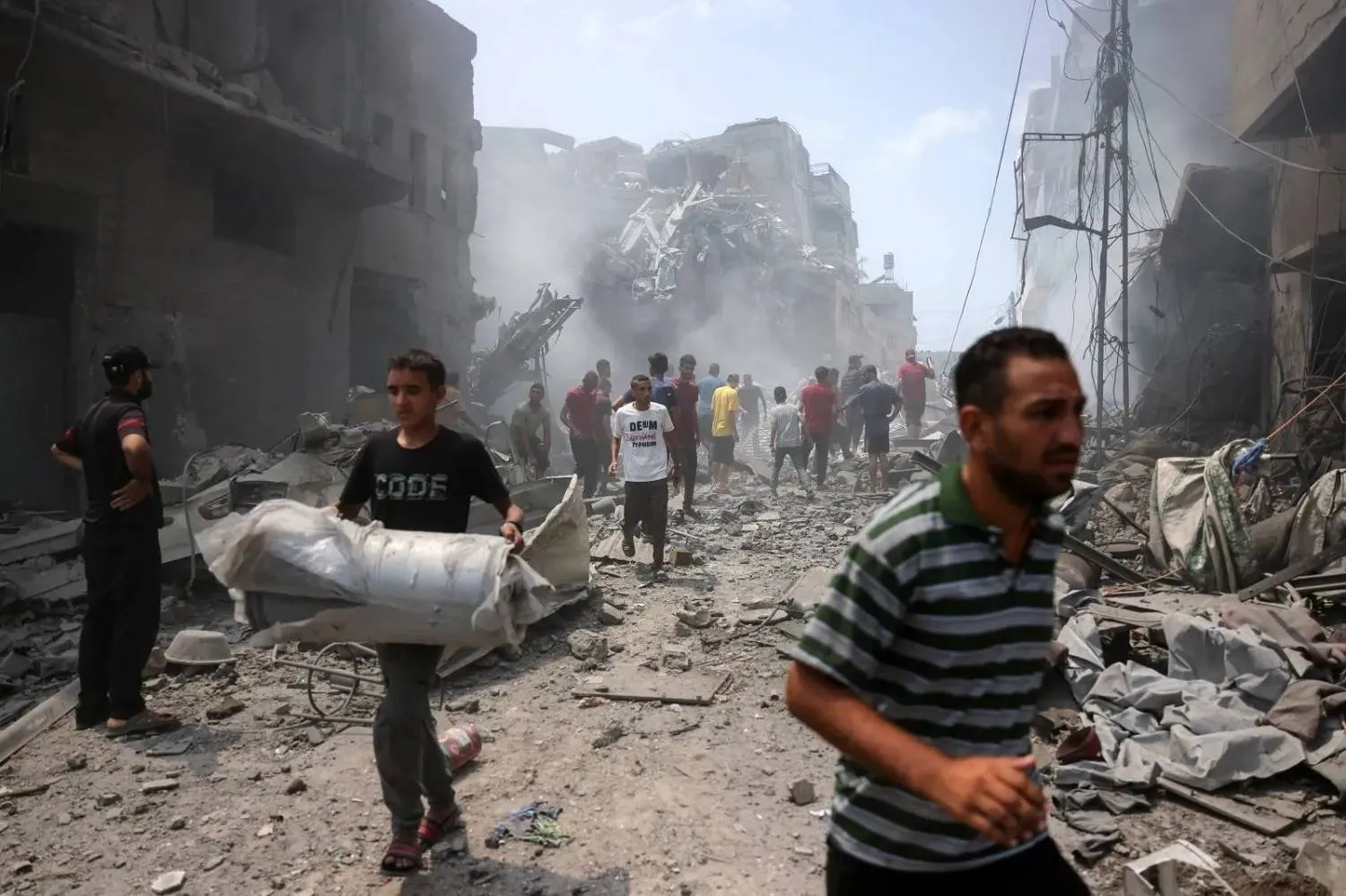

‘Greater Israel’ Remark Sparks Arab Anger

Palestinians survey damage from Israeli strike on Gaza’s Zeitoun district (AFP)
TT

‘Greater Israel’ Remark Sparks Arab Anger

Palestinians survey damage from Israeli strike on Gaza’s Zeitoun district (AFP)

Israeli Prime Minister Benjamin Netanyahu’s reference to being on a “historic and spiritual mission” tied to the vision of a “Greater Israel” has drawn anger across the Arab world and sparked sharp criticism on social media, with analysts saying it was aimed at rallying his domestic base.

Speaking to Israeli broadcaster i24, Netanyahu described the “Israeli dream” as a “mission of generations” passed down over time. “I feel I am on a spiritual and historic mission for the Jewish people,” he said, according to The Times of Israel.

During the interview, former right-wing lawmaker Sharon Gal presented Netanyahu with an amulet engraved with a map of “Greater Israel.” Joking about Netanyahu’s ongoing corruption trial, Gal said: “I’m not giving it to you, so you won’t get in trouble. It’s a gift for your wife, Sara.”

When asked whether he felt a connection with the “Greater Israel” vision, Netanyahu replied: “Very much.” The gift was not shown on screen, according to a clip Netanyahu posted on X.

The term “Greater Israel” has been used since Israel’s victory in the 1967 Six-Day War to describe Israel along with East Jerusalem, the West Bank, Gaza, Egypt’s Sinai Peninsula and Syria’s Golan Heights.

Asharq Al-Awsat sought official comment from Egypt but received no response.

Social media users warned of Israel’s expansionist ambitions, while Palestinian politician Mustafa Barghouti questioned Arab governments’ silence.

Egyptian media figure Nashaat al-Daihi called Netanyahu’s remarks “political suicide,” while Egyptian security expert Maj. Gen. Mohamed Abdel Wahed described them as “the boldest ever,” reflecting “a strategic ambition to reshape the Middle East and expand Israeli influence.”

The comments also stirred anger because of claims on social media that Egypt and Jordan were named as part of “Greater Israel” – although Netanyahu did not mention any countries in the interview.

Egyptian commentator Louay al-Khatib said Netanyahu’s extremism was “beyond dispute” but denied the prime minister had explicitly included Egypt.

Egyptian MP Mostafa Bakry called the remarks “dangerous” and a revelation of Israel’s “real plan to target the whole region.” Former Egyptian deputy foreign minister Rakha Ahmed Hassan said the statement was “serious and demands a serious response,” accusing Netanyahu of seeking to redraw the Middle East map “under an American umbrella.”

Netanyahu has previously signaled ambitions to reshape the region. At the UN General Assembly in September 2023, he held up a Middle East map that omitted the West Bank and Gaza. He repeated the gesture last year, calling one map “paradise” and the other “hell.”

Jordanian analyst Abdel Hakim al-Qarala said Netanyahu’s latest comments reflect “the true face of the Israeli far right” and are intended to appeal to those who believe in the “Greater Israel” dream. Egyptian strategist Khaled Okasha said Netanyahu aimed to frame the Gaza war as part of Israel’s founding mission, strengthening his standing both at home and with the United States.

The Arab League’s statement on Netanyahu’s comments called them a “blatant violation of the sovereignty of Arab states and an attempt to undermine security and stability in the region.”

The remarks, it added, “reflect expansionist and aggressive intentions that cannot be accepted or tolerated” and also “expose a mentality steeped in colonial delusions.”



UN Force in Lebanon Says Peacekeepers Fired Upon ‘Likely by Non-State Armed Groups’

United Nations peacekeepers with the UN Interim Force in Lebanon (UNIFIL) drive past a destroyed healthcare center building in the aftermath of an Israeli strike in the southern Lebanese town of Burj Qalawiya on March 14, 2026. (AFP)
TT

UN Force in Lebanon Says Peacekeepers Fired Upon ‘Likely by Non-State Armed Groups’

United Nations peacekeepers with the UN Interim Force in Lebanon (UNIFIL) drive past a destroyed healthcare center building in the aftermath of an Israeli strike in the southern Lebanese town of Burj Qalawiya on March 14, 2026. (AFP)

The United Nations Interim Force in Lebanon said its peacekeepers were fired upon three times on Sunday, "likely by non-state armed groups" in the country's south.

The incident came two days after a different UN position was hit by fire that official Lebanese media blamed on Israel, with UNIFIL saying it was investigating.

"Today, UNIFIL peacekeepers were fired upon, likely by non-state armed groups, on three separate occasions while conducting patrols around their bases" in south Lebanon, the force said in a statement.

In one of the locations, the fire struck "as close as five meters from the peacekeepers", it added.

"Two patrols returned fire in self-defense and after brief exchanges, the patrols resumed their planned activities. No peacekeeper was injured," the statement said.

"We strongly remind all actors of their obligations under international law to ensure the safety and security of UN personnel at all times."

Lebanon was drawn into the broader Middle East war on March 2, when the Tehran-backed group Hezbollah attacked Israel in retaliation for the killing of Iranian supreme leader Ali Khamenei in US-Israeli strikes.

Israel has since launched waves of air strikes on its northern neighbor and deployed troop into border areas, while Hezbollah has launched rockets and missiles towards Israeli territory and troops.

Lebanese state media said that Israeli fire hit a UNIFIL base in southern Lebanon on Friday.

UNIFIL spokesperson Kandice Ardiel said the position was hit "likely by heavy machine gun fire", without identifying the source, and said an investigation had been launched into the incident, which left one peacekeeper lightly wounded.

Earlier this month, three peacekeepers serving with a Ghanaian contingent were wounded in south Lebanon, with Lebanese President Joseph Aoun accusing Israel of being responsible and UNIFIL saying it would investigate.

On Saturday, during a visit to Beirut, UN chief Antonio Guterres said attacks against peacekeepers and their positions were "completely unacceptable and... may constitute war crimes".

UNIFIL has acted as a buffer between Israel and Lebanon since 1978. Its mission concludes at the end of this year.


WHO Releases $2 Million in Emergency Funds to Lebanon, Iraq and Syria

 A child poses for a photo, at a school hosting displaced people, following an escalation between Hezbollah and Israel, amid the US-Israeli conflict with Iran, in Lebaa, Lebanon, March 15, 2026. (Reuters)
A child poses for a photo, at a school hosting displaced people, following an escalation between Hezbollah and Israel, amid the US-Israeli conflict with Iran, in Lebaa, Lebanon, March 15, 2026. (Reuters)
TT

WHO Releases $2 Million in Emergency Funds to Lebanon, Iraq and Syria

 A child poses for a photo, at a school hosting displaced people, following an escalation between Hezbollah and Israel, amid the US-Israeli conflict with Iran, in Lebaa, Lebanon, March 15, 2026. (Reuters)
A child poses for a photo, at a school hosting displaced people, following an escalation between Hezbollah and Israel, amid the US-Israeli conflict with Iran, in Lebaa, Lebanon, March 15, 2026. (Reuters)

The World ‌Health Organization said on Sunday it had released $2 million from its Contingency Fund for Emergencies (CFE) to support the health response in Lebanon, Iraq and Syria amidst the ongoing crisis in the Middle East.

The conflict has triggered a large-scale population movement, the WHO ‌said last week, ‌estimating that more ‌than 100,000 ⁠people in Iran ⁠have relocated, and up to 700,000 people in Lebanon have been internally displaced.

$1 million has been allocated to Lebanon to strengthen the WHO's emergency coordination ⁠through the Public Health Emergency Operations ‌Center, scale ‌up trauma care, reinforce disease surveillance, ‌and procure and distribute essential ‌medicines and medical supplies, the agency said in a statement.

Iraq and Syria have each been allocated $500,000 to support emergency ‌coordination and mass-casualty management, procure and distribute essential medicines ⁠and ⁠supplies, provide health services for displaced populations, and strengthen disease surveillance and community outreach, it added.

"At a time when health services are already facing significant challenges, support is essential to sustain frontline health workers and maintain critical care services," Hanan Balkhy, WHO Regional Director for the Eastern Mediterranean said.


In Heavy Rain, Lebanese Fleeing War Huddle Under Makeshift Shelters

 A man secures a tent at sunset at a public space where people displaced by Israeli airstrikes have set up tents along the Beirut waterfront in Beirut, Lebanon, Sunday, March 15, 2026. (AP)
A man secures a tent at sunset at a public space where people displaced by Israeli airstrikes have set up tents along the Beirut waterfront in Beirut, Lebanon, Sunday, March 15, 2026. (AP)
TT

In Heavy Rain, Lebanese Fleeing War Huddle Under Makeshift Shelters

 A man secures a tent at sunset at a public space where people displaced by Israeli airstrikes have set up tents along the Beirut waterfront in Beirut, Lebanon, Sunday, March 15, 2026. (AP)
A man secures a tent at sunset at a public space where people displaced by Israeli airstrikes have set up tents along the Beirut waterfront in Beirut, Lebanon, Sunday, March 15, 2026. (AP)

Hussein Murtada and his ‌family are camping in the back of a small truck, a flimsy tarpaulin shielding them from a storm on Sunday, with no room left at shelters for displaced people in the southern Lebanese city of Sidon.

"We are putting tarp over it because we're soaked," said Murtada, using string to fasten the plastic sheet over the back of the truck parked on the seafront. Inside, an infant peered out, surrounded by pillows, blankets and other possessions.

"I asked here at the schools and they are full, they're all full," said Murtada, who fled the town of Hanawiya, some 12 km (8 miles) ‌from the ‌border with Israel, with his family of seven.

"What ‌should ⁠I ask for? ⁠I just want a shelter for me and the children," Murtada added.

More than 800,000 people, around 15% of Lebanon's population, have had to flee their homes since Israel began an offensive in the country after the Lebanese Hezbollah group opened fire at Israel in support of its ally Iran on March 2.

It has dragged Lebanon into the Middle East conflict just 15 months ⁠since the last Israel-Hezbollah war.

Only a fraction of ‌the displaced - some 132,000 according to Lebanese ‌authorities - are in collective shelters. The rest are scattered elsewhere, some with relatives, others ‌in half-finished buildings or host communities and many in the streets.

Mohammad Marie, ‌who fled the city of Nabatieh in southern Lebanon, has been sheltering under a tree on Beirut's seafront Corniche, protected by a plastic sheet before it was blown away.

"It might keep raining for a week, so where will I go? ‌I will stay here, what else can I do? I have no shelter except here, under this tree," ⁠Marie said, his ⁠clothes soaked through.

"I don't have a tent, I don't have anything, and my financial situation is very difficult. I have no money to rent a house," he said.

The United Nations launched a $308 million flash appeal on Friday to help Lebanon cope with the fallout of the war.

Israeli attacks have killed 850 people and wounded more than 2,100 others in Lebanon since March 2, including 107 children and 66 women, the Lebanese health ministry said on Sunday. Its toll does not say how many of the casualties were combatants.

Two Israeli soldiers have been killed in southern Lebanon, while no fatalities have been reported in Israel as a result of Hezbollah rocket and drone attacks since March 2.