


Diplomacy or Defiance: Iran’s Rulers Face Existential Choice After US-Israeli Strikes

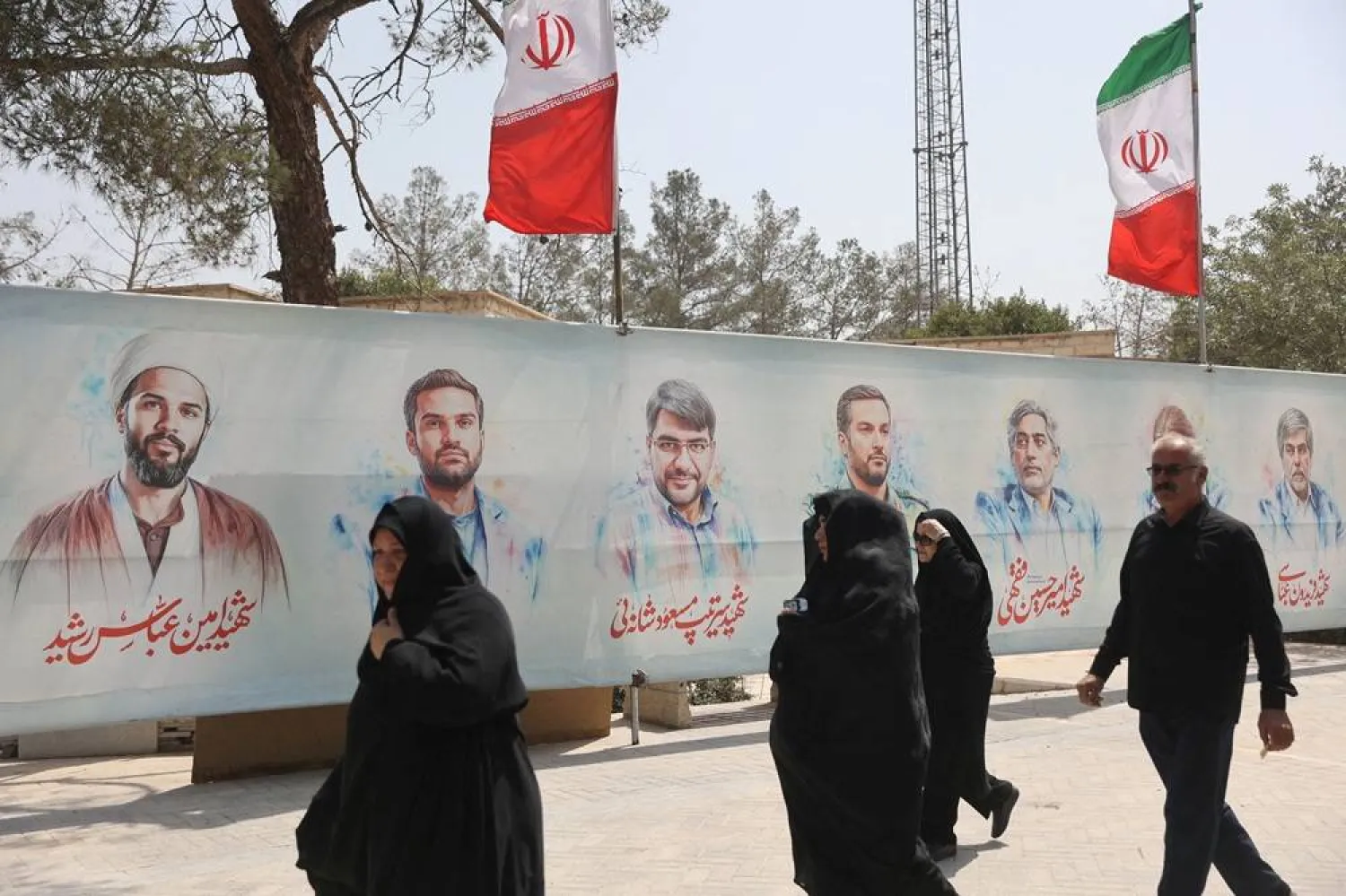
Pictures of Iranian military commanders, nuclear scientists and others killed in Israeli strikes are displayed in Behesht Zahra Cemetery in southern Tehran, Iran, July 11, 2025. Majid Asgaripour/WANA (West Asia News Agency) via Reuters
TT

Diplomacy or Defiance: Iran’s Rulers Face Existential Choice After US-Israeli Strikes

Pictures of Iranian military commanders, nuclear scientists and others killed in Israeli strikes are displayed in Behesht Zahra Cemetery in southern Tehran, Iran, July 11, 2025. Majid Asgaripour/WANA (West Asia News Agency) via Reuters

Weakened by war and diplomatic deadlock, Iran’s clerical elite stands at a crossroads: defy pressure to halt its nuclear activity and risk further Israeli and US attack, or concede and risk a leadership fracture.

For now, the republic establishment is focusing on immediate survival over longer-term political strategy. A fragile ceasefire ended a 12-day war in June that began with Israeli air strikes, followed by US strikes on three Iranian nuclear installations.

Both sides declared victory but the war exposed the military vulnerabilities and punctured the image of deterrence maintained by a major Middle East power and Israel's arch regional foe. Three Iranian insiders told Reuters the political establishment now views negotiations with the US - aimed at resolving a decades-long dispute over its nuclear ambitions - as the only way to avoid further escalation and existential peril.

The strikes on Iranian nuclear and military targets, which included killings of top Revolutionary Guard commanders and nuclear scientists, shocked Tehran, kicking off just a day before a planned sixth round of talks with Washington.

While Tehran accused Washington of "betraying diplomacy", some hardline lawmakers and military commanders blamed officials who advocated diplomacy with Washington, arguing the dialogue proved a "strategic trap" that distracted the armed forces.

However, one political insider, who like others requested anonymity given the sensitivity of the matter, said the leadership now leaned towards talks as "they’ve seen the cost of military confrontation".

President Masoud Pezeshkian said on Sunday that resuming talks with the United States "does not mean we intend to surrender", addressing hardliners opposing further nuclear diplomacy after the war. He added: "You don’t want to talk? What do you want to do? ... Do you want to go (back) to war?"

His remarks were criticized by hardliners including Revolutionary Guards commander Aziz Ghazanfari, who warned that foreign policy demands discretion and that careless statements could have serious consequences.

Ultimately, Supreme Leader Ali Khamenei holds the final say. Insiders said he and the clerical power structure had reached a consensus to resume nuclear negotiations, viewing them as vital to the republic’s survival.

Iran's Foreign Ministry said no decision has been made on the resumption of nuclear talks.

DYNAMICS AND EXTERNAL PRESSURE

US President Donald Trump and Israeli Prime Minister Benjamin Netanyahu have warned they will not hesitate to hit Iran again if it resumes enrichment of uranium, a possible pathway to developing nuclear weapons.

Last week, Trump warned that if Iran restarted enrichment despite the June strikes on its key production plants, "we’ll be back". Tehran responded with a vow of forceful retaliation.

Still, Tehran fears future strikes could cripple political and military coordination, and so has formed a defense council to ensure command continuity even if the 86-year-old Khamenei must relocate to a remote hideaway to avoid assassination.

Alex Vatanka, director of the Iran Program at the Middle East Institute in Washington DC, said that if Iran seeks to rapidly rebuild its nuclear capacity without securing diplomatic or security guarantees, "a US–Israeli strike won't just be possible - it will be all but inevitable".

"Re-entering talks could buy Tehran valuable breathing room and economic relief, but without swift US reciprocity it risks a hardline backlash, deepening elite divisions, and fresh accusations of surrender," Vatanka said.

Tehran insists on its right to uranium enrichment as part of what it maintains is a peaceful nuclear energy program, while the Trump administration demands a total halt - a core sticking point in the diplomatic standoff.

Renewed United Nations sanctions under the so-called "snapback" mechanism, pushed by three European powers, loom as a further threat if Tehran refuses to return to negotiations or if no verifiable deal to curb its nuclear activity results.

Tehran has threatened to quit the nuclear Non-Proliferation Treaty. But insiders say this is a pressure tactic, not a realistic plan - as exiting the NPT would telegraph an Iranian race for nuclear bombs and invite US and Israeli intervention.

A senior Western diplomat said Iran’s rulers were vulnerable as never before, and any defiance was a gamble liable to backfire at a time of rising domestic unrest, impaired deterrence power and Israel's disabling of Iran's militia proxies in wars around the Middle East since 2023.

MOUNTING ANXIETY

Among ordinary Iranians, weariness over war and international isolation runs deep, compounded by a growing sense of failed governance. The oil-based economy, already hobbled by sanctions and state mismanagement, is under worsening strain.

Daily blackouts afflict cities around the country of 87 million people, forcing many businesses to cut back. Reservoirs have receded to record lows, prompting warnings from the government of a looming "national water emergency."

Many Iranians - even those opposed to the Shiite theocracy - rallied behind the country during the June war, but now face lost incomes and intensified repression.

Alireza, 43, a furniture merchant in Tehran, said he is considering downsizing his business and relocating his family outside the capital amid fears of further air attack.

"This is the result of 40 years of failed policies," he said, alluding to Iran's 1979 revolution that toppled the Western-backed monarchy. "We are a resource-rich country and yet people don't have water and electricity. My customers have no money. My business is collapsing."

At least 20 people across Iran interviewed by phone echoed Alireza's sentiment - that while most Iranians do not want another war, they are also losing faith in the establishment's capacity to govern wisely.

Despite broad discontent, large-scale protests have not broken out. Instead, authorities have tightened security, ramped up pressure on pro-democracy activists, accelerated executions and cracked down on alleged Israeli-linked spy networks - fueling fears of widening surveillance and repression.

However, sidelined moderates have resurfaced in state media after years of exclusion. Some analysts see this as a move to ally public anxiety and signal the possibility of reform from within - without "regime change" that would shift core policies.

What to Know About Diego Garcia After Iran Targets the Remote Island’s Key US Military Base

An aerial view of Diego Garcia Island where the joint military base between Britain and the United States is located. (AP)
TT

What to Know About Diego Garcia After Iran Targets the Remote Island’s Key US Military Base

An aerial view of Diego Garcia Island where the joint military base between Britain and the United States is located. (AP)

Iran has launched missiles at Diego Garcia, an Indian Ocean island that is home to a strategic UK-US military base.

Britain condemned “Iran’s reckless attacks” after the unsuccessful attempt to hit the base. It’s unclear how close the missiles came to the island, which is about 2,500 miles (4,000 kilometers) from Iran.

Here is what to know about the remote but strategic base.

Hub for US operations

The US has described the Diego Garcia base as “an all but indispensable platform” for security operations in the Middle East, South Asia and East Africa.

Home to about 2,500 mostly American personnel, it has supported US military operations from Vietnam to Iraq and Afghanistan. In 2008, the US acknowledged that it also had been used for clandestine rendition flights of terror suspects.

The US deployed several nuclear-capable B-2 Spirit bombers to Diego Garcia last year amid an intense airstrike campaign targeting Yemen’s Houthi militants.

Britain initially refused to let the base be used for US Israeli attacks on Iran, but after Iran lashed out at its neighbors, the UK said that American bombers could use Diego Garcia and another British base to attack Iran’s missile sites. On Friday, the UK government said that includes sites being used to attack ships in the Strait of Hormuz.

The United Kingdom says that British bases can only be used for “specific and limited defensive operations.”

But Iranian Foreign Minister Abbas Araghchi said on X that UK Prime Minister Keir Starmer “is putting British lives in danger by allowing UK bases to be used for aggression against Iran.”

Iran previously has put a self-imposed limit on its ballistic missile program, limiting their range to 1,240 miles (2,000 kilometers). Diego Garcia is well outside that range. However, US officials long have alleged Iran’s space program could allow it to build intercontinental ballistic missiles.

Justin Bronk, a senior research fellow at defense think tank the Royal United Services Institute, said that the attempt to his Diego Garcia may have involved improvised use of Iran's Simorgh space launch rocket, "which could offer greater range as a ballistic missile," though at the cost of reduced accuracy.

A contested island chain

Diego Garcia is part of the Chagos Archipelago, a chain of more than 60 islands in the middle of the Indian Ocean off the tip of India. The islands have been under British control since 1814, when they were ceded by France.

In the 1960s and 1970s, Britain evicted as many as 2,000 people from Diego Garcia, so the US military could build the base there.

In recent years, criticism has mounted over Britain’s control of the archipelago and the way it forcibly displaced the local population. The United Nations and the International Court of Justice have urged the United Kingdom to end its “colonial administration” of the islands and transfer sovereignty to Mauritius.

Trump criticism

After long negotiations, the UK government struck a deal last year with Mauritius to hand over sovereignty of the islands. Britain would then lease back the Diego Garcia base for at least 99 years.

The UK government says that will safeguard the future of the base, which is vulnerable to legal challenges. But the agreement has been criticized by many British opposition politicians, who say giving up the islands puts them at risk of interference by China and Russia.

Some of the displaced Chagos islanders and their descendants also have challenged the deal, saying they weren't consulted and it leaves them unclear on whether they will ever be allowed to return to their homeland.

The US administration initially welcomed the deal, but US President Donald Trump changed his mind in January, calling it “an act of GREAT STUPIDITY" on his social media platform Truth Social.

Starmer’s initial refusal to let the US attack Iran from Diego Garcia further angered Trump, who said earlier this month that “the UK has been very, very uncooperative with that stupid island that they have.”

Passage of the UK-Mauritius deal through Parliament has been put on hold until US support can be regained.


How Iran’s IRGC Rebooted Lebanon’s Hezbollah to Be Ready for War

A picture shows damaged buildings and destroyed vehicles following an Israeli airstrike that targeted the Haret Hreik neighborhood in the southern suburbs of the Lebanese capital Beirut on March 21, 2026. (AFP)
TT

How Iran’s IRGC Rebooted Lebanon’s Hezbollah to Be Ready for War

A picture shows damaged buildings and destroyed vehicles following an Israeli airstrike that targeted the Haret Hreik neighborhood in the southern suburbs of the Lebanese capital Beirut on March 21, 2026. (AFP)

Iran's Revolutionary Guards (IRGC) rebuilt Hezbollah's military command after it was mauled by Israel in 2024, plugging gaps with Iranian officers before restructuring the Lebanese group and laying plans for the war it is now waging in support of Tehran, two people familiar with these IRGC activities rold Reuters.

The overhaul was the first of its kind for Hezbollah, a Shiite group founded by the IRGC in 1982, pointing to a hands-on approach after the blows of the 2024 war, including the killing of its leader Hassan Nasrallah and other top commanders.

Iran's investment paid off, getting Hezbollah back on its feet in time to enter the war in the Middle East on Tehran's side after it was attacked by the United States and Israel.

Reuters reported earlier in March that Hezbollah had seen another war as inevitable and spent months readying itself. This article sheds light on the IRGC's role in these preparations, based on accounts from six sources who spoke on condition of anonymity, as well as an expert on Hezbollah.

The IRGC, deeply involved in Hezbollah since it was established, sent officers to retrain its fighters and oversee rearmament, the two sources familiar with ‌IRGC activities said.

They ‌said IRGC officers also reshaped Hezbollah command structures that had been breached by Israeli intelligence - a factor that had ‌helped Israel ⁠kill many Hezbollah ⁠leaders.

An Israeli military spokesperson said on March 12 that Hezbollah remains a relevant and dangerous force despite the damage Israel has inflicted on it over the last three years.

Hezbollah has fired hundreds of missiles at Israel since it entered the regional war on March 2, prompting an Israeli offensive that has killed more than 1,000 people in Lebanon. Hezbollah fighters are battling Israeli soldiers who have seized ground in the south.

It has yet to be seen how Hezbollah, its power still below the peak levels seen a few years ago, would fare in the event of a full-scale Israeli invasion.

Hezbollah's media office, Iran's Foreign Ministry and Israeli Prime Minister Benjamin Netanyahu's office did not immediately respond to requests for comment.

Netanyahu said in January that Hezbollah was making efforts to rearm and rebuild its infrastructure with Iranian support.

SCRAPPING HIERARCHY

The two sources said IRGC officers tasked ⁠with helping Hezbollah recover arrived shortly after a ceasefire in November 2024, and set to work even as Israel ‌continued to strike.

One of them said the deployment involved about 100 officers.

Changes implemented at their behest ‌included replacing a hierarchical command structure with a decentralized one, comprising small units with limited knowledge of each other's operations, helping to preserve operational secrecy.

They said IRGC officers also drew ‌up plans for missile attacks against Israel that would be launched simultaneously from Iran and Lebanon - a scenario executed for the first time on March 11.

A ‌senior Lebanese security source said Iranian commanders had helped Hezbollah rehabilitate and reorganize their military cadres. The source said he believed the Iranians were helping Hezbollah pace the current conflict rather than being involved in the detail of picking targets.

Another source briefed on the matter said the IRGC sent officers to Lebanon in 2024 to conduct a post-war audit of Hezbollah, and took direct supervision of its military wing.

An additional two sources said the IRGC had embedded special advisers with Hezbollah last year to help it direct military affairs.

Andreas Krieg, a lecturer ‌at the security studies department of King's College London, said the IRGC "has basically reorganized Hezbollah as a far more flat system", contrasting this with the political hierarchy that had emerged around Nasrallah before his death.

"That decentralized model that ⁠they've now implemented is also a bit ⁠more like what Hezbollah looked like in the 1980s - very small cells," said Krieg, who has researched the group for 15 years. He described this as a "mosaic defense" that is also being used by the IRGC in Iran.

LEBANON ASKED IRGC TO LEAVE COUNTRY

The IRGC's efforts were going on at the same time as Lebanon's government and its US-backed military were seeking to advance a process to disarm the group, underscoring a huge complication facing that objective.

Lebanon estimates that around 100 to 150 Iranian nationals in the country have ties to the Iranian government that go beyond normal diplomatic functions, including links to the IRGC, a Lebanese official told Reuters.

The official said the government asked those people to leave Lebanon in early March.

The two sources familiar with IRGC activities said Guards officers were among more than 150 Iranians who left Beirut on a flight to Russia on March 7.

IRGC members were among the roughly 500 people killed by Israeli attacks in Lebanon in the 15 months between the 2024 ceasefire and the eruption of the new war.

Around a dozen more have been killed in Israeli attacks since the war erupted, including in a strike on a Beirut hotel on March 8, they said.

The IRGC has been closely involved in Hezbollah since its men established the group in the eastern Bekaa Valley to export Iran's 1979 revolution and fight Israeli forces that had invaded Lebanon in 1982.

Qassem Soleimani, the top IRGC general who was killed in 2020 by a US drone strike, had worked alongside Nasrallah during Hezbollah's 2006 war with Israel. When Israeli airstrikes killed Nasrallah in a bunker in Beirut's southern suburbs, an Iranian general was among those who died alongside him.


A Wave of Executions Is Feared in Iran After 3 Young Men Were Hanged This Week

In this image from video circulating on social media, protesters dance and cheer around a bonfire as they take to the streets of Tehran, Iran, on Jan. 9, 2026. (UGC via AP, File)
TT

A Wave of Executions Is Feared in Iran After 3 Young Men Were Hanged This Week

In this image from video circulating on social media, protesters dance and cheer around a bonfire as they take to the streets of Tehran, Iran, on Jan. 9, 2026. (UGC via AP, File)

A 19-year-old star wrestler and two other young men were hanged in Iran this week, raising alarm among rights groups that a wave of executions may be underway as authorities facing relentless attacks from the US and Israel seek to squelch public dissent.

The three men are the first to be executed from among the tens of thousands who were arrested during a January crackdown on nationwide protests. Rights groups say more than 100 others could face death sentences.

The wrestler, Saleh Mohammadi, was hanged early Thursday morning — along with Mehdi Qasemi and Saeed Davoudi — in Qom, just south of the capital, Tehran, according to state media. They had been sentenced on charges of "moharabeh," or "waging war against God," for allegedly killing two police officers during protests in the city.

Amnesty International said the convictions of the three, and of others arrested during the protests, came in "grossly unfair trials" that used confessions extracted by torture.

The executions were "intended to instill fear in society and deter new protests" amid the US-Israeli war on Iran, said Mahmood Amiry-Moghaddam, director of Iran Human Rights, an Oslo-based group that has documented detentions.

Amiry-Moghaddam said he worries many more "executions of protesters and political prisoners may be imminent."

At least 27 arrested during protests face death sentences

Amiry-Moghaddam said his group has documented at least 27 death sentences that have been issued against people arrested during the protests. Another 100 face charges that carry the death penalty, and Iranian state media have aired hundreds of forced confessions to crimes punishable by death, he said.

Nationwide protests that began in late December peaked in the first week of January, prompting the deadliest crackdown by Iranian security forces since the Islamic Republic took power in 1979.

A complete death toll has been hard to gauge because of internet restrictions by authorities. The US-based Human Rights Activists New Agency, which relies on a network of contacts inside Iran, said it confirmed that more than 7,000 were killed and that it was investigating thousands more. It said over 50,000 were arrested in just over six weeks. The government acknowledged more than 3,000 were killed.

At the height of the protests, Iranian authorities signaled that fast trials and executions lay ahead.

At the time, US President Donald Trump suggested military action might be an option to stop the deadly crackdown. But he soon announced that he learned that plans for executions were halted, signaling that a military operation was no longer on the table.

Just a month later, Israel and the US launched an intense airstrike campaign against Iran, pounding military installations and targeting the top political and security leadership of Iran. The security agencies believed to be responsible for the deadly crackdown on protesters are also being targeted.

War has not stopped Iran's crackdown on dissent

Despite the war, Iranian authorities have kept up the crackdown on dissent. Authorities say scores have been detained since the war began on Feb. 28, including some who took part in the January protests.

Because of Iran’s internet blackout, there have been scant details about the three men executed Thursday. Amiry-Moghaddam said Davoudi was born on March 20, 2004, meaning he was executed a day before his 22nd birthday. Qasemi’s age was not known, he said.

Mohammadi appeared to be a standout in wrestling, a sport that is wildly popular in Iran. In 2024, he won a bronze medal at an international youth freestyle wrestling tournament in the Russian city of Krasnoyarsk.

On his Instagram account, Mohammadi posted photos and videos of his matches and his workouts, along with inspirational "no-pain-no-gain" messages. In his last post in late December, he posted a video of himself in the gym and wrote: "We endured beyond our imagination. Back again #bodybuilding #training #wrestling."

"He was full of energy," said Shiva Amelirad, an Iranian teacher living in Toronto who spoke with Mohammadi in 2022 while he was still in high school.

Amelirad said Mohammadi had participated in anti-government protests that erupted earlier that year when Mahsa Amini died in police custody after being detained for not wearing her headscarf properly. Those demonstrations were also met with a heavy crackdown by authorities.

She said Mohammadi told her that workouts and eating ice cream were his only ways "to forget all this catastrophe that we are facing."

"He always tried to show that he was happy," said Amelirad.

Rights groups say theocracy has forced confessions from protesters

Mohammadi, Qasemi and Davoudi were arrested in Qom on Jan. 15, according to multiple human rights groups. The circumstances of their arrests are not known, and it is not clear if they knew each other beforehand.

They were charged in the killing of a police officer on Jan. 8 and convicted in early February, according to Amnesty and Iran Human Rights.

During his detention, Mohammadi was beaten and one of his hands broken, Amnesty said in a Feb. 19 open letter to Iran’s judiciary criticizing the prosecution of dozens of arrested protesters. Amnesty said Mohammadi denied the charges and retracted his confessions in court, saying they were extracted under torture.

"Authorities have systematically subjected those arrested in connection to the protests to enforced disappearance, incommunicado detention, torture to extract forced ‘confessions,’" Amnesty said in the letter.

Mizan, the Iranian judiciary’s official news agency, announced the execution of the three on Thursday, showing video of them sitting in prison uniforms in court. It said they had confessed to killing two police officers with "knives and swords," and showed video of them allegedly reenacting the killings for judicial officials.

Amiry-Moghaddam, of Iran Human Rights, said the Iranian regime is struggling for its survival "and is well aware that the main threat to its existence comes not from external actors, but from the Iranian people demanding fundamental change."
