Khartoum Mines Pose Hidden Threat to Returning Residents

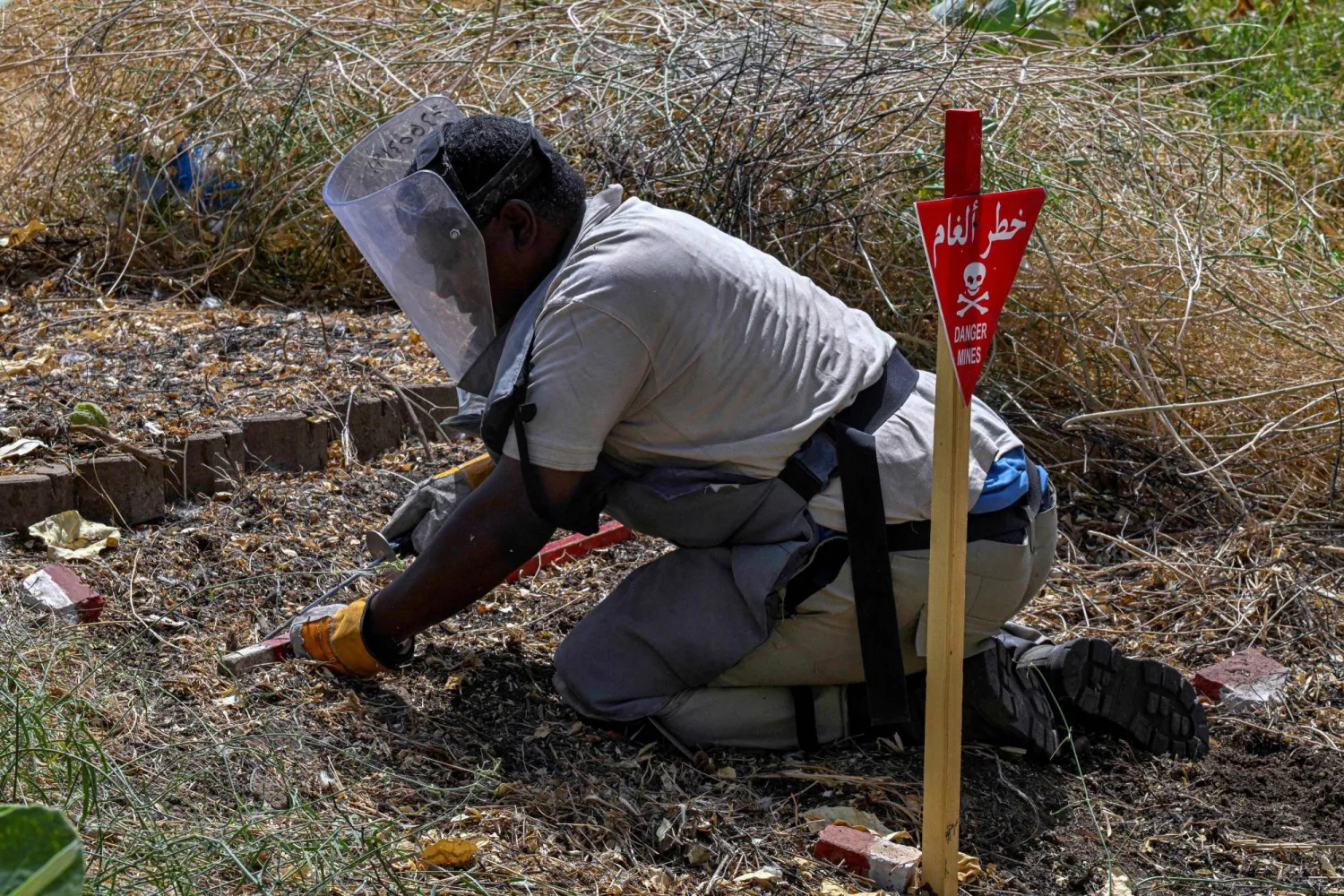
A member of the Danish Refugee Council and Jasmar Human Security Organization uses a metal probe as he searches for land mines in Al-Mogran Park in Khartoum on April 19, 2026. (AFP)
TT

Khartoum Mines Pose Hidden Threat to Returning Residents

A member of the Danish Refugee Council and Jasmar Human Security Organization uses a metal probe as he searches for land mines in Al-Mogran Park in Khartoum on April 19, 2026. (AFP)

Specialized Sudanese army teams are clearing landmines and unexploded ordnance across Khartoum, amid suspicions the Rapid Support Forces had planted explosives in residential neighborhoods when they held large parts of the capital.

The work comes as authorities seek to stabilize security and as more residents return home.

An Asharq Al-Awsat correspondent accompanied a National Mine Action Center team in Al-Mogran, in central Khartoum to observe operations to detect and remove buried explosives.

The center considers Al-Mogran among the most dangerous areas in the capital. Teams began work after the army retook Khartoum in May 2025, uncovering thousands of mines and unexploded remnants.

Field supervisor Jumaa Ibrahim Abu Anja said the team is clearing about 45,000 square meters in Al-Mogran, an area that saw some of the fiercest fighting between the army and RSF.

He said indicators suggest the group planted thousands of mines across central Khartoum, particularly in streets and residential areas.

“We have found more than 300 hazardous items, including mines fitted with smaller charges and highly explosive materials, designed to inflict the highest possible number of casualties upon detonation,” Abu Anja said.

He added that the aim was to slow the army’s advance and inflict losses. Teams have removed multiple types of mines, including anti-vehicle and anti-personnel devices.

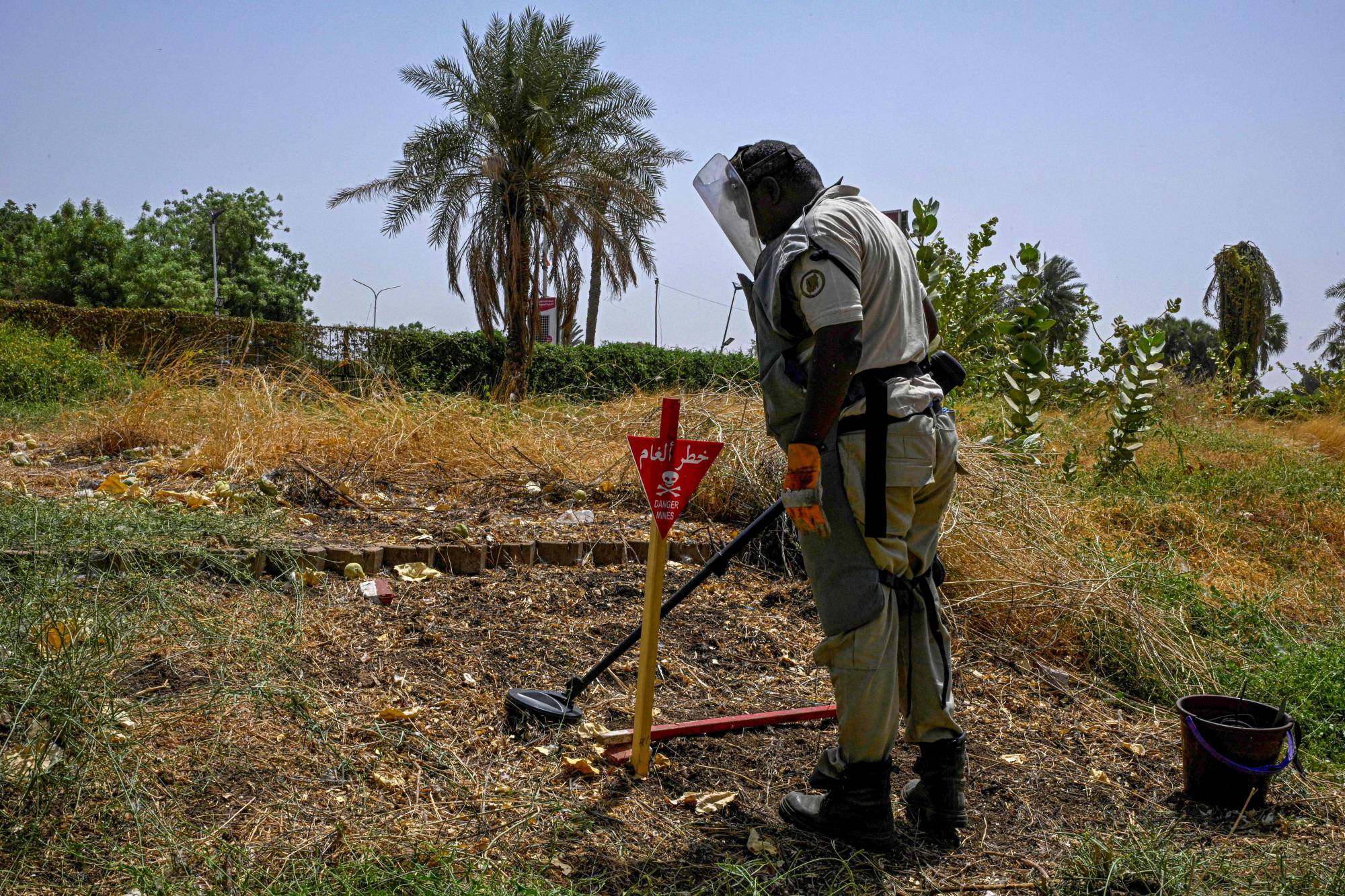
A member of the Danish Refugee Council and Jasmar Human Security Organization sweeps a metal detector as he searches for land mines in Al-Mogran Park in Khartoum on April 19, 2026. (AFP)

The team advances along a line marked with white indicators, moving in measured steps before stopping at a point. A member sweeps the ground with a detector to scan for buried objects.

The team halts again at a triangular area known as the “hot line,” signaling a potential minefield. Work pauses to ensure strict safety checks. Before entering the site, all members must wear armored vests, with journalists kept at a safe distance.

A sharp signal breaks the silence. It may indicate a mine or unexploded ordnance, though it may also be only scrap metal. Every alert is treated as a threat. Once confirmed, the team extracts the device with slow, precise steps to avoid detonation. Photos are taken only from a designated safe zone, with no approach allowed during removal.

Teams mark hazards clearly, placing red signs reading “Danger Mines” to warn residents. When a device is located, a green wooden marker is placed to identify the spot before disposal.

Anti-personnel mines are destroyed the same day under controlled procedures.

Alongside fieldwork, the National Mine Action Center runs awareness campaigns, sending text messages urging residents to report suspicious objects and to avoid them. Authorities also warn against burning waste in neighborhoods due to the risk of hidden explosives.

Abu Anja said about 80 percent of Al-Mogran and other parts of Khartoum have been cleared, but risks remain, especially as residents return.

Progress is slowed by limited funding, affecting the pace of clearance and disposal. Abu Anja warned that delays raise the danger, noting that dozens of civilians have been killed or injured by mines and war remnants.


Report: US May Ask Israel to Put Palestinian Tax Money Toward Trump’s Gaza Plan

Palestinians walk along a street surrounded by buildings destroyed during the Israel Hamas war, in Gaza City, Friday, May 15, 2026. (AP)
TT

Report: US May Ask Israel to Put Palestinian Tax Money Toward Trump’s Gaza Plan

Palestinians walk along a street surrounded by buildings destroyed during the Israel Hamas war, in Gaza City, Friday, May 15, 2026. (AP)

The US is considering asking Israel to give some tax money it is withholding from the Palestinian Authority to Donald Trump's Board of Peace to fund the US president's post-war plan for Gaza, five sources familiar with the matter said, according to Reuters.

The Trump administration has not yet decided whether to make a formal request to Israel, said three of the sources, officials with knowledge of US deliberations with Israel. The two other sources, Palestinians with knowledge of the deliberations, said that under the proposal a portion of the tax money would go to a US-backed transitional government for Gaza and other funds to the PA if it makes reforms.

The PA puts the amount of tax being withheld at $5 billion.

The prospect of the Palestinians' own tax money being repurposed toward Trump's Gaza rebuilding plan, over which their government has had no input, could further ‌sideline the Western-backed PA ‌even as Israel's withholding of the funds begets a financial crisis in the occupied ‌West ⁠Bank.

The PA exercises ⁠limited self-rule in the West Bank but has not had any sway over Gaza since it was exiled from the territory after a brief war with the Hamas movement in 2007.

Trump's plan for Gaza, shattered after more than two years of war, has been held up by a refusal by Hamas to lay down their weapons and by continued Israeli attacks in Gaza that have undermined an October ceasefire.

'MONEY HELD IN A BANK DOES NOTHING'

The Board of Peace declined to comment on whether a proposal to use Palestinian tax money was under consideration.

A Board official said it had asked all parties ⁠to leverage resources to support Trump's rebuild plan, estimated to cost $70 billion.

"That includes the Palestinian ‌Authority and Israel. There is no doubt that money held in a ‌bank does nothing to further the President's 20-Point Plan," the official said.

That appeared to refer to the PA tax revenue ‌that Israel has withheld from the body in a long-running dispute over payments it makes to Palestinians held in ‌Israeli jails.

Israel collects taxes on imported goods on behalf of the PA and is meant to transfer the revenue under a longstanding arrangement. The PA uses the funds to pay civil servants and fund public services.

The sources did not say how much of the tax money Washington was considering asking Israel to transfer to the Board.

The US State Department, Israeli government and PA did not immediately ‌respond to requests for comment.

The US and Israel have long pressured the PA to abolish payments to Palestinian prisoners and families of those killed by Israeli forces, ⁠arguing it encourages violence.

Palestinians ⁠consider them a form of welfare for inmates they regard as national heroes. In response to US pressure, the PA in February 2025 said it was reforming the payment system, but the US said those changes did not go far enough.

As punishment, Israel has withheld taxes it collects on the PA's behalf, an amount that Palestinian officials say has reached $5 billion - well over half of the PA's annual budget.

That has set off a financial crisis in the West Bank, with the PA slashing salaries of thousands of civil servants.

Israel accepted a US invitation to join the Board of Peace. The PA was not invited.

Under Trump's plan, a group of Palestinian technocrats dubbed the National Committee for the Administration of Gaza would take control of Gaza from Hamas as the militants lay down their weapons.

Nickolay Mladenov, Trump's Board of Peace envoy for Gaza, said during a press conference in Jerusalem on Wednesday that reconstruction planning was in advanced stages.

"We're doing it sector by sector. We're costing things. We're coordinating with donors and we're ready to begin in earnest once the conditions allow it," Mladenov said, without mentioning the tax issue.


‘Happiest Day of Our Lives’: Gazans Hold Mass Wedding Among Ruins

 Brides waiting to be wed look on during a mass-wedding celebration for Palestinian couples organized by the Turkish Humanitarian Relief Foundation (IHH) in Gaza City on May 11, 2026. (AFP)
Brides waiting to be wed look on during a mass-wedding celebration for Palestinian couples organized by the Turkish Humanitarian Relief Foundation (IHH) in Gaza City on May 11, 2026. (AFP)
TT

‘Happiest Day of Our Lives’: Gazans Hold Mass Wedding Among Ruins

 Brides waiting to be wed look on during a mass-wedding celebration for Palestinian couples organized by the Turkish Humanitarian Relief Foundation (IHH) in Gaza City on May 11, 2026. (AFP)
Brides waiting to be wed look on during a mass-wedding celebration for Palestinian couples organized by the Turkish Humanitarian Relief Foundation (IHH) in Gaza City on May 11, 2026. (AFP)

Wearing traditional Palestinian dresses, the white fabric intricately embroidered in a rainbow of colors, dozens of smiling brides clutched red bouquets as they walked with their grooms past the tents and ruined buildings of Gaza City.

To the tune of popular songs played from loudspeakers in a city square, the couples whose marriages had been long-delayed by war and displacement, sat on stage with joy written across their faces.

Thousands turned out to watch the mass wedding against the backdrop of buildings gutted by Israeli strikes over the course of the devastating two-year war.

Attendees clapped and smiled as a troupe performed the dabke, an Arabic folk dance, while women's ululations echoed through the crowd.

"I can't quite believe that I'm finally getting married," Ali Mosbeh told AFP at the start of the ceremony.

"I was sitting in the tent when my phone rang... I couldn't believe it. I'm still in shock," he said, recounting the moment he received the call informing him that he was among the 50 young men selected.

The mass wedding is one of many to have been organized since a ceasefire took effect in Gaza in October. This particular event was organized and funded by the Turkish humanitarian organization IHH.

The smartly-dressed grooms wore traditional Palestinian kuffiyeh scarves adorned with the Turkish organization's logo, while the brides' bouquets were dotted with small Turkish flags.

For Mosbeh and his bride Huda al-Kahlout, the high cost of weddings had also posed an obstacle to tying the knot.

"I never imagined I'd get married in such circumstances," he said.

People gather during a mass-wedding celebration for Palestinian brides and grooms organised by the Turkish Humanitarian Relief Foundation (IHH) in Gaza City on May 11, 2026. (AFP)

- 'Carry on living' -

Most of Gaza's population was displaced at least once during the war between Israel and Hamas, with hundreds of thousands still living in tents or makeshift shelters.

Mosbeh said he would now share a tent with his wife while hoping to find a job -- something that has become near impossible in Gaza.

"Our future is uncertain; we depend on aid to survive," admitted Kahlout, but said that despite "war, loss and death... Marriage remains a beautiful milestone for us young people".

"Most of the buildings around the venue have been destroyed and reduced to rubble, with the martyrs buried beneath them," said fellow bride, Fayqa Abu Zeid.

But she added: "We are trying, despite everything, to find joy and carry on living."

Before the war, "the newlyweds would move into a flat with new furniture. Today, we move into a tent, if there is one," she said.

But despite the devastation, her husband Mohammed al-Ghossain was smiling.

"We are very happy," he said. "It is the happiest day of our lives."


Hantavirus Outbreak Tests Post-COVID Health Communications Playbook

The cruise ship MV Hondius, affected by a hantavirus outbreak, leaves the port of Granadilla de Abona, Tenerife, Spain on May 11. (Reuters)
TT

Hantavirus Outbreak Tests Post-COVID Health Communications Playbook

The cruise ship MV Hondius, affected by a hantavirus outbreak, leaves the port of Granadilla de Abona, Tenerife, Spain on May 11. (Reuters)

A rodent-borne virus with a scary name. A mid-ocean cruise ship in quarantine. Several people dead and more falling sick.

It is no wonder that an outbreak of the Andes strain of hantavirus on a luxury liner in the Atlantic has revived some COVID-era trauma and panic online.

That has presented a dilemma to health officials: how to communicate quickly and clearly about a virus which is not new and unlikely to cause a pandemic, but where knowledge gaps remain - without inadvertently fomenting fear.

"Hantavirus thread incoming," posted the health department of Illinois state in the US earlier this week about a risk-free case unrelated to the MV Hondius cruise ship outbreak.

"But you have to promise to read this whole thread before panic-texting your group chat. Deal?"

In interviews with Reuters, half a dozen health officials said they were trying to learn from mistakes around COVID, providing information on hantavirus with more empathy while addressing uncertainties and tackling falsehoods.

"We spend half of our time discussing how we will communicate," said Gianfranco Spiteri, emergencies lead at the EU's European Center for Disease Prevention and Control.

During COVID, many governments were slow to react or in denial, public messaging was sometimes confusing and contradictory, restrictions and vaccine rollouts were applied differently round the world, and misinformation and politicization proliferated.

That helped fuel modern mistrust of institutions. For example, faith in public health institutions declined in 20 of 27 EU countries ‌between 2020 and ‌2022, one study showed.

JUGGLING THE COMMUNICATIONS

Spiteri and others at the forefront of the hantavirus response spoke about the need ‌to balance ⁠explanations of why ⁠it is a serious global health event with reassurances that risks to the public are low and honesty over the open questions about a virus that has rarely spread among humans before.

"There are people who say we are overdoing it, and on the other extreme, that we’re not doing enough," he said. "We always base our messages on the evidence we have."

From a look at social media, their efforts are still a work in progress, with many people needlessly fretting about a return to lockdowns, social distancing and masks.

"We have kind of lost perspective," said Gustavo Palacios, a professor at Icahn School of Medicine at Mount Sinai in the US who is originally from Argentina and a hantavirus expert.

An outbreak can be a major public health event deserving attention and action but without becoming a pandemic, he noted.

Some posts online falsely present hantavirus as a bigger existential threat than COVID, or promote ⁠protections like the ivermectin anti-parasite drug, vitamin D and zinc without scientific evidence.

False conspiracy theories are popping up too - that it ‌is a side effect of the Pfizer vaccine or a hoax to boost pharmaceutical profits.

Sander van der Linden, ‌a psychology professor at England's University of Cambridge and misinformation expert, said the public needed more support in how to interpret information, including potentially showing them conspiracy theories they may face in ‌the event of an outbreak.

"We need to do more preparatory work to create resilience in the population," he said.

As of Thursday, there had been three deaths ‌from 11 reported hantavirus cases in the outbreak, all people who had been on board the Hondius. Dozens of other passengers are being monitored as they return to around 20 countries.

Unlike COVID, there are established measures to control hantavirus' spread, officials said. The strain has circulated in parts of Argentina and Chile for decades and the ship samples show no meaningful variation from that virus.

"I'm definitely seeing improvements," said Gabby Stern, former head of communications at the World Health Organization until September last year, referring particularly to sharing what you know when you know it.

"It seems like ‌the public health community has absorbed crucial lessons, although not all of them."

'EMOTIONAL REACTION' TO CRUISE SHIP

The WHO was quick to reassure the public, holding regular press conferences, issuing alerts and tackling misinformation in social media Q&As since the ⁠outbreak was disclosed on May 3.

WHO chief ⁠Dr. Tedros Adhanom Ghebreyesus even took the unusual step of an open letter to the people of Tenerife, where the Hondius docked on Sunday.

"But I need you to hear me clearly: this is not another COVID," he wrote. "The current public health risk from hantavirus remains low. My colleagues and I have said this unequivocally, and I will say it again to you now."

Some started more slowly: in the US, the Centers for Disease Control and Prevention put out its first information on May 8, five days after the news broke, but has since increased the pace of communications.

"One of the things this is teaching us is a lesson we should have learned from COVID: What we say is really important," said Michael Osterholm, an infectious diseases expert at the University of Minnesota.

The cruise ship hantavirus narrative has not helped, echoing the infamous outbreak on the Diamond Princess docked off Japan early in the COVID pandemic in 2020 where 14 people died and nearly a quarter of the 3,000 passengers and crew became infected.

"The whole cruise ship thing ... is a very significant memory from the beginning of COVID," said Krutika Kuppalli, associate professor of medicine at the University of Texas Southwestern Medical Center.

"There’s an emotional reaction that is stirring people."

The resemblance was not lost on Laura Millán, 40, in Tenerife, as passengers began to disembark at the beginning of this week under strict infection-control measures.

Seeing WHO boss Tedros arrive on the island with Spanish officials to help oversee the hantavirus response took her back.

"It gave me the impression that this isn’t just the flu – otherwise all these people wouldn’t be coming," she said at a playground, adding that overall she understood their involvement helped ensure the right measures.