


Canada Deepens Arctic Defense Ties with Nordics after Trump Threats

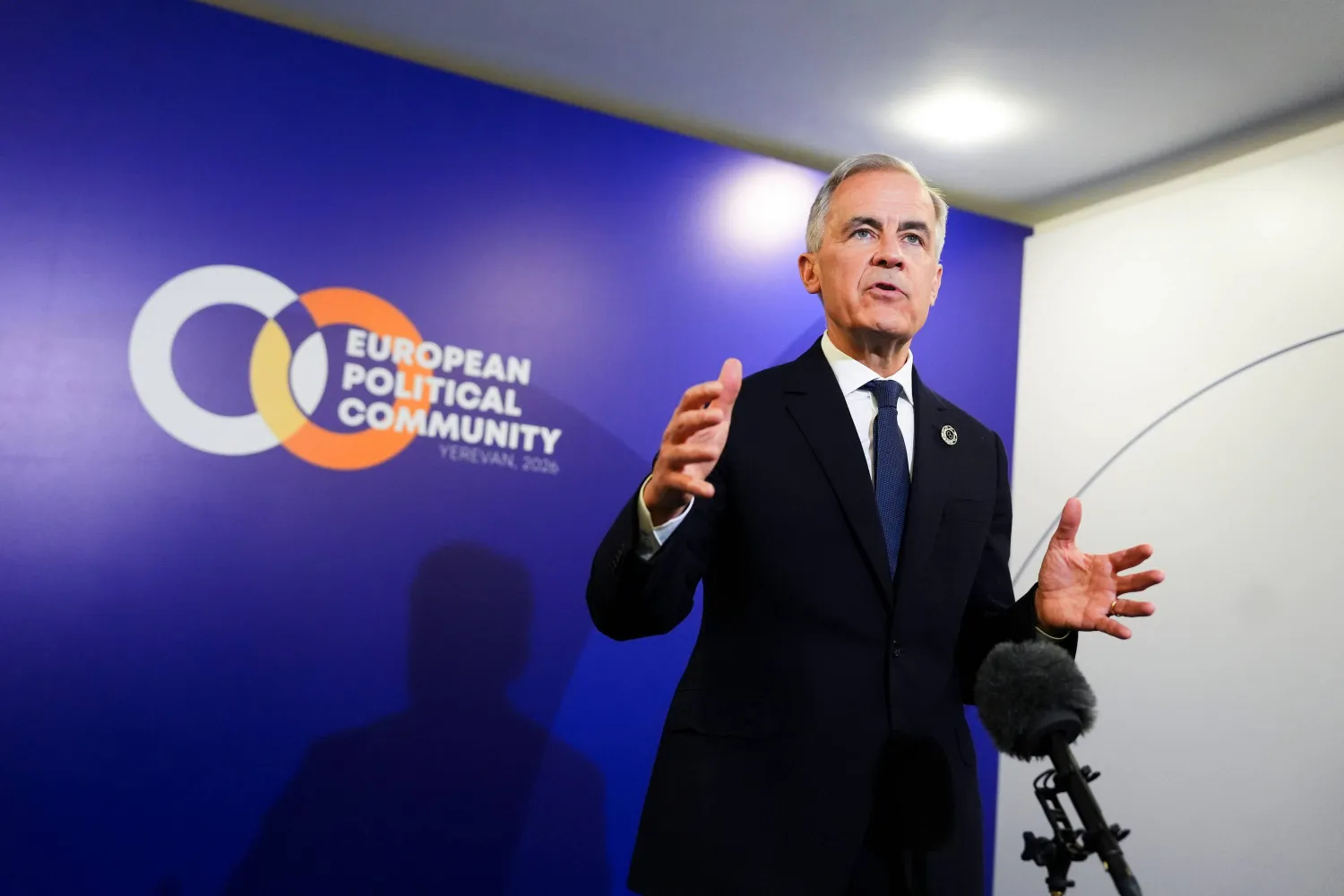
Canada Prime Minister Mark Carney talks to reporters during the 8th European Political Community Summit in Yerevan, Armenia on Monday, May 4, 2026. (Sean Kilpatrick/The Canadian Press via AP)
TT

Canada Deepens Arctic Defense Ties with Nordics after Trump Threats

Canada Prime Minister Mark Carney talks to reporters during the 8th European Political Community Summit in Yerevan, Armenia on Monday, May 4, 2026. (Sean Kilpatrick/The Canadian Press via AP)

Since US President Donald Trump’s barrage of threats to seize Greenland, authorities on the frozen island have been seeking help from a northern ally: Canada.

A reserve unit of the Canadian armed forces called the Rangers has long maintained a year-round presence in mostly inaccessible Arctic communities. For three years, authorities in Greenland and Denmark have consulted with Canadian officials on how to set up their own version of the Rangers — conversations that grew more urgent with Trump’s threats and growing fears of Russian hostility in the Arctic, said Reuters.

“The rhetoric coming out of the White House has sped up efforts to rebuff the idea that Arctic communities need the US to come in and save them,” said Whitney Lackenbauer, an honorary lieutenant-colonel Canadian Ranger involved in the talks, who spoke with Reuters during a recent 5,000-kilometer Arctic snowmobile trek by the Rangers. “The Nordic countries and Canada, we’re increasingly realizing we can come together in military and diplomatic ways to send a message that carries moral weight.” As Canada attempts to pivot away from relying on the US to protect its vast Arctic, Prime Minister Mark Carney is strengthening ties and exchanging security tips with the Nordic countries, which he describes as trusted partners. Canada's increased defense collaboration with the Nordics is part of Carney's effort to strengthen alliances between what he calls “middle powers” in a world where the United States is considered a less reliable partner.

The White House said ‌Trump’s leadership has prompted ‌allies “to recognize the need to meaningfully contribute to their own defense” and that the Arctic is a critical region ‌for US national ⁠security and the ⁠economy.

“The administration is participating in diplomatic high-level technical talks with the governments of Greenland and Denmark to address the United States’ national security interests in Greenland,” a White House spokesperson said in an email.

Alliances are shifting in the Arctic as climate change makes it more accessible. Russia has far more military bases than any other nation there and in recent years China has started to increase its presence in the mineral-rich area, mostly in partnership with Russia. While Carney says Canada will no longer rely on any other nation to protect its own territory, he says the Arctic’s greatest threat is from Russia – and the Nordics have been boosting their own defenses since Russia invaded Ukraine.

In March, Canada and the five Nordic countries — Denmark, Finland, Iceland, Norway and Sweden — agreed to deepen their cooperation in military procurement and ramp up defense production to deal with security threats, including cyberattacks. A plan for how Greenland might adapt the Canadian Rangers is expected by the ⁠end of this year, according to government policy documents. Canadian Foreign Affairs Minister Anita Anand told Reuters she meets regularly with Nordic ‌officials to work on collective defense and Arctic security. Canada’s partnership with the United States through NORAD, the North American ‌Aerospace Defense Command, remains critical, she said. But Canada is focused on bolstering new alliances. That includes the opening of a Canadian consulate in Nuuk in February and an invitation to her Nordic counterparts ‌to visit Canada’s Arctic this year.

“We have to build something new, and it has to be a world order that is built on the values that we ‌represent,” Danish Prime Minister Mette Frederiksen told Carney during the Nordic-Canadian summit in Oslo in March. In April, Alexander Stubb became the first Finnish president to visit Canada in a dozen years and signed several agreements on Arctic cooperation. Stubb and Carney took to the ice in Ottawa for a hockey practice, and afterward Stubb said he and Carney message each other almost every day.

The two national leaders sometimes chat about hockey or baseball, Stubb told reporters, but “most of the time it's about NATO or Ukraine or Iran."

NO MORE ‘FREE PASS IN THE ARCTIC’ FOR HOSTILE NATIONS

Lackenbauer, the honorary Canadian Ranger lieutenant-colonel, ‌is also an Arctic expert at Trent University in Peterborough, Ontario. He said Canada should overhaul its approach to Arctic security just as Nordic countries did after Russian troops marched into Ukraine in 2022.

“The more we can go and help Canada’s ⁠allies in northern Europe, the more hostile nations ⁠will get the message that they do not get a free pass in the Arctic,” he said. Among the eight countries that share the Arctic, Canada’s investment in defending the territory has consistently been near the bottom, trailing Russia, the US, Norway, Sweden, Denmark and Finland, according to the Arctic Business Index, a network of far north research institutions and analysts. Along with Greenland, Canada has historically spent the least. Last year, Canada hit the NATO target of spending 2% of its GDP on defense, around CA$63 billion, after repeated complaints from Trump. That compared to a low point of just 1% in 2014.

Neil O’Rourke, Director General at Canada’s Coast Guard for Fleet and Maritime Services, said he and a Danish defense colleague realized years ago that if either country had a serious incident in the Arctic, their first phone call should be to each other.

“Up north, we’re just across the water and it makes much more sense to share resources than to get help from down south,” O’Rourke said in an interview. He said Canada is also trying to learn more from Norway about how its maritime services handle emergency towing of vessels.

Rob Huebert, an Arctic expert at the University of Calgary, said working with the US remains critical, noting that the country produces arguably the most advanced military weaponry and that Canada’s military remains highly dependent on the US for protecting its northernmost regions.

“If we are talking about war-fighting capability, that means working with the US military,” he said. Huebert said Carney’s March trip to observe a Norwegian-led NATO exercise in Bardufoss is perhaps an indication the country’s approach is changing.

“Until very recently, Canada’s participation in NATO’s Arctic exercises in the Nordics has been very token,” he said. “But then all of a sudden because of Trump, we decide we’d better do something with the Nordics.”



Nigeria Says Joint US Strikes Kill 175 ISIS Militants, Senior Leaders

Nigerian soldiers walk past military tanks prepared for deployment during a tour of the Theater Command Operation Lafiya Dole by Nigeria's Chief of Army Staff at Maimalari Cantonment in Maiduguri, Borno State, Nigeria, November 7, 2025. (Reuters)
TT

Nigeria Says Joint US Strikes Kill 175 ISIS Militants, Senior Leaders

Nigerian soldiers walk past military tanks prepared for deployment during a tour of the Theater Command Operation Lafiya Dole by Nigeria's Chief of Army Staff at Maimalari Cantonment in Maiduguri, Borno State, Nigeria, November 7, 2025. (Reuters)

Nigerian forces, working with the United States, have killed 175 ISIS militants in a series of joint air and ground strikes in the country's northeast in recent days, the Defense Headquarters said on Tuesday.

The military said operations conducted with US Africa Command destroyed checkpoints, weapons caches, logistics hubs, and financing networks ‌used by ISIS West Africa Province, which ‌has ⁠led a years-long ⁠insurgency in the region.

Since suffering major setbacks in the Middle East, ISIS has pivoted toward Africa, which accounted for 86% of the group's global activity in the first three ⁠months of 2026, according to crisis ‌monitoring group Armed ‌Conflict Location & Event Data.

"As of 19 May, ‌assessments indicate that 175 ISIS militants have ‌been eliminated from the battlefield," Nigeria's Defense spokesperson Major-General Samaila Uba said in a statement.

Strikes that killed Abu-Bilal al-Minuki on May ‌16, described by both governments as ISIS’s global No. 2, ⁠were followed ⁠by further raids last weekend that also killed Abd al-Wahhab, an ISWAP leader overseeing attacks and propaganda, Abu Musa al-Mangawi, and Abu al-Muthanna al-Muhajir, a senior media operative and close associate of al-Minuki, the statement said.

The Defense Headquarters said the operations formed part of an ongoing campaign to "hunt down and destroy" militants threatening Nigeria and the wider region.


US Imposes Fresh Sanctions on Iranian Exchange House, Shadow Fleet Vessels

US Secretary of Treasury Scott Bessent poses for a family photograph of G7 Finance Ministers and Central Bank Governors as they meet to prepare the summit of heads of State and government to be held in June 2026 in Evian, in Paris on May 19, 2026. (AFP)
TT

US Imposes Fresh Sanctions on Iranian Exchange House, Shadow Fleet Vessels

US Secretary of Treasury Scott Bessent poses for a family photograph of G7 Finance Ministers and Central Bank Governors as they meet to prepare the summit of heads of State and government to be held in June 2026 in Evian, in Paris on May 19, 2026. (AFP)

The Trump administration on Tuesday imposed sanctions on an Iranian foreign currency exchange house and what it said were front companies overseeing transactions on behalf of Iranian banks as the US maintains pressure on Tehran.

The move came after Iran said its latest peace proposal to the United States over the US-Israeli led war that started February 28 involves ending hostilities on all fronts including Lebanon, the exit of US forces ‌from areas close ‌to Iran, and reparations for destruction caused by ‌the ⁠conflict.

The Treasury Department ⁠imposed sanctions on the Iran-based Amin Exchange, also known as Ebrahimi and Associates Partnership Company, which it said has a widespread network of front companies spanning multiple jurisdictions, including in Türkiye and Hong Kong.

The US also blocked 19 vessels it said were involved in shipping Iranian petroleum and petrochemicals to foreign customers.

The Treasury ⁠Department said Iranian exchange houses facilitate billions of dollars ‌in foreign currency transactions a year, ‌enabling the government to evade sanctions and access the international financial system. It ‌said the front companies oversee hundreds of millions of dollars ‌in transactions on behalf of Iranian banks.

"Iran’s shadow banking system facilitates the illicit transfer of funding for terrorist purposes," Treasury Secretary Scott Bessent said in a release. "As Treasury systematically dismantles Tehran’s shadow banking system and shadow fleet under Economic ‌Fury, financial institutions must be alert to how the regime manipulates the international financial system to ⁠wreak havoc."

The sanctions block US assets of those designated and prevent Americans from doing business with them.

The US also designated vessels for transporting Iranian-origin oil, petroleum products and petrochemicals including the Barbados flagged liquefied petroleum gas tanker Great Sail, the Palau-flagged products tanker Ocean Wave, and the Panama-flagged chemical/oil tanker Swift Falcon.


Israel Finance Minister Says ICC Seeks Arrest Warrant Against Him

Israeli Finance Minister Bezalel Smotrich speaks at a press conference regarding settlements expansion for the long-frozen E1 settlement, that would split East Jerusalem from the occupied West Bank, near the Israeli settlement of Maale Adumim in the Israeli-occupied West Bank, August 14, 2025. (Reuters)
TT

Israel Finance Minister Says ICC Seeks Arrest Warrant Against Him

Israeli Finance Minister Bezalel Smotrich speaks at a press conference regarding settlements expansion for the long-frozen E1 settlement, that would split East Jerusalem from the occupied West Bank, near the Israeli settlement of Maale Adumim in the Israeli-occupied West Bank, August 14, 2025. (Reuters)

Israel's far-right finance minister Bezalel Smotrich said Tuesday that the International Criminal Court prosecutor has requested an arrest warrant against him, accusing the Palestinian Authority of pushing for the move.

Smotrich said he would retaliate by ordering the evacuation of the Palestinian Bedouin community of Khan al-Ahmar in the occupied West Bank.

"Last night I was informed that the criminal prosecutor of the antisemitic court in The Hague has filed a request for an international arrest warrant against me," Smotrich told a news conference broadcast on his X account Monday.

"As a sovereign and independent state, we do not accept hypocritical dictates from biased bodies that time and again take a stand against the State of Israel," he added, without disclosing the charges for which the warrant has been requested.

The ICC prosecutor's office said it was "unable to comment on media speculation or questions related to any alleged application for a warrant of arrest".

In November 2024, the ICC issued arrest warrants for Israeli Prime Minister Benjamin Netanyahu and former defense minister Yoav Gallant, to face accusations of war crimes and crimes against humanity over Israel's actions during its war against Hamas in Gaza.

- 'Declaration of war' -

"Immediately upon the conclusion of my remarks here, we will sign an order to evacuate Khan al-Ahmar," Smotrich said, calling the warrant request "a declaration of war".

More than 750 people live in the community of Khan al-Ahmar, around 10 kilometers east of Jerusalem's Old City in the central West Bank and surrounded by Israeli settlements.

The Palestinian Authority's Settlement and Wall Resistance Commission urged the international community to stop the move.

"Targeting Khan al-Ahmar is part of a long-term strategic settlement project... through which Israel seeks to create complete settlement contiguity that would separate the northern West Bank from its south," the commission's minister, Muayad Shaaban, was quoted as saying.

Peace Now, an Israeli settlement watchdog, also denounced the move.

"The Minister of Expulsion and Annexation seeks to take revenge on The Hague and the international community at the expense of one of the most vulnerable communities," it said.

Khan al-Ahmar sits near land Israel plans to use for its controversial E1 development project that would facilitate settlement expansion in the area near Jerusalem.

Smotrich, who lives in a settlement himself, is a staunch proponent of Israel annexing the West Bank.

"Under this government, we see that for the first time they've approved the very sensitive and significant plan of E1, and they're going ahead with plans to annex that entire region," Lior Amihai, Peace Now's executive director, told AFP.

"In order for them to annex the entire region, they need to also expel the Palestinian communities from there and Khan al-Ahmar is one of them," he added.