

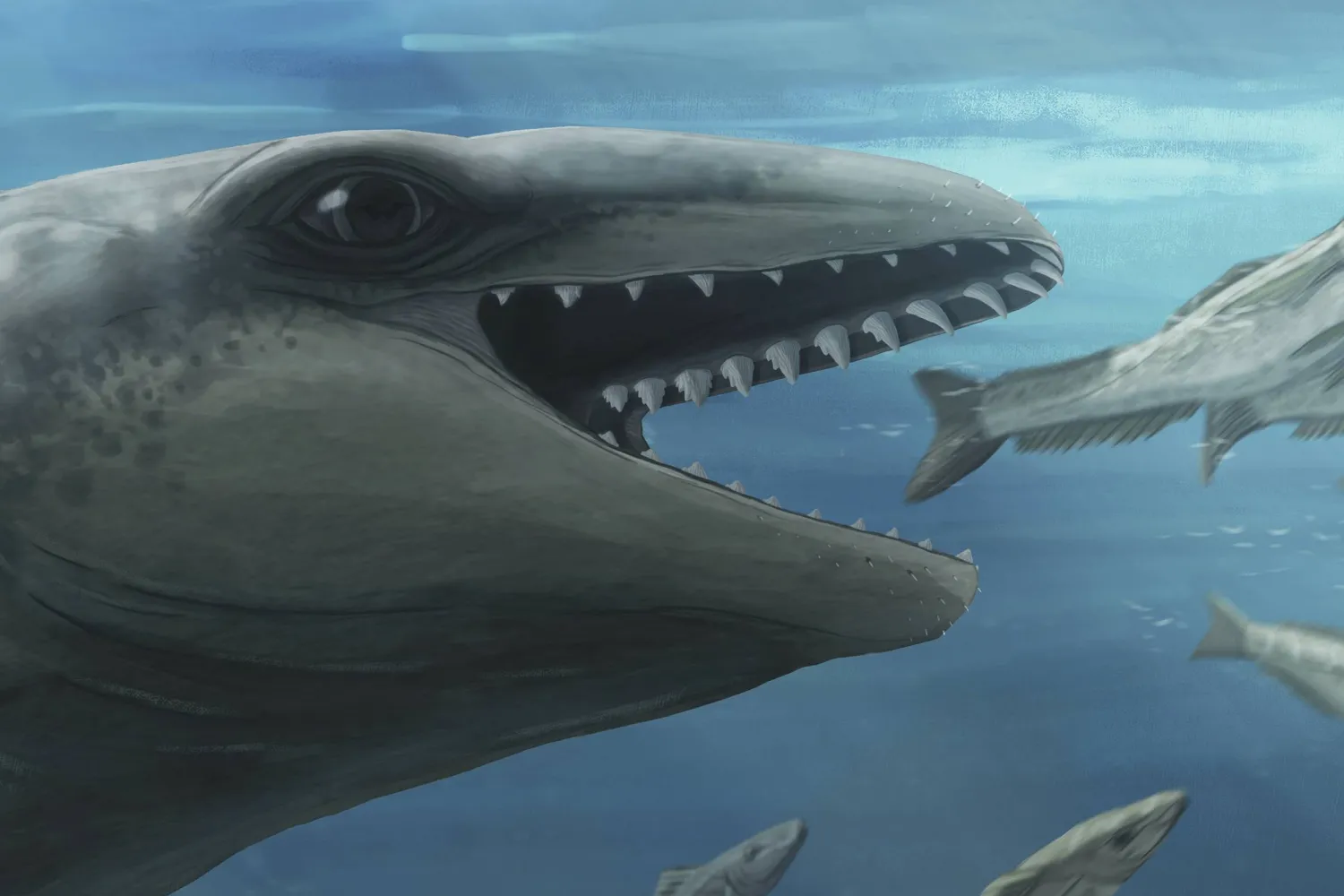

This Prehistoric Whale Had Razor Teeth, Bulging Eyes

In this illustration provided by Ruairidh Duncan a Janjucetus dullardi is depicted chasing a fish. (Ruairidh Duncan via AP)
TT

This Prehistoric Whale Had Razor Teeth, Bulging Eyes

In this illustration provided by Ruairidh Duncan a Janjucetus dullardi is depicted chasing a fish. (Ruairidh Duncan via AP)

Long before whales were majestic, gentle giants, some of their prehistoric ancestors were tiny, weird and feral. A chance discovery of a 25 million-year-old fossil on an Australian beach has allowed paleontologists to identify a rare, entirely new species that could unlock mysteries of whale evolution, The Associated Press reported.

Researchers this week officially named Janjucetus dullardi, a cartoonish creature with bulging eyes the size of tennis balls, in the Zoological Journal of the Linnean Society. Unlike today's whales, the juvenile specimen was small enough to fit in a single bed.

Boasting fiendish teeth and a shark-like snout, however, this oddball of the ocean was nasty, mean and built to hunt.

“It was, let’s say, deceptively cute,” said Erich Fitzgerald, senior curator of vertebrate paleontology at Museums Victoria Research Institute, and one of the paper's authors.

“It might have looked for all the world like some weird kind of mash-up between a whale, a seal and a Pokémon but they were very much their own thing.”

Extinct species was an odd branch on the whale family tree The rare discovery of the partial skull, including ear bones and teeth, was made in 2019 on a fossil-rich stretch of coast along Australia’s Victoria state. Jan Juc Beach, a cradle for some of the weirdest whales in history, is becoming a hotspot for understanding early whale evolution, Fitzgerald said.

Few family trees seem stranger than that of Janjucetus dullardi, only the fourth species ever identified from a group known as mammalodontids, early whales that lived only during the Oligocene Epoch, about 34 to 23 million years ago.

That marked the point about halfway through the known history of whales.

The tiny predators, thought to have grown to 3 meters (10 feet) in length, were an early branch on the line that led to today’s great baleen whales, such as humpbacks, blues and minkes. But the toothy ancestors with powerful jaws would have looked radically different to any modern species.

“They may have had tiny little nubbins of legs just projecting as stumps from the wall of the body,” said Fitzgerald.

That mystery will remain tantalizingly unsolved unless a specimen is uncovered with more of its skeleton intact, which would be something of a miracle. Even the partial skull that allowed the initial identification this week was an astonishing discovery.

For an amateur paleontologist, a life-long obsession paid off Janjucetus dullardi was named by researchers after an amateur fossil hunter who doesn’t mind its looks in the slightest.

“It’s literally been the greatest 24 hours of my life,” said Ross Dullard, who discovered the skull while fossil hunting at Jan Juc Beach. After Wednesday’s confirmation of the new species, the school principal walked like a rock star onto campus with “high fives coming left, right and center,” he said.

His friends and family are probably just relieved it’s over.

“That’s all they’ve heard from me for about the last six years,” he said.

Dullard was on a regular low-tide hunt at Jan Juc the day he spotted something black protruding from a cliff. Poking it dislodged a tooth.

He knew enough to recognize it was unlikely to belong to a dog or a seal.

“I thought, geez, we’ve got something special here,” he said. Dullard sent photos to Museums Victoria, where Fitzgerald saw them and immediately suspected a new species.

Ancient whale finds are rare but significant Confirming the find was another matter. This was the first mammalodontid to be identified in Australia since 2006 and only the third on record in the country.

Fossils of sufficient quality, with enough of the right details preserved to confirm uniqueness, aren’t common.

“Cetaceans represent a fairly miniscule population of all life,” Fitzgerald said. Millions of years of erosion, scavengers and ocean currents take their toll on whale skeletons too.

“It’s only the chosen few, the vast minority of all whales that have ever lived and died in the oceans over millions of years, that actually get preserved as fossils,” he added.

Finds such as Janjucetus dullardi can unlock insights into how prehistoric whales ate, moved, behaved — and evolved. Researchers said the discoveries also helped to understand how ancient cetacean species adapted to warmer oceans, as they study how today’s marine life might respond to climate change.

Meanwhile, Dullard planned to host a fossil party this weekend, featuring cetacean-themed games and whale-shaped treats in jello, to celebrate his nightmare Muppet find, finally confirmed.

“That’s taken my concentration for six years,” he said. “I’ve had sleepless nights. I’ve dreamt about this whale.”



US Astronaut to Take her 3-year-old's Cuddly Rabbit Into Space

FILE PHOTO: An evening launch of a SpaceX Falcon 9 rocket carrying 20 Starlink V2 Mini satellites, from Space Launch Complex at Vandenberg Space Force Base is seen over the Pacific Ocean from Encinitas, California, US, June 23, 2024. REUTERS/Mike Blake/File Photo
TT

US Astronaut to Take her 3-year-old's Cuddly Rabbit Into Space

FILE PHOTO: An evening launch of a SpaceX Falcon 9 rocket carrying 20 Starlink V2 Mini satellites, from Space Launch Complex at Vandenberg Space Force Base is seen over the Pacific Ocean from Encinitas, California, US, June 23, 2024. REUTERS/Mike Blake/File Photo

When the next mission to the International Space Station blasts off from Florida next week, a special keepsake will be hitching a ride: a small stuffed rabbit.

American astronaut and mother, Jessica Meir, one of the four-member crew, revealed Sunday that she'll take with her the cuddly toy that belongs to her three-year-old daughter.

It's customary for astronauts to go to the ISS, which orbits 250 miles (400 kilometers) above Earth, to take small personal items to keep close during their months-long stint in space.

"I do have a small stuffed rabbit that belongs to my three-year-old daughter, and she actually has two of these because one was given as a gift," Meir, 48, told an online news conference.

"So one will stay down here with her, and one will be there with us, having adventures all the time, so that we'll keep sending those photos back and forth to my family," AFP quoted her as saying.

US space agency NASA says SpaceX Crew-12 will lift off on a SpaceX Falcon 9 rocket from Cape Canaveral in Florida to the orbiting scientific laboratory early Wednesday.

The mission will be replacing Crew-11, which returned to Earth in January, a month earlier than planned, during the first medical evacuation in the space station's history.

Meir, a marine biologist and physiologist, served as flight engineer on a 2019-2020 expedition to the space station and participated in the first all-female spacewalks.

Since then, she's given birth to her daughter. She reflected Sunday on the challenges of being a parent and what is due to be an eight-month separation from her child.

"It does make it a lot difficult in preparing to leave and thinking about being away from her for that long, especially when she's so young, it's really a large chunk of her life," Meir said.

"But I hope that one day, she will really realize that this absence was a meaningful one, because it was an adventure that she got to share into and that she'll have memories about, and hopefully it will inspire her and other people around the world," Meir added.

When the astronauts finally get on board the ISS, they will be one of the last crews to live on board the football field-sized space station.

Continuously inhabited for the last quarter century, the aging ISS is scheduled to be pushed into Earth's orbit before crashing into an isolated spot in the Pacific Ocean in 2030.

The other Crew-12 astronauts are Jack Hathaway of NASA, European Space Agency astronaut Sophie Adenot, and Russian cosmonaut Andrey Fedyaev.


iRead Marathon Records over 6.5 Million Pages Read

Participants agreed that the number of pages read was not merely a numerical milestone - SPA
TT

iRead Marathon Records over 6.5 Million Pages Read

Participants agreed that the number of pages read was not merely a numerical milestone - SPA

The fifth edition of the iRead Marathon achieved a remarkable milestone, surpassing 6.5 million pages read over three consecutive days, in a cultural setting that reaffirmed reading as a collective practice with impact beyond the moment.

Hosted at the Library of the King Abdulaziz Center for World Culture (Ithra) and held in parallel with 52 libraries across 13 Arab countries, including digital libraries participating for the first time, the marathon reflected the transformation of libraries into open, inclusive spaces that transcend physical boundaries and accommodate diverse readers and formats.

Participants agreed that the number of pages read was not merely a numerical milestone, but a reflection of growing engagement and a deepening belief in reading as a daily, shared activity accessible to all, free from elitism or narrow specialization.

Pages were read in multiple languages and formats, united by a common conviction that reading remains a powerful way to build genuine connections and foster knowledge-based bonds across geographically distant yet intellectually aligned communities, SPA reported.

The marathon also underscored its humanitarian and environmental dimension, as every 100 pages read is linked to the planting of one tree, translating this edition’s outcome into a pledge of more than 65,000 trees. This simple equation connects knowledge with sustainability, turning reading into a tangible, real-world contribution.

The involvement of digital libraries marked a notable development, expanding access, strengthening engagement, and reinforcing the library’s ability to adapt to technological change without compromising its cultural role. Integrating print and digital reading added a contemporary dimension to the marathon while preserving its core spirit of gathering around the book.

With the conclusion of the iRead Marathon, the experience proved to be more than a temporary event, becoming a cultural moment that raised fundamental questions about reading’s role in shaping awareness and the capacity of cultural initiatives to create lasting impact. Three days confirmed that reading, when practiced collectively, can serve as a meeting point and the start of a longer cultural journey.


Imam Turki bin Abdullah Royal Reserve Launches Fifth Beekeeping Season

Jazan’s Annual Honey Festival - File Photo/SPA
TT

Imam Turki bin Abdullah Royal Reserve Launches Fifth Beekeeping Season

Jazan’s Annual Honey Festival - File Photo/SPA

The Imam Turki bin Abdullah Royal Nature Reserve Development Authority launched the fifth annual beekeeping season for 2026 as part of its programs to empower the local community and regulate beekeeping activities within the reserve.

The launch aligns with the authority's objectives of biodiversity conservation, the promotion of sustainable environmental practices, and the generation of economic returns for beekeepers, SPA reported.

The authority explained that this year’s beekeeping season comprises three main periods associated with spring flowers, acacia, and Sidr, with the start date of each period serving as the official deadline for submitting participation applications.

The authority encouraged all interested beekeepers to review the season details and attend the scheduled virtual meetings to ensure organized participation in accordance with the approved regulations and the specified dates for each season.