


The Volunteers Battling to Save Romania's Cultural Treasures

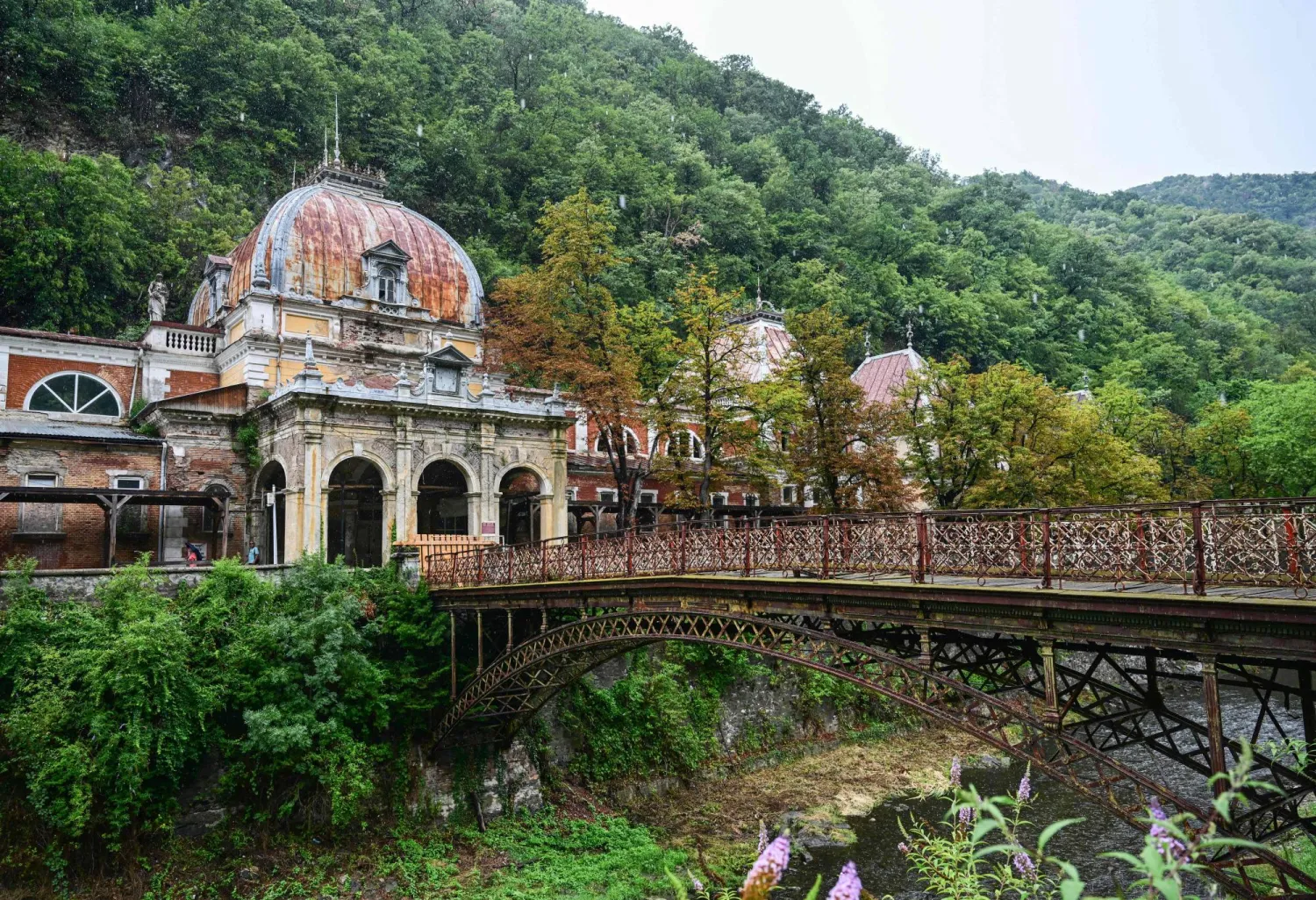
Exterior view of Neptune Imperial Baths building and the wrought iron bridge that is closed for access- in Baile Herculane on July 29, 2025. (Photo by Daniel MIHAILESCU / AFP)
TT

The Volunteers Battling to Save Romania's Cultural Treasures

Exterior view of Neptune Imperial Baths building and the wrought iron bridge that is closed for access- in Baile Herculane on July 29, 2025. (Photo by Daniel MIHAILESCU / AFP)

Graffiti covers the crumbling walls of the main thermal baths in one of Europe's oldest spa towns.

But after decades of neglect, a group of young architects is working to restore the picturesque Romanian resort that once attracted emperors, AFP reported.

"Someone once said that if you drink water from the spring from Herculane, you never leave," said 31-year-old architect Oana Chirila.

"I was struck by the beauty of the place," she said of the town in the southwest of the country, surrounded by mountains and crossed by a river.

"And at the same time shocked by its condition," she said of the decrepit state of the old thermal baths.

She first stumbled upon Baile Herculane eight years ago, purely by chance, she said.
Her group's restoration efforts here are just one of several recent civil society initiatives launched to protect some of Romania's historic monuments.

An estimated 800 of them are in an advanced state of decay or in danger of crumbling altogether. Some of those are already considered to represent a danger to the public.

The neglect is the result of Romania's chaotic transition from Communism to democracy, which was marked by opaque privatizations, often resulting in interminable legal battles and investigations by anti-corruption prosecutors.

Built in 1886, the Neptune Imperial Baths attracted illustrious clients in its heyday, with its warm sulphur treatments.

They included Austria's Emperor Franz Joseph and his wife Elisabeth, popularly known as Sisi. Franz Joseph described the town as Europe's "most beautiful spa resort".

Now the baths are closed, their interior walls covered in graffiti, rubble on the floor and rain leaking in.

Despite the decay, tourists still frequently stop to marvel at and photograph the long, rusty facade, some trying to peek inside through the broken windows.

For the moment, Chirila and her team of volunteers are confined to doing conservation work on the baths' outer structure.

They could not restore the building until legal disputes between the authorities and the private owners are solved, she explained, adding: "There's always this fear that it might collapse."

"Most of the historical monuments are in their current state –- meaning constant decay –- because they are legally blocked," preventing any use of public or European funds for their restoration.

For the moment then, along one side of the riverbank, people take dips in three basins with sulphur water -- dubbed "little bathtubs" by Chirila.

It was her team that refurbished the basins and built the changing booths and wooden pavilions, one of a number of projects they have undertaken in the town.

When AFP met her, about a dozen students were helping out with the renovation of a path through the woods.

In recent years, Baile Herculane, a town of 3,800, has seen a steady rise in tourists, say local officials.

Some 160,000 tourists came in 2024 -- up from 90,000 in 2020 -- many for spa treatments, but also for the hiking and climbing.

"The resort has changed," Aura Zidarita, 50, a doctor, told AFP. She remained hopeful it could once again become a "pearl of Europe".

Initiatives such as Chirila's have multiplied in recent years, according to Stefan Balici, president of the Romanian Order of Architects.

They represent "a lesson in how citizens' initiatives can intervene in heritage preservation", in a country with little record of investing in the restoration of its monuments.

In 2019, young architects got involved in another spa resort, Baile Govora.

Chirila admitted she sometimes feared her work on the Imperial Baths is like "putting a bandage on a patient in sepsis".

But Balici had no doubt of its value. Without her intervention, he said, the building would be "a pile of rubble" by now.

Chirila said she also drew hope from those like herself who believed in investing in the country's heritage.

"Herculane ended up like this because of corruption," she said.

"But we hope that thanks to good people it will heal."



AlUla’s Cultural Legacy Takes Center Stage at the Marvels of Saudi Orchestra

The Music Commission's Marvels of Saudi Orchestra concert at AlUla's Maraya Hall. (SPA)
TT

AlUla’s Cultural Legacy Takes Center Stage at the Marvels of Saudi Orchestra

The Music Commission's Marvels of Saudi Orchestra concert at AlUla's Maraya Hall. (SPA)

The Music Commission's Marvels of Saudi Orchestra concert at AlUla's Maraya Hall showcased the region's rich cultural heritage by seamlessly blending traditional folk arts into a professional, contemporary symphonic performance.

The event featured renowned local folk arts integrated into an artistic tableau, demonstrating Saudi heritage's ability to thrive in modern contexts while maintaining its historical depth, the Saudi Press Agency reported.

This successful convergence of global musical standards and local tradition further establishes AlUla as a premier international hub for creative and cultural expression.


Saudi Cultural Development Fund Debuts at Davos to Showcase Culture as Economic Engine

Saudi Cultural Development Fund Debuts at Davos to Showcase Culture as Economic Engine
TT

Saudi Cultural Development Fund Debuts at Davos to Showcase Culture as Economic Engine

Saudi Cultural Development Fund Debuts at Davos to Showcase Culture as Economic Engine

The Cultural Development Fund (CDF) successfully concluded its participation at the 2026 Annual Meeting of the World Economic Forum, held from January 19 to 23 in Davos, Switzerland, marking a historic and groundbreaking presence for Saudi culture at the world’s premier economic event.

Hosted at the Saudi House, the CDF engaged over 200 international experts, including leading economists and investors, through a series of dynamic activities such as a networking breakfast, panel discussion, and beneficiary talks on the NextOn platform. The CDF emphasized culture not only as a form of artistic and creative expression, but also as a vital economic driver and a strategic pillar for national development, SPA reported.

Reinforcing this vision, CDF CEO Majed Al-Hugail highlighted in a Davos panel Saudi Arabia's belief in culture as a pivotal force for economic diversification and quality of life. By 2030, he stated, the cultural sector is set to contribute $48 billion to GDP, create more than 346,000 jobs, and attract 22 million visitors.

The CDF also underscored the critical role of financing in empowering entrepreneurship and amplifying the economic potential of the cultural sector. Notable participants in the NextOn talk series included Co-Founder of AlMashtal Creative Incubator Princess Noura bint Saud bin Naif, who addressed “Culture as Economic Infrastructure: Unlocking Human Capital Through the Creative Industries.” Additionally, CEO of the Arabian Housing & Building (AHB) Company Eng. Khalid Alhenaidy contributed insights during a session titled “The Value in Cultural Assets.”

Looking ahead, the CDF organized six strategic side meetings aimed at exploring new opportunities and fostering collaborations to accelerate the development of the Saudi cultural sector and attract global investment. It also distributed 150 copies of the comprehensive investment report, Saudi Cultural Market Outlook 2025: Vision, Impact, and Opportunities, developed in partnership with the Ministry of Culture, the Ministry of Investment, and the Invest Saudi initiative.

Furthermore, the CDF showcased Saudi creativity by exporting 60 cultural products from Samuda, a fashion-sector beneficiary brand, highlighting the growing economic significance of the Saudi fashion market.

This milestone reflects the CDF’s commitment to serving as a center of excellence and financial enabler for the Kingdom’s cultural sector. It underscores ongoing efforts to elevate Saudi culture on the global stage, maximizing its economic and social impact in alignment with the ambitious objectives of Saudi Vision 2030.


Five Artists Shortlisted for the Seventh Edition of Ithra Art Prize

The shortlisted artists are Aseel AlYaqoub (Kuwait), Bady Dalloul (Syria), Heba Y. Amin (Egypt), Ala Younis (Jordan), and Jawad Al Malhi (Palestine) - SPA
TT

Five Artists Shortlisted for the Seventh Edition of Ithra Art Prize

The shortlisted artists are Aseel AlYaqoub (Kuwait), Bady Dalloul (Syria), Heba Y. Amin (Egypt), Ala Younis (Jordan), and Jawad Al Malhi (Palestine) - SPA

The King Abdulaziz Center for World Culture (Ithra) announced the five shortlisted artists for the seventh edition of the Ithra Art Prize, which celebrates artists from or based in the 22 Arab countries.

Recognized as one of the most distinguished honors in the Middle East, the Prize is dedicated to empowering artists, fostering innovation, and deepening cultural dialogue across the Arab world.

The shortlisted artists are Aseel AlYaqoub (Kuwait), Bady Dalloul (Syria), Heba Y. Amin (Egypt), Ala Younis (Jordan), and Jawad Al Malhi (Palestine), SPA reported.

Head of Ithra’s Museum Farah Abushullaih said: “The development and expansion of the Ithra Art Prize since its launch have established it as an important platform for artistic expression.

This year’s shortlist reflects the incredible diversity, creativity, and critical thought shaping contemporary art in the Arab world. The open call received more than 500 artistic submissions, which underwent an initial review process before a selected group of works was evaluated by the jury.”

She added that the award, in its current edition, is witnessing an expansion in scope compared to previous years, as the judging panel is providing production grants to the five finalists, with their works to be showcased in a dedicated exhibition at the King Abdulaziz Center for World Culture (Ithra) during the spring of 2026.