
Games Industry in Search of New Winning Combo at Gamescom 2025

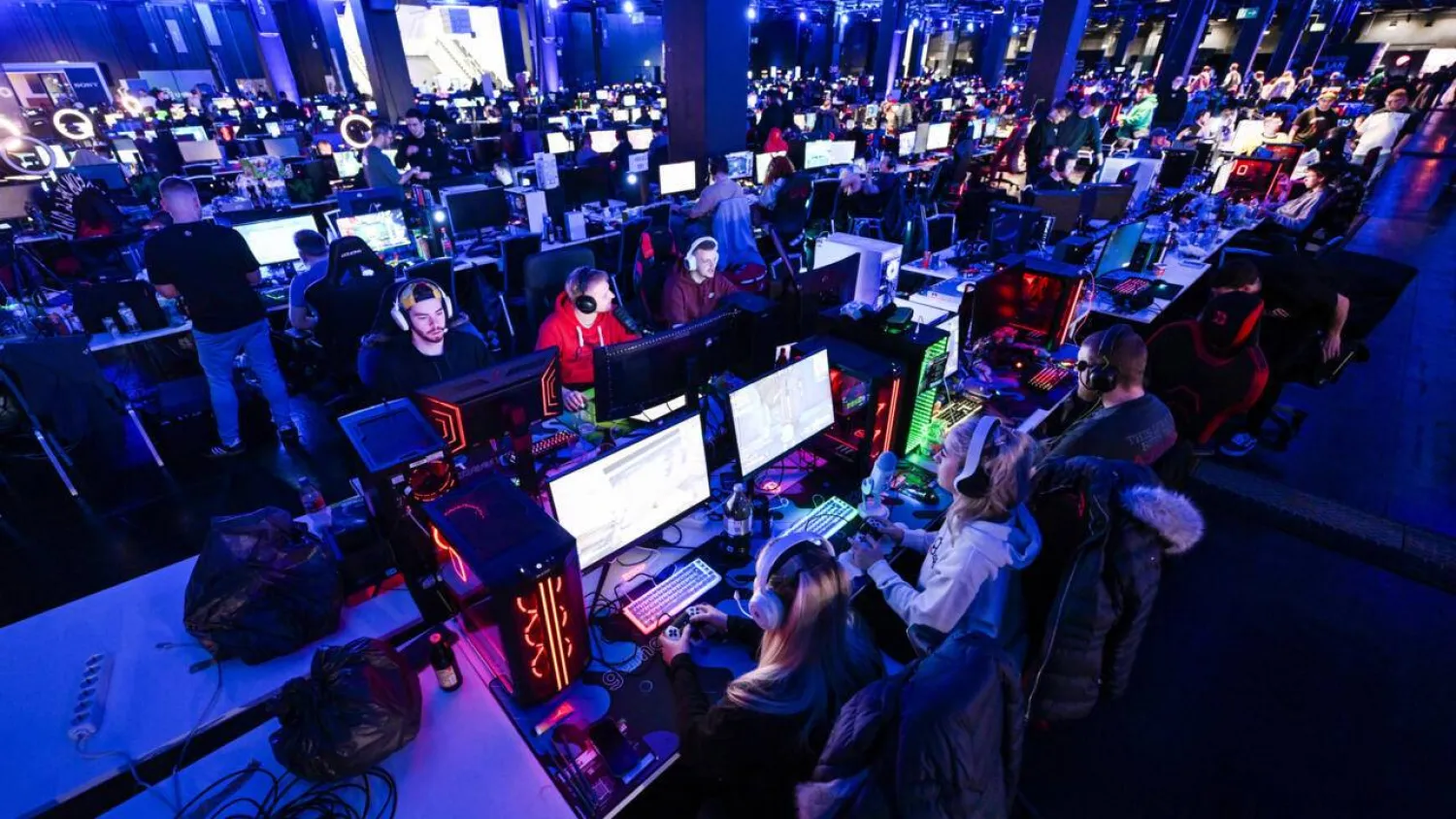
Almost 335,000 people attended last year's Gamescom. Ina FASSBENDER / AFP/File
TT

Games Industry in Search of New Winning Combo at Gamescom 2025

Almost 335,000 people attended last year's Gamescom. Ina FASSBENDER / AFP/File

The global games industry gathers for the vast Gamescom trade fair in Cologne this week, with hopes that upcoming heavy-hitters like "GTA VI" can help the industry escape its doldrums.

Tuesday's opening night event will show off major releases slated for the months ahead, with the starring role going to "Black Ops 7" -- the new instalment in the sprawling "Call of Duty" saga, AFP reported.

Trade visitors will have Wednesday to peruse the stands and make connections, before tens of thousands of enthusiastic gamers are unleashed on the vast salon from Thursday to Sunday.

Last year's Gamescom drew almost 335,000 people to the Cologne exhibition center, where studios lay on vast stands with consoles or PCs offering hands-on play with the latest releases.

Nintendo is back in 2025 after staying away last year, surfing on record launch sales for its Switch 2 console.

And Microsoft's Xbox gaming division will show off new portable hardware expected to be released towards the end of the year.

Sony, the Japanese giant behind the PlayStation, has opted out this time around.

The mood is mixed for the roughly 1,500 exhibitors attending this year, as major publishers have recently steered back into profitability but the job cuts seen over the past two years continue.

In early July, Microsoft said it would lay off around 9,000 people, with hundreds leaving game studios like "Candy Crush" developer King and several games cancelled, including "Perfect Dark" and "Everwild".

Battle for attention

"The industry is consolidating quite a bit" after the bumper years when Covid-19 lockdowns created a captive audience, said Rhys Elliott of specialist games data firm Alinea Analytics.

Around 30,000 workers have lost their jobs since early 2023, according to tracking site Games Industry Layoffs -- more than 4,000 of them so far this year.

Revenue in the global games market should hold steady at just under $190 billion this year, data firm Newzoo has forecast.

The number of players and hours spent with the medium are stable while an ever-expanding number of titles are jostling for attention.

And with leviathans like "Roblox" or "Fortnite" swallowing the attention of hundreds of millions of monthly users, "everyone's fighting for a smaller share of that pie," said Circana expert Mat Piscatella.

The need to find new audiences has pushed Microsoft's Xbox, the biggest games publisher in the world, to switch strategy, increasingly offering its titles on competing console makers' hardware.

"They've had really great success on the PlayStation platform. Sony is making a bunch of money on that too," Piscatella said

"It's a little bit of a win-win all the way around."

Some PlayStation games are making the trip in the opposite direction, with "Helldivers 2" the first to be made available on Xbox as well as the traditional PC port.

Success on a budget

Shoring up sales is vital in an era where the cost of developing high-spec "AAA" games has mounted into the hundreds of millions of dollars -- exposing studios to massive risk should their games not perform as hoped.

But several breakout hits have recently shown that lower-budget games can still win over players with gameplay, story and art style, such as four-million-selling French turn-based battler "Clair Obscur: Expedition 33".

"There's a realization you don't need to spend masses of money to deliver a high-quality game that can appeal broadly and so everyone is rushing towards that model," said Christopher Dring, founder of industry website The Game Business.

But "for every 'Clair Obscur' success story, there are 10 games that fail to find an audience at all," Piscatella pointed out.

"It's hyper-competitive for those products outside of that big sphere" and smaller developers must fight hard for the funding they need to get games to market.

Nor is the cult-hit trend likely to displace the mega-budget mastodons.

Analysts predict that Rockstar Games' vast "Grand Theft Auto VI" could notch up the biggest launch for any entertainment product in history.

That might be the juice the flagging industry needs to regain some of its mojo.


Huawei's New AI Chip Finds Favor with ByteDance, Alibaba Which Plan to Place Orders

FILE PHOTO: The logo of Huawei is seen at the Viva Technology conference dedicated to innovation and startups at Porte de Versailles exhibition center in Paris, France, June 12, 2025. REUTERS/Benoit Tessier/File Photo
TT

Huawei's New AI Chip Finds Favor with ByteDance, Alibaba Which Plan to Place Orders

FILE PHOTO: The logo of Huawei is seen at the Viva Technology conference dedicated to innovation and startups at Porte de Versailles exhibition center in Paris, France, June 12, 2025. REUTERS/Benoit Tessier/File Photo

Customer testing of Huawei's new AI chip, designed to challenge Nvidia in the China market, has gone well and big tech giants including ByteDance and Alibaba plan to place orders, two people familiar with the matter said.

The development marks a milestone for Huawei, said Reuters.

Despite a government campaign to encourage the use of domestic semiconductors, the Shenzhen-based firm struggled to persuade big tech firms in the private sector to adopt its current flagship chip, the Ascend 910C, in large quantities, industry sources have previously said.

This ‌time around, tech ‌firms intend to use the new 950PR more extensively, much happier ‌now ⁠that the chip ⁠is more compatible with Nvidia's CUDA software system and has better response speeds, said the two people and a third person with knowledge of those plans.

Huawei plans to ship around 750,000 950PRs this year, according to two of the people. They said samples were sent to customers in January, and that mass production should begin next month, setting the stage for fully fledged shipments to start in the second half of the year.

The sources were not authorized to speak ⁠to media and declined to be identified. Huawei, ByteDance, Alibaba did not reply ‌to Reuters requests for comments.

RESTRICTIONS ON NVIDIA CHIPS

A ‌launch of the 950PR comes at a difficult time for Nvidia in China. Many of its ‌artificial intelligence chips have been banned from sale in China by Washington on worries ‌that the technology could boost the capabilities of the Chinese military.

The Trump administration last year greenlighted the sale of Nvidia's H200 chips - more powerful than currently restricted products - albeit with a number of conditions that could limit amounts sold.

The H200 has also recently received approval from Chinese authorities, but it remains unclear ‌when they will be allowed into the country.

Huawei mentioned its new chip last September when it outlined its long-term semiconductor plans for ⁠the first time and ⁠said it would be launching some of the world's most powerful computing systems.

The 950PR, which uses traditional DDR memory, will be priced at around 50,000 yuan ($6,900) per card, while a premium version with faster HBM memory will sell for around 70,000 yuan, the sources said.

Where previously Huawei had stuck to its proprietary CANN software system, the new chips will allow developers at Chinese tech firms, which have generally used Nvidia's software system thus far, to migrate those models more easily.

The sources said that compared to the 910C, the chip only offers a small improvement in raw computing power, but it is designed to excel in handling inference workloads - the process of running trained AI models to answer queries or execute tasks.

Demand for AI inference computing in China is surging as the country's tech sector shifts its focus from model development to real-world deployment, a trend turbocharged by the rapid adoption of open-source AI agent OpenClaw.


ByteDance Quietly Rolls Out SeeDance 2.0 Globally

A smartphone displays the logo of Seedance 2.0, the image-to-video and text-to-video AI model. Lionel BONAVENTURE / AFP/File
TT

ByteDance Quietly Rolls Out SeeDance 2.0 Globally

A smartphone displays the logo of Seedance 2.0, the image-to-video and text-to-video AI model. Lionel BONAVENTURE / AFP/File

Chinese artificial intelligence powerhouse and TikTok creator ByteDance has quietly rolled out its latest video generator SeeDance 2.0 worldwide, while its US rival OpenAI called time on a similar product.

The SeeDance 2.0 model was launched in China last month, both stunning and spooking the entertainment industry with its ability to produce near-Hollywood-quality clips from simple text prompts.

However, it has also sparked concerns over copyright infringement, said AFP.

"We have further expanded Dreamina Seedance 2.0 in more markets in CapCut today, across Africa, South America, the Middle East and Southeast Asia, with more regions coming soon," CapCut, ByteDance's popular video editing tool, posted on X on Thursday.

It said the SeeDance 2.0 model would initially be available to some paid users.

The rollout includes "firm safeguards" to prevent violations of its safety policies, including the unauthorized use of individuals' likenesses or intellectual property, CapCut said.

Major Hollywood production studios including Disney, Paramount, Warner Bros and Netflix, have threatened legal action against Beijing-based ByteDance over accusations of copyright infringement.

Reports this month suggested that backlash had prompted ByteDance to pause SeeDance 2.0's global launch.

It was not immediately clear if ByteDance had resolved those legal issues. The United States is not among the current rollout markets.

ByteDance, which runs popular short video platforms TikTok and Douyin, has invested heavily in AI in recent years against a backdrop of increasing global regulatory scrutiny of such platforms.

ByteDance announced on Friday the sale of Moonton, an important gaming asset, to a subsidiary of Saudi Arabia's sovereign fund for more than $6 billion.

Moonton runs Mobile Legends: Bang Bang, one of Southeast Asia's most popular gaming titles.

ByteDance's move coincides with a broader shift in the AI industry towards more "agentic" tools that focus on performing practical, real-life tasks.

US AI giant OpenAI said on Tuesday it was shutting down its popular consumer-facing video-generating service Sora, a move widely understood to focus more on providing business users with agentic AI capacities.


South Korea to Invest $166 Million in AI Chip Startup Rebellions

People walk near Gwanghwamun Square in Seoul, South Korea, 22 March 2026. The band performed their comeback concert on 21 March.  EPA/YONHAP
People walk near Gwanghwamun Square in Seoul, South Korea, 22 March 2026. The band performed their comeback concert on 21 March. EPA/YONHAP
TT

South Korea to Invest $166 Million in AI Chip Startup Rebellions

People walk near Gwanghwamun Square in Seoul, South Korea, 22 March 2026. The band performed their comeback concert on 21 March.  EPA/YONHAP
People walk near Gwanghwamun Square in Seoul, South Korea, 22 March 2026. The band performed their comeback concert on 21 March. EPA/YONHAP

South Korea's industry ministry on Tuesday said the Financial Services Commission's advisory board approved a 250 billion won ($166 million) investment in a local artificial intelligence chip startup called Rebellions, part of a government-backed push to nurture a homegrown advanced semiconductor firm.

Here are some details:

South Korea's Financial Services Commission advisory board, which evaluates investments in advanced strategic industries, ⁠approved a 250 ⁠billion won direct investment into Rebellions, an AI chip startup.

Rebellions, founded in 2020, designs neural processing units (NPUs) that handle AI computations.

The decision was made at a ⁠fund management committee meeting for the state-led "National Growth Fund," marking the first direct investment under the country's "K-Nvidia" initiative.

The funding will support Rebellions' mass production of NPU chips and the development of next-generation AI semiconductors, the industry ministry said in a statement.

The "K-Nvidia" project, jointly led by the Financial Services Commission and the ⁠Ministry ⁠of Science and ICT, seeks to nurture a globally competitive AI chip company amid intensifying competition in the sector, which is dominated by US firms like Nvidia.

The move underscores Seoul's efforts to strengthen its position in the AI supply chain and reduce reliance on foreign technology, as demand for high-performance computing chips surges.